| |
A Resource by Mark D. Roberts |
|
Christian Inclusiveness
by Rev. Dr. Mark D. Roberts
Copyright © 2004 by Mark D. Roberts
Note: You may download this resource at no cost, for personal use or for use in a Christian ministry, as long as you are not publishing it for sale. All I ask is that you give credit where credit is due. For all other uses, please contact me at mark@markdroberts.com . Thank you.
Christian Inclusiveness
Part 17 in the series “Lessons from a Church in Crisis”
Part 1 in the series “Christian Inclusiveness”
Posted at 9:30 p.m. on Sunday, September 12, 2004
Last Friday the Daily Pilot, the Los Angeles Times-owned newspaper of Newport Beach and Costa Mesa, California, published the responses of several readers to the crisis involving the St. James Church in Newport and the Episcopal Diocese of Los Angeles. Fairly, the Pilot printed responses that represent both sides of the debate. One of these read:
I applaud Bishop J. Jon Bruno's courageous stand in firing the clergy and vestries of his three errant parishes. I hope only that the parishioners there learn some much-needed lessons about the real meaning of Christianity.
These parishes have strayed from the roots of the church by defining themselves to be exclusive membership clubs instead of inclusive, as the teachings of the New Testament would have us be.
The crucial word in this response is “inclusive.” This writer believes that inclusiveness is central to “the real meaning of Christianity.”
Bishop Bruno would surely agree. A Los Angeles Times article explains how the issues of homosexual ordination and salvation through Christ alone have led three Southern California churches to leave the Episcopal diocese. The Times continues:
For conservatives, those issues have become a test of fidelity to biblical tradition. To Bruno, they test something equally important: Christ's message of inclusion.
The church must be inclusive because Jesus was inclusive, he said during a recent sermon at St. John's Episcopal Church near downtown Los Angeles. Seated in the first pew were his wife, Mary, his daughter and grandchildren, and Boyd and Thompson.
"Jesus loved us unconditionally," Bruno said, his words resounding through the vaulted Romanesque nave. "He had an unconditional love of all humanity, allowing for no outcast in this community as he built the true religion, a religion of inclusion and wisdom."
Again and again during this crisis in the Episcopal church I have heard those who support the diocese mention “inclusiveness” as a primary virtue for the church. In fact “inclusiveness” figures prominently as one of the main reasons why one should be an Episcopalian, according to the recent book 101 Reasons to be Episcopalian.
The concept of inclusiveness, though theoretically applicable to all people, is used by Episcopalians especially in reference to the inclusion of practicing gay and lesbian people in the church, and even in ordained ministry. The complier of 101 Reasons to be Episcopalian, Louie Crew, wrote in an article called “Changing the Church,”
In the church, however, lesbigays [sic] are driven instead by the Gospel imperative, the profound faith that God loves absolutely everybody. Our ministry is less about who we are than Whose we are. I attribute any success that we have to the authenticity of this calling. I believe that God is present in our world with a marvelous sense of humor, using lesbians and gays to evangelize the Church and bring it back to its first principle, name the boundless love of God and its absolute inclusiveness (emphasis added).
Because the notion of inclusiveness is central to the current crisis in the Episcopal church, it deserves careful analysis. In particular we need to ask: |
|
| |
Louie Crew is the founder of Integrity, a pro-gay organization of Episcopalians.
|
• Is it true that Jesus was inclusive? And if so, in what sense was Jesus inclusive? Were there limits to Jesus’s inclusiveness? How does the teaching of Jesus help us to understand his inclusive practice? Was the religion of Jesus “a religion of inclusion and wisdom,” as Bishop Bruno claims?
• What does it mean for the church to be inclusive? What doesn’t it mean?
• Is inclusiveness “the real meaning of Christianity,” as claimed by a letter writer to the Daily Pilot? Does God’s love include “absolute inclusiveness” as claimed by Louie Crew?
• In particular, how should the church’s call to inclusiveness be played out today as we grasp the thorny issue of homosexuality in the church?
As you can well imagine, I won’t be able to answer these questions in a single post. They demand more care than this. So I’m beginning a new series today, which I’m calling “Christian Inclusiveness.” I may get back to the “Lessons from a Church in Crisis” series in time, since there’s still so much more to consider. But for now, a careful look at inclusiveness is required.
Home
The Inclusiveness of Jesus (Section A)
Part 2 in the series “Christian Inclusiveness”
Posted at 9:30 p.m. on Tuesday, September 14, 2004
In the past few weeks I’ve been reflecting upon the recent crisis in the Episcopal church in Southern California, where three parishes voted to leave the diocese, and the diocese responded by firing the leaders and suing them in civil court. At the root of this crisis is a significant theological disagreement over the nature of biblical authority and interpretation, especially with respect to fitness for leadership in the Episcopal church. Whereas the breakaway churches would exclude from leadership those whose lifestyle – especially their sexual practices – are inconsistent with biblical teaching, Episcopal church officials have argued that the church must be inclusive of all people because this follows the example of Jesus. In particular, gays and lesbians should be included, not only in church fellowship, but in ordained leadership, as priests and even as bishops. Only this kind of inclusiveness reflects the “true religion” of Jesus, according to Bishop Jon Bruno of Los Angeles, “a religion of inclusion and wisdom.”
Is this an accurate description of Jesus’ “religion”? Do we find inclusiveness, even “absolute inclusiveness” as one Episcopal leader claims, in the example and teaching of Jesus? These are the questions I want to begin to answer in today’s post.
Jesus began his ministry in a religious and cultural environment where exclusion was common. Many of his Jewish contemporaries understood their status as God’s chosen people to be evidence of God’s care for them, but not the gentiles. Overlooking texts from the Hebrew Bible that envisioned the ultimate inclusion of the gentiles in God’s kingdom (for example, Genesis 12:1-3; Psalm 22:27-28; Isaiah 49:1-6; 56:3-8), first-century Jews emphasized the exclusion of gentiles from God’s glorious future. Of course the fact that gentile Romans dominated the Jewish people didn’t help them to prize the Old Testament promises of an inclusive kingdom.
| But even among Jews, exclusion of others was often associated with true piety. The Pharisees, a popular Jewish renewal movement in the time of Jesus, accepted into their fellowship only men who adopted priestly purity laws in daily life. The Pharisees looked down upon the majority of the Jews as “the people of the land,” the unspiritual masses. The Essenes, who gathered in Qumran near the Dead Sea, took exclusion to a level far beyond the Pharisaic standard. Entrance into the Essene community required, not only that one be a male who practiced priestly purity, but virtual separation from all who were not part of their monastic community. Not only were outsiders unwelcome in the Essene fellowship, but also they had nothing to look forward to from the Lord other than fiery judgment. |
|
| |
Part of the ruins of the Essene community at Qumran, near the Dead Sea. A picture of the place where members of the community copied scrolls (scriptorium). Photo courtesy of Holy Land Photos. |
When contrasted to the exclusionary practices of the Pharisees and the Essenes, Jesus’s openness to common people – even those who were ritually unclean or regarded as sinners – stands out starkly. Consider a story from early in the Gospel of Mark.
And as he sat at dinner in Levi’s house, many tax collectors and sinners were also sitting with Jesus and his disciples—for there were many who followed him. When the scribes of the Pharisees saw that he was eating with sinners and tax collectors, they said to his disciples, “Why does he eat with tax collectors and sinners?” When Jesus heard this, he said to them, “Those who are well have no need of a physician, but those who are sick; I have come to call not the righteous but sinners.” (Mark 2:15-17, NRSV)
We’re told that “many tax collectors and sinners” were sitting with Jesus, and that many of this kind of people followed him. These were exactly the sort whom the Pharisees and Essenes readily excluded from their company. In fact, even ordinary Jews would have little desire to be sullied through fellowship with “tax collectors and sinners.” Tax collectors, after all, were Jewish turncoats who made their money through collusion with the Roman imperialists. Sinners were people whose lives were so obviously and publicly contrary to God’s law that one should avoid all unnecessary contact with them. Yet, here was Jesus, allowing the rabble to follow him, and even to eat with him. Remember that the act of sharing a meal was, in the culture of Jesus, a powerful statement of acceptance and inclusion.
To make matters worse, Jesus was enjoying table fellowship with moral, religious, and cultural outsiders in the home of Levi, the tax collector. And, even more scandalously, Jesus had just recently invited Levi to follow him as one of Jesus’s closest disciples. This sort of inclusiveness was both unprecedented and unacceptable in the time of Jesus.
Why did he mix it up with such outcasts, and even include them among his followers? This is the question that some of the leaders of the Pharisees asked. Jesus answered: “Those who are well have no need of a physician, but those who are sick; I have come to call not the righteous but sinners” (Mark 2:17). Using the categories of the Pharisees themselves (righteous, sinners), Jesus made it clear that his mission involved reaching out to and drawing to God those whom the Pharisees ignored, excluded, and even despised.
So, those who claim that Jesus was exceptionally inclusive are surely onto something important. But in order to evaluate their attempt to imitate Jesus, we need to examine other examples of his inclusiveness, and then to grapple with his reasons for such unexpected and unorthodox behavior.
Home
The Inclusiveness of Jesus (Section B)
Part 3 in the series “Christian Inclusiveness”
Posted at 9:30 p.m. on Wednesday, September 15, 2004
In my last post I began examining the inclusiveness of Jesus. (If you’re just now joining this series, you can find out why I’m doing it in Part 1.) We have already seen how Jesus hung out with social and religious outcasts, such as tax-collectors and sinners. Thus Jesus included among his followers those who would have been excluded by contemporaneous Jewish movements, such as the Pharisees or the Essenes.
In the opening chapter of the Gospel of Mark, Jesus began his ministry by calling the first of his disciples. As I explain in my book, Jesus Revealed, the very fact that Jesus chose his own followers, rather than letting them come to him, set him apart from the common practice of rabbinic teachers in his day. It’s also striking that Jesus reached out, neither to religious elites, nor to the wealthy, nor to people of power, but to common fishermen. The sorts of qualities that often impress us didn’t impress Jesus. And the kinds of people we might choose as the core leaders of a new movement weren’t the kinds of people chosen by Jesus.
With his small band of followers, Jesus began his public ministry in the synagogues (Jewish gathering places) of Galilee (the region in which he was raised). There he taught with unexpected authority, backing up his teaching with works of exceptional power (healings, exorcisms). The people were amazed by the authority of Jesus as a teacher and a healer.
One day Jesus was approached by a man suffering with what we usually call leprosy. (In fact the original language could refer to a variety of debilitating and highly contagious skin diseases.) Here’s the way Mark tells the story: |
|
| |
The Plain of Gennesaret, along the sea of Galilee, where the early ministry of Jesus took place.
|
A leper came to him begging him, and kneeling he said to him, “If you choose, you can make me clean.” Moved with pity, Jesus stretched out his hand and touched him, and said to him, “I do choose. Be made clean!” Immediately the leprosy left him, and he was made clean. After sternly warning him he sent him away at once, saying to him, “See that you say nothing to anyone; but go, show yourself to the priest, and offer for your cleansing what Moses commanded, as a testimony to them.” But he went out and began to proclaim it freely, and to spread the word, so that Jesus could no longer go into a town openly, but stayed out in the country; and people came to him from every quarter (Mark 1:40-45).
A little background will help us see what’s really going on in this story. Lepers were cursed, not only with a terrible illness, but also with exclusion from society. On the one hand, people wanted to keep far away from those with a contagious disease. On the other hand, because of their illness, lepers were ceremonially unclean, and therefore excluded from communal religious activity. They lived in the outskirts of civilization and, if they came close to people, had to warn them by yelling, “Unclean! Unclean!” Talk about social ostracism!
The leper who approached Jesus broke social and religious convention. He was taking a huge risk in presenting himself to Jesus, especially because Jesus would have been known as a holy man, not the sort to mix it up with ceremonially unclean lepers.
But then Jesus himself broke social and religious convention, not only by healing the leper, but by touching him. According to the law, by touching an unclean person Jesus was making himself unclean – exactly the opposite of what one would expect from a holy man. Thus, though Jesus’s healing of the leper was wonderful, his act of touching this man stands out as a powerful symbol of compassion. Moreover, since we know from other stories that Jesus could heal from a distance, it’s clear that Jesus’s act of touching wasn’t necessary for the leper’s physical healing. He touched the leper, not to heal his body, but to heal his soul, and to indicate the beginning of the man’s inclusion within human society.
Jesus told the healed leper to show himself to the priest. Why? Because only the priest had the authority within Jewish society to determine that the former leper was now clean (Leviticus 13). Thus this man would be welcome once again in both social and religious activities. He would be restored to the community from which he had been excluded. Jesus’s concern, therefore, was not only for the leper’s physical healing, but also for his inclusion once more within human community.
From this story it would be tempting to conclude that the inclusiveness of Jesus extended to all people, since he reached out even to a leper, one of the most excluded people in history. But this would be an imprecise conclusion. As far as we know, Jesus did not include lepers among his followers or urge that they be accepted in the villages of Galilee. Rather, he healed lepers, so that they might be fully whole, experiencing a wholeness that entailed restoration to human fellowship. To say that the community of Jesus included lepers would be to overlook one of the most salient facts of this story: after Jesus finished with him, the leper wasn't a leper anymore. Jesus didn't include lepers, but former lepers.
It is correct to say that Jesus reached out to a leper in love, and did so even with a costly personal sacrifice (of ritual cleanliness). He did not exclude lepers from his caring, therapeutic ministry. This is certainly true. But it would be incorrect to say that in this story Jesus included a leper. Rather, he healed a leper, and then provided a way for this restored human being -- no longer a leper -- to be included once again in Jewish society. The inclusiveness of Jesus wasn’t of the “Come as you are and stay as you are ” variety. Instead, it was more like "Come as you are, be healed and transformed, and then stay as a whole person."
In my next post I’ll examine other passages where Jesus includes people typically excluded from religious activity.
Home
The Inclusiveness of Jesus (Section C)
Part 4 in the series “Christian Inclusiveness”
Posted at 9:30 p.m. on Thursday, September 16, 2004
So far in this series we’ve seen how Jesus included social outcasts in his fellowship, even reaching out to touch and to heal an unclean leper, so that this man might be restored to human community. Yet Jesus also sought to embrace within his ministry a large group of people who, though not outcasts from society, were regularly excluded from organized religious life. I’m speaking here of women.
In an earlier post I mentioned that the Pharisees and the Essenes, two Jewish movements contemporaneous with Jesus, accepted only men into their membership. Women were also excluded from the Jewish priesthood, as well as from the important role of scribe. Some ancient rabbis even refused to teach women. One said, “Rather should the words of the Torah be burned than entrusted to a woman . . . . Whoever teaches his daughter the Torah is like one who teaches her obscenity” (Mishnah, Sotah, 3.4). Another rabbi discouraged men from even speaking with women, “Who speaks much with a woman draws down misfortune on himself, neglects the words of the law, and finally earns hell” (Mishnah, Aboth, 1.5).
Jesus, on the contrary, regularly interacted with women, allowing himself to have fellowship even with a woman of ill repute (Luke 7:36-50). Not only did Jesus speak with women, but he also taught them. When one of his followers named Mary sat at his feet to learn rather than attending to “women’s work,” much to the consternation of her busy sister, Martha, Jesus commended Mary for choosing “the better part” (Luke 10:38-42).
Although the New Testament gospels relate that Jesus had an inner core of twelve male disciples, they also bear witness to the presence of women among Jesus’ closest followers. Consider this telling passage from Luke 8:
Soon afterwards he went on through cities and villages, proclaiming and bringing the good news of the kingdom of God. The twelve were with him, as well as some women who had been cured of evil spirits and infirmities: Mary, called Magdalene, from whom seven demons had gone out, and Joanna, the wife of Herod’s steward Chuza, and Susanna, and many others, who provided for them out of their resources. (8:1-3, NRSV)
|
|
| |
"Christ in the House of Martha and Mary" by Jacopo Tintoretto, a 16th century Venetian painter. Martha certainly dressed up to do housework! |
Luke reports that “some women who had been cured” accompanied Jesus, along with “many others” who provided financial support for him and the twelve. So, as Jesus traveled around Galilee preaching and healing, those with him included both the twelve male disciples and a substantial group of women as well.
Luke 8 adds a fascinating detail that many of the women with Jesus “had been cured of evil spirits and infirmities.” One of these, Mary Magdalene, had actually been delivered of seven demons. Once again we learn that Jesus reached out to people who were social outcasts, as would be the case with sick or demonized women. Yet he didn’t simply include them among his retinue in the state in which he found them. Rather, he first healed them or delivered them from demonic bondage. Then, as free and whole people, they were included in the fellowship of Jesus’ followers.
In another passage of the gospels some Jewish leaders brought to Jesus a woman who had been caught in the act of adultery (John 8:1-11). They reminded Jesus that, according to the Law, this woman should be stoned to death (see Leviticus 20:10; conveniently, the leaders seem to have forgotten that the Law called for the same penalty for the male partner in the adulterous relationship) Jesus responded to them, at first by drawing in the sand, and then by saying, “Let anyone among you who is without sin be the first to throw a stone at her” (8:7). In time the accusers left, finally leaving the woman alone with Jesus. Noting that no one remained to condemn this woman, Jesus added, “Neither do I condemn you. Go your way, and from now on do not sin again” (8:11).
In this instance the woman did not join the entourage of Jesus, so it would be inaccurate to say he included her within his actual community. But, undeniably, Jesus included this woman within his compassion and forgiveness. Or, to put it differently, Jesus saw this adulterous woman as included within the grace of the kingdom of God.
We must notice, however, that this case is similar to that of the leper in Mark 2 (see my last post). In that situation Jesus did not merely accept the leper as is, but healed him, returning him to his village as a whole man. In John 8 Jesus extended forgiveness to the adulterous woman, but he didn’t bless her in her adultery and release her to return to her lover. Rather, as he forgave her, Jesus also told her not to commit adultery anymore. He accepted this woman as a child of God worthy of forgiveness, but did not accept her sinful activity. Rather, the grace of God offered through Jesus was meant to lead the woman into a new life of holiness.
Therefore, although Jesus surely included the adulterous woman within the scope of God’s merciful reign, he didn’t thereby imply that it was just fine for her to keep on committing adultery. In fact the opposite was true. This is important for us to note because sometimes advocates of “inclusiveness” seem to interpret this as implying the acceptance of behaviors contrary to God’s revealed will. I can almost hear someone accusing Jesus of “excluding” this woman because he told her to stop committing adultery, rather than embracing her as she was. As we proceed in this study, we may need to sort out the difference between reaching out in love to all people, no matter what their state or condition, and including people in the community of Christ if they wish to persist in sin. Inclusiveness, however important it may be and however dramatically Jesus practiced it, cannot be separated from the promise of wholeness and the priority of holiness.
Without a doubt, however, Jesus included people within his ministry and community who were generally excluded from polite religious society in his day. Yet there are also passages in the gospels that seem to emphasize the exclusiveness of Jesus. To these I’ll turn in my next post in this series.
Home
The Exclusiveness of Jesus (Section A)
Part 5 in the series “Christian Inclusiveness”
Posted at 9:30 p.m. on Sunday, September 26, 2004
After a brief blogging detour to write about The Church and Politics in America, I’m back to my series on Christian Inclusiveness. If you’re just now joining this series, or if you can’t quite remember where we’ve been, let me provide a brief synopsis:
Part 1: One of the roots of the current crisis in the Episcopal Church concerns the church’s attitude towards homosexuals. Many Episcopal leaders argue for the full inclusion of gays and lesbians, even into ordained church office, on the grounds that Jesus was fully inclusive. This claim deserves carefully scrutiny.
Part 2: Jesus included among his followers those who were generally excluded from other religious movements, people like “tax collectors and sinners.” He even shared meals with such outcasts – and astounding gesture of intimacy and acceptance. The inclusiveness of Jesus is striking indeed.
Part 3: Jesus reached out to some of the most excluded of all people in his society: lepers. In one case he not only healed a man of leprosy, but showed concern for his full inclusion in Jewish society. Jesus reached out in love to a leper, a truly amazing action. Yet he didn’t include a leper so much as a former leper. Jesus offered, not just inclusion, but healing and wholeness on the way to inclusion.
Part 4: Unlike almost all of the Jewish leaders in his day, Jesus included women among his followers to a striking degree. Moreover, he reached out in love to a woman caught in egregious sin. Yet he didn’t “include” her so much as forgive her and call her to repent of her sin. Though it would be correct to say that Jesus reached out to sinners, he didn’t include them in the kingdom of God as sinners. Rather, he offered forgiveness and new life.
To wrap up where we’ve been so far, it’s true that the inclusiveness of Jesus was extraordinary. Unlike his religious contemporaries, Jesus included among his followers those who were generally excluded from religious life, if not polite society, people such as tax-collectors, “sinners,” lepers, and women. Yet, the inclusiveness of Jesus was not of the “come as you are” sort. Jesus offered new, transformed life in the kingdom of God, not acceptance of all people as they were in their broken, sinful state.
However, in other ways Jesus was also exclusive, or so it seems.
Not everyone in the time of Jesus was interested in the life he offered so generously. In particular, many among the religious elite opposed Jesus, ultimately silencing him by turning him over to the Romans for crucifixion. Prior to his death, Jesus wasn’t exactly trying to make peace with the Jewish religious leaders, however. Consider the following passage from the Gospel of Matthew:
“But woe to you, scribes and Pharisees, hypocrites! For you lock people out of the kingdom of heaven. For you do not go in yourselves, and when others are going in, you stop them. Woe to you, scribes and Pharisees, hypocrites! For you cross sea and land to make a single convert, and you make the new convert twice as much a child of hell as yourselves.” (Matt 23:13-15).
Notice that, according to Jesus, the scribes and Pharisees keep people out of the kingdom even as the fail to enter themselves. One would be hard pressed to say that that inclusiveness of Jesus extended to the majority of the religious leaders among the Jews. He seems rather to exclude them from the kingdom of God (or to note that they exclude themselves).
| Yet Jesus did not cut off relationship with all of these leaders. In fact on more than one occasion he ate in the home of a Pharisee (Luke 7:36; 14:1). The Gospel of John records a conversation between Jesus and a leading Pharisee named Nicodemus. In this context Jesus explained that in order to see the kingdom of God, one must be “born from above” (John 3:3; or as the Greek is traditionally rendered, “born again”). In other words, Nicodemus the Pharisee could be included in God’s kingdom, but only if he was reborn by the power of God, only if he believed in Jesus, the only Son of God (3:16). By implication, if Nicodemus rejected Jesus as God’s Son, then he would not be included in the eternal life of the kingdom. |
|
| |
"Christ at Simon the Pharisee" by Pieter Rubens (1618-1620)
|
The New Testament gospels also picture Jesus as being less than inclusive of gentiles. Though he did respect the faith of a Roman centurion to such an extent that he healed the man’s son (Matthew 8:5-13), on another occasion he seemed at first reticent to exorcise the daughter of a gentile woman (Mark 7:24-30). Only her wisdom and persistence ultimately persuaded Jesus to deliver her daughter from a demon (7:28-29). On another occasion, Jesus sent out his twelve closest disciples to spread the good news of the kingdom, though instructing them not to go among the gentiles (Matthew 10:5).
Why was Jesus so focused upon ministry among the Jews that he was resistant to including the gentiles? Answer: because he was so focused upon ministry among the Jews. Jesus had his priorities right, and he operated consistently in light of them. Jesus understood that his chief calling during his earthly ministry had to do with the Jewish people. In time, of course, he would instruct his followers to carry his good news throughout the world (Matthew 28:18-20). But this comes later.
Once more, we see that the inclusiveness of Jesus was neither simplistic nor generic. Rather, it was shaped by a clear vision of the kingdom of God and the priorities of his messianic ministry. We’ll see this even more clearly in my next post, which will continue the discussion of the exclusiveness of Jesus.
Home
The Exclusiveness
of Jesus (Section B)
Part 6 in the series “Christian Inclusiveness”
Posted at 9:30 p.m. on Monday, September 27, 2004
Without a doubt, the inclusiveness of Jesus was exceptional. But, as we have seen so far in this series, it wasn’t “absolute” in the sense that Jesus invited all people to join him without qualification or condition. Jesus offered, not just inclusion in God’s kingdom, but healing, wholeness, and transformation. He reached out widely to sinners, but didn’t simply accept them as they were. Rather, he invited them to be forgiven and to turn around their lives as they responded to the good news of the kingdom of God.
Furthermore, as I discussed in my last post, at times Jesus seemed to be more exclusive than inclusive. He criticized many of the religious elite in his society, suggesting that they would fail to enter the kingdom. Moreover, he was hesitant to reach out to gentiles prior to the resurrection.
On one occasion, Jesus called a man to follow him, but the man asked for permission to go and bury his father first – seemingly an innocent request. Yet Jesus responded negatively, saying, “Let the dead bury their own dead; but as for you, go and proclaim the kingdom of God” (Luke 9:60). When another potential disciple asked to say farewell to his relatives before following him, Jesus answered, “No one who puts a hand to the plow and looks back is fit for the kingdom of God” (Luke 9:62). In both of these episodes Jesus rejected apparently understandable requests to delay following him. The kingdom of God was for those who urgently sought it, Jesus revealed, making it a top priority for their lives. Once again, this is far from a “come as you are and stay as your were” kind of inclusiveness. In fact, entrance to the kingdom of God is not for everyone. At one point Jesus said, “Enter through the narrow gate; for the gate is wide and the road is easy that leads to destruction, and there are many who take it. For the gate is narrow and the road is hard that leads to life, and there are few who find it” (Matthew 7:13).
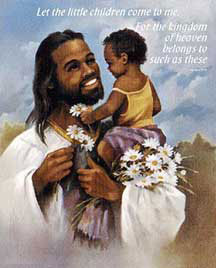
| The inclusiveness of Jesus can be quite elusive, it seems. At one moment he was generously inclusive, upsetting cultural and religious norms. At another, he appeared to raise the bar for entrance into the kingdom of God, excluding rather than including potential disciples. The paradox of Jesus’s inclusiveness is highlighted in a passage from Mark 10 that comprises two short episodes (Mark 10:13-22). In the first, people were bringing small children to Jesus so that he might bless them, but his disciples were blocking them. Presumably, they thought Jesus was too busy to mess around with kids. But Jesus rebuked his disciples, saying, “Let the little children come to me; do not stop them; for it is to such as these that the kingdom of God belongs. Truly I tell you, whoever does not receive the kingdom of God as a little child will never enter it” (Mark 10:14-15). So, on the one hand, Jesus included in the kingdom those whom others would have excluded (children, women, sinners, etc.). Yet, on the other hand, he excluded those who did not receive the kingdom in a childlike manner, by openly and trustingly giving themselves to God’s reign over their lives. |
|
| |
A fascinating artistic vision of the inclusiveness of Jesus. The text reads: "Let the little children come to me. . . ." |
Mark follows this story of Jesus and the children with an account of his interaction with a wealthy man. This man asked Jesus how he might “inherit eternal life” (Mark 10:17). Jesus responded by reminding him of six of the Ten Commandments, which the man claimed to have kept since his youth. Mark concludes the story in this way:
Jesus, looking at him, loved him and said, “You lack one thing; go, sell what you own, and give the money to the poor, and you will have treasure in heaven; then come, follow me.” When he heard this, he was shocked and went away grieving, for he had many possessions. (Mark 10:21-22)
Rather than simply including the rich man within the promise of eternal life, Jesus told him to give away that which he loved more than the kingdom of God, namely, his riches. This certainly looks more exclusive than inclusive, doesn’t it? Even more striking, Mark adds that Jesus did this in love for the man. Simply accepting him as he was, with his heart sold out to riches rather than the kingdom, was not a loving action. How different is this perspective from the one so popular in our day! Excluding anybody from anything for any reason is said by many well-meaning Christians to be unloving. Yet Jesus knew that there are more important things than being included, things like having a pure heart and putting the kingdom of God first in your life. In fact, if we make Jesus our model for life, then we must admit that it is unloving to accept people as they are with their sinful hearts, without calling them to repent. Unconditional inclusiveness is both unloving and contrary to the example of Jesus.
After the rich man went away sorrowfully, Jesus commented to his disciples, “How hard it will be for those who have wealth to enter the kingdom of God!” (Mark 10:23). When his disciples were troubled by these words, Jesus explained that though it is impossible for anyone to enter the kingdom by human initiative, “for God all things are possible” (Mark 10:27). In context, this means that the rich man could indeed have entered the kingdom, if he had allowed God to transform his greedy heart. God alone could have given this rich man a childlike heart so that he might be included within the kingdom of God.
I want to end the post with a couple of reflections. First, texts like this should make most of us in North America uncomfortable, because we are so much like the rich man in this story. We too have many possessions. And these often keep us from living fully under God’s reign. Before we rush to find a way to rationalize our materialistic lives, perhaps we should let the words and actions of Jesus in Mark 10 unsettle us a bit (or even more than a bit.)
Second, I got into this whole issue of Christian inclusiveness because of comments made about Jesus’s inclusiveness by Episcopalian leaders who are fighting to take church property away from the congregations that bought it and currently uses it. To put it more bluntly, they’re fighting for their “many possessions.” I don’t mean to put things too simply, because I know there are multiple issues at stake in this Episcopalian crisis. But it should at least give pause to those involved to realize how easily the power of possessions – even church properties – can keep them from living in the kingdom of God. Yet the good news is that God can set us free from our love of things so that we might live truly and freely under his gracious reign.
The Exclusiveness of Jesus (Section C)
Part 7 in the series “Christian Inclusiveness”
Posted at 9:30 p.m. on Tuesday, September 28, 2004
In my last two posts I examined ways in which Jesus was more exclusive than inclusive in his ministry. Not only did he see the religious elites as excluding themselves from the kingdom of God, but also he did not include those who were unwilling to put the kingdom first in their lives. According to Jesus, only God could change the hearts of those who resisted the kingdom so that they might enter it as receptive children.
A curious combination of inclusiveness and exclusiveness can be found in several sayings of Jesus about himself and his relationship to God. In Matthew 11, for example, he said,
“I thank you, Father, Lord of heaven and earth, because you have hidden these things [about the kingdom of God] from the wise and intelligent and have revealed them to infants; yes, Father, for such was your gracious will. All things have been handed over to me by my Father; and no one knows the Son except the Father, and no one knows the Father except the Son and anyone to whom the Son chooses to reveal him” (11:25-27).
In this passage Jesus claimed to have a unique knowledge of God the Father, something he alone could reveal to others. Those who claim to know God apart from Jesus, therefore, are mistaken. Not exactly inclusive of other religious people, is it?
Yet, after claiming that he alone knew God truly, Jesus extended a generous invitation to all:
“Come to me, all you that are weary and are carrying heavy burdens, and I will give you rest. Take my yoke upon you, and learn from me; for I am gentle and humble in heart, and you will find rest for your souls. For my yoke is easy, and my burden is light.” (Matthew 11:28-30)
On the one hand, what could be more inclusive than this? Jesus invites all who are weary to enjoy his rest, echoing the offer of divine Wisdom in the Jewish wisdom tradition (see, for example, Sirach 6:26-30; 24:19-21). No one is excluded from this invitation. But, on the other hand, Jesus offers rest to those who take his yoke and learn from him. By implication, those who do not accept his instruction will not receive rest for their souls. In the same invitation, therefore, Jesus is both inclusive and exclusive. Rest is offered to all, but only if they receive it through Jesus.
In a similar vein, John 14 records Jesus as encouraging people to believe in God and also in him (14:1). In fact, he claimed to be “the way, and the truth, and the life” (14:6). According to Jesus, there aren’t “many roads up the mountain,” because “No one comes to the Father except through me” (14:6). Here is the exclusiveness of Jesus in its most blunt and extreme form. The kingdom of God is available both in this life and in the life to come, but only through Jesus himself. Jesus is not just the gatekeeper; he is the gate through whom one must pass to be saved (John 10:9).
Now this would sound terrible narrow and unfriendly, not to mention exclusive, except for the fact that Jesus wants to open the gate to all people. In the end of Gospel of Matthew, the risen Jesus gave the following instructions to his disciples: “Go therefore and make disciples of all nations, baptizing them in the name of the Father and of the Son and of the Holy Spirit, and teaching them to obey everything that I have commanded you” (Matthew 28:19-20). So the community of Jesus isn’t to be some exclusive club, like the Jewish monastery at Qumran or the Pharisaic holy huddles. All persons are welcome and should receive Jesus’s invitation to join the kingdom. |
|
| |
A mosaic of Jesus from Ravenna, Italy. He is dressed as a soldier, and is stomping on the serpent (Satan). His book reads "ego sum via veritas et vita," which means "I am the way, the truth, and the life." |
Yet Jesus did not send out the disciples with the good news that all people are included in the kingdom of God regardless of their response to Jesus. They weren’t to go about preaching, “God loves you just as you are. Whatever you happen to believe is just fine.” Instead, they were to call people to believe in Jesus and to turn their lives around in response to him. Once again, inclusiveness and exclusiveness come together in Jesus. Through him, the kingdom of God is open to all, yet on his terms. Apart from Jesus, one cannot enter the kingdom.
The exclusive claims of Jesus don’t go over too well in our syncretistic and relativistic culture. (Actually, they didn’t go over too well in the syncretistic and relativistic first-century Roman world either!) Because the exclusiveness of Jesus doesn’t fit our cultural assumptions, many Christians have downplayed or even rejected the exclusiveness of real Jesus, preferring to refashion his extraordinary inclusiveness to fit our cultural milieu.
This appears to be the case with many leaders in the Episcopal church, and it has contributed to the crisis in the Los Angeles diocese (and elsewhere). Bishop Jon Bruno, when asked to sign a statement affirming Jesus as the only way to salvation, refused, claiming that he could not speak for God when it came to Jews, Muslims, and others. “I’m not willing to say that all other people, whether they are Hindus, Buddhists, Muslims or Jews, will be rejected by God,” the bishop said. “Christianity is an optimum way of life.” Yet Bishop Bruno is unwilling to say that Jesus himself is the life, and that outside of Jesus one cannot experience true life, both now and in the world to come. The reason for the bishop’s hesitation? His sense of Jesus’s inclusiveness: “Jesus loved us unconditionally. He had an unconditional love of humanity, allowing for no outcast in this community as he built the true religion, a religion of inclusion and wisdom.” Yet whereas the love Jesus had for the world led him to invite others to accept him and his message, Bishop Bruno’s vision involves including others regardless of their response to Jesus. Curiously enough, the bishop cites the inclusiveness of Jesus as the rationale for his un-Jesus-like vision of inclusion.
Bishop Bruno would be well served to refresh his knowledge of the inclusiveness of Jesus as revealed in the Gospels, unless, of course, his detractors are correct, and he has abandoned biblical authority. Yet if he truly seeks to model himself after Jesus, as he claims, then he may want to tighten up his understanding of inclusiveness in light of the gospel truth, rather than his culturally-molded perceptions of that truth.
In my next post in this series I’ll examine how the early church understood and applied the distinctive inclusiveness of Jesus in both theology and practice.
Home
The Inclusiveness of the Early Church (Section A)
Part 8 in the series “Christian Inclusiveness”
Posted at 9:30 p.m. on Thursday, September 30, 2004
As we have seen so far in this series, Jesus was both scandalously inclusive and curiously exclusive. He included in his fellowship those who were often excluded from religious fellowship (tax collectors, “sinners,” lepers, women, children). Yet he excluded notable religious leaders and others who were unable to receive the kingdom of God with the humility and openness of a child. Moreover, though Jesus extended the grace of the kingdom to many who were wounded or sinful, he didn’t include them in their brokenness, but rather restored them to wholeness as they entered his community.
After his resurrection, Jesus continued his scandalously inclusive ways by revealing himself first to women (Matthew 28:9-10), who weren’t even entitled to bear witness in a court of law. Jesus, however, enlisted Mary Magdalene as the first person to proclaim the good news of his resurrection (John 20:17-18). Surely this was not some accident, but rather an intentional action with powerful symbolism. The inclusiveness of Jesus’s earthly ministry was to continue in the new community of his disciples.
Jesus’s final words to his disciples in Matthew confirmed this perspective, as he told his closest followers to go and make disciples from all nations (Matthew 28:19). Whatever reticence Jesus showed about ministry to gentiles prior to his resurrection was overshadowed by his new passion to invite the whole world into God’s kingdom. To this end, he promised that the Holy Spirit would come upon his disciples, empowering them to be his witnesses not only in the homeland of Jerusalem and Judea, but also in the region of the despised outcasts (Samaria), and even “to the ends of the earth” (Acts 1:8). Talk about broad inclusiveness! Yet, as I mentioned in my last post, Jesus intended to include all people among his disciples, but only if they made an exclusive commitment to him as Lord and Savior.
Seven weeks after Jesus was crucified, and only days after he ascended to heaven, the Holy Spirit was poured out upon the disciples, just as Jesus had promised. In Acts 2 the followers of Jesus were supernaturally empowered to speak in many different languages so they could proclaim God’s mighty deeds to the Jewish pilgrims who had come to Jerusalem for the Feast of Weeks (pentecoste in Greek, from which we get Pentecost). The fact that the disciples spoke in various languages dramatized what Jesus himself had said, namely, that his disciples would be his witnesses to the whole world.
When cynical observers accused the disciples of being drunk, Peter arose to set them straight. “They’re not drunk,” he explained, adding ironically, “for it is only nine o’clock in the morning” (Acts 1:15). Then he went on to explain the outpouring of the Spirit as the fulfillment of a prophecy from the Hebrew prophet Joel. This prophecy stated, in part: |
|
| |
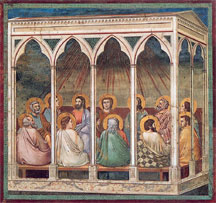
A fresco depicting Pentecost by Giotto di Bondone from the Scrovegni Chapel, Padua, 14th century.
|
“In the last days it will be, God declares,
that I will pour out my Spirit upon all flesh,
and your sons and your daughters shall prophesy,
and your young men shall see visions,
and your old men shall dream dreams.
Even upon my slaves, both men and women,
in those days I will pour out my Spirit;
and they shall prophesy.” (Acts 2:17-18)
Who gets included in the outpouring of the Spirit? Everybody, so to speak, both men and women, both young and old, no matter one’s social or economic condition. Not only would such people be included in the new community of Jesus, but they would also be empowered by God for ministry, even the crucial ministry of prophecy (see 1 Corinthians 14). No longer would leadership be limited to men, or to those who were priests by heredity, or to those who adopted the extra burden of the oral law, or to those who could purchase influence through their wealth. In the church, all who acknowledge Jesus as Lord and Savior will receive the power of the indwelling Spirit (Acts 2:39; Romans 8:1-11; 1 Corinthians 12:4-11).
In his letter to the Galatians, written about twenty years after the outpouring of the Spirit at Pentecost, the Apostle Paul addresses this inclusive reality from a theological perspective. Whereas God made the old covenant of law with the Jews, the new covenant of faith is open to all:
for in Christ Jesus you are all children of God through faith. As many of you as were baptized into Christ have clothed yourselves with Christ. There is no longer Jew or Greek, there is no longer slave or free, there is no longer male and female; for all of you are one in Christ Jesus. (Galatians 3:26-28)
All are “one” not in the sense that all are exactly the same, of course. Rather, all are now included in the community of Christ if they put their faith in him.
Now I’ll admit that this can sound like highfalutin theology, especially if you’re not accustomed to reading the letters of Paul. But Paul’s point is really quite simple. The kinds of divisions between people that characterize human society are not to be found in the church of Jesus Christ. Neither race, nor ethnicity, nor economic status, nor gender, nor any other human distinction should exclude people from the church. All are invited to put their faith in Christ; and when they do, they receive the Spirit and are transplanted by the Spirit into the body of Christ, the church (1 Corinthians 12:12-13).
For Paul and the early Christians, this was not merely some bit of obscure theology. It was a defining mark of their real life in community. Moreover, it set the Christian church apart from virtually every other religion, philosophy, and social group within the Roman world.
Yet inclusiveness in Christ is easier said than done, and the early Christians struggled mightily with the real life implications of their commitment to inclusiveness and unity. In my next post in this series I’ll examine some of the problems faced by the early church, and how they dealt with these problems. In this way we’ll see more clearly exactly what inclusiveness means, and what it doesn’t mean.
Home
The Inclusiveness of the Early Church (Section B)
Part 9 in the series “Christian Inclusiveness”
Posted at 9:30 p.m. on Sunday, October 3, 2004
In my last post in this series I began examining how the distinctive inclusiveness of Jesus was played out in the community of his first followers. At Pentecost the Holy Spirit was poured out upon the disciples, who spoke in various languages as a sign of the Spirit’s being given to all people. Yet, even as all were to receive the Spirit and to be included in the community of Jesus, their way in was through faith in Jesus as Messiah and Savior. Those who put their trust in Christ entered a community in which the divisions of ethnicity, race, economic status, social status, and gender were broken down.
Yet I concluded my last post by noting that inclusiveness in Christ is easier said than done. For an example of this fact we need look no farther than the letter we know as 1 Corinthians. (In fact it was Paul’s second letter to the church in Corinth, but I’ll save discussion that for another day. [see 1 Cor 5:9]). Although the issues that led Paul to write 1 Corinthians were many, it would be safe to say that inclusiveness (or non-inclusiveness) was one of his prime considerations.
| The Corinthian church was being split apart by several factions, with some Christians excluding others for a variety of reasons (1 Cor 1). Socio-economic factors came into play, with rich Christians looking down upon poorer Christians and acting as if they had no place within the community. The wealthy, who tended to be well-educated, scorned the theological simplicity of the poor. Moreover, certain members of the church were experiencing exciting spiritual manifestations. Yet rather than employing these for the growth and unity of the church, they were saying that others who lacked these manifestations were unnecessary to the church (1 Cor 12). |
|
| |
|
Paul wrote 1 Corinthians, in part, to call the church to unity. Those who overvalued their own importance, even to the point of excluding others, needed to rethink who they were in light of the gospel. The majority of the Corinthians needed to remember that, before they believed in Christ, they were relative nothings within Corinthian society (1 Cor 1:26). Yet God chose them to prove that his ways are not human ways. He chose the weak to shame the strong (1 Cor 1:27-29). Notice: the Corinthian church included many people who lacked social status, wealth, or higher education. Like Jesus, the church was exceptionally inclusive. And so it should have been, Paul argued. Those who would exclude other believers because they lacked learning or spiritual experience or wealth or status were missing the point.
The basis for the inclusion of many different types of people in the church was, as we have already seen in this series, the work of the Holy Spirit. As Paul put it in 1 Corinthians 12:12-13:
For just as the body is one and has many members, and all the members of the body, though many, are one body, so it is with Christ. For in the one Spirit we were all baptized into one body – Jews or Greeks, slavers or free – and we were all made to drink of one Spirit.
Yet the inclusiveness of the Spirit was not absolute, as if anyone was to be included within the church no matter what. For one thing, entrance into the Christian community was a result of a person’s confessing Jesus and Lord and being immersed into the body by the Spirit (1 Cor 12:1-13). Moreover, continued inclusion was contingent upon living in a way that was consistent with God’s standards for Christian disciples.
In my next post I’ll examine Paul’s counsel to the Corinthians when they were confronting a situation when a church member was, as we say, “living in sin.”
Home
The Inclusiveness of the Early Church (Section C)
Part 10 in the series “Christian Inclusiveness”
Posted at 9:30 p.m. on Monday, October 4, 2004
In my last post I began looking at how Christian inclusiveness (or exclusiveness) was played out in the church in Corinth (in southern Greece) in the middle of the first century A.D. God had included within the Corinthian church those who were on the outs of society. Moreover, the Apostle Paul rebuked those who excluded others from the church because they lacked certain spiritual experiences, explaining that the Spirit includes within the church all who profess faith in Jesus Christ.
Yet, in the same letter where Paul showed such concern for Christian inclusiveness, he also counseled the Corinthian Christians to exclude a member of their community. In 1 Corinthians 5:1-8 Paul dealt with a scandalous problem in the Corinthian congregation: a man was having sexual relations with his step-mother (5:1). Many of the Corinthians thought this was a fine idea, boasting that they were free in Christ to do even that which was socially unacceptable (5:2). What did Paul think they should they have done instead? They should have “removed” this man from their assembly (5:2). So Paul, even though physically absent from the church, pronounced judgment upon the man who engaged in sexual immorality, and told the Corinthians to “hand this man over to Satan for the destruction of the flesh, so that his spirit may be saved in the day of the Lord” (5:5). In other words, they were to exclude him from their community, but in the hope that, in the end, he would be saved. Exclusion (what we call excommunication) is not merely punishment. Rather, it is a discipline by which a person might bring his or her life in line with God’s desires.
But this did not mean that the Corinthian believers should have nothing to do with sexually immoral unbelievers. In an earlier letter Paul had written that the Corinthians should not “associate with sexually immoral persons” (5:9). The Corinthians interpreted this to mean that they should cut off relationship with “the immoral of this world” and live in some sort of holy huddle (5:10). But this was not what Paul had intended. Rather, he meant that the Corinthians should not associate “with anyone who bears the name of brother or sister who is sexually immoral or greedy, or is an idolater, reviler, drunkard, or robber” (5:11). To make his point crystal clear, he added, “Do not even eat with such a one” (5:11). Yet the Corinthians should have relationship with pagan sinners in order to share the gospel of Christ with them. |
|
| |
A picture of the Acrocorinth viewed from the ancient city. A temple of the goddess Aphrodite once stood upon this hill. Though there were not hundreds of temple prostitutes there in the time of Paul, as is sometimes claimed, nevertheless Corinth was rife with sexual immorality of various kinds. |
Once again we stumble over the peculiar nature of Christian inclusiveness. In some ways it is exceptionally inclusive, but at the same time it doesn’t simply include everyone without regard to their behavior or condition. Christian brothers and sisters who persist in sin without repentance should be excluded from fellowship, in the hope that someday they might be included once again, after they repent. Yet Christians were to continue to have relationship with non-Christians who persisted in sin, in the hope of drawing them to Christ.
What do we learn from 1 Corinthians? I’d summarize thus:
1. We Christians must reach out to all persons in love, excluding none from our evangelistic effort.
2. We must not exclude people from the Christian community because they lack worldly status, wealth, education, or certain spiritual experiences.
3. We must strive to include all persons in the body of Christ, even and especially those who are different from us.
4. Yet we must not tolerate persistent sin in a brother or sister who will not repent. Such a person must be excluded from the community, in the hope that such exclusion will be redemptive in that person’s life.
5. In particular, Christians are not to associate with other believers who persist in sexual sin.
Though the life setting of 1 Corinthians is different from that of Jesus, the dynamics of inclusion and exclusion are quite similar. Jesus hung out with “sinners” and invited them to join his community. Yet repentance was a condition for their inclusion (Mark 1:14-15). Furthermore, Jesus did not include those who hearts were not open to the reign of God.
This double standard can be confusing. It was for the Corinthians in the first century, and it continues to be for Christians in our day who believe that absolute inclusiveness is essential to the church of Christ. How much simpler it would be if we were to avoid relationship with all sinners, or, conversely, to accept all people no matter what their behavior. Yet, according to the New Testament, we are to reach out to all people regardless of their sinful condition. And, at the same time, if someone in the church continues to sin and will not repent, we are to exclude that person, in the hope that he or she will repent. Only true repentance leads to inclusion once more in the Christian community.
You can see why this was a bit confusing to the Corinthians, and why it continues to confuse Christians today. The leaders of the Episcopal church, the ones whose rhetoric led me to deal with the issue of inclusiveness, rightly point out how Jesus and the early church reached out to all people in love, excluding nobody from their gracious outreach. But they draw from this the false conclusion that all people are to be included in the church and even in church leadership without regard to their sexual behavior.
Of course you don’t have to be a rocket scientist to figure out where I’m going in this series. In my next post I’ll consider in more detail how the church today might imitate the inclusiveness of Jesus when it comes to its relationship with homosexual persons.
Home
How Should Christians Be Inclusive of Gays and Lesbians? (Section A)
Part 11 in the series “Christian Inclusiveness”
Posted at 9:30 p.m. on Tuesday, October 5, 2004
My discussion of Christian inclusiveness was ignited by comments from several leaders in the Episcopal Church. They defend their inclusion of gays and lesbians, both as church members and as ordained leaders, even bishops, by pointing to the inclusiveness of Jesus. According to Bishop Jon Bruno of Los Angeles, Jesus “had an unconditional love of all humanity, allowing for no outcast in this community as he built the true religion, a religion of inclusion and love.” For this reason Bishop Bruno supports the full inclusion of gays and lesbians in the Episcopal church. Similarly, another Episcopal leader states that the “first principle” of the church is “the boundless love of God and its absolute inclusiveness.” On this basis the church should ordain gays and lesbians, join them in marriage, and so forth.
So, does the inclusiveness of Jesus, rightly understood, lead to these conclusions?
Of course it’s easy to throw around the word “inclusiveness” carelessly, without tying its meaning to the actual practice of Jesus and his earliest followers. For this reason, in the earlier posts of this series I went back to the biblical texts to examine the ways that Jesus and his disciples were and were not inclusive. What I found was a curiously mixed picture. In some ways Jesus and the early church were radically and scandalously inclusive. In other ways Jesus and the early church were surprisingly exclusive. Jesus, for example, did not include within his community those who were unwilling to receive the kingdom of God humbly and with repentance. Moreover, he did not include in the kingdom sinners as sinners, but rather offered then the possibility of forgiveness, wholeness, and new life. Repentant and redeemed sinners were included by Jesus. Similarly, the earliest church included people across the social, economic, and ethnic spectrum. Yet they were instructed by the Apostle Paul to exclude a Christian brother who engaged in sexual immorality and was unwilling to repent.
Therefore those that argue from the inclusiveness of Jesus to the inclusion of gays and lesbians in the church today are making one giant assumption, namely, that gays and lesbians are not engaging in sinful behavior from which they should repent as they enter the kingdom of God. Now it might turn out that this assumption is correct, of course. But, correct or not, it is an absolutely essential tenet of the “inclusivist” argument. And it’s one which inclusivists rarely defend anymore. They simply assume it to be true and move on. Yet if this assumption turns out to be incorrect, then their argument for inclusion falls apart (at least from a biblical perspective, or from the perspective of Jesus).
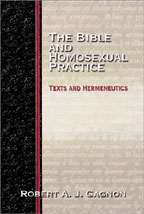
Yet, if we want to be faithful to the real Jesus, not to mention to the Scripture, then we can’t simply assume that homosexual activity is right. Rather, we need to look at what the biblical texts actually say about homosexual behavior in light of broader biblical teaching about sexuality. This is a complex topic, I’ll admit. The best book on the subject, The Bible and Homosexual Practice, by Robert A. J. Gagnon, contains 520 dense pages. So in this post I can’t even begin to lay out the exegetical arguments involved in this debate. Yet I find Gagnon’s arguments to be extremely persuasive.
The power of his arguments can be seen in the fact that very few gay and lesbian advocates in the church try anymore to argue for their position from specific biblical texts. This was a common approach in the seventies and eighties, but it is rarely used today. Gay advocates still use scriptural generalities, like “justice-love” or “inclusiveness” or “love of neighbor.” But they almost never argue from the biblical passages that speak of sexuality and homosexuality to defend their position. Why? Because this approach has been shown by Gagnon and others to be a dead end. It just doesn’t work. So gay advocates generally refer to the Bible as “one” authority among many, giving equal voice to things like “modern psychology” and “the experiences of our gay and lesbian brothers and sisters.” They don’t refer much to Christian tradition either, because this also falls consistently on the biblical side of the argument. |
|
| |
In addition to his book, Robert Gagnon has a website with lots of resources on the question of homosexual practice, including specific responses to some of the arguments made in favor of gay and lesbian inclusion.
|
For Christians who still believe that the Bible is in some strong sense God’s Word, and that it trumps other authorities, the only reasonable conclusions about biblical teaching do not bode well for gay and lesbian inclusivists. I’ve studied this issue in depth for over twenty-five years, and here are some of the conclusions I have drawn from this study:
1. Whenever the Bible speaks positively about human sexuality, as it often does, this is always in the context of male-female sexuality. Clearly, God created sex as something to be shared between a man and a woman, and in this context it can be a very good thing.
2. Whenever the Bible speaks directly about same-sex practice of any kind, it always shows such practice to be wrong. One cannot point to a clearly “pro-homosexual” biblical text without reading between the lines so much that you can’t even make out what the original lines actually said.
3. There is no compelling argument from Scripture for the rightness of homosexual activity. At best there is a very spurious argument from silence, an argument which, by the way could also be used to defend sex between an adult and a child, or between a brother and a sister, etc. (Jesus explicitly didn’t condemn sex in these contexts either, as far as we can tell from the gospels.)
4. Homosexual activity is sinful, no matter what the context. Yes, even in a loving and committed relationship between people of the same sex, sexual activity is morally wrong. This fact doesn’t deny other good aspects of the relationship. It simply means that two people of the same sex should not engage in sexual intimacy together.
5. Christians are called to love all people, including those who engage in homosexual behavior. The behavior of many Christians towards homosexuals (unhelpfully called homophobia by gay advocates) often falls far short of the biblical ideal, or flatly contradicts it. This is truly tragic and just as sinful as homosexual behavior.
6. Yet just because many Christians have been unloving towards gay and lesbian persons, this does not mean that we should now love them by affirming their sexual behavior. From a biblical point of view, love never means saying that sin is okay. When a Christian brother or sister engages in sexual immorality of any kind – gay or straight – that person needs to hear God’s call to sexual holiness, as well as God’s offer of forgiveness and restoration. Love means telling this person the truth, even if it is difficult to say and to hear.
So then, how should the church of Jesus be inclusive when it comes to gays and lesbians? I’ll answer this question tomorrow.
Home
How Should Christians Be Inclusive of Gays and Lesbians? (Section B)
Part 12 in the series “Christian Inclusiveness”
Posted at 9:30 p.m. on Wednesday, October 6, 2004
In my last post I began to consider the question of how Christians should be inclusive of gays and lesbians. I explained that an essential element of this answer is one’s view of the morality of homosexual behavior. If one believes that this behavior can be morally acceptable, then one will envision a different sort of inclusiveness than the person who believes that homosexual behavior is sinful. I explained, moreover, that I fall into the latter camp, believing that homosexual activity, even in the context of a genuinely loving relationship, is wrong according to biblical standards.
| I must confess, however, that I have come to this conclusion in spite of my own feelings. I spent several years studying as a member of the community of Harvard Divinity School (though I was officially a Ph.D. student in the Graduate School of Arts and Sciences). This community was, and still is, strongly pro-gay and pro-lesbian. Those students who believed that homosexuality was wrong were often mocked as homophobic and rejected as unloving. My desire to fit in gave me every reason to try and believe that homosexual behavior was okay in some settings. (For the most part I kept my beliefs about homosexual activity to myself.) |
|
| |
Harvard Divinity School, where I spent four and a half years while in graduate school. |
More importantly, throughout my life I have had several dear gay and lesbian friends, some who were and still are genuine believers in Christ. These friends had tried hard to live heterosexual or celibate lives. But, in the end, their homosexual feelings overwhelmed these efforts and they adopted a gay or lesbian lifestyle. My heart went out to these friends, and I would have loved to affirm them in their homosexuality, to tell them that I believed their choice of a homosexual lifestyle was just fine. I hated hurting their feelings and, in most cases, losing their friendship because I couldn’t affirm them in the way they required. Besides, I would have greatly preferred to be on the side of the perceived liberator, setting gay and lesbian people free from social condemnation, rather than on the side of the perceived persecutor, telling gay and lesbian people that their sexual actions were wrong. So I tried to find a way to justify gay liberation from Scripture. But I just couldn’t do it with integrity. Yes, I knew that there were some scholars who had tried to do this (John Boswell, for example; see also Robert Gagnon’s online critique of Boswell) But I saw the obvious flaws in their scholarship. (This was before Gagnon sealed the case for the sinfulness of homosexual behavior in his magisterial book, by the way.) So, in the end I faced a difficult choice. Would I hang onto the authority of Scripture and reject the rightness of homosexual behavior? Or would I compromise biblical authority in order to affirm my friends and join the side of perceived liberation? Well, if you read my last post, you already know the answer. I choose to uphold biblical authority, and therefore I believed – and still do believe -- that homosexual behavior is wrong.
So how, therefore, can I be inclusive of gay and lesbian people in a way that is modeled after Jesus? Like Jesus and the early church, my inclusiveness cannot be absolute or unqualified. I cannot say to my gay and lesbian friends, “Sure, come be a part of the church and you’ll be affirmed in your sexual choices. You can be in leadership. Your sexual activity isn’t a problem.” To do so would, in my view, be inconsistent with the actual inclusiveness of Jesus, as we have seen in this series. Moreover, I believe it would be truly unloving to minimize or affirm the homosexual behavior of my friends. It is never loving to affirm people’s sinfulness, no matter how much they argue to the contrary.
Yet, at the same time, if I’m going to be like Jesus, I must reach out in love to all broken and sinful people. Part of reaching out in love means welcoming people into the grace of the community of Jesus. So, is a gay person welcome to worship in my church? Absolutely! But will we affirm that person’s sexual behavior. No. Will we encourage this person to seek God’s will for his entire life, including his sexuality? Absolutely! Will we condemn him and single him out in his sin. No. Will we call him to repentance and to experience God’s forgiveness, just like the rest of us? Absolutely! Will we elect him to church office if he continues to live a gay lifestyle? No. Will this man be free to bring his lover to church with him? Absolutely! I hope they come together to worship, frankly. Will they be free to be physically expressive on the church campus, much as a husband and wife might be in a public setting? No. Will we pray for them and seek to love them in imitation of Christ? Absolutely! Will we bless their relationship in some sort of civil union or marriage? No.
This isn’t just theoretical for me. I have found myself in real situations like this with real people – in fact, with close friends. In my next post I’ll share one of these situations, as well as reflect further on how Christians can reach out in love to gay and lesbian persons.
Home
How Should Christians Be Inclusive of Gays and Lesbians? (Section C)
Part 13 in the series “Christian Inclusiveness”
Posted at 10:30 p.m. on Thursday, October 7, 2004
In my last post I tried to show how I, as a Christian, and how my church, as a congregation committed to the authority of Scripture, might include and not include a gay person. I readily admit that what I described is open to debate. I’m not at all convinced I’ve got the details worked out correctly. As I noted in my study of Jesus and the early church, genuine Christian inclusiveness can be pretty messy in practice. I’ve certainly found this to be the case.
The sort of situation I described in my last post, where a gay person wanted to be actively involved in my church, isn’t just theoretical for me. On several occasions I have found myself as a pastor facing this very challenge. One time, in particular, the person who wanted to be fully included in my church as a homosexual was a dear friend. |
|
| |
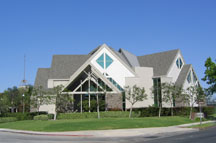
The sanctuary of Irvine Presbyterian Church, where I am the pastor
|
This friend had tried for years to be heterosexual or celibate. Yet, after countless hours of counseling and prayer, she decided that she was a lesbian, and that she was going to engage in homosexual behavior. Ironically, she did not argue that God had made her that way because God endorses homosexuality. Rather, she saw herself like a blind person, someone with a deep wound. She thought of lesbian behavior as rather like Braille, a second-best substitute until she was healed. She believed that when she finally stood before the Lord, she would have lesbian feelings no longer because she would be fully whole. So my friend was not at all your typical gay advocate. Her theology, though confused at points, was much closer to correct biblical theology. In many ways she was quite orthodox. Moreover, she continued to take the Bible very seriously, though choosing to follow the scholars whom I had discounted when it came to passages that addressed homosexual behavior. Nothing I could say or do would change her mind.
This friend was a member of my church. She loved the church and very much wanted to remain in it. “Can I still come to worship?” she asked. “Yes, at least for now,” I answered, “but you must understand that you’ll sometimes hear things that will be very hard for you to hear.” I realized that at some point in the future some kind of church discipline might be appropriate in her case, but that was far off. I still had hope that my friend might be led to repent if she were included in a loving, worshipping, forgiving community.
She continued, “And if I have a lover and we’re in a committed relationship together, can she come to church with me?” “Yes,” I answered. “And what if we hold hands or something like that? Would that be okay?” “No, I don’t think so,” I replied. “That would seem to imply endorsement of your relationship, and it would model something that isn’t right.” “And would the church ever be able to bless our relationship?” she wondered. “No. I don’t think that would ever happen.” “Then,” my friend concluded sadly, “I don’t think I can come to the church anymore. If you can’t accept me as I am, if you can’t approve of my choices, then I just can’t be there. I need to go to a church that can affirm me as a lesbian.” And so she did, beginning to attend a church she really didn’t like much at all, but one that approved of homosexual behavior.
I understood my friend’s predicament. And my heart ached for her. Yet I knew that I had to uphold biblical truth in this situation, no matter what her feelings or my feelings might be. So my friend left our church, never to return. Our friendship continued for a while, but in time it ended. Though I was willing to remain her friend, she needed affirmation I just couldn’t give. I understood, but did not feel free to give her what she thought she needed.
Many gays and lesbians, and many of their advocates, say that one cannot love a homosexual person without endorsing his or her homosexuality. But I do not believe this to be true. In fact I know it’s not true. Jesus loved sinners, yet still called them to repent of their sin. And we should try to do the same. This means we should include gays and lesbians within our loving outreach. It does not mean we should include gays and lesbians in the church in such a way that they are affirmed for their sexual choices.
A common objection to what I’ve just said goes like this: “So you’re telling me that I can come to your church, but I can’t be openly gay. And you’re telling me that you will love me, but not affirm me. And you’re telling me that I can be in your church, but that I cannot be an elder or a pastor. This is a double standard. It’s not loving and it’s not inclusive.” My response is to point out that we aren’t singling out gay and lesbian people for special treatment (or mistreatment, as they might claim). This is exactly how we deal with all sinners (and we all are sinners). We invite sinners to church, but don’t affirm their sin. We seek to love sinners, but not accept their sinfulness. We allow sinners to fill our pews – otherwise nobody would be in church, including pastors – yet we do not ordain those who say that they intend to keep on sinning. To this the gay person would object, “Yes, but I don’t think my behavior is wrong!” To which I would say, “Yes, that’s the rub. That is indeed the difference. But it’s a real difference, not something we can pretend doesn’t matter. If we believed that your sexual behavior was okay, then we’d be in a completely different position altogether. But my church and I have chosen to stand on the bedrock of biblical authority. So, here we stand, and we can do no other. I’m sorry this seems so unloving to you.”
Now I’ve also heard Christians object that even to include gay and lesbian people within a church is wrong. “We can’t have that sort of person in our church,” they argue, “because this means that we’re approving of their behavior.” But my question is: “Where do you draw the line? Will you exclude all sinners from church, not only homosexual sinners, but also heterosexual sinners, and lustful people, and prideful people, and judgmental people, and . . . ?” Yes, there is a point when a person who will not repent from persistent sin should be excluded from the community in the hope that he or she will repent. But how can we justify rushing to apply church discipline in the case of homosexual sin when we rarely (if ever) apply it in other cases? Besides, don’t we believe that people experience grace and healing in the context of the church? And isn’t this the very thing we want gay and lesbian people to experience?
In my next post in this series I want to examine examples of how Christians have in fact reached out to gay and lesbian people in love, including them within their Christ-like embrace without endorsing their sinful behavior.
Home
How Should Christians Be Inclusive of Gays and Lesbians? (Section D)
Part 14 in the series “Christian Inclusiveness”
Posted at 9:30 p.m. on Sunday, October 10, 2004
In my last three posts in this series I’ve been trying to explain how Christians who believe that homosexual behavior is sinful, can, nevertheless be inclusive of gays and lesbians. Following the example of the real Jesus, rather than some figment of liberal theological imagination, we should reach out to gays and lesbians with genuine love and concern, though not endorsing their sinful behavior. More than once I have mentioned that fact that this is not some novel way to treat homosexuals, but is consistent with how Christians ought to relate to all people.
In my last post I shared a personal story from my own experience as a pastor of a lesbian woman and her relationship to my church. In this post I want to relate a different kind of story, an account of the leadership of a church trying to wrestle with how to reach out to persons with HIV/AIDS.
In the late 80’s and early 90’s I was on the staff of the First Presbyterian Church of Hollywood. Dr. Lloyd Ogilvie was the Senior Pastor (before he became the Chaplain of the U.S. Senate). At that time the AIDS crisis had come to Hollywood, especially because of the large numbers of gay men in the community. Many were dying of AIDS, often without the love and support of other human beings. Families were also going through terrible times as their sons and brothers were dying in a most painful and tragic way. Dr. Ogilvie believed that our church needed to do something for AIDS victims and their families.
But the First Presbyterian Church of Hollywood had always taken a strong, clear, biblical stand on human sexuality. Outreach to persons with HIV, most of whom got the virus through homosexual activity, raised challenging questions. How much emphasis would the church place upon the wrongness of homosexual behavior as it reached out to AIDS victims? Too much emphasis would chase away the very people we sought to reach. Yet we didn’t want to appear as if we endorsed a gay and lesbian lifestyle. |
|
|
At first the staff worked hard on a position paper to lay a foundation for this ministry. We reflected for long hours on the biblical call to love, and what this would mean in our situation. We considered how we could reach out to persons within the gay culture of Hollywood without compromising our beliefs about homosexuality. In the end, our position paper laid out the basic biblical principles and their implications for our ministry. The bottom line was that we sought to reach out with the love of Christ to those around us who so desperately needed it. We would remain true to our convictions, but not let these convictions keep us from loving our hurting neighbors.
The staff presented the paper at the meeting of the board of elders (what Presbyterians call the Session). We had at least two long conversations before we took a vote. Some elders were eager to begin a ministry for persons with AIDS and their families. Others were hesitant, fearful that doing this would imply our approval of homosexual activity. After much discussion and prayer, we finally voted. Honestly, I can’t remember if the vote was unanimous or not, but I know it was almost completely in favor of beginning the new ministry.
And so a new ministry was begun. Now you might suppose that the gay community wouldn’t welcome a ministry such as this, given the Hollywood church’s position on homosexual behavior. But you’d be wrong, for the most part. The secular gay community, sensing the genuine heart of the church for people in pain, accepted it with gratitude. In fact one gay and lesbian organization – I can’t remember the details, sorry – actually gave an award to the church’s ministry. Ironically, the only real criticism I heard of this ministry was from liberal Presbyterians who resented the ministry because it didn’t endorse homosexual behavior. (Sigh!)
Over the years, dozens if not hundreds of people received the love of Christ through people in the church. Volunteers did not make a big deal out of the wrongness of homosexual behavior. And, frankly, when you’re caring for persons with advanced AIDS, sexual behavior just isn’t an issue. The ministry never misrepresented its beliefs about human sexuality, but, frankly these were rarely a topic of concern. (If you go to the emergency room with a heart attack, having eaten poorly and exercised rarely all of your life, the doctors and nurses don’t begin by chewing you out for your bad choices in the past. There’s a time and a place for everything.)
Those who received the love and care of the church were grateful, as were their families, and, yes, as were their gay partners. Many volunteers learned to love people without seeing them first as gay or straight or whatever, but as human beings worthy of Christ’s love.
Did the First Presbyterian Church of Hollywood include gay people through this ministry? Yes, in the sense that they were included within the love and grace of Jesus Christ present among his people. Yes, in the sense that they were welcome in worship and in other areas of ministry. But such inclusion did not involve approving of sinful behavior.
In my next post I’ll tell one more story, another personal one from the experience of my own family. Stay tuned . . . .
Home
How Should Christians Be Inclusive of Gays and Lesbians? (Section E)
Part 15 in the series “Christian Inclusiveness”
Posted at 11:30 p.m. on Monday, October 11, 2004
Yes, this post contains yet another illustration of how Christians can “include” gays and lesbians without affirming their sexual choices. You may wonder why I’m adding so many illustrations to this series. It’s not just filler, I assure you. Rather, I think the illustrations help to make my point, and they also help you to see how the theoretical position I have defended can be worked out in real life situations.
My last post focused on the effort of the First Presbyterian Church of Hollywood to care for people, primarily gay men, who were stricken with AIDS. The church was able to do this without compromising its understanding of biblical morality.
Today’s post is much more personal. It has to do with a gay man who entered the life of my family in the midst of a crisis. (If this story seems familiar to you, I have included it in a couple of my books.)
Twenty years ago my father was dying slowly and painfully of cancer. His failing health laid a heavy burden on my mother, as well as upon the rest of my family. A friend of my sister learned what we were going through and offered to live in my parents' home so he could help my mom and dad. Rick was a loving man who cheered up my parents with his humor and excellent cooking. He helped care for my father in many ways. Rick also happened to be gay. He was not a Christian, so he didn't see anything wrong with his lifestyle.
When Rick moved in, my mother made clear what she believed about sex outside of marriage. She asked him to respect her values in her home, which Rick was glad to do. During the months of his stay, he and my mother had many discussions about the most important things in life. They talked about family, love, God, sex, death, and dozens of other subjects. In time, Rick became like a member of our family. He shared our holiday celebrations and our long vigils at my dad's bedside. Rick’s presence with us was a true gift in a desperate time. He was included as a member of our family, loved as if he were a brother, and deeply appreciated. |
|
| |
My dad, a few months before he was diagnosed with terminal cancer.
|
Shortly after my father died, Rick discovered that he was HIV positive. In those days medical treatment was less advanced so he quickly developed full-blown AIDS. During that painful time, Rick continued to be a part of our family, sharing our life as we shared his.
I'm sure there were some who wondered about Rick's presence in our family. My mother was a highly regarded leader in the church, a woman of exemplary Christian maturity. Perhaps some people questioned her inclusion of Rick in our family. Though my mother sometimes struggled over how to relate to him, she never abandoned her commitment to biblical morality. Yet she continued to open her heart to Rick in his time of suffering, even as he had opened his heart to us when my dad was dying.
Rick eventually moved home to Canada to spend his last few months with his family. During that period, my mother visited him. Once again, they talked about what it meant to be a Christian. Through much suffering, Rick had come to realize his need for God. He finally put his trust in Jesus. Rick's own imminent death, a tragic loss for those of us who loved him, would be his eternal gain. He is with the Lord today, largely because my mother was willing to include him within our family and within the scope of her love.
As I look back on Rick’s time in my family, I don’t think of him as “the gay man who lived with us.” Yes, he was gay, but he was so much more than merely a sexual being who did things I didn’t think were right. He was a loving, kind, talented, fun human being. He was a man who cared for my family in a time when we most needed it. And, though I never was able to see Rick after he put his faith in Christ, I think of him now as a dear brother in the Lord. One of the things I look forward to about heaven is being able to greet Rick and tell him more clearly than I ever did before, how much he meant to me and my family.
Home
Concluding Reflections
Part 16 in the series “Christian Inclusiveness”
Posted at 9:30 p.m. on Tuesday, October 12, 2004
When I write an article or a book, I always begin with a detailed outline that lays out my main points and the overall structure of what I’m planning to produce. Blogging is different. When I do a series, I start off in a general direction and go. Rarely do I anticipate all the twists and turns in the blogging road ahead until I get to them. I’m also not entirely sure when it’s time to stop until I get to the end. So there’s an adventure in blogging that I don’t experience as much in other kinds of writing.
The adventure of this series on “Christian Inclusiveness” is just about to end. In this final post, I want to add a few final reflections.
As you probably know if you’ve been following along, this series began as a response to leaders in the Episcopal Church who were basing their full inclusion of gays and lesbians in church leadership on “the inclusiveness of Jesus.” One spoke of “the true religion of Jesus, a religion of inclusion and wisdom.” Another claimed that the “first principle” of the church was “the boundless love of God and its absolute inclusiveness.” The use of inclusiveness by these leaders troubled me because it seemed overly general and in many ways inconsistent with what I had always envisioned as the actual inclusiveness of Jesus. But, frankly, I had never studied this topic with intentionality. So it seemed good to do such a study and share the results with you.
These results were fascinating to me, but not altogether simple. In fact the inclusiveness of Jesus was at the same time extraordinarily broad and curiously limited. I ended up doing three posts on “The Inclusiveness of Jesus” and three on “The Exclusiveness of Jesus.” Just because Jesus loved unconditionally, that did not imply his full acceptance of all people just as they were. Some, like lepers, he healed so that they might enter his community as whole people. Others, like unrepentant religious leaders, he excluded (or recognized their self-exclusion) quite assertively. Clearly the inclusiveness of Jesus was not of the “y’all come just as you are” variety. Though he reached out in love to all, and though he invited all into the kingdom, only those who received the kingdom as a child, with openness and repentance, in fact were included within the community of Jesus. Remember the basic message of Jesus included a call to repent: “The time is fulfilled, and the kingdom of God has come near; repent, and believe in the good news” (Mark 1:15).
Therefore, to interpret the unconditional love of God in Christ as some sort of “absolute inclusiveness” is a mistake. God invites all people into relationship with himself. But entry into this relationship and maintenance of this relationship depend on such things as repentance, faith in Jesus, and a life of “walking in the light” (1 John 1:5-9). To say that, on the basis of Jesus’s own practice, the church should include all people just as they are is simply wrong.
In point of fact, the advocates of inclusiveness within the Episcopal Church don’t actually practice the sort of inclusiveness the seem to promote. They don’t, for example, say to those they label as homophobic, “Y’all come. It’s just fine if you continue to act unlovingly towards gays and lesbians. We practice absolute inclusiveness here.” In fact many of the strongest proponents of inclusiveness in the Episcopal Church are increasingly moved to exclude those in their own denomination whom they label as fundamentalist because of their commitment to the authority of Scripture. Now I would in fact defend this notion of limited inclusiveness, because I think absolute inclusiveness is both impossible and wrong. The church needs to be more precise and discerning when it comes to inclusion (and exclusion). Of course, though I defend the idea of limited inclusiveness, such as practiced by the Episcopal Leaders who would include gays and exclude “fundamentalists,” I think they’re making precisely the wrong choices about whom to include and whom to exclude.
| Yet, having said this, I must add that the church’s zeal to exclude gay and lesbian people has, sadly, far outstripped its commitment to Christ-like love. Many Christians practice a double standard, whereby homosexual sin is worse than heterosexual sin, the one unforgivable, the other easily overlooked. A father once admitted to me that he continued in relationship with his daughter, who was living “in sin” with her boyfriend, while he had completely broken relationship with his son, who had chosen a gay lifestyle. This sort of double standard is indefensible. The church needs desperately to reach out to all persons, including gays and lesbians, with the forgiving, healing, renewing love of Christ. |
|
| |
A portion of Rembrandt's painting, "Christ and the Woman Taken in Adultery" (1644). This story shows Jesus's response to one who is engaging in sexual sin: forgiveness and a call to repentance and holiness. |
During this series I have received an unusually high volume of e-mail. Some of it has been critical of my ideas, and this is fine. Nobody has insulted my character or accused me of homophobia, and this I appreciate. But most of my mail has been appreciative in a particular way. It seems that many Christians have felt as if they have been forced to accept one of two options when it comes to homosexual persons and the church. Option #1 is the way of complete inclusiveness, whereby Christian love means accepting gays and lesbians as they are. Period. Option #2 is the way of legalistic judgmentalism, in which gays and lesbians are condemned and rejected for their sin, often with a harshness that is so contradictory to the way of Jesus. People have explained to me that they have often been pressed – by those on both extremes of this issue – to choose either option, as if these were the only real possibilities.
The idea of “another way” has been appealing to many who have written to me. They want to uphold biblical orthodoxy when it comes to sexual ethics. For this reason they believe that homosexual behavior is wrong. But they don’t want to be unloving, judgmental people. Rather, they want to love as Jesus loved, offering the grace and mercy of Christ to all people, including gays and lesbians. My theoretical discussion of inclusiveness, as well as my real-life examples, have been an encouragement to many people that this is not only right, but also possible. For the chance to offer such encouragement I am truly grateful.
Home
|