| |
A Resource by Mark D. Roberts |
|
Is the TNIV Good News? Volume 1 of 3
by Rev. Dr. Mark D. Roberts
Copyright © 2005 by Mark D. Roberts
Note: You may download this resource at no cost, for personal use or for use in a Christian ministry, as long as you are not publishing it for sale. All I ask is that you give credit where credit is due. For all other uses, please contact me at mark@markdroberts.com. Thank you.
Is the TNIV Good News?
Part 1 of the series “Is the TNIV Good News?’
Posted at 11:55 p.m. on Sunday, February 13, 2005
Earlier this month, Zondervan, the world’s #1 Bible publisher, in association with the International Bible Society and the Committee on Biblical Translation, released the whole Bible in a new translation: Today’s New International Version, or TNIV.
Last month the TNIV made headlines when Rolling Stone magazine at first rejected an ad for the TNIV, and then reversed ground by accepting that ad. (When you think of it, Rolling Stone ended up doing a huge favor for Zondervan, because their peculiar rejection and then acceptance of the TNIV ad greatly increased the public awareness of the new translation’s pending release. If you’re interested in the whole Rolling Stone matter, I did a blog series on it last month: “A Rolling Stone Gathers No . . . Bible?”)
If you’re unaware of the TNIV, let me answer some basic questions about it. |
|
| |
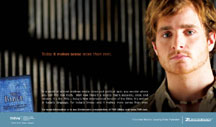
How the copy reads:
Today it makes more sense than ever. In a world of almost endless media noise and political spin, you wonder where you can find real truth. Well now there’s a source that’s accurate, clear, and reliable. It’s the TNIV—Today’s New International Version of the Bible. It’s written in today’s language, for today’s times—and it makes more sense than ever. |
What is the TNIV?
This translation, though closely related to its predecessor, the NIV, is a new translation based upon the Greek, Hebrew, and Aramaic texts from which we get our English Bible. According to Zondervan, 93% of the TNIV mirrors the NIV, while 7% is a fresh translation. The new material “clarifies and updates passages and words to provide a more timely, contemporary English rendition for a new generation of Bible readers.” Yet the TNIV is not meant to replace the beloved NIV, but to complement it. Nevertheless, Zondervan claims that the TNIV is “uncompromisingly accurate Bible translation in today's language from the translators of the most trusted modern English translation, the NIV.” This claim to accuracy is central to the TNIV’s purpose.
Why do we need another translation?
Here is the core of Zondervan’s answer to this question:
Perhaps the most important reason to produce a new translation is to reach today's generation of 18- to 34-year-olds, a generation that is leaving the church in record numbers. According to research, four out of ten people leave the church after high school, and another eight million twenty-somethings will likely leave the church by the time they turn 30. . . . .
While older forms of English may not present a problem for some readers, they can present barriers to understanding and fully engaging the Bible for today's generation because they've grown up using more contemporary English. In addition, the TNIV translators were mindful of what they were working on: Today's New International Version. It is intended for English-speaking readers no matter where they live.
English usage keeps changing – between 1993 and 2003, Merriam-Webster made 100,000 changes and added more than 10,000 words and phrases to its collegiate dictionary. Thirty years have passed since the NIV was released.
So, the TNIV is a response to the fact that the English language keeps on changing. It is meant especially for the younger generations, who would be put off by the dated language of the NIV.
Who did the translation?
The translation was overseen by the Committee on Bible Translation (CBT), the same organization responsible for the original NIV. Many of the key TNIV translators had worked on the NIV as well. The members of the CBT have top academic and evangelical credentials, having written outstanding books and Bible commentaries, and having taught in some of the finest Christian educational institutions in the world, including Bethel Theological Seminary (San Diego), Calvin Theological Seminary, Wycliffe Hall (Oxford), Regent College, Westmont College, Wheaton College, and Reformed Theological Seminary (Orlando).
Who recommends the TNIV?
Supporters of the TNIV include many of the heavyweights of evangelicalism: Bill Hybels, Lee Strobel, Erwin McManus, Darrell Bock, Philip Yancey, John R. W. Stott, Ted Haggard, Craig Blomberg, Roger Nicole, Timothy George, Dan Kimball, Diane Komp, John Kohlenberger III, Tremper Longman, Jim Cymbala, and Cornelius Plantinga, Jr. It’s hard to imagine a finer collection of evangelical scholars, pastors, and leaders, representing a broad spectrum of evangelicalism.
Yet with such top evangelicals standing behind the TNIV, it’s telling that Zondervan’s homepage feature on this translation includes a quotation from Peter Furler. This name would be unfamiliar to most folks over 30, but well known to many (most?) evangelical Christians under 30. Peter Furler is the lead singer of the extremely popular Christian band, the newsboys. Here’s what he says about the TNIV:
"The only foundation that will prevail is the one built on God’s Word. That’s why I’m proud to stand with Zondervan, bringing the Word to today’s generation. That’s why I believe so strongly in Today’s New International Version, the TNIV; a new translation that speaks the timeless truth of God’s Word in the language of today."
|
|
| |
Peter Furler in concert |
Good News, Right?
So, to sum up the main facts, the TNIV is:
• a translation closely related to the NIV, but based on the original languages, and thus “uncompromisingly accurate” according to Zondervan
• a translation into contemporary English, reflecting the latest English usage
• a translation produced by one of the most trusted and successful Bible translation partnerships: Zondervan, the International Bible Society, and the Committee on Bible Translation.
• a translation targeted especially for readers under 35, who have great spiritual hunger, but who are leaving the church (or never getting to it) in distressingly large numbers
• a translation meant to foster both evangelism and discipleship among people under 35
• a translation recommended by some of the most trusted and influential evangelical scholars, pastors, and other leaders.
Given everything I’ve said here, you might think that the release of the whole Bible in the TNIV translation would be a cause for great celebration among all evangelical Christians (except, I suppose, for publishers of competing translations, who might lose market share). Given the church’s sorry track record in reaching the younger generations, and the fact that the TNIV targets these very generations, you’d expect that all evangelical believers would support the TNIV effort with their encouragement and their prayers, even if they did not intend to use the TNIV themselves. Given the facts as I’ve laid them out, you might think that the publication of the TNIV is being heralded as good news by almost all biblically-committed Christians throughout the country.
But if you thought any of these things, you’d be wrong. Though a large and diverse group of evangelical leaders has endorsed the TNIV, another large contingent of evangelical leaders has publicly withheld their support for this translation. They are encouraging individuals and churches not to use the TNIV as their primary Bible.
Now if you’re not a close follower of evangelical church politics, and if you read the first part of this blog post, you may have a hard time believing that any truly evangelical people would oppose the TNIV. But among the opposition you’d find such well-known leaders as James Dobson, Chuck Colson, and J. I. Packer. So we’ve got highly trusted, influential evangelical Christian leaders both supporting and opposing the TNIV.
This can be very confusing for the average Christians who aren’t particularly interested in internecine evangelical disputes and who simply want to understand and obey the Word of God. Should we use the TNIV or not? Should we encourage others to do so, or warn them not to?
In this series I will unravel the various issues bound up in the TNIV dispute. I will try to help you grasp what’s really going on here so you can make an informed decision about the TNIV. In the process, I will try to be as fair as I can be to both sides of the debate. In my next post I’ll explain why I think I can do this. Stay tuned . . . .
My Background and Bias
Part 2 of the series “Is the TNIV Good News?’
Posted at 11:35 p.m. on Monday, February 14, 2005
Yesterday I began a new series by focusing on a new Bible translation, Today’s New International Version (TNIV), and by introducing the controversy surrounding the release of the whole Bible in this translation. I mentioned that highly regarded evangelical leaders have lined up to support the TNIV while other highly regarded evangelical leaders have lined up to announce their lack of support for the translation. So as I begin to investigate what’s going on here, I am well aware that I will step on the toes of Christian leaders for whom I have the highest respect. I will do this as respectfully as I can, but there’s not way down this path that doesn’t end up mashing a few toes (probably my own as well).
If you’re not familiar with me or my writing, you may wonder about my credentials and, for that matter, my personal preferences when it comes to Bible translations. So let me explain how I have come to this conversation and what I bring to the table, and also my peculiar approach to English Bible translations. |
|
| |
This picture has nothing to do with today’s post. It’s really nothing more than a chance for me to brag about the benefits of living in Southern California. This evening, in celebration of St. Valentine’s Day, my family and I headed down to the beach for a picnic. It was a gorgeous evening: about 60 degrees with a gentle wind blowing. I thought you’d enjoy this picture of my barbeque. Not a bad view, is it? |
My Background
When I was in graduate school working on a Ph.D. in New Testament, I spent a major part of my time studying the ancient languages in which the Bible was originally written. I studied ancient Greek for five years, ancient Hebrew for two and a half years, and Aramaic for one semester. In these classes and in biblical exegesis classes, I learned a great deal about the theory and practice of Bible translation. In the process I also learned how tricky this can be, and how many hundreds of decisions a translator must make when trying to render even a short passage into contemporary English.
It’s been over twenty years since I was a resident graduate student. In this stretch of time I
• finished my Ph.D. (with a dissertation on Acts and Paul);
• served on the staff of two churches (Hollywood Presbyterian Church, as an associate pastor under Dr. Lloyd Ogilvie, and Irvine Presbyterian, as senior pastor);
• preached over 700 sermons and taught more than a thousand Bible classes in church;
• taught over a dozen seminary courses as an adjunct professor of New Testament, including New Testament Greek;
• wrote five books, including a commentary on the Old Testament books of Ezra, Nehemiah, and Esther; also was a major contributor to the NIV Worship Bible.
In all of these activities I have spent thousands upon thousands of hours studying the Bible, both in English translation and in the original languages. Though I am a pastor, not a full-professor, I regularly use the academic skills I developed in graduate school. Yet my “angle” if you will is generally a pastoral more than a scholarly one. I have a passion for Christ, for his church, and for his mission in the world.
I must say at the outset of this series that I have never participated on a Bible translation team, and that my linguistic skills, though fairly well developed for a pastor, are not nearly as sharp as those of scholars who are true experts in the field of biblical translation. Nevertheless, I’m able to understand most of the technical arguments and, as fits my primary calling, interpret them for the sake of a lay Christian audience.
My Translational Bias
Let me confess my oddness right of the top: I am a translationally-eclectic, one might even say "translationally-challenged." I use a wide range of translations for different purposes, and I’m more than willing to see the flaws in the translations I use most often. I know many Christians who are translational zealots. They seem almost to revere their favored translation, whether it be the NIV, the KJV, the NRSV, the NLT, the ESV, the NASB, or you name it. I don’t have anything against such enthusiasm for a translation, necessarily, though I don’t share it.
To exemplify and help explain my peculiar eclecticism, let me mention the translations I have used in writing my books:
| Ezra, Nehemiah, Esther (Word, 1993; commentary in the Communicator’s Commentary series, now called The Preachers’ Commentary). Translation used: NKJV. This was not my choice, but it was the required translation for the series. At the time I preferred the NIV, but I was impressed by the usefulness and accuracy of the NKJV. And I was also surprised at how often the NKJV was, in my opinion, more accurate than the NIV, which I continued to us for study and teaching. |
|
|
| NIV Worship Bible (Zondervan, 2000). It should come as no surprise to you that the required translation for the NIV Worship Bible was – you guessed it – the NIV. I wrote about 20% of the devotional content for this Bible, as well as all of the introductions to the biblical books. While writing for this Bible I was tending to use the NRSV in my preaching, so I enjoyed comparing the two translations. Both had strengths; both had weaknesses. Both were basically reliable and helpful. |
|
|
| After “I Believe” (Baker, 2002). This book was written for new believers with little biblical knowledge, so I used the New Living Translation because it is very readable and accessible. Usually this translation is exceptionally good at capturing the author’s original meaning. Yet sometimes it strays from that meaning to such an extent that I supplemented my use of the NLT with my own translations of the biblical languages. |
|
|
| Jesus Revealed (WaterBrook, 2002) and Dare to Be True (WaterBrook, 2003). In these books I stayed with the NLT for the sake of readability, though supplemented this translation with the NIV and NRSV, as well as my own translations. I found that sometimes the NLT rendering was astoundingly good, both in terms of readability and accuracy. Sometimes it became overly interpretive, however. |
 |
|
| No Holds Barred: Wrestling with God in Prayer (WaterBrook, 2005). This book will be released exactly a month from today. It is based upon careful exposition of about twenty Psalms. I had a very difficult time deciding upon which translation to use for this book. The NLT was the most readable, but sometimes just not accurate enough. In the end I went with the NRSV because I found it to be generally the most accurate of the translations I consulted. In some cases, however, I used the NIV when it rendered the Hebrew original more precisely. (For the record, I did not consider the English Standard Version (ESV), largely out of habit, or the TNIV, because the Old Testament wasn’t published yet.) |
|
|
So now you have proof of my translational eclecticism. Perhaps “translational confusion” seems to you a more accurate description! If you’re thinking this now, just wait until tomorrow!
Eclecticism and Essentials in Bible Translation
Part 3 of the series “Is the TNIV Good News?’
Posted at 9:35 p.m. on Tuesday, February 15, 2005
Yesterday I began to explain my background and bias as I approach the controversy surrounding the TNIV Bible translation. As an example of my own “translational eclecticism,” I showed how my several books use a wide range of English translations, including the NKJV, NIV, NLT, and NRSV. It probably won’t surprise you to learn that my pastoral and personal practices are similar.
As a pastor, I have not established (or had the elders of my church establish) one standard Bible translation for our church. In preaching and worship services I have used the NLT, NRSV, NIV and others. Our adult education classes tend to prefer the NIV or the NRSV. Our youth ministry favors the NIV, especially because there are excellent resources associated with this translation. Our children’s ministry uses the NIV, but the NLT has become more and more popular because of its readability. If this sounds a bit chaotic, I’ll admit that it can be, at times. But I have tried to let each ministry determine which translation is best suited to the particular needs of the ministry.
When I teach Bible studies at church (or seminary classes), I encourage folks to bring a variety of translations. During the course of a study we’ll compare and contrast different versions, trying to discover nuances we’ve missed by looking at one translation only. The original languages of the Bible provide the firm foundation for our study, of course.
My personal Bible use is also quite varied. For study, when I’m not working directly from the ancient languages, I use the NRSV, NIV, NLT, and KJV. I’m seriously considering adding a couple of new versions into the mix. For my devotional reading I use the NIV primarily, but also the NRSV and the NLT. My travel Bible is a wonderful little NASB that my wife gave me before we were married. Since I don’t use the NASB very often, I always enjoy the variety and preciseness of this translation. |
|
| |
My favorite traveling Bible. As you can see, the NASB is quite small, and getting a little worn around the edges. |
The Downside of Translational Eclecticism
I’ll confess that there is a downside to working with and encouraging the use of several translations. One main problem is that it hampers Bible memorization. I have internalized the sense of hundreds of Biblical passages, but I cannot easily cite these in English. This has to do, in part, with my tendency to vary translations. In fact, sometimes when I’m reading one translation in church I find myself using words I’ve learned from another translation. This can be confusing. I admit it. No matter what esparganomenon really means, I don’t know if I’ll ever have the baby Jesus “wrapped in cloths” (Luke 2:12, NIV) rather than “swaddling clothes’ (KJV).
Another problem with encouraging the use of a variety of translations is that people often want simple direction. When someone asks me, “Which translation should I use?” this person usually wants a few letters (NIV, NLT, KJV, etc.), not a lecture on the nature of translations and the benefits of various options. Now, when somebody asks me about which translation to buy, I ask a number of questions about who will use the Bible, such as: Age? Christian experience? Education? Primary purpose of Bible (devotional or study)? And so on. For new Christians I generally recommend the NLT because it is very readable and still fairly accurate. If a mature Christian is looking for a study Bible, I recommend The Reformation Study Bible (formerly New Geneva Study Bible) which as of this date comes only in the NKJV. It will soon be released in the ESV, however, which should improve readability and accuracy. This Study Bible comes with the best notes of any Bible of which I am aware, though Christians who are not Reformed theologically won’t appreciate it as much as I do. If someone is looking for a devotional Bible, I recommend The NIV Worship Bible. For hardcore Bible students who really want to go deeper into the Scripture, I recommend that they take Greek or Hebrew at a local college or seminary. Seriously! The best translation in the world can never match the original for clarity, nuance, and accuracy. No joke!
Some Essentials About Bible Translation
1. No translation is perfect, not even close. There are many reasons for this, apart from human fallibility. Good translations can get close to the original meaning of a text, but cannot perfectly duplicate that meaning. Some of the debates about English translations (not just the TNIV debate) seem almost to assume that perfection is possible, and has been achieved by one particular translation. But this is wishful thinking. It’s important for those of us who take the Bible seriously to remember that translations are not inerrant. At best they convey the meaning of the inerrant text in a relatively accurate and faithful way.
2. There is not a one-to-one correspondence of meaning between languages, especially languages that are distantly related, if at all (like Greek and English). You can say, for example, that the word logos in John 1 means “word,” and this is true on a superficial level. But logos has a rich range of meaning that far surpasses the ordinary sense of “word” in English. Plus, you can be quite sure that John never thought of logos as a leading word-processing program. So, though logos is translated as “word,” it means a whole lot more and quite a bit less than “word.” Every time you translate from one language to another, you lose bits of meaning and you gain other bits. The translator's challenge is to minimize both sides of this equation.
| 3. Translation is more of an art than a science. Scientific theory, of course, allows for a wide range of opinion. But theories are usually tested by experiments that are objectively sound. A scientific experiment, for example, should be repeatable. Under the same conditions, you should be able to reproduce what another scientist has done and get the same results. So, if you were to go to the Leaning Tower of Pisa today, you could replicate Galileo’s classic (though apocryphal) experiment that showed how bodies of different weights would fall at the same rate. But Bible translation is not like this. Though it involves some relatively scientific elements, translation is not objective, and specific translations are not like repeatable scientific experiments. So, for example, if you were to form two teams of scholars with similar credentials and theology, and if they were to make independent translations of even one chapter of Scripture, you’d find dozens of differences, some slight, some not so slight. Though the scholars of both teams would all agree on the basics of grammar and meaning, they would differ on all matter of details. Translation is a much more complex and creative process than one might at first think. |
|
| |
|
Tomorrow I’ll lay out a couple more essential facts of Bible translation.
| It may seem like I’m beating around the bush here. I expect that some of my readers are eager for me to dive into the swirling waters of the TNIV controversy head first. But I’m not just procrastinating. If you really want to understand the issues involved in the TNIV debate, and if you want to be able to make sensible choices about which translation(s) to use and not to use, then it’s important for you to understand some of the basics of Bible translation theory and practice. I'll get to the juciy stuff soon enough. |
Essentials in Bible Translation (continued)
Part 4 of the series “Is the TNIV Good News?’
Posted at 10:55 p.m. on Wednesday, February 16, 2005
I need to begin with an ironic story. Tonight I attended a class at church along with my sixth-grade son. It was a sex education class taught from a Christian point of view, the second class in a series of six. The teacher was an elder from my church who is also a medical doctor. Before getting down to the anatomical basics, he read several Bible passages (portions of Genesis 1, 2, & 3, and Psalm 8). He did a great job with both the biblical and the physiological parts. But here’s the irony. He used the NASB tonight, which is not even the translation he usually prefers. He chose it for its precision and poetry (especially the Thees and Thous in Psalm 8). So I just had to chuckle. Here I am blogging about the eclecticism of translations in my ministry and a class in my own church uses the NASB tonight. I’m grateful for the fact that this man thought carefully about which translation to use, and that he felt the freedom to use one that is fairly uncommon in our church.
Back to business. . . . In my last post I began summarizing some essentials of Biblical translation, basics that may not be obvious to people who haven’t done translations before. So far I’ve mentioned the following:
1. No translation is perfect.
2. There is not a one-to-one correspondence of meaning between languages.
3. Translation is more of an art than a science.
Let me add that by calling translation an art I do not mean that there are no standards or methods, that translation is some sort of free-for-all. Great translations, like great works of art, require tremendous knowledge and skill on the part of the artist. My point is that that translation isn’t simply a matter of filling the blanks, so to speak. Rather, it involves hundreds or even thousands, or in the case of a whole Bible translation, hundreds of thousands of subtle and not-so-subtle choices. These choices cannot be proven true by some objective experiment. They reflect the informed but ultimately personal judgment of the translator(s).
Today I want to add one more essential into the mix.
4. Biblical scholarship is continually changing our understanding of what the original words actually meant. I’m not referring here to the agenda-driven scholarship so popular in the secular academy, but to the more traditional literary-historical scholarship practiced by most evangelicals who hold Scripture in high regard. Even conservative scholarship often leads to newer and deeper understandings of the text, which impact contemporary translations.
Consider, for example, the case of Romans 16:2. Here Paul commends Phoebe, a Christian woman from Cenchrea (near Corinth), who has been active in that church. To the Romans Paul wishes:
That ye receive her in the Lord, as becometh saints, and that ye assist her in whatsoever business she hath need of you; for she hath been a succourer of many, and of myself also (KJV).
I want to focus on the word translated in the KJV as “succourer.” The Greek word underlying this translation is prostatis. It is a female version of the male noun prostates. In classic Greek this noun had the following connotations: “one who stands before, front-rank man, leader, chief, ruler, president, presiding officer, one who stands before and protects, guardian, champion, patron, suppliant, prostate gland” (these options come straight from the standard Greek lexicon by Liddell, Scott, and Jones). Those who translated the KJV backed away from the obvious renderings, no doubt because Phoebe, as a woman, would not have been expected to have such a leading role, especially in relationship to Paul.
The RSV kept the basic meaning of “succourer,” but updated the language. In this translation Phoebe is a “helper of many and of myself as well.” The NIV follows suit: “give her any help she may need from you, for she has been a great help to many people, including me.” But biblical scholarship has shown that the title of prostatis was used for women who served in positions of authority, and especially for women who supported and cared for others with their wealth. Hence the obvious meaning of “patron” becomes much more likely. Many more recent translations follow this path: |
|
| |
In the category of “strange but true,” a 1997 Greek film had the title: Prostatis Oikogeneias (Protectress of the Family; eta in modern Greek is transcribed by ‘i’.). I’d rather doubt that the biblical Phoebe wore a t-shirt or used a gun in her role as a prostatis. (Picture from the video cassette box.)
|
“help her in whatever she may require from you, for she has been a benefactor of many and of myself as well” (NRSV)
“help her in every way you can, for she has helped many in their needs, including me” (NLT)
“give her any help she may need from you, for she has been the benefactor of many people, including me” (TNIV)
“help her in whatever she may need from you, for she has been a patron of many and of myself as well” (ESV)
Three comments: 1) Notice that the NLT, though recent, does not go with “patron” or “benefactor.” This is one of those myriad of choices that translators have to make. In this case I think the NLT missed the boat. 2) If the NRSV or the TNIV had a hidden agenda to promote the leadership of women, Romans 16:2 would have been a great place to enact that agenda, since one could argue that prostatis really means “leader.” I find it telling that both translations stick with the safer and less agenda-laden “patron” or “benefactor.” Ironically, though, over a hundred years ago Robert Young’s Literal Translation read: “assist her in whatever matter she may have need of you--for she also became a leader of many, and of myself.” 3) This is a good example of the ESV offering a more informed alternative than the RSV and the NIV. Though the ESV preserves traditional language in many cases, it takes reliable biblical scholarship into consideration.
Of course one must weigh input from biblical scholars carefully, because scholars are not inerrant and all scholars have certain biases. Moreover, just because scholarship shows better how to interpret certain words or passages, this doesn’t necessarily mean that translations should change. For example, in the Gospel of John, when we find in traditional translations the phrase “the Jews,” scholars have shown that this is often a reference, not to all Jewish people of that time, but to the Jewish leaders in particular. “The Jews” is John’s shorthand for “Jewish leaders,” if you will. Yet, in my opinion, it would be a mistake to translate John’s original hoi Ioudaioi as “the Jewish leaders.” This is what John means in a broader sense, but I think this sort of insight belongs in exposition, not translation. Here I would disagree with the TNIV and NLT translators, who often paraphrase hoi Ioudaioi in John as “the Jewish leaders.” For example, John 18:14 the TNIV reads, “Caiaphas was the one who had advised the Jewish leaders that it would be good if one man died for the people” (italics mine; the NLT goes with “Jewish leaders” also.). This is clearly the right interpretation of this verse. But, in my opinion, the translation should stick with the more literal “the Jews.”
Of course “the Jews” is not only more literal. It is also more controversial, given our contemporary context in which John’s language has been used to support anti-Semitism. “Jewish leaders” gets around the potential offense, but in a way that goes too far. Ironically, the best translations often don’t solve problems found in the original text. Rather, they preserve those problems in translation so that the English interpreter must wrestle with them much as if working with the Greek or Hebrew original.
A Letter from Mark: Some Observations and a Pastoral Plea
Part 5 of the series “Is the TNIV Good News?”
Posted at 9:30 p.m. on Thursday, February 17, 2005
Dear Blog Friends,
If you’ve been eagerly waiting for me to get to the guts of the TNIV controversy, I must apologize for being so slow. With this post I’m even interrupting my own pokey pace as I move slowly closer to the core issues. But I feel compelled to share with you a couple of observations, and to add a pastoral plea. If you read this post, I think you’ll understand why I’ve interrupted myself today.
My series on the TNIV controversy has generated more e-mail than any series I have ever written – and I’m just getting warmed up. I’ve received notes of appreciation from people who are looking for guidance re: using the TNIV. And I’ve received notes from people gently encouraging me to use one translation or another, rather than remain stuck in my translational eclecticism. And I’ve received notes urging me to think one way or the other regarding the TNIV (and the ESV, the NET, the KJV, etc.).
Having read these notes, here are my observations.
First, this is an issue of great concern to many Christians. Lots of folks are genuinely curious or even concerned about the TNIV controversy. People who are inclined to use the TNIV are worried about the fact that some leaders whom they respect have been so negative about it. And those who oppose the TNIV are equally concerned about why so many outstanding evangelicals support use of this translation. More deeply, people really want to know which Bible translations to use and recommend, and whether some should be avoided altogether. |
|
| |
This picture doesn't have much to do with the content of the post. I just wanted to share with you a recent sunset. Winter sunsets in Southern California are often the best. |
Second, people are looking for fair, balanced guidance. Now I’m not the only one to approach this issue in a calm, open-minded way. But some of the critics of the TNIV have used rhetoric that is both exaggerated and pugilistic. For example, one columnist referred tongue-in-cheek to the TNIV as “Today’s New International Perversion.” Others have made insinuations about the translators of the TNIV, openly doubting their stated motives and accusing them of selling out to a feminist agenda. This sort of discourse, it seems to me, doesn’t help matters at all. It confuses the real issues and creates a context in which genuine dialogue is thwarted. Moreover, my e-mail suggests to me that many readers don’t even trust those whose rhetoric is overly hyperbolic and accusatory.
Third, it’s possible for Christians to discuss matters of translation, and even to disagree, in an atmosphere of genuine Christian love and mutual respect. I’ve received a number of e-mails from people who have disagreed with me about one thing or another – and this before I’ve gotten to the really juicy parts. Yikes! But every one of these notes has been kind and respectful. Nobody has questioned my intentions or my commitment to God’s Word. Several notes have been extraordinarily helpful to me, making me aware of great resources I had previously overlooked. For example, I’m now familiar with a fine article on translation by Alan Jacobs (thanks, Justin Taylor, who also has blogged on a helpful review of a book on translation by Leland Ryken). Plus, my miniscule experience of the NET Bible (New English Translation) is now greatly expanded because of a recommendation from Mike Beidler.
Now to my pastoral plea (actually, pleas).
Plea #1: Let’s not get so wrapped up in controversial language and hyperbole that we miss a chance to talk seriously and helpfully about crucial issues for Christians today. The TNIV controversy is about core matters: how we understand and preserve God’s revelation in Scripture; how we reach a generation of people we’re generally missing; how we can be relevant to our culture and yet faithful to God’s timeless revelation; how we deal with the tricky issues related to gender. These are crucial issues, and they deserve serious conversation and genuine dialogue. Throwing rhetorical grenades at the other side won’t contribute in a positive way. Careful analysis, respectful criticism, openness to learn – these will help our conversation produce more light than heat. So, whether you’re happy about the release of the TNIV or not, the fact of its release gives us a great chance as evangelical Christians to talk about matters that are crucial for us.
Plea #2: Let’s work hard to identify real points of difference, rather than exaggerating and even misrepresenting matters to win an argument, or to whip up people’s emotions, or to promote or squash any particular translation. Moreover, it would be good for all parties to discover and state what they hold in common with those with whom they disagree.
Plea #3: Let’s try to talk about the translation of the Word of God in a way that reflects its teachings, rather than in the way of the world. Our world today is all about spin, selling, winning, one-up-manship, etc. It’s about using language to shape the way we talk about an issue so that our very language usage guarantees the victory of our side (so the pro-life/anti-abortion language debate). Instead of talking about translation issues as if we were political candidates duking it out in an election, why not talk as if we were brothers and sisters in Christ truly seeking together for the mind of Christ? We may do well to remember the counsel of Ephesians 4, which reminds us to “speak the truth in love” (4:15). Then, in the good ol’ words of the King James, it continues:
Wherefore putting away lying, speak every man truth with his neighbour: for we are members one of another. Be ye angry, and sin not: let not the sun go down upon your wrath: Neither give place to the devil. . . . Let no corrupt communication proceed out of your mouth, but that which is good to the use of edifying, that it may minister grace unto the hearers. And grieve not the holy Spirit of God, whereby ye are sealed unto the day of redemption. Let all bitterness, and wrath, and anger, and clamour, and evil speaking, be put away from you, with all malice: And be ye kind one to another, tenderhearted, forgiving one another, even as God for Christ’s sake hath forgiven you (4:25-27, 29-32).
It has always seemed sadly ironic to me that some of those who do battle for the authority or integrity of Scripture do so in such an unscriptural way. As we discuss and debate the TNIV (and other translations), may our conversation reflect the content of God’s Word, not only our commitment to it.
Plea #4: Let’s remember and celebrate our genuine unity in Christ, even when we differ about matters like Bible translations. We live in a world torn asunder by real big differences, like whether God revealed himself through Christ or the Qur’an, or whether there is absolute truth or not, etc. When Christians who together affirm the lordship and saving grace of Jesus Christ, and the Nicene Creed, and the preeminent authority of Scripture, cannot celebrate their unity in Christ, this is truly sad. And when we turn our non-essential disagreements into reasons for disunity, then the body of Christ is hurt, not to mention the mission of God in the cosmos (see Ephesians 1-4). Our unity as Christians does not come from having one common Bible translation, though I admit this would certainly make matters easier. Rather, our unity is based upon the nature of God and God’s work among us. Once again I turn to a portion of Ephesians 4, once again citing the KJV:
I therefore, the prisoner of the Lord, beseech you that ye walk worthy of the vocation wherewith ye are called, With all lowliness and meekness, with longsuffering, forbearing one another in love; Endeavouring to keep the unity of the Spirit in the bond of peace. There is one body, and one Spirit, even as ye are called in one hope of your calling; One Lord, one faith, one baptism, One God and Father of all, who is above all, and through all, and in you all (4:1-6).
Here’s what matters most. Here’s the reason for our unity. I pray we won’t forget it. Let’s keep the main thing the main thing.
Your brother in Christ,
Mark
P.S. Though he’s addressing the issue of Christians and politics, for a thematically similar appeal and a positive example of what I’m talking about, see the recent blogging of Mark Sides at Stones Cry Out. Start here, then read the comments from Catez, then go here.
Essentials in Bible Translation: Hitting a Moving Target
Part 6 of the series “Is the TNIV Good News?”
Posted at 11:45 p.m. on Sunday, February 20, 2005
Last week I began outlining some essentials of Bible translation that will help us unravel the tangled threads of the TNIV controversy. To review:
1. No translation is perfect.
2. There is not a one-to-one correspondence of meaning between languages.
3. Translation is more of an art than a science.
4. Biblical scholarship is continually changing our understanding of what the original words actually meant.
Today I want to add a fifth essential into the mix.
5. Translation from an ancient language into a modern language is trying to hit a moving target. Biblical translators take the words and meaning of ancient languages and help them communicate in a contemporary language. The starting point is the ancient text, which is relatively fixed. Though we don’t have direct access to the original manuscripts of the biblical documents, the academic discipline of text criticism allows us to get fairly close to what the first authors actually wrote. And, although text critics continue to suggest minor adjustments to the accepted text, for the most part translators can begin their work from a hard and fast point: the well-established Hebrew, Aramaic, and Greek texts of the biblical documents.
From this textual terra firma, however, the translator tries to hit a moving target, the ever-changing English language. Though the basics of our language are fairly consistent from day to day, over time thousands of changes make the English of today quite a bit different from the English of yesterday. |
|
| |
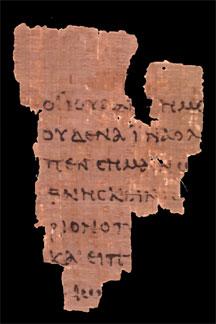
This is the oldest known fragment of the New Testament, so-called p52 (for Papyrus 52). It is dated by scholars to the early part of the second century A.D. It contains a portion of John 18:31-33, Pilate’s examination of Jesus. |
At first this sort of claim might seem exaggerated. But the more you think about it, the more you’ll realize just how much our language is in flux. Consider for a moment what you are doing right this moment. You’re staring at an LCD screen or some other monitor, reading a blog I have posted on my website by uploading it from my hard drive to the server of my Internetserviceprovider so it can be accessed on the World Wide Web. This last sentence makes sense to you today, but would it have done so five years ago? Ten? Fifteen?
 |
|
About ten years ago I had an experience that forever impressed upon me just how transitory our language can be. I was working with my 20-month old son on his animal sounds. You know the drill: “What does a cat say? Meow. What does a dog say? Bark. Etc.” I got to the question, “What does a mouse say?” Nathan answered quickly, “Click.” “Now c’mon,” I responded, “what does a mouse say?” “Click.” “Nathan, you know this one, what does a mouse say?” “Click, Daddy. Click!” In frustration Nathan cupped his little hand, turned it upside down, and pretended to push down on something on the table. “Click, click, click,” he said, “The mouse says click!” At that moment I realized that for Nathan the primary meaning of “mouse” wasn’t “furry little rodent” but “mechanical device that controls a computer.” He was right. A mouse did say “click.”
Of course these computer lingo examples aren’t immediately relevant to biblical translation, but they help to illustrate the point that translation shoots at a moving target. Consider, for example, the translation of the Greek adjective lampros in James 2:2-3. The King James Version renders it this way (with translations for lampros in italics):
For if there come unto your assembly a man with a gold ring, in goodly apparel, and there come in also a poor man in vile raiment; And ye have respect to him that weareth the gay clothing, and say unto him, Sit thou here in a good place; and say to the poor, Stand thou there, or sit here under my footstool.
Lampros in Greek means “bright” or “brilliant.” It can also have a negative connotation such as “opulent.” In James 2 it refers to the fancy garments worn by a rich man, in contrast to the shabby clothing worn by a poor man. The KJV’s translation in verse 3, “gay clothing” reflects a standard meaning of the “gay” in the 17th century: “brilliant” or “showy.”
(If, for fun, you want to see a real moving target, click here for a short video clip.) |
| |
 |
| |
 |
| |
 |
| |
Of course “gay” is doubly outdated today. By the end of the 19th century some English translators had abandoned “gay” in favor of “splendid” (Darby, 1890), “fine” (Douay-Rheims, 1899; ASV, 1901). Apparently the “brilliant/showy” sense of the term had become less familiar. It wasn’t until the latter part of the 20th century that “gay” picked up the sexual connotation it has today. So it comes as no surprise that the 21st Century King James Version has replaced “gay clothing” with “grand clothing.” (Curiously, however, this updated KJV continues to use the peculiar expression, “sit here under my footstool.”)
The example of “gay clothing” in James 2:3 could suggest merely that we need an updated English Bible translation every few centuries, not every few years, as is claimed by many translators today. “The linguistic target is moving,” one might argue, “but so slowly as to be almost imperceptible. We certainly don’t need a brand new version of the NIV only three decades after the first version was released.” But linguists would point out that language changes much more rapidly today than it once did, owing to a variety of factors, including mass communication, globalization, and the overall pace of social change. Zondervan, the publisher of the TNIV, makes this sort of claim in explaining why a new translation is needed: “English usage keeps changing – between 1993 and 2003, Merriam-Webster made 100,000 changes and added more than 10,000 words and phrases to its collegiate dictionary.” Thus Zondervan, along with its partners, the International Bible Society and the Committee on Bible Translation, saw fit to publish a thoroughgoing revision of the NIV.
Yet not everyone is convinced that English has changed so much as to warrant “today’s” NIV. Many would argue that “yesterday’s” NIV is just fine, that it continues to serve as an accurate translation of the Bible. And my sense is that this is in fact true for many people, though it may not be true for all. If folks are actively involved in a Christian community that uses the NIV, and if they have been using this translation for quite a while, then their own English usage will have been shaped by the NIV itself. Thus they may not need an updated translation at all. And they may be perplexed or even bugged by the claim that others do need such a translation.
Zondervan is positioning the TNIV as a translation made especially for younger generations (people under 35). The company’s publicity acknowledges that many readers will find the NIV to their liking. But they claim that others will not resonate with the NIV’s dated language:
While older forms of English may not present a problem for some readers, they can present barriers to understanding and fully engaging the Bible for today's generation because they've grown up using more contemporary English.
Not everybody agrees with this claim about “older forms of English” not working for “today’s generation.” I’ve already received a number of e-mails from people who think this notion of changing English is a lot of baloney (or bologna, if you prefer the King James Version of the word).
There’s no way I can begin to settle this matter here, nor do I have the sociological or linguistic knowledge that would allow me to make a convincing case one way or the other. But, in my ministry I interact with quite a few people under 35, including some valued staff colleagues in the younger generations. As I reflect on our conversations, I believe we are able to communicate fairly well in English, so the basics of the language haven’t changed.
Yet I have noticed that my younger colleagues use certain words in ways that differ from my usage. For example, they don’t say “Hi!” when they see me. They say “Hey!” They don’t mean any disrespect. For them, “Hey!” means “Hi!” (I was taught that calling out “Hey” to an adult was impolite.) Or, to take another example, when something is pleasant or positive, I tend to say that its “cool” – a happy remnant of my growing up in the 60’s and 70’s. But my younger staff members don’t use the adjective “cool” as I do. Instead, they say that something is “sweet” or that it “rocks.” These are relatively inane examples of linguistic variation, ones that probably won’t find their way into translations of the Bible. But they do suggest to me that Zondervan’s claim about “older English” isn’t completely crazy, though whether a new translation will be sweet or not remains to be seen.
The crux of the TNIV controversy has to do not with general changes in English, but with purported changes in the way the English language of today refers to gender. The TNIV translates biblical gender terms in a strikingly different way from the NIV: “men” have become “people” and “brothers” are now “brothers and sisters.” And this change, more than anything else, is what has the TNIV critics so stirred up. I’m not going to get into this issue now, but it looms on the near horizon.
Essentials in Bible Translation: What Kind of Equivalence?
Part 7 of the series “Is the TNIV Good News?”
Posted at 11:45 p.m. on Monday, February 21, 2005
Growing up in the Sunday School of the First Presbyterian Church of Hollywood, the King James Version reigned supreme. I read it. Studied it. Memorized it. And, when I had memorized enough verses in third grade, I received a leather-bound Bible in a special ceremony with the Senior Pastor, Raymond I. Lindquist. The translation that was given to me? None other than the King James.
But when I entered the Junior High Department in the summer of 1969, I was introduced to the exciting, scandalous Good News for Modern Man. This new translation (the New Testament was published in 1966) sounded different from any Bible I had ever read before. It made sense in a way the King James never had. Plus there were rather funky line drawing pictures throughout the Bible to keep my interest. We referred to the Good News as a “paraphrase” to distinguish it from the “literal” King James or Revised Standard “translations.”
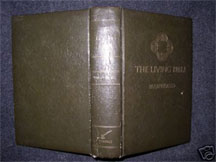
But then, not long after I started using the Good News Bible, a competitor emerged on the scene. The Living Bible: Paraphrased was first published in 1971, though portions had been released in the 60’s. This Bible, which contained the word “Paraphrased” on the cover, made the Good News Translation seem stiff and dated. The Living Bible spoke, not only in the language of “modern man,” but also in a colloquial version of that language. So in high school I switched from the Good News to The Living Bible.
In my senior year I made a fateful decision: to get serious about Bible reading. So I took out my trusty Living Bible and read through Romans from start to finish. Time and again, however, I was distressed by what I was reading. It just seemed to me, well, wrong somehow. So I confessed my uneasiness with Bible reading to my uncle, who was a wise pastor. He went out and bought me an RSV study Bible, explaining that my theological problems weren’t actually with what Paul had said, but with the inexact paraphrase found in The Living Bible. As I read Romans in the RSV, I discovered that my uncle was right. The verses from The Living Bible that had offended me sounded very different in the RSV. So I put aside the paraphrase and returned to what I called a more “literal” translation, something I could count on to convey the true meaning of the original languages of the Bible.
|
|
|
Today I went with my children to see the film Because of Winn-Dixie. This movie has been promoted as a “kid film,” so I went with relatively low expectations. I figured I’d see lots of overdone slapstick and saccharine melodrama. Well, I must say that I was pleasantly surprised. Only a couple of scenes were too silly or syrupy. For the most part, however, I was entranced by a moving story of a young girl and her “preacher” father, and the impact on their lives made by a dog named Winn-Dixie. Far beyond my expectations, I was touched by a film that invites us to deal with our losses in a healthy way, in the context of genuine community. And I was pleased to see a film in which Christian faith, though not the focus of the movie, nevertheless was portrayed in a relatively positive light. This is one “kid film” that I could recommend to almost anyone. I would add a note to parents of younger children: This movie is rated PG for good reason. Though almost completely free of bad language and completely clean on the sex front, some of the themes are quite heavy (a mother who left her husband and daughter, the impact of alcoholism, grief). I don’t think I’d take a child under six years old. Parents should be prepared to discuss the themes with their children. For more information, check the Screen It! in depth review of potentially objectionable material. |
In graduate school I learned that my way of describing Bible versions as “literal” or “paraphrased” was no longer standard among scholars. Drawing from the seminal work of Eugene Nida (see the fascinating interview of Nida in Christianity Today), scholars and translators talked about “formal equivalence” and “dynamic or functional equivalence” where I would have talked of “literal translation” and “paraphrase.”
Formal equivalence strives to make translations in which the forms of the source language (the ancient language) and closely reproduced in the receptor or target language (the modern language, English, for us). Sometimes formal equivalence is called word-for-word translation, because it tends to preserve the meaning and forms of basic words, rather than conveying the overall thought of larger phrases. Nevertheless, the meaning of individual words is often revealed by the context, which formal equivalence must take into account. For example, the Hebrew word ruach means both “wind” and “spirit.” Only context will tell which rendering is the right one.
Dynamic equivalence, or as it is often called, functional equivalence, seeks to render the meaning of words and phrases from the source language into the target language, but with greater freedom not to reproduce the precise forms of the source language. Whereas formal equivalence is described as word-for-word translation, dynamic equivalence is thought-for-thought translation. Though freer in some ways that formal equivalence, dynamic equivalence still tries to convey the thought of the source language with a high degree of accuracy. Bible paraphrases, such as Eugene Peterson’s The Message, operate within the broad category of dynamic equivalence, but demonstrate a great deal of freedom (and colloquialism) in their thought-for-thought renderings.
Most current translations employ a combination of formal equivalence and dynamic equivalence. The following chart provides my own estimation of how translations I have mentioned in this series line up on the scale from formal to dynamic equivalence.
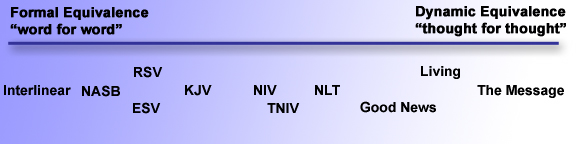
All of this theoretical discussion deserves an example, which I’ll supply tomorrow. Stay tuned . . . .
Essentials in Bible Translation: An Example of Equivalence
Part 8 of the series “Is the TNIV Good News?”
Posted at 11:55 p.m. on Tuesday, February 22, 2005
So far I’ve summarized five basic essentials of Bible translations, essentials that will help us when we come to evaluate the TNIV controversy. Those essentials are:
1. No translation is perfect.
2. There is not a one-to-one correspondence of meaning between languages.
3. Translation is more of an art than a science.
4. Biblical scholarship is continually changing our understanding of what the original words actually meant.
5. Translation from an ancient language into a modern language is trying to hit a moving target.
In my last post I began to lay out my sixth and final essential, which could be stated in this way:
6. Some translators emphasize word-for-word translation (formal equivalence) while others stress thought-for-thought translation (dynamic/functional equivalence). These different approaches will often yield different results.
I briefly explained the theory behind point six in my last post. Now I want to provide an example so you can see the different theories in practice.
| Let’s examine one uncontroversial verse in Matthew, a description of Jesus’s eating with “tax collectors and sinners” in Matthew’s house (1). I want especially to focus on the translation of the phrase that is used to describe Jesus’s assuming a posture for eating dinner. That phrase reads very literally in Greek, “he was reclining in the house.” The verb “to recline” had a clear, specific meaning in Greek, however. To recline wasn’t merely to lie down, as for a nap. It meant to lie back around a low table in order to eat a meal. So in using the phrase “he was reclining in the house” Matthew meant something like this, in my amplified version, “Jesus assumed the posture for eating dinner while in the house of Matthew.” Of course we’d say something like, “Jesus sat down at the table in Matthew’s house to eat.” |
|
| |
This fresco from ancient Pompeii pictures three couples reclining together in order to eat a meal.
|
The chart below begins with the Greek text (transliterated). Next you’ll find an interlinear “translation” along with my literal word-for-word translation (strict formal equivalence). Then I give a variety of translations to illustrate different ways translators have rendered the expression “he was reclining in the house.”
Different Versions of Matthew 9:10
Kai egeneto autou anakeimenou en te oikia, kai idou polloi telonai kai hamartoloi elthontes sunanekeinto to Iesou kai tois mathetais autou. (Greek transliterated)
And it happened of him reclining in the house, and indeed many tax collectors and sinners coming they were reclining with Jesus and the disciples of him. (interlinear)
And it happened as he was reclining in the house, indeed many tax collectors and sinners were coming to recline with Jesus and his disciples. (my word-for-word translation)
And it came to pass, as Jesus sat at meat in the house, behold, many publicans and sinners came and sat down with him and his disciples. (KJV)
And as he sat at table in the house, behold, many tax collectors and sinners came and sat down with Jesus and his disciples. (RSV)
And as he sat at dinner in the house, many tax collectors and sinners came and were sitting with him and his disciples. (NRSV)
And as Jesus [b] reclined at table in the house, behold, many tax collectors and sinners came and were reclining with Jesus and his disciples. [b] Greek he (ESV)
Then it happened that as Jesus was reclining at the table in the house, behold, many tax collectors and sinners came and were dining with Jesus and His disciples. (NASB)
While He was reclining at the table in the house, many tax collectors and sinners came as guests to eat [e] with Jesus and His disciples. Holman Christian Standard Bible. [e] Lit came, they were reclining (at the table); at important meals the custom was to recline on a mat at a low table and lean on the left elbow. (HCSB, Holman Christian Standard Bible)
That night Matthew invited Jesus and his disciples to be his dinner guests, along with his fellow tax collectors and many other notorious sinners. (NLT)
Later when Jesus was eating supper at Matthew’s house with his close followers, a lot of disreputable characters came and joined them. (The Message)
While Jesus was having dinner at Matthew’s house, many tax collectors and “sinners” came and ate with him and his disciples. (NIV)
While Jesus was having dinner at Matthew’s house, many tax collectors and sinners came and ate with him and his disciples. (TNIV) |
It’s fascinating to compare and contrast the various options here. You can easily see differences between the more formal translations (ESV, NASB, HCSB) and the more dynamic (NLT, The Message), with others falling somewhere in between. Note, however, that even the most “literal” translations supply more information than was in the original Greek. The ESV, NASB, and HCSB all have Jesus reclining “at the table,” even though the Greek word trapeza (table) doesn’t appear.
No translation, interestingly enough, sticks with an exclusively formal, word-for-word approach. Each mostly word-for-word translation of Matthew 9:10 (ESV, NASB, HCSB) in fact diverges from a purely formally equivalent approach in three different ways (not the same three in each case; see Note 2). Why? Because though formal equivalence preserves the word meanings and forms of the original, it cannot render these in the most natural and intelligible English. Thus formal equivalence translators consistently abandon a strict word-for-word approach in order to make their translations intelligible and readable.
I am not criticizing these translators for choosing to change from a literal Greek translation of a word to something more meaningful in English, or for choosing to add English words that are not based on some Greek word, or for choosing not to translate some Greek words into English. On the contrary, I would argue that such choices actually make for better and more accurate translation. It would be unfair and incorrect if anyone were to accuse these translations of changing or subtracting or adding to God’s own words as if they had done something wrong. Accurate translation of New Testament Greek into English will necessarily involve changing Greek words into English, subtracting from translation those Greek words that don’t need to be translated, and adding English words when necessary to convey the true meaning of the Greek.
Which of the translations in the chart above is the most accurate? One might be tempted to point to one of the three formal equivalence translations that preserve the verb “recline.” And since only the ESV uses “recline” in both instances where the Greek verb (sun)anakeimai is used, this translation wins the prize for the most literal, word-for-word translation of Matthew 9:10.
But is the ESV therefore the most accurate? Let me put this question a little differently: Would the ordinary English speaker who reads “Jesus reclined at table” really get the sense of Matthew’s Greek? This is possible, I believe, only if the reader is familiar with biblical languages or the customs of first-century Palestine, in which a person did not sit at a table for a formal meal, but reclined on an elbow at a low table. But even if a person had this knowledge and could figure out what “reclined at table” means, nevertheless the English expression “reclined at table” is not standard English. The dynamic translations that speak of Jesus “sitting down to eat” or simply “having dinner” get closer to the real meaning and “feel” of Matthew’s Greek, even though they don’t use the word “recline.”
Formal equivalence is more literal in that it sticks very close to the vocabulary and grammar of the source language. But it does not necessarily come up with a more accurate translation into English. A good English translation needs, not only to capture to meaning of the original, but also to express that meaning in reasonably ordinary and intelligible English. Stilted, “biblicized” English may reflect the words and forms of the underlying ancient language, but it doesn’t necessarily convey the meaning of this language in contemporary English.
Yet the problem with dynamic equivalence is that it tends to allow for imprecision and looseness in translation. The NLT version of Matthew 9:10 reads: "That night Matthew invited Jesus and his disciples to be his dinner guests, along with his fellow tax collectors and many other notorious sinners." It's highly likely, of course, that Matthew invited Jesus and his entourage to dinner, but the Greek doesn't actually tell us this. On at least one other occasion in the gospels (Luke 19:5), Jesus invited himself to dinner! So the NLT gives us more information than we really have in the Greek. It's dynamism, if you will, is overly creative, even though it might well tell us what really happened.
The NLT also gives us more information than the Greek supplies by calling the sinners in Matthew 9:10 "notorious sinners." This is probably a good rendering of the Matthew's tone, however, as is the The Message's "disreputable characters." I find it interesting, however, that every other translation uses "sinners", except the NIV, which puts "sinners" in quotation marks (not there in the original). The TNIV, oddly enough, removes the quotation marks, but otherwise reproduces the NIV translation verbatim. So in this case the TNIV is more literal than the NIV. Go figure!
If strict formal equivalence binds the translator too rigidly to the original language, dynamic equivalence can allow for too much variation and inexact paraphrase. With a formal equivalence translation you can be fairly confident that what you’re reading closely parallels the original language, even if it doesn’t make much sense in contemporary English. With a dynamic equivalence translation you can’t be sure whether you’re getting the genuine sense of the original or simply the translator’s SCV (Subjective Creative Version). For these reasons almost every contemporary translation (including the ESV, HCSB, NIV, TNIV) uses a mix of formal and dynamic approaches, with some more formal and others more dynamic.
Finally I've come to the end of my presentation of six essentials in Bible translation. What I've laid out here will help us to evaluate the arguments for and against the TNIV translation, which I will begin to do in my next post. If you're interested in technical translation issues, let me recommend an excellent website that has collected a wide variety of resources. It's called, simply, Bible Translation. This website, by the way, fairly represents both sides of the TNIV debate.
My next post will begin to explore the reaons why many evangelical leaders are unhappy with the TNIV.
What’s Wrong With the TNIV?
Part 9 of the series “Is the TNIV Good News?”
Posted at 11:15 p.m. on Wednesday, February 23, 2005
In case you’re just tuning in to this series, I’ll briefly summarize what I’ve said so far. In Post 1 I began by noting the release of the full Bible in the new TNIV translation, a thorough updating of the NIV. But, even though this Bible comes with strong endorsements from Christian leaders and organizations, it has been opposed by a large group of respected evangelical leaders. So I proposed to ravel the tangle of arguments in this controversy so you can understand the issues and make informed decisions about which Bible to use.
In Post 2 I laid out my own background and bias as I approach this conversation, which led into an extended look at six essentials of biblical translation. For a summary of these essentials, see Post 8. I interrupted this survey of essentials with a pastoral plea for all parties to engage this controversy in a way that is consistent with biblical teaching on how Christians should teach one another. Some of the rhetoric concerning the TNIV has seemed to me inconsistent with the call to be kind, tenderhearted, and forgiving. Not only does this exaggerated and incendiary rhetoric contradict Scriptural teaching, but it also keeps us from actually having the sort of serious conversation about translation that we really need. I have been very encouraged, however, by some of the e-mails I have received from people, including Christian leaders who are influential in the whole TNIV debate. My hope is that sanity and charity will soon characterize the crucial discussion of how best to translate God’s Word in today’s world.
Now I am ready to lay out the concerns of the TNIV critics. I am thankful that the leading critics have put these in a succinct statement entitled “Statement of Concern about the TNIV Bible.” This statement and many other materials critical of the TNIV are available online at the TNIV Response Center.
When I was at first explaining the release of the TNIV, I intentionally quoted the language of Zondervan’s publicity. Similarly, in this post I’ll mostly quote what the TNIV critics have said themselves. This way I can be sure to represent their concern accurately. Though I won’t editorialize too much, I should say at the outset that I appreciate the directness and succinctness of the “Statement of Concern.” It really helps to identify the core issues. Also, I commend the writers of this statement for what it does not do and say. It does not use hyperbolic language to stir up opposition. And it does not criticize the motives or integrity of the TNIV translators. Thus this statement advances the discussion rather than retarding it.
Excerpts from the “Statement of Concern About the TNIV Bible”
Recently, the International Bible Society (IBS) and Zondervan Publishing announced their joint decision to publish a new translation of the Bible, known as Today's New International Version (TNIV). The TNIV makes significant changes in the gender language that is in the NIV. The TNIV raises more concern in this regard than previous Bible versions because, riding on the reputation of the NIV, the TNIV may vie for a place as the church's commonly accepted Bible. We believe that any commonly accepted Bible of the church should be more faithful to the language of the original.
We acknowledge that Bible scholars sometimes disagree about translation methods and about which English words best translate the original languages. We also agree that it is appropriate to use gender-neutral expressions where the original language does not include any male or female meaning. However, we believe the TNIV has gone beyond acceptable translation standards in several important respects:
• The TNIV translation often changes masculine, third person, singular pronouns (he, his and him) to plural gender-neutral pronouns. . . .
• The TNIV translation obscures many biblical references to "father," "son," "brother," and "man." . . .
• The TNIV translation inserts English words into the text whose meaning does not appear in the original languages. . . .
Thus, in hundreds of verses, the TNIV changes language with masculine meaning in the original Greek to something more generic. It does this in many ways, such as changing
• "father" (singular) to "parents";
• "son" (singular) to "child" or "children";
• "brother" (singular) to "someone" or "brother or sister," and "brothers" (plural) to "believers";
• "man" (singular, when referring to the human race) to "mere mortals" or "those" or "people";
• "men" (plural, when referring to male persons) to "people" or "believers" or "friends" or "humans";
• "he/him/his" to "they/them/their" or "you/your" or "we/us/our"; and
• switching hundreds of whole sentences from singular to plural.
We wonder how the TNIV translators can be sure that this masculine language in God's very words does not carry meaning that God wants us to see.
Gender problems are not the only serious problems with the TNIV. . . .
Because of these and other misgivings, we cannot endorse the TNIV as sufficiently trustworthy to commend to the church. We do not believe it is a translation suitable for use as a normal preaching and teaching text of the church or for a common memorizing, study, and reading Bible of the Christian community.
[List of signatories] |
Note: For the most part, what I did not include in these excerpts were the specific examples used in the statement. For these you should check the full statement online.
The “Statement of Concern” was signed by more than 100 evangelical leaders, including people for whom I have great respect: Darryl DalHousaye, James Dobson, Jack Hayford, Al Mohler, Marvin Olasky, Ray Ortlund Jr., J.I. Packer, and John Piper, among others. Some of these people I know personally, others only from a distance. I trust both their judgment and their intentions, so I take their “Statement of Concern” very seriously.
The “Statement of Concern” does answer one of the questions frequently posed by TNIV supporters and neutral onlookers: Why has the TNIV stirred up such opposition, when other recent translations, such as the NLT, have made very similar choices with regard to the use of inclusive gender language? (In fact, at least one signer of the “Statement” actually contributed to the NLT.) The answer given by the “Statement” for singling out the TNIV is that the TNIV could become “the church’s commonly accepted Bible.” It’s okay for supplementary translations (my words) to use inclusive language, but the primary teaching/preaching/studying/memorizing Bible of the church “should be more faithful to the language of the original.” |
|
|
|
|
|
Among those who do not support the TNIV are (clockwise from the top left): James Dobson, Jack Hayford, John Piper, and J. I. Packer. These are outstanding leaders and godly men. |
So, there you have it. The main objection has to do with the TNIV’s “gender language.” This translation turns the Greek “he” into “they” or “you” in English. It renders “brothers” in Greek as “brothers and sisters” in English. And so forth and so on. Thereby, it is claimed, the TNIV obscures the original language rather than rendering it accurately into contemporary English.
In the days to come I’ll examine these objections to the TNIV more closely, using specific examples. I’ll also look at some of the broader concerns about inclusive language translation that have been raised by critics of the TNIV.
What’s Wrong With the TNIV? Changing "Him" to "Them" (Section A)
Part 10 of the series “Is the TNIV Good News?”
Posted at 11:55 p.m. on Thursday, February 24, 2005
In my last post I quoted substantial sections of the “Statement of Concern” signed by over a hundred critics of the TNIV. At its core, the stated problem with the TNIV is this: “The TNIV makes significant changes in the gender language that is in the NIV. . . .We believe that any commonly accepted Bible of the church should be more faithful to the language of the original.” From here on it’s my purpose to analyze as fairly as I can the arguments for and against the TNIV.
Where I start in this analysis is significant, since my starting point will tend to point the whole conversation in one direction or another. If, for example, I start with the main criticisms of the TNIV – perhaps the translation’s greatest weaknesses – then I risk creating a primary impression that the TNIV is severely flawed. If, on the other hand, I begin by surveying the many advantages of the TNIV – quite a few of which are acknowledged even by its critics – then it will seem as if the translation is basically solid, an improvement over the NIV. The criticisms will, in light of the positive starting point, seem far less significant in the overall picture. So I’ve been puzzling over what my next step should be, and how I can move this conversation along in a fair and helpful way.
| I’ve decided to begin with the main criticisms of the TNIV. I’m doing this not because I want to stack the deck against this translation, but because this seems to be the best way to get into the core issues of the disagreement. So, yes, I’m not going to catalog the non-controversial benefits of the TNIV. You can find most of these at the TNIV-Info website. (By the way, I’m sending you to the older, non-Flash website. It seems to have most of the important information. There is a newer TNIV website that uses Flash technology. If you have lots of time on your hands and a broadband connection, go ahead and enjoy this site. I imagine that it will have appeal to younger generations. But I’m not in these generations and I find such technological tomfoolery to be frustratingly slow and hard to read. I apologize for this idiosyncratic and basically irrelevant gripe, but I feel better with this off my chest!) |
|
| |
The homepage of the new TNIV website. Looks great. Sounds great. But is rather a pain to use. Of course I'm not in the target market either. But the small print in this website almost guarantees that the TNIV will be sold only to younger people who still have reasonably good vision. |
Criticism #1 in the Statement of Concern: “The TNIV translation often changes masculine, third person, singular pronouns (he, his and him) to plural gender-neutral pronouns.”
 |
The Statement of Concern follows this initial salvo with a specific example. Again I quote:
For example, in Revelation 3:20, the words of Jesus have been changed from "I will come in and eat with him, and he with me" to "I will come in and eat with them, and they with me." Jesus could have used plural pronouns when He spoke these words, but He chose not to. (The original Greek pronouns are singular.) In hundreds of such changes, the TNIV obscures any possible significance the inspired singular may have, such as individual responsibility or an individual relationship with Christ.
The summary criticism here is quite strong. “In hundreds of such changes, the TNIV obscures any possible significance the inspired singular may have, such as individual responsibility or an individual relationship with Christ.” This sounds awfully bad, doesn’t it? If it’s really true that in hundreds of places the TNIV actually conceals the importance of individual accountability and even one’s individual relationship with Christ, then this is a telling criticism. |
Here is a classic painting by the American Warner Sallman: "Christ at Heart's Door." Inspired by Revelation 3:20, this painting creates the image of a heart with the light around Jesus. I loved this painting when I was young. Click here for more info on this painting. |
|
I don’t have the time to survey hundreds of examples and you don’t have the time to read such a survey, so instead I’ll focus on the example provided in the Statement of Concern itself. Presumably this is both a good representation of the problem and, given the point of the Statement, one of the examples that shows most strongly the weakness of the TNIV.
I’ll provide the text of Revelation 3:20 in several different versions (transliterated Greek, interlinear, KJV, NIV, TNIV, ESV, NLT, HCSB, and NET). I am including the last four versions because they show how other recent translations have treated the passage in question.
Versions of Revelation 3:20
Idou hesteka epi ten thuran kai krouo; ean tis akouse tes phones mou kai anoixe ten thuran, [kai] eiseleusomai pros auton kai deipneso met’ autou kai autos met’ emou. (Greek transliteration)
Look! I stand at the door and knock; if anyone hears my voice and opens the door, I will come in to him and eat with him and he with me. (my interlinear version)
Behold, I stand at the door, and knock: if any man hear my voice, and open the door, I will come in to him, and will sup with him, and he with me. (KJV)
Here I am! I stand at the door and knock. If anyone hears my voice and opens the door, I will come in and eat with him, and he with me. (NIV)
Here I am! I stand at the door and knock. If anyone hears my voice and opens the door, I will come in and eat with them, and they with me. (TNIV)
Behold, I stand at the door and knock. If anyone hears my voice and opens the door, I will come in to him and eat with him, and he with me. (ESV)
Look! Here I stand at the door and knock. If you hear me calling and open the door, I will come in, and we will share a meal as friends. (NLT)
Listen! I stand at the door and knock. If anyone hears My voice and opens the door, I will come in to him and have dinner with him, and he with Me. (HCSB)
Listen! [66] I am standing at the door and knocking! If anyone hears my voice and opens the door I will come into his home [67] and share a meal with him, and he with me. [66] Grk “Behold”; [67] Grk “come in to him” (NET) |
With this data in hand, let’s take the charge of the Statement of Concern line by line. It begins: “For example, in Revelation 3:20, the words of Jesus have been changed from “I will come in and eat with him, and he with me” to “I will come in and eat with them, and they with me.” This statement, though potentially true, could easily be misinterpreted. It’s true that the words of Jesus as translated into English in the NIV have been changed in the TNIV (“him” to “them” and “he” to “they”). But the wording of the Statement could be understood to mean “the words of Jesus as they were said by Jesus himself have been changed from ‘I will come in and eat with him, and he with me’ to ‘I will come in and eat with them, and they with me.’” Of course this is not true, because what Jesus really said wasn’t “I will come in and eat with him, and he with me” but in fact, “eiseleusomai pros auton kai deipneso met’ autou kai autos met’ emou.”
Now I know this might seem like I’m quibbling. But the point is important. I’ve spent a lot of time in the last couple of weeks reading criticisms of the TNIV. In many places those critiques talk as if the TNIV translators have been changing the actual words of the Bible. But this sort of talk is itself quite inaccurate. No TNIV translator has actually changed one word of the Hebrew, Aramaic, or Greek text of Scripture (apart from a few minor textual changes). For example, nobody has doctored the Greek original of Jesus’s words in Revelation 3:20, or anywhere else for that matter. Everybody agrees on what the words of Jesus in Revelation 3:20 really are. The issue is not the real words, but the best way to translate them into English.
What the TNIV translators have done is to make a different translation into English from the NIV (and others). In the process they have quite clearly and openly translated singular third person pronouns as plural third person pronouns (“he” to “they,” “him” to “them”, etc.). They have done so because they believe that these translations render the original language more accurately into contemporary English. They may of course be wrong in this belief, and it’s absolutely appropriate for critics to challenge these beliefs. But I would contend that talking about “changing the words of Jesus” runs a great risk of obscuring what’s really going on. It sounds like the TNIV translators have, willy-nilly, altered the very Greek text of Revelation 3:20. And this is exactly the sort of rhetoric that can get people who don’t understand the issues pretty riled up. Imagine the publishers and translators of the beloved NIV actually changing the very words of Jesus! How scandalous! (Sigh!)
So, though I agree that the TNIV differs from the NIV in translating auton as “them” rather than “him” and so forth, and though I agree that the TNIV translates singular Greek pronouns as plural English pronouns, I don’t think it’s either clear or fair to say that the TNIV changes the words of Jesus. I would hope that future versions of the Statement of Concern might be more carefully worded for the sake of accuracy, not to mention fairness. As I’ve said before, the issues in this debate are extremely important. Our discussion needs to be both exceptionally clear and exceptionally Christ-like if it’s going to be helpful to the church, and eventually to the world.
Of course it could also be said that every translation of the Bible into English changes the actual words of Jesus into different words: Greek words into English words. Every responsible translation is an effort to render the sense of the Greek original in good English, and this necessarily involves changing every single word. The real issue in Revelation 3:20, and in hundreds of similar passages, is not the changing of words, but whether translating Greek singular pronouns into English plural pronouns makes the sense of the original more or less clear in English. To this question I’ll turn in my next post in this series.
To continue reading, go to Volume 2.
|