| |
A Resource by Mark D. Roberts |
|
Advent. Advent Meaning. the Meaning of Advent. Advent Practices. Observing Advent. Advent Celebrations. Adventophile. Advent F.A.Q.
Advent and the Christian Year
by Rev. Dr. Mark D. Roberts
Copyright © 2008 by Mark D. Roberts
Note: You may download this resource at no cost, for personal use or for use in a Christian ministry, as long as you are not publishing it for sale. All I ask is that you give credit where credit is due. For all other uses, please contact me at mark@markdroberts.com . Thank you.
Posts for 2007
My Greatest Advent Discovery Revisited and Retooled 
Part 1 of Advent and the Christian Year (2007) 
Posted for Monday, December 3, 2007
On Saturday evening I attended a Christmas parade in my new hometown of Boerne, Texas. Actually, it was a Weihnachts Parade. The German word for Christmas is Weihnachten (literally, "holy nights"). Boerne, which is pronounced like "journey," (in German, Börne, named after the 19th-century German writer, Ludwig Börne) has strong German roots, which are celebrated at Christmas and other times of the year. (The Boerne Village Band, a German, oompah-type band, was founded in 1860 and continues to this day, playing all over Texas.)
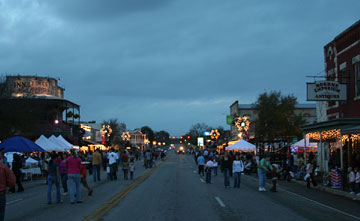 The parade was well attended, not only by residents of Boerne, but also by folks from throughout the area. Thus the crowds were ample. When I stopped in a local mini-mart to pick up a drink, the line must have been twenty people long, and was moving rather slowly. As I waited in that line, feeling anxious for fear I'd miss the start of the parade, I was reminded of one of my all-time favorite blog posts: "My Greatest Advent Discovery." It's time to roll out that post again, since we've just entered the season of Advent. (Photo: A few minutes betore the parade begins) The parade was well attended, not only by residents of Boerne, but also by folks from throughout the area. Thus the crowds were ample. When I stopped in a local mini-mart to pick up a drink, the line must have been twenty people long, and was moving rather slowly. As I waited in that line, feeling anxious for fear I'd miss the start of the parade, I was reminded of one of my all-time favorite blog posts: "My Greatest Advent Discovery." It's time to roll out that post again, since we've just entered the season of Advent. (Photo: A few minutes betore the parade begins)
I have a confession to make: I am terrible at waiting. This makes me an especially lousy Christmas shopper, because, almost by definition, Christmas shopping requires waiting in line. Whether you're at a fine department store or just grabbing some chips from the local mini-mart, chances are you'll be waiting in line during the month of December. And, if you're like me, inevitably you'll end up right behind somebody who needs a price check on aisle 3 or who requires some sort of special assistance. This sort of thing can just about ruin the Christmas season for me, because waiting makes me grumpy.
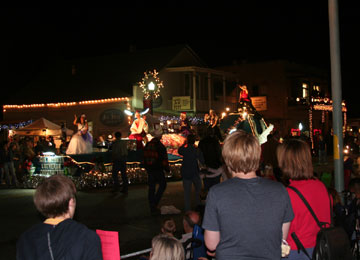 A few years ago I was waiting in a long line at Costco. In spite of my best efforts to find the shortest line, of course I ended up in the slowest moving line of all. As I stood there, I could feel my blood pressure rising. The more I waited, the more frustrated I became. Words I never say (well, almost never) filled my mind, and I'm not referring to "Happy Holidays." "Why do I always get in the slowest line?" I asked myself. "And why is this taking so long?" I grumbled under my breath. (Photo: my son and my wife enjoying a parade float) A few years ago I was waiting in a long line at Costco. In spite of my best efforts to find the shortest line, of course I ended up in the slowest moving line of all. As I stood there, I could feel my blood pressure rising. The more I waited, the more frustrated I became. Words I never say (well, almost never) filled my mind, and I'm not referring to "Happy Holidays." "Why do I always get in the slowest line?" I asked myself. "And why is this taking so long?" I grumbled under my breath. (Photo: my son and my wife enjoying a parade float)
Then, all of a sudden, it dawned on me. I had one of those moments of grace, in which God managed to slip a word into my consciousness. As I stood in line at Costco, I was waiting. Waiting! I was doing exactly what Advent is all about. Of course I wasn't waiting for God to save me or anything momentous like that. I was simply waiting to get out of that store so I could go home. But, nevertheless, I was waiting. I was forced to experience something that's at the very heart of Advent.
So I decided, right then and there in the line at Costco, that I was going to use the experience of waiting in line as an Advent reminder. In that moment, and in similar moments yet to come, I was going to remember what Advent is all about. I was going to put myself back into the shoes of the Jews who were waiting for the Messiah. And I was going to remember that I too am waiting for Christ to return.
As I decided to let the experience of forced waiting be a moment of Advent reflection rather than a cause for getting an ulcer, I found my anger quickly drain away. Waiting in line at Costco became, not a trial to be endured, but a moment of grace. And get this: I even found myself thanking God for the chance to slow down a bit and wait. This was, indeed, a miracle.
By the time I got to check out, my heart was peaceful, even joyous. I felt as if I had discovered a treasure. The next Sunday I shared my discovery with my congregation at Irvine Presbyterian Church. In the days that followed, many of my flock told me how much their Advent had been improved by thinking of waiting in line, not as a curse, but as a potential blessing.
Honestly, I can still forget my commitment to use waiting in line as a time for Advent reflection. My gut instinct can take over. I can easily start grinding my teeth as I think of how much time I'm losing. But then a gentle breeze from the Spirit will remind me of how waiting can enrich my life, rather than rob me of joy.
In the last few years, what I hate most about the days prior to Christmas – waiting in line – has become a quasi-sacrament, a time to experience God’s grace. If you’ve never tried this, it may sound to you as if I’ve lost my mind. This sounds even sillier than wearing purple in the weeks before Christmas rather than red and green. But let me encourage you to try it. By experiencing waiting in line not as a punishment but as a opportunity to wait peacefully, you'll find a bit of grace, hidden and ready to be discovered, much like a little picture behind one of those doors of an Advent calendar.
Posts for 2006
Why I Am an Adventophile
Part 1 of Advent and the Christian Year (2006)
Posted for Monday, December 11, 2006
I am an avowed Adventophile. I may be the only person in the world who claims this title, at least in the way I mean it. (I found one use of "adventophile" through a Google search, but this referred to a lover of Advent stereo speakers.) I'm an Adventophile in that I'm a lover of Advent.
If you've been reading my blog for the last couple of years, this comes as no surprise. But if you're one of my newer readers, you may be perplexed. Why would somebody love Advent? And, for that matter, what really is Advent, anyway?
I was not raised to be an Adventophile. In fact, the word "Advent" had a relatively narrow meaning for me. It was used only to describe the special paper calendars we used each year in the month of December. With their glittery winter scenes, they helped me and my siblings whet our appetites for the coming of Christmas. But there wasn't anything terribly meaningful about opening up little paper windows in order to see little drawings of bells, candy canes, and reindeer. It was fun. That's all.
In my church growing up, I heard the word "Advent" rarely, mostly to describe the wreath we used in the weeks before Christmas to focus our thoughts on the coming (Latin adventus, from which we get Advent) of Christ. Yet otherwise the Sundays prior to Christmas seemed more Christmasy than Adventish, with red and green decorations and lots of Christmas carols. |
|
| |
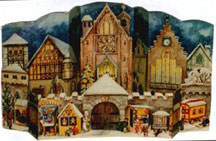
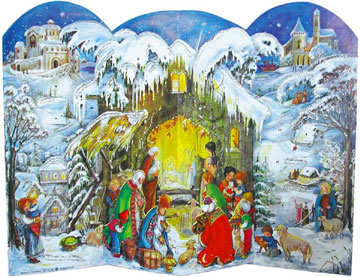
An Advent calendar like those I used as a child
|
When I arrived at Irvine Presbyterian Church in 1991, Loren Wiebe, my worship director, explained his idea of Advent, including the conviction that we really shouldn't sing any Christmas carols prior to Christmas Eve. Loren had tried out this idea on the congregation a couple of years before I arrived, but hadn't had much success. Most people resented not being able to sing carols during Advent. Though I ended up somewhere in between Loren and the congregation on the carol-singing question, I did appreciate Loren's understanding that Advent was a special season of waiting and watching, a time to prepare our hearts to celebrate the coming of Christ at Christmas.
Loren helped me begin to discover a whole new dimension of worship and faith that I had missed in my first 33 years of life. Of course Loren didn't make this up. He was drawing upon centuries and centuries of Christian experience. In fact, setting aside a time of year to prepare for celebrating the coming of Christ is something Christians have been doing in one way or another for about 1500 years.
During the last fifteen years I've grown from someone with a modest awareness of Advent to become what I'm calling an Adventophile, a lover of Advent. Why? There are many reasons. But perhaps the most important one has do to with how Advent has enriched my relationship with God during the weeks prior to Christmas.
Like most other Christians who enjoy the secular aspects of Christmas (presents, parties, decorations, etc.), I've struggled to focus on "the reason for the season." To be sure, I go to church on Christmas Eve (four times, actually, five this year). And my family and I include special Christmas prayers in our cultural celebrations. But, still, the days prior to Christmas are filled with all sorts of pleasures that don't make it easy for me to focus on what Christmas is really all about.
That's where Advent comes in. By recognizing Advent, by focusing on its themes, by using its distinctive colors, I've injected a hearty dose of genuine spirituality into my Christmas spirit. Advent has given me a way to enrich my celebration of Christmas and, even more importantly, my relationship with God.
So I'm now a lover of Advent because it means so much to me. I've also seen how Advent can enrich the lives of others, especially those in my church. So I've become a bit of an Advent evangelist, one who has taken on the responsibility of telling others the good news about Advent.
If all of this is relatively new to you, tomorrow I'll lay out a few basics about Advent, its meaning and practices. In the meanwhile, if you'd like to begin to explore the significance of Advent, let me point you to a couple of my recent posts (December 3; December 10). Be sure to use the virtual Advent wreath that goes with these posts! Also, you can use my online Advent calendar (homepage: above) to focus your prayers in an Advent direction.
Advent F.A.Q.
Part 2 of series: Advent and the Christian Year (2006)
Posted for Tuesday, December 12, 2005
If you're relatively unfamiliar with Advent, or if you'd like a brief refresher, here are some answers to Frequently Asked Questions. (Note: This is an edited and updated version of a blog post I have put up in previous years.)
What is Advent?
Advent is a season of the Christian year when we focus on the coming of Christ. It's a time of waiting, hoping, and getting in touch with our need for a Savior. It's a season of preparation for Christmas, much as Lent is a season of preparation for Easter. In some Christian churches, Advent is a time of fasting and repentance.
In Advent we look back to the experience of Israelites as they yearned for God to forgive their sin and restore their nation. We put ourselves in their shoes as they hoped for the coming of the Messiah. Thus we ready our hearts to celebrate the good news of Christmas.
Yet Advent is also a time to look forward to the second coming of Christ. Though defeating sin and death through His cross and resurrection, Christ hasn't yet finished His work of renewing creation and restoring the kingdom of God. Thus we continue to experience the brokenness of this world, in violence, disease, natural disasters, and other forms of human suffering. In Advent we yearn for God's completion of the salvation begun in Christ.
What does "Advent" mean?
"Advent" comes from the Latin word adventus, which means "visit" or "coming" or "arrival." The season of Advent is a time to get ready for the two "visits" of Christ: His first coming through the Incarnation, and His second coming as the reigning Lord.
When is Advent?
All Christians who keep Advent do so immediately prior to Christmas. Western Christians (Catholics, Protestants) begin Advent four Sundays before Christmas. Because Christmas falls on various days of the week, Advent ranges from 22 to 28 days (including Christmas Eve). This year (2006) is the shortest possible Advent, since Christmas Day comes on Monday. Technically, in most traditions, Christmas Eve is both the end of Advent and the beginning of Christmas (at sunset).
Eastern Orthodox Christians have a different liturgical calendar. Though they celebrate the nativity of Christ on December 25th, they begin their Advent fast on November 15th. Advent, or the Nativity Fast, for the Orthodox, is a serious season of preparation and self-denial. (For more information on the Eastern Orthodox calendar, check out this excellent Orthodox Church in America website.)
Many of us associate Advent with so-called Advent calendars. Most of these begin with December 1st, so they don't exactly correlate with the season of Advent, the start of which moves a bit from year to year. Most Advent calendars are more secular than spiritual in theme.
Where and when did Advent begin?
For over ten centuries Christians many Christians in Europe have used the time prior to the celebration of Christmas as a season of preparation. Actually, the earliest recognition of Advent was in anticipation of Epiphany (on January 6, when Christians remember Jesus's baptism and/or the visit of the Magi). Historically, Advent was a time, rather like Lent, of fasting and spiritual preparation. The specifics of Advent celebration varied widely throughout Christian history, and at times the season was ignored. But in the last few centuries the basic Advent traditions have become relatively fixed.
Where can I find more historical information on Advent?
I have found the following links to be helpful:
"The History of Advent" from Inter Mirifica
"Advent – Close Encounters of the Liturgical Kind" in Christianity Today
"Advent" in the Catholic Encyclopedia
"The Season of Advent" from The Voice
Why do Christians celebrate Advent?
Christians celebrate Advent for many different reasons. For some, I'm sure, it's a continuation of personal and family traditions. They grew up recognizing Advent, and they still do today, for nostalgic if not spiritual reasons. Others, like me, have come to appreciate Advent in adulthood, since it's not something we grew up with. (I describe my own "discovery" of Advent in this post from 2004 .)
I believe Advent is important because it helps us focus on certain crucial aspects of Christian faith and theology that we easily overlook. For example, apart from Advent, I don't look forward to Christ's second coming very often. Among the personal reasons for keeping Advent, many Christians recognize that a season of preparation and even (gasp!) self-denial enriches both our celebration of Christmas and our relationship with God.
Why do some Christians not celebrate Advent?
Most Christians who don't recognize Advent are unaware of its practices and benefits. This was true for most of my life as a Christian. I expect there are different reasons for this unawareness. Some churches, especially of the evangelical/fundamentalist variety, were once very skittish about anything that seemed too "Catholic." So one could have grown up in a church that celebrated Christmas but neglected Advent completely.
It's important for me to say here that there is no biblical imperative to keep Advent. Nor is there specific biblical teaching on what to do in Advent. This is very much like Christmas, which is also an extra-biblical tradition. Though I believe that Christians can be blessed by keeping Advent, I respect the right of any Christian to choose otherwise. This is not a matter of right and wrong for those of us who are guided primarily by Scripture. Catholic and Orthodox believers are not so free to disregard the tradition of their churches, of course. I must add, however, that we Protestants have much to learn from the wisdom of those who have gone before us. Too often we reject human traditions that God has used for centuries and that can enrich our relationship with Him.
What are the Advent colors and what do they mean?
The primary Advent color is purple (or dark blue). It signifies royalty (the coming birth of the King) and seriousness or penitence. Pink is a secondary Advent color, representing the joy of the season. The green of the Advent wreath signifies life, and especially new life that comes through the Savior.
The typical secular colors of Christmas (red, green, white) are not primary Advent colors. Some churches are quite strict about limiting the liturgical colors of Advent to purple and, perhaps, pink. Other churches, like mine, follow a more hybrid option. The focus of our Advent recognition is the wreath, with its purple and pink candles. We also use purple paraments (cloths on the communion table and pulpit). But our sanctuary decorations include some more typical Christmas colors as well.
If I want to begin to celebrate Advent, what should I do?
Let me point you to a couple of posts from past years. These will help you with some of the specifics of Advent: |
|
| |
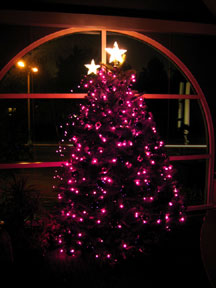
Last year I started my own Advent tradition, putting up an Advent tree in the large window of my office at church. It is a typical fir tree, with all purple lights. The ornaments are mostly purple, with a handful of pink scattered in.
|
Growing Closer to God in Advent: Some Practical Suggestions
My Greatest Advent Discovery
If you'd like to begin to celebrate Advent, let me point you to a couple of my recent posts (December 3; December 10). Be sure to use the virtual Advent wreath that goes with these posts! Also, you can use my online Advent calendar (at the top of my homepage) to focus your prayers in an Advent direction.
Posts for 2005
Happy New Year! Again?
Part 1 of series: Advent and the Christian Year (2005)
Posted for Sunday, November 27, 2005
Happy New Year! That's right, Happy New Year!
No, no, I'm not one of those people who rushes the holidays, who puts up Jack O' Lanterns while it's still blazing in September and who starts playing Christmas music before Thanksgiving. So I'm not rushing to get you to sing Auld Lang Syne or anything like that. And, no, I didn't fall on my head while putting up Christmas lights. And, no, I'm not hung over from an overdose of L-Tryptophan in my Thanksgiving turkey. Don't worry. I'm quite aware that we're still in 2005, and that we haven't even celebrated Christmas yet.
If you've been reading my blog for over a year, you may remember a similar post last year at this time. Why am I repeating myself? Because a small part of my mission in life is to raise awareness of what we call the Christian year. And for those of us who pay attention to such things, Sunday, November 27, 2005, is the beginning of a new year. So I'll say it again: Happy New Year!
If you’re a member of a highly liturgical church (Catholic, Episcopal, Lutheran, Orthodox, etc.), what I’ve just said makes sense. But if you're not involved in such a church, I had better explain what I'm talking about. |
|
| |
No, it's not time for
Happy New Year hats.
|
The Christian year, sometimes called the church year or the liturgical year, is a centuries-old way that many Christians have ordered the 365-day year. It depends, not on the positions of the sun and moon, or on the start and end of school, but on key aspects of the life of Christ that are coordinated with the solar calendar. The key days in the church year are Christmas (December 25), Good Friday and Easter (in the spring, dated according to Jewish Passover), and Pentecost (seven weeks after Easter). Every other special day or season fits around these crucial days (Advent, Epiphany, Ash Wednesday, Lent, Palm Sunday, Holy Week, Maundy Thursday, etc.).
When I have taught worship leaders from around the country, I have often asked about their awareness of the liturgical year. The vast majority have little or no knowledge of it, apart from the big holidays, Christmas and Easter. If they have any sense of the liturgical year, they assume that its something for Catholics and other high church folk, with little relevance for the rest of us.
I can understand this perspective because I was raised in a church that recognized Christmas, Palm Sunday, Good Friday, and Easter, but that’s about it. I had always assumed that things like Lent were for my Catholic friends. And since Lent seemed to involve some sort of fasting, I was happy to leave it well enough alone. Give me the feasts, I reasoned. Leave the fasts for the Catholics and Jews. (I didn’t have any sense of Ramadan back then.)
It wasn’t until I was preparing for ordained ministry that I gained some exposure to the Christian year. I learned – much to my surprise – that many Presbyterians take this stuff quite seriously. For the first time in my life I heard a Presbyterian pastor get excited about the benefits of the church year for corporate worship and private devotions. I was curious, though I didn't quite get his enthusiasm. What difference would the liturgical year make in my life? The answer seemed to be: none at all.
When I came to Irvine Presbyterian Church as Senior Pastor, the church already recognized more of the liturgical year than I ever had before. In the last fourteen years I have grown to appreciate the richness that such a perspective can bring to the worship life of a church, as well as to my own devotional life. The truth is, all kidding aside, that I actually have begun to experience the first Sunday of Advent (in late November or early December) as the beginning of a new year. Today I can feel the flow that begins now and carries me and my church through the birth of Jesus to his death and resurrection, and beyond to the sending of the Spirit and the celebration of Christ's kingly reign. Believe it or not, today I'm beginning my celebration of Easter. I know this may sound odd to you, even esoteric and weird. But I've found that recognizing the Christian year has enriched my faith in many ways. I'd like to share some of these with you.
Now, let me hasten to add that nothing in Scripture demands such a practice. Although the liturgical year is structured around the biblical story of Jesus, it is not prescribed in Scripture in the way of the Jewish holidays in the Old Testament. Of course Christians aren’t commanded to celebrate Easter or Christmas in the way we do either. The church year, therefore, is not something all Christians must observe, or must observe in the same way. (In fact, Orthodox believers have a different pattern throughout the year and even celebrate Easter on a different day!) But I believe that an awareness of the liturgical year can enrich our worship and spirituality. In fact, when I’ve taught on this subject to worship leaders who have very little idea of what I’m talking about, they come away excited about the potential for their churches.
In 2004 I wrote a seven-part series called Advent and the Christian Year. I'm not going to reproduce this year everything I wrote then. I'll refer to portions of last year's series that are relevant to this year. This year I plan to focus more narrowly on the meaning of Advent and what it might mean for you to honor this wonderful season of the Christian year. Tomorrow I'll write more specifically about the meaning and purpose of Advent.
The Advent Wreath: The First Candle
Part 2 of series: Advent and the Christian Year (2005)
Posted for Monday, November 28, 2005
Today in our worship services – I'm writing this on Sunday evening – we lit the first candle of the Advent wreath. As that small fire atop a purple candle burned slowly, I felt my own heart warmed with the hope of the coming of Christ.
If you're in a fairly traditional or liturgical church, you may immediately connect with what I'm saying here. But it's quite possible, given the wide varieties of Christian experience in our world today, that you have no idea what I'm talking about or why the lighting of a candle would be so special to me.
In the next few days I'll explain more about Advent and why I think it's such an important season of the year. But, today, I'd like to focus instead on the meaning of Advent as represented by the first candle in our Advent wreath. |
|
| |
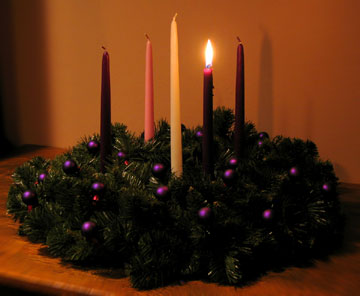
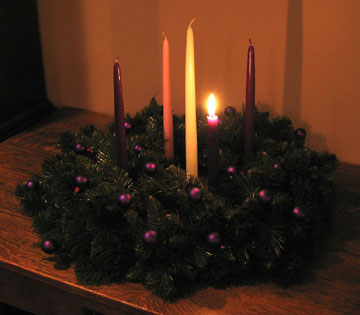
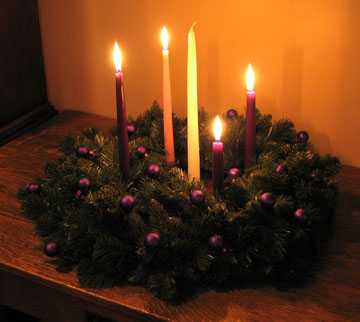
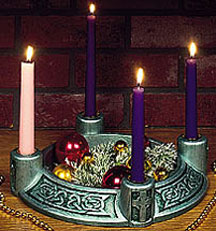
An Advent wreath with the first candle lit. |
I should explain that there is no one, official set of meanings for the candles of the Advent wreath. I can't even remember where the one we use at Irvine Presbyterian Church originated. Nevertheless, the typical Advent wreath has five candles, one for each Sunday of Advent and one for Christmas Day (or Christmas Eve). The candle colors vary, though most wreaths have purple candles (the standard Advent color, signifying solemnity or royalty) and a central white candle for the birth of Christ. Some wreaths use a pink candle for one of the Sundays of Advent, as a symbol of joy. If you're not used to all of this, it can seem strange to have purple and pink colors prominent in the weeks right before Christmas. But, in time, the colors make sense to both mind and heart. (For more information on the colors of the Christian year, see my posts: "Overview of the Christian Year" and "The Colors of the Christian Year.")
In my church, all of candles of the Advent wreath signify some dimension of our waiting. Advent is, after all, a season of hopeful waiting for the coming of Christ. The first candle reminds us that we are waiting for our Good Shepherd. This morning, those who lit the candle read a portion of Isaiah 40:
Comfort, O comfort my people,
says your God.
Speak tenderly to Jerusalem,
and cry to her
that she has served her term,
that her penalty is paid,
that she has received from the LORD’S hand
double for all her sins.
A voice cries out:
“In the wilderness prepare the way of the LORD,
make straight in the desert a highway for our God.
Every valley shall be lifted up,
and every mountain and hill be made low;
the uneven ground shall become level,
and the rough places a plain.
Then the glory of the LORD shall be revealed,
and all people shall see it together,
for the mouth of the LORD has spoken.”
A voice says, “Cry out!”
And I said, “What shall I cry?”
All people are grass,
their constancy is like the flower of the field.
The grass withers, the flower fades,
when the breath of the LORD blows upon it;
surely the people are grass.
The grass withers, the flower fades;
but the word of our God will stand forever.
Get you up to a high mountain,
O Zion, herald of good tidings;
lift up your voice with strength,
O Jerusalem, herald of good tidings,
lift it up, do not fear;
say to the cities of Judah,
“Here is your God!”
See, the Lord GOD comes with might,
and his arm rules for him;
his reward is with him,
and his recompense before him.
He will feed his flock like a shepherd;
he will gather the lambs in his arms,
and carry them in his bosom,
and gently lead the mother sheep.
If you're familiar with Handel's Messiah, no doubt you can hear the way Handel set these lines to music. They convey God's good news to Judah: He is coming to make all things right! Notice that the Lord is strong, but His strength is not something to be feared by His people. Rather, it enables Him to gather His people as a shepherd picks up his lambs.
The first candle of the Advent wreath helps us to recognize just how much we need God to be our Good Shepherd. We need guidance. We need protection. We need comfort. And this is what God provides. Advent heightens our awareness of our need for a Shepherd, and it points us to the only One who can meet this need. His is not power to be feared, but to be desired.
(Note: If you'd like to use an Advent wreath for your personal, family, or church's recognition of Advent, I've prepared an Advent wreath guide that you might find helpful.)
Advent F.A.Q.
See the 2006 version
Growing Closer to God in Advent: Some Practical Suggestions
Part 4 of series: Advent and the Christian Year (2005)
Posted for Wednesday, November 30, 2005
So what if you'd like to experience Advent, but you don't know where to start? Or what if you'd like to go deeper with God through your Advent celebrations? This post is meant to offer some practical answers to these questions.
Pay Closer Attention to the Advent Content of Corporate Worship
If your church celebrates Advent, be ready to pay close attention to the readings, prayers, songs, and seasonal pageantry (like the lighting of the Advent wreath). Your intentionality in worship can infuse your whole life with Advent expectation.
Many churches, even if they don't plunge head-first into the spirit of Advent, nevertheless wade into Advent worship. They use readings from the Old Testament prophets or sing Advent carols like "O Come, O Come, Emmanuel." The more you pay attention to these Advent elements, the more your personal experience will be enriched.
If your church doesn't acknowledge Advent, you may decide to talk with your pastor or worship leader about it. But, please, be kind and encouraging! As a pastor myself, I find it much easier to receive "Here's something I find exciting!" than "What's wrong with our stupid church?"
Enjoy Advent Music
This isn't quite as easy as it sounds, unfortunately. There are hundreds of Christmas songs and carols, played everywhere during Advent, from churches, to gas stations and shopping malls. There are comparatively few Advent songs, though many songs and carols do touch upon Advent themes of waiting, hoping, yearning, etc.
If you enjoy classical music, there are a few Advent albums available, including:
I'm aware of only one folk Advent album, The Advent of the Promised Son, by Susan Bailey. It's pleasant, but not my favorite. (If I had lots of extra time and money, I'd produce an Advent album using popular Christian songs and classic Advent carols. It would include such songs as "Hungry" by Kathryn Scott, "Breathe" by Marie Barnett, "There is a Louder Shout to Come" by Matt Redman, and "We Will Dance" by David Ruiz.)
I listen to quite a bit of Christmas music in Advent, but try to stick with instrumental versions. Thus I save listening to sung Christmas carols for Christmas Eve and thereafter. This way I still have a sense of waiting even while listening to familiar carols.
Use an Advent Wreath in Your Home
You can get Advent wreath kits online or from most Christian bookstores. But you can easily make your own with a wreath (natural or artificial) and five candles. In Monday's post I included a picture of the Advent wreath in my home.
If you aren't sure what to do with an Advent wreath, I've written a guide that you can access by clicking here. Feel free to adapt it as you see fit, or to use it in ministry settings.
Let Your Nativity Scene Function as an Advent Calendar
I have not done this before, but I have friends who do. They have nativity scenes with lots of characters. They time the setting up of their nativity scene so that they add one character each day, adding the Christ child on Christmas (or Christmas Eve). This can also be a wonderful family tradition that involves each member, especially younger children.
I actually begin my celebration of Advent by putting up a large nativity scene on my roof. It wouldn't be practical for me to add a character a day, so I put up the whole scene early. (I'll include some pictures of my nativity scene later in Advent.)
Dress for the Season
It's common for people to wear Christmas colors throughout the month of December, so why not Advent colors? I do this when I lead worship, wearing a purple sweater or a purple tie.
Focus in Your Personal Devotions on Advent Themes
There are many texts, both in the Old Testament and New Testament, that express Advent themes. By reading and meditating on these passages you’ll enhance your Advent experience of God. Some possibilities for Advent Bible readings can be found in my Advent wreath guide. |
|
|
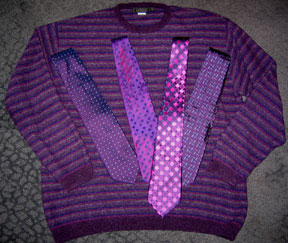
No, I don't wear these all at once.
|
Don't Become an Advent Snob
No, I'm not kidding. I have known what I call "Advent snobs." They're Christians who actually look down on people who don't keep Advent. How does an Advent snob behave? For example, such a person might ask with apparent innocence, "Oh, do you sing Christmas carols in your church before Christmas Eve?" Then, after hearing an affirmative answer, the Advent snob will say, "Oh, in my church, we don't do Christmas music until Christmas. We sing only Advent carols in Advent." Ugh! This sort of attitude, apart from being unChristianly prideful, will chase people away from Advent faster than just about anything.
If Advent makes a difference in your relationship with God, by all means share your excitement with others. But stay away from snobbery at all costs!
Tomorrow I'll explain why I believe keeping Advent can be such a wonderful and important part of Christian discipleship in today's world.
Why Advent Matters
Part 5 of series: Advent and the Christian Year (2005)
Posted for Thursday, December 1, 2005
Recently I've been running off at the fingers about Advent. If you're an Advent devotee, I expect you can relate to my enthusiasm for this undervalued holiday season. But if you're not familiar with Advent, or if you know something about it but aren't all that thrilled, you may be wondering why I'm putting so much emphasis on Advent. Why not focus instead on Christmas, a holiday so beloved and so filled with theological meaning?
Well, I'll get to Christmas soon enough. Don't worry. But in today's post I'd like to explain a bit further why Advent matters to me, and why I think it can matter to you too.
Part of my rationale for Advent depends on an overall appreciation for the Christian year and its impact upon corporate worship and private devotion. Last year I wrote a whole post on this topic. My point, in a nutshell, was that the thematic variations of the Christian year allow us to experience greater variety and depth in our relationship with the Lord. (You can read the whole post here.)
So what does Advent, in particular, contribute to our lives, including our experience of God?
The Value of Waiting
Advent teaches us about waiting, and helps us to experience the blessing of intentional waiting. I say this a someone who hates to wait. I'm the sort of person who, if I'm getting ready to check out in the market, quickly calculates which line is moving the quickest so I can minimize my waiting. I avoid lines like the plague, almost to the point of obsession. My hatred of waiting may be a bit extreme, but I think most people in North America can relate to my confession here. What else explains the massive credit card debt in our country? Rather than wait to buy something we can afford, we gladly fall deep into dept in order to get it right away. We're an instant gratification society, no question about it.
Advent is about delayed gratification. Rather than hop scotching from Thanksgiving right into Christmas, Advent is a time of waiting. On a literal level, we who keep Advent wait before enjoying some of our beloved Christmas traditions. On a deeper level, we get in touch with the spiritual discipline of waiting. We remember how the Jews waited for centuries for the Messiah. And we attend to our own waiting for Christ to return.
Waiting intensifies yearning. It teaches us patience. It reminds us that God is sovereign and we are not. It challenges us to trust God even when He does not act according to our expectations. |
|
| |
Folks waiting in line for a flu shot.
|
Waiting also intensifies joy. When we have to wait for something, our joy in finally receiving our wish is far greater than if we'd received it earlier. Delayed gratification, so taboo in our society, actually increases gratification. Thus, by keeping Advent, we augment our delight when we finally sing "Joy to the world, the Lord is come."
An Infusion of the Spiritual into the Secular
When I was young, Christians were fond of saying that we need to "put Christ back in Christmas." Folks got angry when signs in stores referred to "Xmas" rather than "Christmas." (They didn't realize that "X" was a classic abbreviation for "Christ," as the first Greek letter in the word Christos.) Of course now we'd be thrilled if stores mentioned "Xmas" instead of "holiday" or "winter solstice." How times change!
Yet the basic need to infuse genuine spiritual meaning into the secular celebration of Christmas remains. Advent can help us to do this. It is, almost entirely, a spiritual season. There isn't much demand for advent wreaths and purple sweaters, after all, though I'm doing my best to stir it up. Seriously, though, when it comes to Advent we don't have to compete with the secular. There's a sort of spiritual purity to the season.
I know some Christians who frown upon the secular dimensions of Christmas. They discourage attendance at Christmas parties or too much attention to presents and Santa. My emphasis, in my personal life and in my ministry, is less oriented to fighting secular Christmas celebrations and more focused on taking Advent seriously.
Confident Hope
Advent is a season of hope, and who doesn't need hope today? Yet the hope of Advent isn't like other kinds of hope. We can hope that the economy will be strong, that terrorists won't injure us, and that the avian flu won't kill us. But, honestly, we can't be sure of any of these things.
Advent hope is not wishful thinking. On the one hand, when we remember the hope of Israel, we know that God has fulfilled that hope in the birth of Jesus the Messiah. On the other hand, we look forward to the time when Christ will return and complete the task of restoring creation. We embrace this hope with the confidence of faith.
Advent hope empowers us to live today with greater gusto. We seek to love, knowing that Love will one day be victorious over hate. We seek justice, knowing that the Just Judge will one day make all things right. In the third verse of "O Come, O Come Emmanuel," one of the few well-known Advent carols, we sing of this hope with faithful assurance:
O come, Desire of nations, bind
All peoples in one heart and mind;
Bid envy, strife, and discord cease;
Fill the whole world with heaven's peace.
Rejoice! Rejoice! Emmanuel
Shall come to thee, O Israel!
My Greatest Advent Discovery
Part 6 of series: Advent and the Christian Year (2005)
Posted for Friday, December 2, 2005
Last year I mentioned this discovery as part of a longer post. This year I think it deserves more attention.
In yesterday's post I confessed that I am terrible at waiting. This makes me an especially lousy Christmas shopper, because, almost by definition, Christmas shopping requires waiting in line. Whether you're at a fine department store or just grabbing some chips from the local 7-Eleven, chances are you'll be waiting in line during the month of December. And, if you're like me, inevitably you'll end up right behind somebody who needs a price check on aisle 3 or who requires some sort of special assistance. This sort of thing can just about ruin the Christmas season.
A couple of years ago I was waiting in a long line at Costco. In spite of my best efforts, of course I ended up in the slowest moving line of all. As I stood there, I could feel my blood pressure rising. The more I waited, the more frustrated I became. Words I never say (well, almost never) filled my mind, and I'm not referring to "Happy Holidays." "Why do I always get in the slowest line?" I asked myself. "And why is this taking so long?" I yelled under my breath. |
|
| |
Ah, this warms your heart, doesn't it?
|
Then, all of a sudden, it dawned on me. I had one of those moments of grace, in which God managed to slip a word into my consciousness. As I stood in line at Costco, I was waiting. Waiting! I was doing exactly what Advent is all about. Of course I wasn't waiting for God to save me or anything momentous like that. I was simply waiting to get out of that store so I could go home. But, nevertheless, I was waiting. I was forced to experience something that's at the very heart of Advent.
So I decided, right then and there in the line at Costco, that I was going to use the experience of waiting in line as an Advent reminder. In that moment, and in similar moments yet to come, I was going to remember what Advent is all about. I was going to put myself back into the shoes of the Jews who were waiting for the Messiah. And I was going to remember that I too am waiting for Christ to return.
As I decided to let the experience of forced waiting be a moment of Advent reflection rather than a cause for getting an ulcer, I found my anger quickly drain away. Waiting in line at Costco became, not a trial to be endured, but a moment of grace. And get this: I even found myself thanking God for the chance to slow down a bit and wait. This was, indeed, a miracle.
By the time I got to check out, my heart was peaceful, even joyous. I felt as if I God had discovered a treasure. The next Sunday I shared my discovery with my congregation. In the days that followed many of my flock told me how much their Advent had been improved by seeing waiting in line, not as a curse, but as a potential blessing.
Honestly, I can still forget my commitment to use waiting in line as a time for Advent reflection. My gut instinct can take over, I can easily start grinding my teeth as I think of how much time I'm losing. But then a gentle breeze from the Spirit will remind me of how waiting can enrich my life, rather than rob me of joy.
In the last couple of years, what I hate most about the days prior to Christmas – waiting in line – has become a quasi-sacrament, a time to experience God’s grace. If you’ve never tried this, it may sound to you as if I’ve lost my mind. This sounds even sillier than wearing purple in the weeks before Christmas. But let me encourage you to try it. You’ll find a bit of grace, hidden and ready to be discovered, much like a little picture behind one of those doors of an Advent calendar.
The Advent Wreath: The Second Candle
Part 7 of series: Advent and the Christian Year (2005)
Posted for Sunday, December 4, 2005
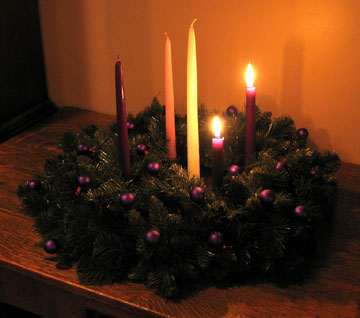
Today is the second Sunday in Advent. On this day Christians light the second candle of the Advent wreath. (If you missed my post on the first candle, you may wish to read it before you continue, but this isn't necessary.) In today's post I'm going to put up a version of the Advent candle lighting ceremony we use in my church. The candles signify different dimensions of our Advent waiting. Last week we focused on waiting for a Good Shepherd. Today we wait for forgiveness.
You can use this material for your own Advent wreath, if you have one, or you can let your reading of this post be a time of Advent reflection.
Note: What follows is based upon something I wrote several years ago for my church. You can find my whole Advent Wreath Guide here, by the way. You'll notice that some of the language is fairly simple. This is because I've encouraged families with young children to use this material in their Advent devotions. To be honest, I can't remember if I came up with the particular themes myself or if I borrowed them from elsewhere. You are more than welcome to use this material (or adapt it) for personal use or for use in any non-profit ministry. As you know, I don't charge anything for the materials on my website, and am glad to make them available for free. I would ask only that if you print this material or a portion thereof, you provide suitable acknowledgement. For other uses, please contact me.
The Lighting of the Second Candle: Waiting for Forgiveness
[Begin by lighting the first purple candle from last Sunday.]
We Remember the Meaning of Advent
Advent is a word that means "coming" or "visit." In the Christian season of Advent we prepare for the "advent" or coming of Christ at Christmas. Our preparation includes many things:
• We remember Israel's hope for the coming of God's Messiah to save, to forgive, and to restore them.
• We remember our hope for the second coming of Jesus.
• We remember our need for a Savior to save us from our sins.
• We prepare to welcome Christ at Christmas into our world . . . and into our hearts.
By lighting one candle each week of Advent, we help ourselves get ready for the birth of Jesus. Last week we lit a candle that signified our waiting for God our Shepherd. Today we focus on the coming of Christ who brings forgiveness from our sins.
Prayer for God's Help
Dear God, thank you for this season of Advent that helps us to prepare for the coming of Christ at Christmas. As we read the Bible and light a candle, may excitement for Christ's coming burn in our hearts. Amen.
Scripture Readings
Psalm 130:1-8
Out of the depths I cry to you, O LORD.
Lord, hear my voice!
Let your ears be attentive
to the voice of my supplications!
If you, O LORD, should mark iniquities,
Lord, who could stand?
But there is forgiveness with you,
so that you may be revered.
I wait for the LORD, my soul waits,
and in his word I hope;
my soul waits for the Lord
more than those who watch for the morning,
more than those who watch for the morning.
O Israel, hope in the LORD!
For with the LORD there is steadfast love,
and with him is great power to redeem.
It is he who will redeem Israel
from all its iniquities.
In this psalm we join the psalmist in crying out for God's forgiveness. And we remember what it's like to wait for God's salvation with hope.
Suggested readings also include Jeremiah 31:31-34 and Luke 1:68-79.
Lighting of the Candle
[Note: In order to "light" the next Advent candle, click on the purple candle immediately behind the lit candle.]
We light this candle because, like God's people centuries ago, we also need a Savior who will forgive our sins. The purple color reminds us of the seriousness of our sin and our great need for God's forgiveness.
Prayer of Hope
Gracious God, as we light this candle, we recognize our sin and our need for a savior. We wait to receive the fullness of forgiveness in Christ, knowing what He has accomplished for us on the cross. We long to be purified so that we might present ourselves to you in righteousness. Come, Our Savior! Amen! |
|
|
Closing Song
[To be sung to the tune of "O come let us adore him" from "O Come All Ye Faithful."]
O come to us, forgive us, O come to us, forgive us,
O come to us, forgive us, Christ the Lord!
The Advent Wreath: The Third Candle
Part 8 of series: Advent and the Christian Year (2005)
Posted for Sunday, December 11, 2005
Today is the third Sunday in Advent. On this day Christians light the third candle of the Advent wreath. (If you missed my posts on the first candle or second candle, you may wish to read them before you continue, but this isn't necessary.) In today's post I'm going to put up a version of the Advent candle lighting ceremony we use in my church. The candles signify different dimensions of our Advent waiting. So far we've focused on waiting for our Good Shepherd (week 1) and for forgiveness (week 2).
Note: Remember, I have written this so it would be accessible to children. Hence the simple language. Plus, if you have different readings, please feel free to add them or to replace mine. This is just a guide. Use it as you wish, or let it inspire you to write your own. The whole guide, by the way, is available here.
The Lighting of the Third Candle: Waiting with Joy
[Re-light the first two purple candles]
Remember the Meaning of Advent
Advent is a word that means "coming" or "visit". In the Christian season of Advent we prepare for the "advent" of Christ at Christmas. Our preparation includes many things:
• We remember Israel's hope for the coming of God's Messiah to save, to forgive,
and to restore them.
• We remember our hope for the second coming of Jesus.
• We remember our need for a Savior to save us from our sins.
• We prepare to welcome Christ at Christmas into our world . . . and into our hearts.
By lighting one candle each week of Advent, we help ourselves to get ready for the birth of Jesus. So far we have lit two candles. The first helped us to hope for God our Shepherd; with the second we asked God to come and forgive our sins.
Today we remember the joy of waiting -- because we know how the story ends!
Prayer for God's Help
Dear God, thank you for this season of Advent that helps us to prepare for the coming of Christ at Christmas. As we read the Bible and light a candle, may excitement for Christ's coming burn in our hearts. Amen.
Scripture Readings
Through the prophet Zephaniah God looks ahead to the time when he will renew and heal his people. It will be a day of great rejoicing, both for them and for God!
Sing aloud, O daughter Zion;
shout, O Israel!
Rejoice and exult with all your heart,
O daughter Jerusalem!
The LORD has taken away the judgments against you,
he has turned away your enemies.
The king of Israel, the LORD, is in your midst;
you shall fear disaster no more.
On that day it shall be said to Jerusalem:
Do not fear, O Zion;
do not let your hands grow weak.
The LORD, your God, is in your midst,
a warrior who gives victory;
he will rejoice over you with gladness,
he will renew you in his love;
he will exult over you with loud singing
as on a day of festival.
I will remove disaster from you,
so that you will not bear reproach for it.
I will deal with all your oppressors
at that time.
And I will save the lame
and gather the outcast,
and I will change their shame into praise
and renown in all the earth.
At that time I will bring you home,
at the time when I gather you;
for I will make you renowned and praised
among all the peoples of the earth,
when I restore your fortunes
before your eyes, says the LORD.
Zephaniah 3:14-20
Other readings for today might include Psalm 126:1-6 and Philippians 4:4-7.
Lighting of the Candle
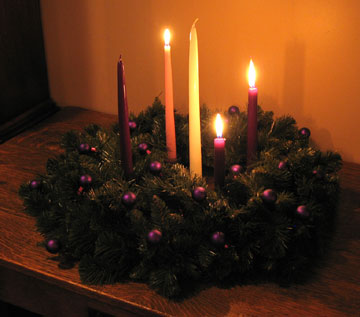
[This is the time for the lighting of the candle. If you have your own wreath, you can light the pink candle now. If you want to do an online lighting, click on the wick of the pink candle in the picture to the right.]
We light this candle because, like God's people centuries ago, we know that God has come in Christ and that Christ will come again. We rejoice in God's work in history and in the future. The pink color means joy! |
|
|
Prayer of Hope
Dear God, as we light this candle, we rejoice. We know how the first act of the story ended -- with the birth of Jesus the Messiah. And we know that he will come again in glory. So even though the story isn't over, we rejoice in our hope. We wait for you, rejoicing! Amen!
The Advent Wreath: The Fourth Candle
Part 9 of series: Advent and the Christian Year (2005)
Posted for Sunday, December 18, 2005
Today is the fourth Sunday in Advent. On this day Christians light the fourth candle of the Advent wreath. In today's post I'm going to put up a version of the Advent candle lighting ceremony we use in my church. The candles signify different dimensions of our Advent waiting. So far we've focused on waiting for our Good Shepherd (week 1), waiting for forgiveness (week 2), and waiting with joy (week 3).
Note: Remember, I have written this so it would be accessible to children. Hence the simple language. This is just a guide. Use it as you wish, or let it inspire you to write your own. The whole guide, by the way, is available here.
The Lighting of the Fourth Candle: Waiting for the Son
[Re-light two purple candles and the pink candle.]
Remember the Meaning of Advent
Advent is a word that means "coming" or "visit". In the Christian season of Advent we prepare for the "advent" of Christ at Christmas. Our preparation includes many things:
• We remember Israel's hope for the coming of God's Messiah to save, to forgive, and
to restore them.
• We remember our hope for the second coming of Jesus.
• We remember our need for a Savior to save us from our sins.
• We prepare to welcome Christ at Christmas into our world . . . and into our hearts.
By lighting one candle each week of Advent, we help ourselves to get ready for the birth of Jesus. So far we have lit three candles. The first reminded us to wait for God our Shepherd. With the second we asked the Lord to come and forgive our sins. The third, pink, candle signified our joy as we wait.
Today we focus on the coming of the Son -- the son of Mary, the Son of God!
Prayer for God's Help
Dear God, thank you for this season of Advent that helps us to prepare for the coming of Christ at Christmas. As we read the Bible and light a candle, may excitement for Christ's coming burn in our hearts. Amen.
Scripture Reading
Isaiah 9:1-7
1 But there will be no gloom for those who were in anguish. In the former time he brought into contempt the land of Zebulun and the land of Naphtali, but in the latter time he will make glorious the way of the sea, the land beyond the Jordan, Galilee of the nations.
2 The people who walked in darkness
have seen a great light;
those who lived in a land of deep darkness—
on them light has shined.
3 You have multiplied the nation,
you have increased its joy;
they rejoice before you
as with joy at the harvest,
as people exult when dividing plunder.
4 For the yoke of their burden,
and the bar across their shoulders,
the rod of their oppressor,
you have broken as on the day of Midian.
5 For all the boots of the tramping warriors
and all the garments rolled in blood
shall be burned as fuel for the fire.
6 For a child has been born for us,
a son given to us;
authority rests upon his shoulders;
and he is named
Wonderful Counselor, Mighty God,
Everlasting Father, Prince of Peace.
7 His authority shall grow continually,
and there shall be endless peace
for the throne of David and his kingdom.
He will establish and uphold it
with justice and with righteousness
from this time onward and forevermore.
The zeal of the LORD of hosts will do this.s
Other readings might include: Psalm 89:1-4, 19-37, 46-52; Luke 1:26-28
Lighting of the Candle
[As someone lights the final purple candle, the following should be read or paraphrased. You can "light" the candle of the Advent wreath to the right by clicking on the wick of the unlit purple candle.]
We light this candle because we look forward with eagerness to the birth of a child, the son of Mary and the Son of God! The purple color reminds us of how serious we are in looking forward to the Son's birth. |
|
|
Prayer of Hope
Dear God, as we light this candle, we look ahead with hope to the birth of your Son -- the Son of David, the son of Mary. May we be prepared to welcome him with open arms and open hearts. O come now, Son of David! Amen!
| The Advent Wreath: The Christ Candle |
Part 10 of series: Advent and the Christian Year (2005)
Posted for Saturday, December 24, 2005
Today is Christmas Eve. On this day Christians light the fifth candle of the Advent wreath, the Christ candle. In today's post I'm going to put up a version of the Advent candle lighting ceremony we use in my church. The candles signify different dimensions of our Advent waiting. So far we've focused on waiting for our Good Shepherd (week 1), waiting for forgiveness (week 2), waiting with joy (week 3), and waiting for the son (week 4).
Note: Remember, I have written this so it would be accessible to children. Hence the simple language. This is just a guide. Use it as you wish, or let it inspire you to write your own. The whole guide, by the way, is available here.
The Lighting of the Fifth Candle: The Savior is Born!
[Re-light the three purple candles and the pink candle]
In the season of Advent we have used the Advent wreath and its candles to help us get ready for this great celebration of the birth of Christ. When we lit the first purple candle, we asked God to come and be our Good Shepherd. God our Shepherd has come in Jesus Christ! When we lit the second purple candle, we asked God to come and forgive our sins. God has come in Jesus Christ to take our sins and die upon the cross so that we might be forgiven! When we lit the third, pink candle, we felt joyful even in our longing for Christ to come. Christ, who has been born in a manger, will come again in glory to wipe away every tear from our eyes! When we lit the fourth candle, we remembered that Christ would come as a son -- the son of Mary, the Son of David, and the Son of God! This Son has been born! He is Immanuel -- God with us!
Today we celebrate the birth of Jesus the Christ, Jesus the Good Shepherd, Jesus who forgives our sins, Jesus who will come again, Jesus the son of Mary, the Son of David, and the very Son of God!
Prayer
Dear God, as we light the center candle today, may we celebrate with full joy the birth of your Son, Jesus the Christ. Amen!
Scripture Readings
Hear the Christmas story from Luke 2:1-20:
In those days a decree went out from Emperor Augustus that all the world should be registered. This was the first registration and was taken while Quirinius was governor of Syria. All went to their own towns to be registered. Joseph also went from the town of Nazareth in Galilee to Judea, to the city of David called Bethlehem, because he was descended from the house and family of David. He went to be registered with Mary, to whom he was engaged and who was expecting a child. While they were there, the time came for her to deliver her child. And she gave birth to her firstborn son and wrapped him in bands of cloth, and laid him in a manger, because there was no place for them in the inn.
In that region there were shepherds living in the fields, keeping watch over their flock by night. Then an angel of the Lord stood before them, and the glory of the Lord shone around them, and they were terrified. But the angel said to them, “Do not be afraid; for see—I am bringing you good news of great joy for all the people: to you is born this day in the city of David a Savior, who is the Messiah, the Lord. This will be a sign for you: you will find a child wrapped in bands of cloth and lying in a manger.” And suddenly there was with the angel a multitude of the heavenly host, praising God and saying,
“Glory to God in the highest heaven,
and on earth peace among those whom he favors!”
When the angels had left them and gone into heaven, the shepherds said to one another, “Let us go now to Bethlehem and see this thing that has taken place, which the Lord has made known to us.” So they went with haste and found Mary and Joseph, and the child lying in the manger. When they saw this, they made known what had been told them about this child; and all who heard it were amazed at what the shepherds told them. But Mary treasured all these words and pondered them in her heart. The shepherds returned, glorifying and praising God for all they had heard and seen, as it had been told them.
Other Christmas reading might include: Micah 5:1-5; Psalm 145
Lighting the Candle
[As someone lights the center, white candle, the following should be read or paraphrased. If you want to "light" the Advent wreath to the right, click on the wick of the white candle.]
We light this candle with great joy and celebration, because Christ is born in Bethlehem. God's Son has come into the world to be our Savior!
Prayer of Hope
Dear God, as we light this candle, we rejoice in the birth of your Son. May we worship him, welcome him, and make room for him in our hearts. O come, let us adore him! Amen! |
|
|
Posts for 2004
Overview of the Christian Year
Part 2 of the series “Advent and the Christian Year”
Posted at 10:00 p.m. on Monday, November 29, 2004
In my last post I began talking about the Christian year (or liturgical year, or church year). In Part 2 of this short series “Advent and the Christian Year” I want to provide an overview of the liturgical year in case you are not familiar with it.
Before I do this, however, I should say that there is not one, universally-recognized version of the Christian year. In fact you’ll find considerable variation in timing and practices, even within one denomination or tradition. All versions, to my knowledge, recognize Christmas and Easter as the twin hubs around which rotate the variety of feasts, fasts, and seasons of the year. But even the specific dates for Christmas and Easter vary among different Christian traditions. So, the Christian year I’m going to describe is a version of the Western tradition, which you’ll find in many Protestant denominations, as well as the Roman Catholic church.
One other prefatory note. Part of what makes observing the liturgical year special is color. Different events and seasons are reflected in a variety of colors, including purple, white, green, black, red, pink, blue, gold, and some other colors as well. The seasonal color, usually displayed in various ways in the place of worship, reflects and augments the thematic elements of the season. So, for example, purple is understood to symbolize penitence (among other things), so it is used during the season of Lent. Once again I should emphasize that there is no single color scheme either recognized by or imposed upon all Christians. (In the twelfth-century Pope Innocent II systematized the Roman Catholic color scheme, but since Vatican II in the 1960s Roman Catholic churches have exercised considerable freedom in their use of alternative or additional colors.)
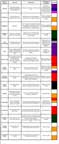
The following chart summarizes the Christian year, with calendar dates, themes, and major colors: |
|
|
The Eastern Orthodox Alternative
In response to my last post, two of my readers sent e-mails filling me in on a dimension of the Christian year that I had overlooked: the Eastern Orthodox Liturgical Year. I had known that Eastern Christians celebrate Easter on a different date from their Western siblings, but I was unaware that their liturgical calendar is substantially different and more complex than the Western calendar. (I found a helpful webpage that provides an overview of the Orthodox liturgical year.) The Orthodox year begins in September and includes several feasts and fasts that are not part of the Western Christian year. Advent, for Orthodox Christians, begins on November 15 and is a season of serious fasting in preparation for the 12-day season of Christmas. One of those who wrote me explained how all of this is not just a matter of outward religiosity, but inward spirituality as well. “I now pay far greater attention to the liturgical year, “ she wrote, “and attempt to order my life around it, and it has made a difference in my spiritual life.” I have several friends who began worshipping in an Orthodox church, in part because they experienced a deeper relationship with God through the liturgical richness of the Orthodox church. (Thanks to A.G. and N.W. for your helpful notes!) |
|
|
|
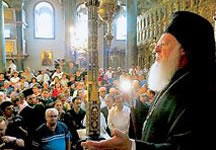
Bartholomew I, the Ecumenical Patriarch of the Eastern Orthodox Church, blessing a congregation in his home city of Istanbul. |
|
Day or Season |
Date(s) |
Theme(s) |
Meaning of Color(s) |
Color(s) |
Advent |
From four Sundays before Christmas Day to Christmas Eve |
Waiting; expectation; hope; longing; joy |
Purple (or sometimes blue) for solemnity and royalty; pink for joy on third Sunday |
|
| |
| |
Christmas |
Twelve days from December 25 to Jan 5 |
Birth of Jesus; Word Incarnate; Celebration; Joy; Light; Salvation |
White and gold for celebration, light, purity |
|
| |
Epiphany |
January 6 |
The "epiphany" (manifestation) of Jesus as the Son of God; the visit of the Magi; joy. Sometimes the baptism of Jesus is celebrated here. |
White and gold for joy and celebration
|
|
| |
Ordinary Time |
January 7 to the day before Ash Wednesday |
"Ordinary Time" describes the Christian year when there is no unusual focus
|
Green for life and growth |
|
|
The Wednesday seven weeks before Easter
|
Penitence; mere humanness; sin; our need for a savior; mortality
|
Black or gray for sinfulness and death; purple for penitence and solemnity
|
|
| |
| |
|
The 40 weekdays before Easter, not counting Sundays, includes Holy Week |
Penitence; solemness; spiritual focus; self-denial; preparation for Easter. |
Purple for penitence and solemnity |
|
|
The week before Easter (including Palm Sunday, Maundy Thursday, and Good Friday) |
Preparation for Easter; remembering the last week of Jesus's life; the death of Jesus |
Red for passion and the blood of Christ |
|
|
The Sunday of Holy Week |
Jesus's triumphal entry into Jerusalem; Jesus as king |
Red for Holy Week; sometimes gold or white or purple (for royalty) |
|
| |
| |
| |
|
The Thursday before Easter |
Remembering the "new commandment" to love one another (mandatum novum in Latin, from which we get "Maundy") |
Red for passion and Christ's sacrifice |
|
|
The Friday before Easter |
Remembering the death of Jesus; sorrow; confession; anticipation |
Black for death, sorrow |
|
|
The Sunday after the first full moon after Vernal Equinox (more or less) |
The resurrection; eternal life; victory; joy; light; life |
Gold and white |
|
| |
|
Seven weeks after Easter (including Ascension Sunday) |
Continued joyful celebration of the resurrection and its implications |
Red (for the church); gold and white for Easter |
|
| |
| |
|
The seventh Sunday after Easter |
The outpouring of the Holy Spirit; the birth of the church; God's power. |
Red (for power) |
|
|
From Pentecost to the day before Advent |
Growth in Christ; can include special celebrations such as Trinity Sunday, Christ the King Sunday, Reformation Sunday, All Saints Day, etc. |
Green (for life and growth) |
|
|
The Sunday after Pentecost |
Recognizing the presence and power and majesty of the Triune God |
White or gold |
|
| |
|
The last Sunday before Advent |
Honoring Christ as the King of the present and the future |
White or gold |
|
| |
I've not included many minor holy days, such as Ascension Sunday, Reformation Sunday, All Saints Day, etc. Some Christians recognize these days; some do not. Moreover, there is considerable variation on many of the details. My chart represents one approach among many.
In my next post I'll say more about how the liturgical year and the colors associated with the seasons can enrich our corporate worship and our personal spirituality. If you think all of this stuff is relevant only to highly liturgical churches, think again!
I've not included many minor holy days, such as Ascension Sunday, Reformation Sunday, All Saints Day, etc. Some Christians recognize these days; some do not. Moreover, there is considerable variation on many of the details. My chart represents one approach among many.
In my next post I'll say more about how the liturgical year and the colors associated with the seasons can enrich our corporate worship and our personal spirituality. If you think all of this stuff is relevant only to highly liturgical churches, think again! |
|
If you'd like a large JPEG of the chart above, click on the chart to the left and download the picture from the next page. |
Home
The Colors of the Christian Year
Part 3 of the series “Advent and the Christian Year”
Posted at 11:30 p.m. on Thursday, December 2, 2004
In my last post of this series I gave an overview of the Christian year, including a chart that listed key themes and colors. In Part 3 I want to talk a bit more about liturgical colors and their meaning.
The use of color and visual art in worship is nothing new. For centuries the Roman Catholic church incorporated elaborate artistic works in her sanctuaries. But, with the Protestant Reformation in the 16th century, and especially in the Reformed branch of the Reformation, the perceived excesses of Catholic art in worship led to the virtual excommunication of visual art from worship. Visual symbolism in Reformed churches was minimal (cross, pulpit, baptismal font) and modest. This artistic minimalism continued to be the dominant force in most evangelical churches in the United States, though some mainline Protestant churches developed visual traditions along the familiar lines of the Roman Catholic tradition.
In the last decade, however, many churches throughout the Western world have “discovered” the power of the visual in worship. Owing partly to the pervasive influence of visual imagery in our culture, partly to the cross-pollination between different streams of Christian tradition, and partly to the power of digital projection, churches that would never have considered the use of visual art in worship have not only begun to use it, but even to major in it. Many large evangelical and charismatic churches, the kind that only twenty years ago would have incorporated only words and music in worship, have even hired staff whose primary responsibility is to provide stunning visuals for liturgical purposes (though they would avoid the word “liturgical” in favor of something like “celebrative” or "worshipful").
I believe that, for the most part, the rediscovery of visual art in worship is a positive development. (For my hesitations about this, see my series, “Visual Arts in Faith and Worship.”) Yet some churches have set off on the journey of liturgical art as if they were groundbreaking pioneers, rather than pilgrims traveling along a well-worn path. These churches might do well to look into the use (and occasional misuse) of visual art in Christian history. We all have much to learn from the centuries of Christian worship that precede us. Or, to use a different metaphor, we who are beginning to utilize the visual in worship might just find in Christian tradition a treasure trove with gems just waiting to be used afresh.
In my opinion, the colors of the Christian year are part of this treasure trove. The intentional use of colors and color changes in worship spaces can enliven and deeper our worship, as well as add to the beauty of the experience. Colors can symbolize truth. Colors can delight the eyes. Colors can move the heart. And so much more.
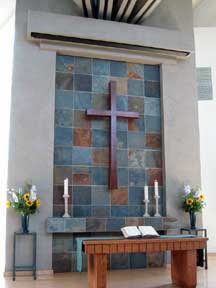
Let me give just one example among many from my worship in my own church. One of the most striking aspects of our worship space is the cross at the front of our sanctuary. Its simplicity and power conveys symbolically and emotionally the truth of the gospel. Along with the members of my congregation, I have meditated upon this cross many times, remembering what Jesus did for me. It has impacted both the depth and the passion of my worship.
Our cross stands alone, not as a decoration, but as a simple image of salvation. We never hang anything from the cross, except for one day of the year: Good Friday. Early in the morning of Good Friday, somebody drapes a basic black cloth over the horizontal bar of the cross. I know in advance that this will be there. I’m not surprised to see it. Yet, every year when I enter our sanctuary on Good Friday and see the black drape, my heart is struck. For some reason that black cloth hanging on the cross brings home to me the horror and the wonder of Jesus’s death. I often find myself brought to tears by that compelling yet basic symbol. |
|
| |
The cross at the front of the sanctuary of Irvine Presbyterian Church |
This is just one example among many possibilities from my personal experience. It illustrates, I think, the potential power of color to motivate and shape our worship.
I know that some of you will relate immediately to what I’m saying because your experience is similar. Others of you will understand what I’m describing, but it isn’t something you yourself know in a personal way. If you’re wondering how colors might be incorporated into your corporate worship – or your private devotions – let me close by putting up a number of representative pictures. Some of these come from highly liturgical churches and may not make much sense in a band-led service meeting in school gymnasium. But, then again, who knows? The creative use of color in such a space might transform an ordinary room into a genuine sanctuary. At any rate, these pictures might inspire you to be creative in your own worship settings. The possibilities for the use of color in worship are truly limitless.
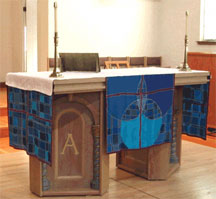 |
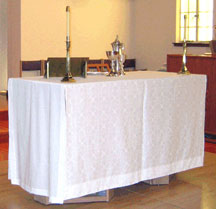
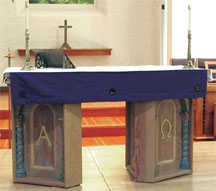
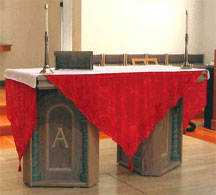
All of these photographs are of the communion table from the First Lutheran Church of Palo Alto, California. Here you can see one way that a church uses color to enhance worship in a particular time of the Christian year.
The upper left image is from Advent; the upper right image from Christmas. The middle left picture is of Ordinary time; the middle right from Lent. The lower left image is from Easter and the lower right from Pentecost Sunday. For the significance of the colors, see my last post. |
|
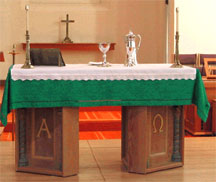 |
|
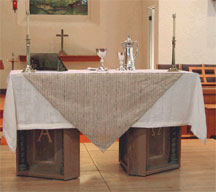 |
|
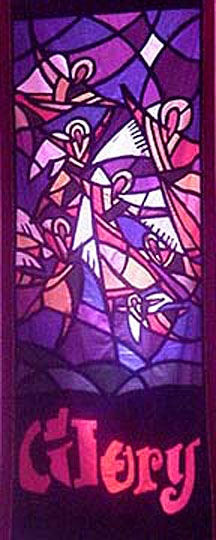 |
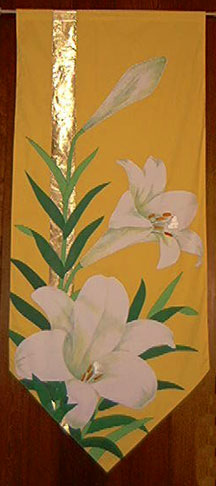
If your church does not have a communion table at the front, there are many other options for colorful art. Here are two banners that have been displayed in churches. The one on the left is an Advent banner, using the colors of this season (purple, violet, and pink). This banner is the creation of Jean Cross, a Christian artist who has made her work available to many churches. See her website.
The banner on the right is an Easter banner. It employs the dominant Easter colors, white, gold, and yellow, and also the celebrative shape of the Easter lily. |
|
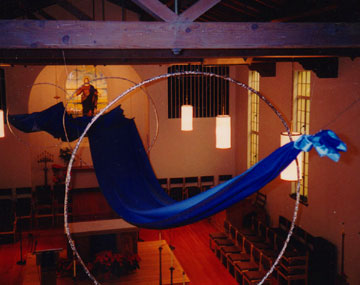 |
The last two images are both advent images. One the left a royal blue draping of material fills the worship space. One the right, the traditional purple candles of the Advent wreath glow tellingly. |
|
Home
The Christian Year and the Textures of Worship
Part 4 of the series “Advent and the Christian Year”
Posted at 10:00 p.m. on Sunday, December 5, 2004
In Part 3 of this series I explored the ways that liturgical colors can enrich our worship. In this post I want to pursue a bit further how the Christian year can enhance our worship and therefore our relationship with God.
As Christians we worship in light of the gospel. Our worship is a response to the God who has reached out to us in Jesus Christ, saving us from sin, death, isolation, and meaninglessness. Thus Christian worship is consistently infused with joy and gratitude. Moreover, since we worship the King of king and Lord of lords, we approach God humbly as well as boldly. And because God is glorious and majestic, our worship is filled with praise. At the core and in many of the details, Christian worship from day to day, from week to week, and from year to year, is essentially the same.
But this is not to say that our worship should be monotonous. In a given worship service we might focus on one particular aspect of God’s nature and therefore utilize distinctive expressions. For example, we might focus on the holiness of God, praising God’s perfection, thanking him for the gift of the Holy Spirit, and asking God to finish in us his work of sanctification (making us holy). Another week we might emphasize God’s grace, praising him for his forgiveness and seeking help to be gracious with one another. And so forth and so on. When our worship responds to the multifaceted character of God, and especially when it is shaped by the diversity of biblical revelation, it will have different textures and colors, even though the basic fabric is consistent from week to week.
The liturgical year contributes to the variety of our worship. Therefore it helps us to have a broader, deeper, and more vital relationship with God. It keeps us from the possibility of our worship becoming so routine that we cease to wonder at the grandeur of God. To put it bluntly, the variations of the Christian year help us not to become bored in worship.
Bored in worship? Is it possible? Logically speaking, this seems utterly impossible. If we remember that we worship the awesome Creator of the Universe, it’s hard to factor boredom into the worship equation. But sometimes, no matter how wonderful God is, and no matter how truthful our worship might be, if our expressions of worship are virtually the same from week to week, a kind of monotony can set in, and we can become – Heaven forbid! – bored. Perhaps you’ve had the experience of learning a new hymn or worship song and absolutely loving it. As you sing, your mind and heart are truly lifted before God. But, after you’ve sung the same song for the hundredth time, it loses some of its punch. Its tune is still memorable and its lyrics still full of truth, but its power to move your heart and stretch your mind has been diminished.
Worshipping in the same mode every week is a little like driving for a long distance through awesome mountains. When I first see the Rocky Mountains, for example, my heart explodes with joy and awe. These feelings continue for quite a while. But after I’ve driven among the Rockies for a day or more, I must confess that my appreciation begins to wane. I no longer remark on the stunning scenery, but begin to take it for granted. Of course the mountains themselves are still as majestic as ever. They haven’t changed or diminished, but my own sensibilities have become dull. I need refreshed vision so I can see the Rockies once again in their awesome beauty.
 |
If, however, my scenic menu were to be varied a bit, I’d be much less likely to become complacent in my admiration of the scenery. Last summer my family and I took a driving trip from Southern California, through the southwestern desert, the rangelands of Utah, and the verdant forests of eastern Idaho. We drove through the varied terrain of Yellowstone National Park and alongside the majestic Grand Tetons. Then we returned by way of the stunning redness of Zion National Park. |
|
 |
 |
|
| In over two weeks of travel, I was never bored because my world kept changing. There were always new wonders to behold. |
| What I’ve just described is analogous to worshipping in light of the liturgical year. We begin in the rising plain of Advent, which leads us to the top of the celebrative pinnacle of Christmas. Then, after a month of travel through the fertile grasslands of “ordinary time,” we enter the parched desert of Lent in which our thirst for God is magnified. Holy Week guides us through the tortuous geography of Jesus’s last week, culminating in the dark cave of Holy Saturday. On Easter morning, the sun breaks forth with glorious light, and we are filled with awe as we gaze upon the towering mountain of God’s victory over death. Throughout the season of Eastertide the world seems brighter, more alive than ever before. At Pentecost we remember the our fellow travelers and refuel to continue on through the rolling hills of ordinary time, until we return to where we began at the start of Advent. |
|
|
I’ve known Christians who have been uncomfortable with certain aspects of the Christian year. They haven’t liked the waiting of Advent or the focus on our mortality in Lent. They want to live each day as if it were Easter. Now in a sense my friends are theologically correct. We should indeed live daily in light of the victory of God in Christ. But, speaking from my own experience, the less celebrative seasons of the church year (Lent, Advent) actually prepare me to experience greater vitality and rejoicing on the great feasts of Christian year, Christmas and Easter. Before I paid much attention to Lent and Holy Week, Easter zipped by without making a major dent in my consciousness. Now, as I keep the seasons of Lent and Holy Week, and as Easter has been stretched to include Eastertide, my joy over the resurrection has been multiplied several times over.
Once again I should emphasize that what I’ve been describing here is not a matter of biblical rule. You don’t have to recognize the Christian year to be a faithful follower of Jesus. But the experience of countless believers throughout the centuries should at least encourage you to consider shaping your yearly life by the themes and narratives of Scripture – and this is, after all, what the Christian year is really all about.
In my next post I’ll begin to focus more directly upon the season of Advent, where we find ourselves right now. I’ll talk about the meaning(s) of this season and suggest ways you might let this season enhance both your celebration of Christmas and your experience of God.
Home
What is Advent? My Personal History
Part 5 of the series “Advent and the Christian Year”
An excerpt from my sermon "The Heart of Advent"
Posted at 11:00 p.m. on Monday, December 6, 2004
| Growing up, I knew the word "Advent" in one context: Advent calendars. Every year when I was young, my parents would give me an Advent calendar: an elaborate picture of some winter scene, perhaps a quaint European village, complete with glitter for snow. What made this picture really special was the fact that it contained twenty-five hidden windows, each one numbered from one to twenty-five. Behind these windows were little drawings of things we associate with Christmas: bells, candy canes, holly, angels, shepherds, and so forth. According to the rules of the Advent calendar, I could open one window each day of December, beginning with window #1 on December 1st. As December proceeded, and more windows were opened, my excitement for Christmas increased.Of course my favorite Advent calendar moment happened on Christmas morning when I was finally able to open window #25. Inevitably it revealed a tiny nativity scene. It was Christmas at last! |
|
| |
This particular calendar was made by Richard Sellmer Verlag, a company that specializies in Advent Calendars, and that claims a unique role in their history. For more information, see their website.
|
Sometime in my teenage years my notion of Advent was expanded. My church started using an Advent wreath to focus the congregation's attention upon the coming of the Christ Child. The wreath at Hollywood Presbyterian Church contained five candles, four embedded in the greenery and one in the center. During each of the Sundays in December the pastor would light one of the outside candles, relating each candle to some aspect of the Christmas spirit, including hope, love, joy, peace, etc. Like the Advent calendars of my childhood, the liturgical Advent wreath kindled my excitement for the coming of Christ. I looked forward to Christmas Eve, when our pastor would finally light the center candle, the Christ candle, signifying the birth of the Savior.
It wasn't until I was preparing for my ordination exams that I came to learn more about Advent. Advent wasn't just about paper calendars and candle-filled wreaths. In fact Advent was a season of the Christian year, a time of intentional preparation for a deeper and richer celebration of Christmas. Many Christians, even Presbyterians, I discovered, viewed Advent as a holy season, not so much a time for parties and Christmas shopping as a time for spiritual devotion. Some even considered it to be a time for fasting, not feasting. All of this impressed me, but didn't make too much difference in my life because Advent didn't receive too much attention at Hollywood Pres, where I worked on the staff during the 1980's.
But then I came to Irvine Presbyterian Church in 1991. For the first time I was part of a church that had a history of honoring Advent. Beyond using the Advent wreath, this church saw the weeks prior to Christmas as an occasion to prepare hearts for the birth of Jesus. Our music director at the time, a man named Loren, told me that he strongly preferred not to sing Christmas carols before Christmas Eve, though he usually gave in to popular demand and allowed for carol singing on the Sunday prior to Christmas.
Now that's not to say we got to sing Christmas carols only one day a year. Loren led us in the Christian tradition of viewing Christmas as a twelve-day season. We'd sing carols for at least one more Sunday after Christmas, and usually two. Yet, I soon learned a couple of things about Loren's "no-Christmas-carols-before-Christmas Eve" rule. First, I found out that it was not unique, but was in fact commonly practiced among highly liturgical churches. Second, I ascertained that it was pretty unpopular in my own church. Most of my members were just fine with the main themes of Advent, but as we moved into the middle of December, they wanted to sing some familiar Christmas carols and were pretty cranky if we didn't get to. So, in time, we found a compromise that seemed to work for most people. On the first week of Advent we sang Advent hymns only, such as "Come Thou Long Expected Jesus." But as we moved worshipfully through the four weeks of Advent, we introduced more carols each week. The frequency of carol usage became a kind of musical Advent calendar: the closer to Christmas, the more carols.
During the last thirteen years I've learned quite a bit about Advent, not just about its traditions, but about its deeper meaning. I've come to understand and to treasure the heart of Advent, and this is what I will discuss in my next post in this series.
Home
The Heart of Advent
Part 6 of the series “Advent and the Christian Year”
Posted at 10:00 p.m. on Tuesday, December 7, 2004
In my last post I talked about my personal journey of Advent discovery, from festive Advent calendars to a deeper experience of Advent as a solemn season of the Christian year. (Note: If you’re just now joining this series and are not familiar with the Christian year, you may want to check Parts 2-4 of the series.) In this post I want to focus upon the deeper meaning of Advent, the heart of Advent, if you will.
The word “advent” comes from the Latin word “adventus,” which means “visit” or “coming” or “arrival.” In the season of Advent we celebrate the visit of Jesus, or, more accurately, both visits of Jesus. On the one hand, we look back to the experience of the Israelites as they suffered under foreign tyrannies. We remember their yearning for God to fulfill his promise of salvation. We put ourselves back in their shoes, imagining what it must have been like to wait and wait upon the Lord.
On the other hand, in Advent we also look forward to the second coming of Christ. Although he accomplished the ultimate defeat of sin and death on the cross, we still live in the midst of a fallen, broken world. We have full confidence that someday Christ will return and God will renew creation. Yet, like the Israelites, we wait with eager longing for this renewal. Of course our waiting is different from Israel’s because of what God has already done in Christ. But it’s similar in that we find ourselves looking forward to the time when God will fulfill his promises so that we might experience life as it was meant to be.
In a recent sermon at my church I preached on the heart of Advent. I looked for a Psalm that captured what this season was all about, and settled on Psalm 130. No other chapter in the whole Bible is more thoroughly an Advent chapter. If you’re looking for biblical exposition on the meaning of Advent, you may want to check out this sermon.
The main themes and emotions of Advent are: waiting, hoping, yearning, solemnity mixed with joy. In this season we wait for God to act, both in the future and in our own lives. We renew our hope in God, knowing that, though God’s timing often mystifies us, nevertheless God will be faithful to fulfill his promises. We yearn, not only for the new creation yet to come, but also for a deeper experience of God right now.
Advent is a solemn season, which explains the predominance of purple (or royal blue) as the primary seasonal color. But because we know of the first Advent of Christ (at Christmas), and because we believe that he will indeed come again, our waiting is tinged with hope. Thus pink (or rose) is a secondary color of Advent. Many churches will use purple and pink during the season of Advent. The advent wreath at my church, like many other congregations, uses three purple candles and one pink candle circled around the central white Christ candle. (Again, this color scheme is traditional, but in no way mandatory.)
I realize that what I’ve said about the heart of Advent can sound rather academic. You may be wondering: How can I experience the heart of Advent in my own life? In my next post I’ll suggest some things you can do to get into the spirit of Advent. In the rest of this post I want to share some recent experiences that have increased my Advent passion. |
|
| |
Here's a so-called Advent Wreath. It uses the right colors, but it's looks a little bit more like a pewter candle holder than a genuine wreath to me. |
One of these experiences is paying attention to the news with my heart as well as my mind. When there’s so much bad news in the world, it’s easy to become rather numb to it all. But in the last few days – maybe because I’ve been in an Advent frame of mind – I’ve been particularly sensitive to the pain in the world and our need for God’s new creation. Stories of suffering in the Sudan have broken through my defenses and have caused me to long for God’s intervention. And, ironically, the ongoing suffering of people in and around Israel also makes my heart cry out to God. Our world still needs the healing that only God can give.
 |
My other experience is a much more personal one. A dear friend of mine named Julie is struggling with very serious cancer. Recently she has received discouraging reports from her doctors. If the chemotherapy she is trying now doesn’t work, they have nothing left to offer. Then, apart from a true miracle, Julie’s cancer will take her life.
This is always a hard thing to go through, but it’s even harder in this case because Julie is a young mother with two small children and a dear husband. She’s also one of the sweetest and wisest Christians I have ever known. If anyone in the world doesn’t deserve serious cancer, it’s Julie. Thus my heart aches for her and her family several times each day. I am regularly crying out to God to heal Julie. I sense profoundly how much she needs the Lord, and this puts me in touch with my own hunger for more of God. I know that, in time, God will make all things right. He will wipe away every tear. Bodies will be whole and suffering will be no more. Yet I yearn for this right now for Julie and her family. |
Julie is the woman to the left. Her daughter is in the front of the picture, looking for Easter eggs. I would greatly appreciate it if you would offer a short prayer for Julie and her family. |
|
For Julie and all who love her, it is a time to wait on God, to trust God even when things aren’t going the way we think they should be. It’s a time to remember God’s goodness, and to confess that, no matter what, our good and gracious God will always “work all things together for good” (Romans 8:28). Thus we have hope, ultimate hope, aching hope, confident hope in God. And this is the heart of Advent.
Home
|