| |
A Resource by Mark D. Roberts |
|
Seeking the Peace of Christ:
Christianity and Peacemaking
by Rev. Dr. Mark D. Roberts
Copyright © 2005 by Mark D. Roberts
Note: You may download this resource at no cost, for personal use or for use in a Christian ministry, as long as you are not publishing it for sale. All I ask is that you give credit where credit is due. For all other uses, please contact me at mark@markdroberts.com . Thank you.
Seeking the Peace of Christ: Introduction 
Part 1 of the series – Seeking the Peace of Christ: Christianity and Peacemaking 
Posted for Monday, July 25, 2005
I recently finished up an extended series in which I examined a new statement published by the National Association of Evangelicals. This Statement, For the Health of the Nation, seeks to guide social activism by evangelicals in America. My overall appraisal of the Statement was quite positive, though I found fault with some sections. One of the sections that disappointment me the most was on peace. I didn't have a problem with anything the Statement actually said so much as with what it didn't say.
So I've decided to offer my own version of a more inclusive and broader vision of peace and its implications for the Christian life. This new series, Seeking the Peace of Christ: Christianity and Peacemaking, is based upon the last chapter of my book, After "I Believe," though it is not identical to that chapter and it includes quite a bit more material. So even if you've read that part of my book, you'll get much more in this blog series.
When it comes to Christianity and peace, it seems to me there are many problems. Three stand out in particular. First, theologically conservative American Christians (like me) have tended to think of Christ's peace mainly if not exclusively in terms of personal peace with God and the inner peace that follows from this divine relationship. Now let me say that I truly believe that, through Christ, you and I can have personal peace with God. I also believe that one result of this peace is deep, inner tranquilty and a sense of well-being, the "peace that passes understanding" (Phil 4:7).
I would never deny the wonder of these dimensions of peace, and will not do so in this series. But I would contend that the peace of God, as revealed in Scripture, includes much more than we evangelicals sometimes think. It's not that we are wrong in what we believe, but that we believe far too little. |
|
| |
One of the classic evangelical statements of this view of peace in found in the 1953 book by Billy Graham, Peace with God. |
The second problem is that we, not just Christians, but English speakers in general, then to think of peace in negative terms, as the absence of war. When two sides in a war come together and sign a treaty, then peace has been achieved. But this sense of peace falls short of the biblical vision. As you'll see in this series, the Bible speaks of peace as something far broader and grander than merely the absence of conflict.
The third problem when it comes to Christianity and peace is that the language of peace and peacemaking is often used among more liberal and/or mainline Christians. This means that many evangelical Christians associate a concern for peacemaking with non-evangelical theology. But, as we'll see very soon, Bible-believing Christians should be profoundly concerned about and committed to peace and peacemaking.
Tomorrow I'll begin to lay out the biblical vision of peace by starting right at the Beginning.
Peace and Paradise
Part 2 of the series – Seeking the Peace of Christ: Christianity and Peacemaking
Posted for Tuesday, July 26, 2005
I have seen Paradise . . . well, sort of. Let me explain. A few years ago my wife and I were camping in Kings Canyon National Park, a deep valley in the Sierra Nevada mountains of California. On the first morning of our stay, we packed a lunch and headed off along a trial that ran beside the South Fork of the Kings River. As we meandered through the pine and cedar forest, the trail gradually climbed up the narrowing canyon. After about four miles of uphill hiking we came to upon the dazzling cascades of Mist Falls. Suitably named, the falls cooled us with the mist that showered our trail. Clambering up the trail that had become quite steep, we finally arrived at the top of the falls.
Before us lay an exquisite sight. The valley above the falls became wider and flatter. The river that rushed through the gorge below was now placid as it flowed gently between verdant forests and blooming meadows. The granite walls of the glacier-carved valley shone in the unrelenting Sierra sunlight. Locating a perfect spot for our picnic lunch, Linda and I drank in the tranquility of our heavenly realm. No wonder it was called "Paradise Valley." And, no wonder that peace should pervade a place called "paradise."
Paradise and peace: these two ideas are inseparable. I can't imagine being in paradise that was anything other than peaceful. Moreover, when I think of experiencing real peace, that sounds like paradise to me. I know lots of people who would readily agree: the mom with young children who cherishes those rare moments when her kids are asleep and the house is quiet; the harried manager who takes an extra minute in the quietness of his car just to calm his soul after work; the high school student whose gorged schedule allows no time for sleep. Then there are folks who find themselves in heartbreaking conflicts with family or friends. Others experience a war on the inside as old fears and wounds haunt them every day. Many in our world today confront life-threatening violence in their communities. Peace in relationships, in our hearts, in daily life -- now that would be paradise indeed. |
|
|
Most of us are familiar with the Old Testament word for "peace." It is shalom. For Hebrew speakers, shalom has a much richer and fuller significance than the English word "peace." Whereas we sometimes limit the idea of peace to the absence of conflict, shalom includes far more. It comprises the notions of wholeness, completeness, soundness, and prosperity. The Psalmist sings, "Those who are gentle and lowly will possess the land; they will live in abundant peace" (Ps 37:11, literal translation). God's promise of blessing to Israel through Isaiah uses similar language: "I will make your towers of sparkling rubies and your gates and walls of shining gems. I will teach all your citizens, and their peace will be great" (Isa 54:12-13, literal translation).
In the Old Testament, peace is also inseparable from righteousness and justice. These latter concepts are embodied in one Hebrew word that connotes right-relationship between two or more parties. This word is usually translated as "righteousness," referring not only to doing morally correct deeds, but also to living rightly in relationship with others. Righteousness is also closely connected to justice, because the righteous person acts with justice in the civil or judicial sphere. The necessary link between righteousness and peace can be seen, for example, in Isaiah's vision of a future day when a righteous king will reign over Israel and God's Spirit will be poured out upon the people:
Then the wilderness will become a fertile field, and the fertile field will become a lush and fertile forest. Justice will rule in the wilderness and righteousness in the fertile field. And this righteousness will bring peace. Quietness and confidence will fill the land forever (Isa 32:15-17, NLT).
With a similar picture in mind, the Psalmist looks forward to a time with God's salvation pervades the nation. It that day one will proclaim, "Unfailing love and truth have met together. Righteousness and peace have kissed! (Psa 85:10).
In biblical perspective, therefore, the absence of conflict is only the bare beginning of peace. True peace includes personal wholeness, corporate righteousness, political justice, and prosperity for all creation. That's exactly the way God intended things to be when he created his garden, his paradise. (Our word "paradise" comes from a Greek word that described the elegant parks of ancient Persian kings.) Perhaps no term better describes God's perfect paradise than "peaceful," a world full of wholeness, righteousness, justice, and prosperity.
The creation accounts in Genesis reveal the peaceful dimensions of God's masterpiece. Not only do we find no evidence of conflict in the first chapter of Genesis, but we sense that all relationships are sound as creation works together to fulfill God's purposes. That same picture is confirmed and clarified in Genesis 2. There creation is pictured as a garden both beautiful to the eyes and filled with delicious food (Gen 2:8-9). Adam will work in the garden and it will produce abundant fruit with minimal toil. The right-relationship between God and Adam is seen in God's generous provision for Adam, in God's ongoing care for him, and in his complete obedience to God's command (Gen 2:18-25). When the Lord creates a female companion for the man, the relationship between the two people is also full of peace. They share intimate fellowship with each other, naked in body and soul, completely without shame (Gen 2:25). In their lack of shame we also sense the peace that fills their own souls.
The Old Testament conception of peace is closely related to the New Testament notion of fellowship. In my book, After "I Believe," I showed that the New Testament Greek word for fellowship, koinônia, might better be translated as "intimate fellowship." When we have peace with God, we live in intimate fellowship with him. Similarly, peaceful (peace-full) human relationships are also characterized by koinônia. What could be more intimate than the fellowship shared by the man and the woman in Genesis 2? Peace, intimate fellowship, righteousness, justice, these interrelated qualities characterize God's perfect paradise. They reveal God's intentions for how we are to live. In a nutshell, we're to live in peace.
Paradise Lost and Peace Destroyed
Part 3 of the series – Seeking the Peace of Christ: Christianity and Peacemaking
Posted for Wednesday, July 27, 2005
I my last post I showed that peace, in biblical perspective, is closely related to the idea of paradise. God created the world as a place of peace: justice, harmony, fellowship. Through the end of Genesis 2, peace prevails in God's good creation.
Unfortunately, however, the story doesn't end in Genesis 2. Even as my wife and I had to leave Paradise Valley (see my last post), the first humans couldn't remain in God's perfect creation. Linda and I left voluntarily, however. Adam and Even were kicked out of their paradise. Whereas Linda and I left our valley in its pristine state, Adam and Eve ruined everything, not only for themselves, but for the rest of us as well. In fact, they disrupted the peacefulness of God's entire creation.
How did this terrible thing happen? When he was created, Adam was told by the Lord that he could enjoy the fruit of all the trees in paradise, save one. The fruit of the tree of the knowledge of good and evil he was to avoid completely (Gen 2:16-17). When the serpent entices the woman to eat some of the forbidden fruit, she disobeys God's command and is joined by her husband in an illicit feast (Gen 3:6). All of sudden, peacefulness is shattered.
Immediately after they disobey God's command, Adam and Even feel shame about being naked. They feel the need to hide from one another and from themselves. They no longer have peace between each other or even in their own souls (Gen 3:7). When God comes to enjoy fellowship with them, they try to hide from God as well (Gen 3:8). Sin has also destroyed human peace with God.
Once God finds the cowering couple, he explains the dire results of their actions. The intimate partnership God had designed for man and woman will be replaced with oppressive domination. The woman will fulfill God's command to bear children, but only with intense pain (Gen 3:16). The man will also continue to till a garden, but now he will fight against thorns and thistles as creation itself turns against him. Whereas God intended humans to live forever in his peace, now they will die, both physically and spiritually (Gen 3:19). Finally, as the ultimate demonstration of what sin has destroyed, God banishes Adam and Even from paradise. They can no longer enjoy the perfect, peaceful creation God had intended for them. |
|
| |
Michaelangelo's depiction of the expulsion of Adam and Eve from Paradise, on the wall of the Sistine Chapel.
|
The story of Adam and Even grips our hearts because it is not simply an ancient account of two people and their tragic mistake. It is our story as well. It is our personal tragedy. We share in this story both because Adam and Eve are our spiritual ancestors and because we mirror their behavior in our own lives. Like the first humans, we have rebelled against God. We live outside of God's paradise. We yearn for the peace for which we were created, but never experience that peace outside of Christ. Though we were meant to live in peace with God, our neighbors, our world, and even ourselves, we experience brokenness in all of these relationships.
One of the things I find most attractive about Christianity is its realistic appraisal of human life. Some religious traditions minimize or even deny the reality of sin and its results. Suffering and evil are considered to be illusory. The Bible shows us, on the contrary, that these sorry states are all too real. God doesn't try to sweep them under the rug of religious pretense, and neither should we. Thus when terrible things happen in our world, when terrorists blow up innocent children, when tsunamis wipe out whole cities, when rich CEO's steal from their hapless shareholders, Christians should not be surprised. Sad, yes; horrified, indeed; but not surprised.
Yet, at the same time, we must not fall pretty to cynicism or fatalism. Though we face the pain of this world head on, we don't surrender to it. Unlike some philosophies and religions, we do not believe that suffering is essence of material existence. Beneath, the suffering there is the goodness of God's creation, encapsulated in God's peace. As Christians, we live fully in this world, facing its brokenness head on, but not trapped forever within it. Though peace was truly destroyed in the fall of humankind, the Creator of peace remains. And He has a plan to reestablish peace throughout his creation. I'll have more to say about this in my next post.
The Peacemaking Mission of Jesus
Part 4 of the series – Seeking the Peace of Christ: Christianity and Peacemaking
Posted for Thursday, July 28, 2005
So far in this series I've shown that God created this world with the intention that it be full of peace. But human sin twisted God's creation, so that brokenness now pervades that which God had intended to be so peaceful. Yet God has not given up on His creation, nor on His creatures.
In the Old Testament God promised to mend that which had been lost in the Fall by reinstituting peace on earth. Through Ezekiel, the Lord looked forward to such restoration for his people:
And I will make a covenant of peace with them, an everlasting covenant. I will give them their land and multiply them, and I will put my Temple among them forever. I will make my home among them. I will be their God, and they will be my people (Ezek 37:26-27).
Peace will come by God's effort; the result will be material blessing and, most importantly, a mended relationship between people and God. The prophet Isaiah brought a message similar to that of Ezekiel:
How beautiful upon the mountains are the feet of the messenger who announces peace, who brings good news, who announces salvation, who says to Zion, "Your God reigns" (Isa 52:7).
Notice how God's peace is integrally related to His salvation, to the restoration of his reign on earth. When God saves, He will restore His kingdom so that those who live under His rightful rule will experience the fullness of his peace.
Isaiah's vision of God's future peacemaking effort takes an unexpected turn in the next chapter. There the prophet describes God's Suffering Servant, "a man of sorrows, acquainted with bitterest grief" (Isa 53:3). This Servant suffers, not because of his own sins, but so that we might be forgiven for our sins. "But he was wounded and crushed for our sins. He was beaten that we might have peace. He was whipped, and we were healed!" (Isa 53:5). God would restore peace on earth, but only through one who took upon himself the penalty for human sin.
Jesus entered the world as the one who would fulfill the mission of the Suffering Servant, thus bringing divine peace. Even before Jesus was born, one of his relatives proclaimed what God was about to do:
By the tender mercy of our God, the dawn from on high will break upon us, to give light to those who sit in darkness and in the shadow of death, to guide our feet into the way of peace (Luke 1:78-79)
Upon the occasion of Jesus's birth, angels filled the sky with praise to God. What did they sing? "Glory to God in the highest heaven, and peace on earth to all whom God favors" (Luke 2:14).
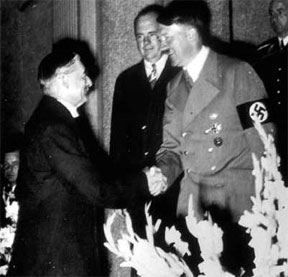
Peace on earth sounds just great, doesn't it? It also sounds like something you might read on a tacky poster in college dorm, or like something cooked up by a politician to win a few extra votes in the next election. Or it sounds very much like something a British Prime Minister once said, to his ultimate shame.
In March 1938, Germany absorbed Austria under the leadership of Adolf Hitler. Then, turning his eyes to Czechoslovakia, Hitler and his generals drew up a plan to take over that sovereign nation as well. As war between Germany and Czechoslovakia seemed imminent, the Czechs looked to their allies, France and Great Britain, for help. But the French and the British were eager to avoid a war with Hitler's military machine.
In September 1938, the British Prime Minister Neville Chamberlain, in partnership with French leaders, began negotiations with Hitler. Things appeared hopeless, however, because Hitler insisted on Germany's right to annex a substantial portion of Czechoslovakia. Yet Prime Minister Chamberlain was so eager to avoid war that he caved in to Hitler's demands. Hitler did promise, however, to resolve all future differences through consultation rather than military action. A trustworthy promise to be sure!
In October 1938 Neville Chamberlain returned to jubilant crowds throughout Britain, announcing that he had achieved "peace with honour. I believe it is peace in our time." Of course we know the rest of the story. Within months Hitler had annexed the rest of Czechoslovakia and would soon invade Poland. "Peace in our time" was no peace at all because it failed to remedy the root cause of the strife: Hitler's plan to dominate Europe. |
|
| |
Neville Chamberlain shakes hands with Adolf Hitler after achieving "peace in our time."
|
"Peace on earth" doesn't mean much unless it deals with the basic human problem of sin. Peace doesn't come along just because baby Jesus was born in a manger. It isn't a by-product of Christmas cheer or other happy thoughts. Jesus's birth was only a prerequisite to His final peacemaking effort, something we celebrate during Holy Week, not during Christmas. As a human being, the Word of God made flesh, Jesus represented us on the cross. He bore our sin as had been prophesied for the Suffering Servant in Isaiah 53. His death dealt a fatal blow to sin, the root cause of human brokenness and separation from God. Because Jesus was crucified, we can have peace in all of its fullness (Isa 53:5). Paul triumphantly celebrates Jesus's peacemaking work in the opening of his letter to the Colossians:
For God in all his fullness was pleased to live in Christ, and by him God reconciled everything to himself. He made peace with everything in heaven and on earth by means of his blood on the cross (Col 1:19-20).
The peace God intended for creation -- once lost because of sin, often promised by the prophets -- God reestablished through Jesus by "his blood on the cross." For this reason Paul can say simply of Christ: "He himself is our peace" (Eph 2:14; NIV).
But what are the dimensions and implications of the peace Jesus has wrought on the cross? What kinds of peace can we expect to experience through believing in Jesus? I address these questions in future posts in this series.
Peace with God through Christ
Part 5 of the series – Seeking the Peace of Christ: Christianity and Peacemaking
Posted for Friday, July 29, 2005
So far in this series I've shown how God intended His creation to be full of peace. This intention was broken but not destroyed when the first human sinned against God. Yet God had a plan to restore His shalom on earth, a plan focused on the life, death, and resurrection of His Son, the one who fulfilled the role of the Suffering Servant of Isaiah.
How do we experience God's peace? It all begins when we enter into relationship with God through Jesus Christ. As we put our trust in Him, Jesus not only promises us eternal life in the future, but also He invites us to begin to experience that life right now, however incompletely.
When we receive the benefits of Christ's sacrifice through faith, we can have peace with God: "Therefore, since we have been made right in God's sight by faith, we have peace with God because of what Jesus Christ our Lord has done for us" (Rom 5:1). Where once we were God's enemies because of sin, now because of Christ we have been reconciled to God (Rom 5:10-11). The strife between us and the Lord has been overcome by His grace. |

|
| |
I grew up looking at pictures like this one in evangelistic tracts. The point, obviously enough, is that only through Christ can we have peace with God. (Well, okay, the pictures I grew up with didn't include a Balrog. That's my addition.) |
I realize that this way of thinking about people and God will seem strange to most of us. Even many Christians tend to think of those who are not Christian as being basically good, as being in touch with God to some extent. We think of non-Christian people more as seekers than as God's enemies in need of peace with God. And, indeed, those who don't know the Lord may be seekers. But they are also, in a profound sense, both separated from God and opposed to God. Yet God has extended an offer of peace through Jesus Christ. Faith means receiving this offer, putting down our opposition to God, and entering into a peaceful relationship with Him.
Peace with God begins when we experience reconciliation through Christ, but it doesn't end there. When Paul, a faithful Jew, speaks of "peace with God," he thinks of the Old Testament concept of shalom. Peace with God includes intimacy, blessing, and the unimpeded flow of divine love. It encompasses everything God had intended for His relationship with us. When we have peace with God, we begin already to live in the restored creation, even while we yearn for that restoration to be completed. Once our peaceful relationship with God is renewed, the other dimensions of peace will follow, including peace with ourselves and peace with others. I'll explore these dimensions in future posts.
Inner Peace Beyond Understanding
Part 6 of the series – Seeking the Peace of Christ: Christianity and Peacemaking
Posted for Monday, August 1, 2005
Jesus promised to give his followers supernatural peace:
I'm leaving you with a gift -- peace of mind and heart. And the peace I give isn't like the peace the world gives. So don't be troubled or afraid (John 14:27).
After Jesus ascended to heaven, He gives this peace through the mediation of the Holy Spirit. Peace is one aspect of that which the Spirit produces in our lives (Gal 5:22).
The inner peace given by God isn't like the peace provided by the world, according to Jesus (John 14:27). It isn't peace that depends upon outward circumstances or inward rationalizations. Indeed, God's peace often comes when events or reasons would provide just cause for worry. As Paul notes, God's peace "is far more wonderful than the human mind can understand" (Phil 4:7).
If you've never experienced this kind of peace, all of this talk can sound rather dreamy and unrealisitic. But millions upon millions of Christians have known supernatural, inexplicable peace precisely in situations that would seem to demand fear and distress. The great hymn writer Charles Wesley, who wrote such beloved songs as "Hark! The Herald Angels Sing," lived a full life of service to Christ. Early in his 79th year, however, his health began to falter. As sickness dominated his body, Wesley knew that he would soon die. His doctor, who regularly visited his bedside during the last days, described Wesley's attitude in the face of death:
He possessed that state of mind which he had been always pleased to see in others -- unaffected humility, and holy resignation to the will of God. He had no transports of joy, but solid hope and unshaken confidence in Christ, which kept his mind in perfect peace. [Note 1]
Lest you think that only the unique heroes of Christian history have such peace when death approaches, I have sat with many ordinary saints in the hours before their passing. These also known the perfect peace that once filled the heart of Charles Wesley.
Obviously, I have not yet confronted the imminence of my death. I'm hoping to delay this experience for a quite few more years. But I have known the peace of God that is "far more wonderful than the human mind can understand." Such peace first came to me when I was in junior high. My father worked as a computer analyst in the aerospace business in Southern California. After Americans finally landed on the moon, zeal for space exploration waned and federal funding dried up. My dad lost his job and remained out of work for many months. The expenses associated with supporting a family of six continued, however. Before too long my family's financial situation was very bleak. I was panicked, afraid that we would lose our home and be forced to move away from our friends and family. I felt afraid as I had never felt before. My world seemed to be crumbling before my very eyes.
I vividly remember lying awake one night, envisioning the worst case scenario for my family. I just couldn't escape from the grip of fear. In desperation I cried out to God for help. "Please take care of us," I pleaded, "help Dad to get a job. Don't make us move. Help us!" In that moment I sensed God's thick, comforting presence as I had never known it before. Though I didn't receive any reassurance about my family's financial situation, I felt utterly, uniquely, supernaturally peaceful. My worries evaporated in the warmth of God's love for me. Without knowing what lay ahead for my family, I knew beyond any doubt that God would take care of us.
In that watershed moment of my life I experienced for the first time the gift of incomprehensible peace, that which I couldn't understand and which really made no sense at all. I also learned that such peace comes, not by human effort, but by God's grace as we turn our hearts to Him. The prophet Isaiah understood this truth when he said to the Lord, "You will keep in perfect peace all who trust in you, whose thoughts are fixed on you!" (Isa 26:3). Paul reiterated this same thought, making more explicit the connection between fixing our thoughts on God and prayer:
Don’t worry about anything; instead, pray about everything. Tell God what you need, and thank him for all he has done. If you do this, you will experience God’s peace, which is far more wonderful than the human mind can understand. His peace will guard your hearts and minds as you live in Christ Jesus (Phil 4:6-7).
What a marvelous promise! What an astounding reality!
Frances Havergal lived in the mid-19th century. A faithful and talented Christian, she wrote many beloved hymns, including "Take My Life, and Let It Be Consecrated." Her relatively short life was filled with difficult challenges. When she was eleven, her mother died. Shortly thereafter her father remarried. Frances's stepmother came between her and her father, causing deep hurt to the girl. As a young adult, Frances became chronically ill. Even to get up from her bed was painful. Yet she continued to live actively, especially in her song writing ministry. During one of her periods of illness, she composed these words:
Like a river glorious,
Is God's perfect peace,
Over all victorious,
In its bright increase;
Perfect, yet it floweth,
Fuller ev'ry day;
Perfect, yet it groweth,
Deeper all the way.
|

|
| |
Frances Ridley Havergal |
Stayed upon Jehovah,
Hearts are fully blessed;
Finding, as he promised,
Perfect peace and rest. [Note 2]
Perfect peace in the midst of severe physical pain, that's beyond our comprehension. It's a gift from God.
Notes:
[Note 1] Words to "Like a River Glorious" are in the public domain. For more on the life of Frances Havergal, see Jane Stuart Smith and Betty Carlson, Great Christian Hymn Writers (Wheaton: Crossway Books, 1997) pp. 79-84.
[Note 2] From "The Life of the Rev. John Wesley" in The Works of John Wesley, 3rd edition, Volume 5, (1872). Retrieved through Ages Software.
Peace Among People, Section A
Part 7 of the series – Seeking the Peace of Christ: Christianity and Peacemaking
Posted for Tuesday, August 2, 2005
Peace with God and peace within our souls do not exhaust the potentialities of peace through Christ. Scripture connects inner peace specifically to peace among people: "Let the peace that comes from Christ rule in your hearts. For as members of one body you are all called to live in peace" (Col 3:15). If divine peace reigns within us, it should touch the rest our lives, especially our most important relationships in family, among friends, and in church. But the peace Christ brings impacts an even broader set of human relationships than these.
Paul's letter to the Ephesians lays the spiritual foundation for peace among people. After first showing that the death of Christ leads to our personal salvation (Eph 2:4-10), Paul goes on to explore the corporate implications of the cross, focusing on the fundamental division between Jews and Gentiles.
For Christ himself has made peace between us Jews and you Gentiles by making us all one people. He has broken down the wall of hostility that used to separate us. By his death he ended the whole system of Jewish law that excluded the Gentiles. His purpose was to make peace between Jews and Gentiles by creating in himself one new person from the two groups. Together as one body, Christ reconciled both groups to God by means of his death, and our hostility toward each other was put to death (Eph 2:14-16).
The death of Jesus not only brings reconciliation between individuals and God, but also creates reconciliation among people by exploding the hostility that keeps us from living peacefully together. It's crucial that we pay attention to what Paul is teaching here, because sometimes we get so excited about the personal relevance of the cross that we neglect its corporate implications. We end up proclaiming the possibility of peace with God and peace within ourselves without mentioning peace among people.
But God's plan for you includes more than reconciliation with Him, however essential and foundational this reconciliation is. On the basis of peace with God, you can have peace with others as well, an essential dimension of God's perfect peace. Notice, too, that peace among people is not limited to a few close relationships. It transforms the relationship between Jews and Gentiles. It impacts races, ethnicities, and even nations. The Old Testament foresaw that the righteous king who comes humbly, "riding on a donkey . . . will bring peace to the nations" (Zech 9:9-10). When Jesus entered Jerusalem on Palm Sunday, He came to die so that God's peace would pervade all peoples and nations.
I didn't always think of God's peace in this way. I grew up focusing on Christ's provision of peace with God, with my own soul, and with my closest companions. Biblical passages that spoke of the social and political dimensions of divine peace could be reinterpreted to fit my preconceived notions of peace. I could easily ignore the texts that connect peace with righteousness and justice, or else relegate them to the future when Christ returns.
But when I was in graduate school, my best friend was a Mennonite pastor, one who conceived of God's peace much more wholistically. While not denying the central importance of peace with God or the blessings of inner peace, Tom spoke passionately of the fuller dimensions of peace. He helped me take seriously biblical passages I had ignored or misinterpreted, especially the latter half of Ephesians 2, which shows how Christ's death makes peace between hostile peoples. He also showed me the rich meanings of the Hebrew term shalom, a word that I had understood to refer primarily to the absence of conflict. Through Tom, I realized that I had truncated biblical peace to fit my own values, needs, and preconceptions. By his influence, I came to embrace the richer and truer sense of biblical peace, recognizing its interconnectedness with righteousness, justice, and wholeness in all of life. |

|
| |
|
Peace Among People, Section B
Part 8 of the series – Seeking the Peace of Christ: Christianity and Peacemaking
Posted for Wednesday, August 3, 2005
In my last post I began to lay out some of the broader implications of Jesus's life and death. He came to bring peace, not only between God and people, but also among people. Jesus Christ died on the cross and rose from the grave to restore peace to a broken world. Wherever there is conflict, whether inside individual hearts, or within families, or among brothers and sisters in church, or between different ethnic groups, or even between warring nations, Christ "wages peace" as his disciples wield the paradoxical power of the cross. This power is paradoxical because victory comes through the embodied proclamation of Christ's own powerlessness.
It would be a great error to think of the social dimensions of peace as simply whitewashing social evil in a grand attempt to "make nice." It's all too easy for us to confuse peacemaking with "nice-making." This was also true in Jesus's own day. Some Jews believed that, if he were the Messiah, Jesus would usher in a season of painless prosperity. To these mistaken folk Jesus said,
Do you think that I have come to bring peace on earth? No, I have come to bring strife and division! From now on families will be split apart, three in favor of me, and two against -- or the other way around. There will be a division between father and son, mother and daughter, mother-in-law and daughter-in-law (Luke 12:52-53).
Does this passage contradict everything else we have read about the peacemaking work of Christ? No, because it must be interpreted in its unique context. Jesus is speaking in Luke 12 to those who expected a superficial peace, a peace that was really no peace at all because it failed to deal with the true cause of human brokenness. Many of the Jews in the first-century equated peace with the expulsion of the Romans. "Get rid of foreign rule and we'll have peace," they thought. But Jesus came to bring an unanticipated kind of peace. His peace would address the root cause of human suffering. His peace would be offered to people who were not Jews, even to the hated Romans.
As Jesus pursued his peculiar peacemaking mission, he engendered plenty of strife. His failure to fulfill Jewish expectations led to his being rejected by his own people, while his insistence on the presence of God's reign brought about his crucifixion at Roman hands. It would have been so much easier for Jesus if he had simply joined the Zealots, who fomented violence against Rome, or the Sadducees who tolerated partnership with the Romans, or the Pharisees who by the time of Jesus focused on personal piety to the exclusion of social reformation. But Jesus was unwilling to settle for a peace that was no peace. He resolutely pursued the all-encompassing peace that comes only when sin is abolished and God's rule is reestablished on the earth.
Jesus's statement about strife and division should warn us not to equate the absence of conflict with true peace. There are families, for example, which appear to be peaceful only because the head of the household is a tyrant who uses emotional and sometimes physical violence to institute order. Churches sometimes pride themselves on avoiding conflict, but they do so only because the pastor has learned to silence open discussion through his authoritarian leadership. And there are nations that are not at war, but in which wholistic peace cannot be found. One could say, for example, that before the U.S. invaded Iraq, Iraq was at peace. But this would be a shallow understanding, both of peace and of life in Saddam's Iraq. Whether the U.S. should have gone to war against Iraq can be debated elsewhere. But it's surely true that the "peace" in Saddam's Iraq was nothing like biblical peace. |
|
|
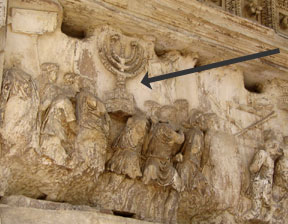
The Zealot desire for "peace" apart from Roman rule ultimately led to the destruction of Jerusalem by Rome, a sad fact of history that is memorialized on the Arch of Titus in the Roman Forum. Above: The Arch of Titus in Rome as it appears today. Below: A close-up of a frieze in the arch. The arrow points to a menorah that was taken from the temple in 70 A.D. Jerusalem by the Roman army. |
|
When we look for peace, we must keep before us the concept we find throughout Scripture. True peace will always include right-relationships, just treatment of all persons, wholeness in all dimensions of life, and divine blessing to boot. Sometimes the path to true peace must pass through strife and division before it arrives at its destination.
What does all of this mean for you personally? It means that, no matter how much you enjoy peace with God and within your own heart, you must also pursue the corporate aspects of shalom. In a nutshell, you must be a peacemaker. I'll turn to this in my next post.
Being Peacemakers in Church, Section A
Part 9 of the series – Seeking the Peace of Christ: Christianity and Peacemaking
Posted for Thursday, August 4, 2005
Jesus said it bluntly: "Blessed are the peacemakers, for they will be called children of God" (Matt 5:9). Time and again the rest of the New Testament echoes his preference for peacemaking:
Let us therefore make every effort to do what leads to peace and to mutual edification (Rom 14:19; NIV).
Bind yourselves together with peace (Eph 4:3).
Try to live in peace with everyone (Heb 12:14).
Each of these passages sets peacemaking within the context of Christian community. We seek to live in peace as part of our koinônia together.
Martin Luther was correct. The Church of Jesus Christ is indeed a mighty fortress, against which the gates of Hell cannot prevail. But individual Christian communities are sometimes quite fragile. Frequently they shatter because members seek their own good, rather than the benefit of the community as a whole. You and I are called to be peacemakers within our churches, to preserve the unity and seek the wholeness of Christian koinônia. Paul's instruction quoted above, "bind yourselves together with peace," falls within a broader exhortation to church unity.
Be humble and gentle. Be patient with each other, making allowance for each other's faults because of your love. Always keep yourselves united in the Holy Spirit, and bind yourselves together with peace. We are all one body, we have the same Spirit, and we have all been called to the same glorious future (Eph 4:2-4).
We are to make peace among our brothers and sisters in Christ because we are one body together, united by the one Spirit.
How can you be a peacemaker in your church? Note carefully Paul's wise counsel. First, "be humble and gentle" (Eph 4:2) Don't think too highly of yourself, but consider others better than yourself (Phil 2:3). If you have a complaint or criticism, communicate it with humility, realizing that you could be wrong. And in all interactions, treat people with gentleness, remembering that they are precious to God.
Second, you can make peace within your fellowship by being "patient with each other, making allowance for each other's faults because of your love" (Eph 4:2). This call to patience implies that those around you will frustrate you with their slowness. They won't repent quickly enough. They won't serve actively enough. They will pray too long or not pray enough. Yet you must put up with their faults and weaknesses, even as they must put up with yours, thank God! It is certainly right to confront a brother or sister who sins. (See my series entitled What To Do When Someone Sins Against You: Guidance from the Master.) But patience is necessarily for all the little things others do that aren't sinful, but just bothersome.
When I read verse 2 with its call to humility, gentleness, and patience, I immediately think of one of the founding members of Irvine Presbyterian Church, a man named Jack. Jack was on the search committee that called me as pastor, as he had been on the first committee that called our founding pastor, Ben Patterson. Jack had retired after a successful business career. He was the most respected and beloved man among church members -- a well-deserved honor. When I arrived at the church, I quickly noted that Jack also had a room named after him, the only room in the church named after any person, living or dead. It was apparent to me that Jack had great power within Irvine Presbyterian Church.
Jack could have used his power to dominate me, but he never chose to do so. Instead, he always used his power in a Christ-like manner. He was a strong, outspoken supporter of my ministry. |

|
| |
Jack, standing behind me (or at least someone who looks like me, but with a lot more hair!)
|
As is natural, however, at times he believed that my leadership was lacking or misdirected. Jack would make an appointment to see me. After affirming my ministry and reassuring me of God's call to be pastor of the church, he would tell me what was bugging him. Every single time he did this with humility, gentleness, and patience. Jack could have wielded his power to coerce my agreement. But he never even tried to do it. He could have wounded my spirit by pointing to his superior wisdom. He never did that. He could have said that he was sick and tired of trying to help young pastors grow up. But he never said anything like that. When Jack and I finished our meetings, I always felt encouraged. In Jack's woodshed there weren't any switches, just abundant peace and lots of wisdom.
In my next post I want to say a little more about being a peacemaker in church.
Being Peacemakers in Church, Section B
Part 10 of the series – Seeking the Peace of Christ: Christianity and Peacemaking
Posted for Friday, August 5, 2005
If you are going to make peace within your church, you must "make every effort to maintain the unity of the Spirit" (Eph 4:3). Church unity is not something you can take for granted, but it is something to be sought with vigorous effort. Where you see the beginning of division, snuff it out. If two church members are stuck in disagreement, help them to understand each other. If something about the church begins to get on your nerves -- and, believe me, something will! -- don't complain behind the leaders' backs or threaten to leave the church. Rather, talk directly and humbly with those who are responsible. Don't ever brandish the "I might leave" threat unless you're facing a major issue of intractable heresy or unrepentance. (I once heard a faithful church member threaten to leave if the high school minister didn't start sending out flyers on time. No kidding!)
In his letter to the Colossians Paul mentions one other activity that is essential to peacemaking within the church:
You must make allowance for each other’s faults and forgive the person who offends you. Remember, the Lord forgave you, so you must forgive others. And the most important piece of clothing you must wear is love. Love is what binds us all together in perfect harmony. And let the peace that comes from Christ rule in your hearts. For as members of one body you are all called to live in peace. (Col 3:13-15)
Peacemaking requires forgiveness. Over and over again our Christian siblings will hurt us. That's too bad, but that's the way it is. If we hold onto the offense and the pain, if we formulate plans to get even, if we fail to forgive or pretend to forgive without actually doing so, then we will contribute to the demise of our Christian community just as much or more than the one who wronged us. When we do forgive, however, our relationships with be renewed and the body of Christ will strengthened.
| I remember a time when an elder named Tim helped the leaders of our church resolve a contentious discussion about worship. While he served on our elder board, Tim was an exemplary leader. He also drove me crazy at times, and I generously returned the favor. Both Tim and I are fairly active thinkers and robust communicators. We tend to like our own opinions a lot, and to defend them vigorously. When Tim and I disagreed about something, the conversation could get hot. Both of us would sometimes end up saying things to each other that were more than a little inappropriate. No cussing or fist fights, just barbs that poked too hard or insinuations that punched below the emotional belt.
But Tim and I never let those offenses lie. On any number of occasions we'd be on the phone the next day, asking for and granting forgiveness. As a result, the leadership of our church was stronger. Our relationship, far from being injured, grew into deeper koinônia. Tim is one of my dearest friends, and I would love for him to serve on the board again, if he ever feels called to do so. We'd probably go a few more rounds in the ring, I'd imagine. But I know the outcome already. My experience with Tim illustrates that genuine forgiveness not only preserves peace, but also makes it better. |
|
| |
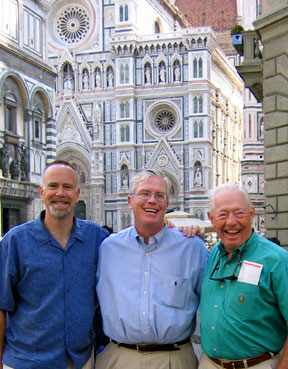
Last year Tim and I, along with our wives, joined Hugh Hewitt on one of his cruises. It was a blast! Here we are (Tim on the right, Hugh in the center) in front of the Duomo in Florence.
|
In my next post I want to discuss one of the most important contexts for peacemaking: the family.
Peacemaking in Families
Part 11 of the series – Seeking the Peace of Christ: Christianity and Peacemaking
Posted for Monday, August 8, 2005
In my last post in this series I spoke of the centrality of forgiveness in peacemaking. While I'm speaking of forgiveness, I want to say a word about peacemaking in families. Everything I have said about peacemaking in church applies equally to family life. Humility, gentleness, patience, unity, and forgiveness belong at home. Unfortunately, home is often the toughest place to live out these virtues. When I come home from work, after a day of exercising humility, gentleness, patience, and forgiveness with my staff and church members, I'm worn out. My children might get the last bit of peacemaking I can muster, though sometimes they don't even get the dregs. My wife, Linda, however, can get pride, insensitivity, impatience, and unforgiveness. If she's had a bad day too, you can imagine how much peace will bless our marriage that night. |

|
| |
My family, on the day we got our new puppy Sandy
|
As I grow in Christ, I'm learning to live my faith at home first and foremost, not last and least. But because I'm so human, as are my other family members, forgiveness pervades our household. Without forgiveness, we'd soon build up walls of hostility that would damage our fellowship and reflect poorly on the Lord. That's the state of many families today, including many Christian families. Husbands and wives have substituted nice-making for genuine peacemaking, thus storing up bitterness against one another. The same is often true of other family relationships. Only forgiveness, forgiveness modeled after God's own forgiveness and inspired by God's own Sprit, will bring wholeness -- shalom -- to our families.
Throughout my years as a pastor I have witnessed deeply moving examples of forgiveness in families. I've seen children forgive a father for his years of alcoholic abuse. I've seen husbands forgive wives who have been unfaithful in their marriage. And I've seen wives do the same. God's grace enables us to forgive, genuinely and fully, what we could never do on our own.
But forgiveness is not pretending that everything is okay. If a husband is physically abusing his wife, for example, she does, in time, need to forgive him. But this doesn't mean she should simply stick around and take the abuse. Forgiveness doesn't turn us into human doormats, and it doesn't take away the need for wrongdoers to confess and repent.
A Christian leader I know has a terrible temper. He has said and done things in anger that are clearly sinful. Yet, to my knowledge, he's never truly confessed his sin to those he has wronged and asked them to forgive him. He seems to assume that his fellow Christians owe him forgiveness, which is true, of course. But it's only half of the equation. The other half includes his willingness to admit his mistakes and seek forgiveness, not to mention to be held accountable for his behavior.
Peacemaking, whether in church or family or in the broader world, often begins when we work on the things in ourselves that disrupt peace. You and I will be better peacemakers when, through the Spirit, we become more like Christ.
Peacemaking in the World, Section A
Part 12 of the series -- Seeking the Peace of Christ: Christianity and Peacemaking
Posted for Tuesday, August 9, 2005
As I've shown in my recent posts, our peacemaking task begins right in front of us, in our closest relationships at home, at work, at school, and at church. But it doesn't stop there. As God's peacemakers, we must take the message and substance of peace into the whole world. I am discussing the global dimension of peacemaking after the ecclesial and familial, not because the global is less important, but because we can hardly commend the peace of Christ to the world if our primary relationships are fractured and contentious.
How can we bring God's peace to the world? First of all, we announce the peacemaking work of Christ on the cross. Telling the good news about Jesus is essential to any Christian peacemaking effort. This good news invites others to renounce their sin and to be reconciled to God. Thus it opens the door so that they might begin to live in God's peace and to join the ranks of divine peacemakers.
Second, we bring God's peace to the world by holding up the cross of Christ as an example to emulated. Though the world might scoff at Christ's paradigm of self-sacrifice, it shows us all how to live.
Third, we extend divine peace into the world by living peaceably each day: "Do your part to live in peace with everyone, as much as possible" (Rom 12:18). Notice that we are to live peaceably with "everyone," those inside the church and outside of the church, those in our families and those at our workplace, the servers who wait on our tables with extra consideration and the "stupid idiots" who cut us off in the parking lot.
Fourth, we bring God's peace to the world by seeking his righteousness and justice. Jesus tells us to "seek first the kingdom [of God] and his righteousness/justice" (Matt 6:33, MDR). Most translations refer only to God's "righteousness," but the Greek word carries both connotations. Jesus maintains the Jewish interconnection of righteousness, justice, and peace. We would expect as much from Jesus, since he is the fulfillment of Isaiah's prophecy as the Prince of Peace who will rule forever with "justice and righteousness" (Isa 9:6-7, NIV). He is the one who brings good news to the poor, release to the captives, and freedom to the downtrodden (Luke 4:18).
In practical terms, how do we seek God's righteousness and justice? We treat all people with respect and dignity, even and especially those who are most helpless and defenseless. We make sure our practices and policies reflect God's revealed values, even when we operate in "the world." We don't turn the other way when we see injustice, but invest our energies so that God's justice and righteousness might take form in and ultimately transform our world.
This last activity, doing justice in the world, has been the cause of considerable debate and conflict among Christians. When I was young, I watched Christians pummel each other verbally over American involvement in Vietnam. For some, a Christian commitment to peace demanded immediate withdrawal. For others, Christian values required that we free the South Vietnamese from the domination of communism. In the 1980's, I had Christian friends who protested against the American nuclear arms build-up, even to the point of being arrested in acts of civil disobedience. I had other Christian friends who committed their professional lives to helping the U.S. make nuclear weapons. They did this conscientiously, believing that their efforts would further the cause of peace in the world. Within contemporary society, some Christians focus their efforts on justice for the unborn, while others ignore this issue altogether, claiming that racial injustice deserves our primary attention.
I can't begin to resolve these issues here. They are complex and, quite frankly, often beyond my own powers of discernment. But let me offer a few words of guidance. Even though the relationship between Christian peacemaking and political activism can be confusing, we may not forget about it. Scripture calls us to make peace in every dimension of life and to seek justice in this world. Many peacemaking actions are clearly taught in Scripture and therefore require little debate. Feeding the homeless, building a home with Habitat for Humanity, sponsoring a child through World Vision, embracing someone from an ethnic background other than your own, caring for inmates through Prison Fellowship -- all of these actions and countless more are clearly biblical. Invest yourself in doing that which God obviously favors, without spending all your time debating the difficult issues and doing nothing tangible.
When it comes to the tricky issues, however, and we all must face them, let me urge you to seek God's wisdom in Scripture. Many advocates of social causes, including many Christians, do not ground their efforts in God's Word. Thus they easily go astray, either in goals or in strategies, and usually in both. Before you adopt a pet issue, search the Scriptures. Is your position really taught there? Is it a major theme of Scripture, or really just your pastor's favorite bugaboo?
For example, I knew a Christian woman who had a rabid passion for animal rights. It consumed her time, her energy, and her money. It's all she could talk about. In corporate prayer meetings, it's the only thing she prayed about. She was hoping that our church might lead protests outside of medical labs at a local university, where they used animals in medical research. She was one of the early members of PETA (People for the Ethical Treatment of Animals). |

|
| |
As far as I can tell, this is a genuine bumper sticker produced by PETA. In fact the evidence that Jesus was a vegetarian is non-existent. This doesn't mean there's anything wrong with being a vegetarian, however.
|
Now I would certainly grant that one can make an argument from Scripture for the need to treat God's creation well, including animal life. Given the Old Testament sacrificial system and the fact that Jesus ate fish, however, it's a little hard to say that God always and in every instance opposes the killing of animals. But even if this were true, does the cause of animal rights deserve the investment of your entire energy as a Christian? I don't think so. With so many human beings starving in this world, with so many who are victims of oppression, with so many who have never heard the gospel of Christ, I believe that biblical priorities will guide our energies into more eternally meaningful efforts.
Peacemaking in the World, Section B
Part 13 of the series -- Seeking the Peace of Christ: Christianity and Peacemaking
Posted for Wednesday, August 10, 2005
When I consider Jesus's blessing of peacemakers, I think of a ministry in Hollywood, California called "City Dwellers." In my last years at Hollywood Presbyterian Church, I was privileged to watch this ministry grow. It flourishes to this day as a parachurch ministry related to the Hollywood church.
City Dwellers was, in part, a response to God's word through Jeremiah:
But seek the peace [shalom] of the city to which I have sent you in exile, and pray to the Lord for it, because in its peace [shalom] will be your peace [shalom] (Jer 29:7; MDR).
Members of the City Dwellers team moved into one of the neighborhoods in the city of Hollywood, a barrio of filled primarily with lower class immigrant families. Violence, crime, poverty, injustice -- all were common in "the neighborhood." They sought God's shalom for that community.
City Dweller teammates were usually young adults who commit to spend a year living in Hollywood as peacemakers. Their ministry was multi-faceted. They shared the gospel and their possessions with their neighbors. They shepherded children and encouraged parents. They sought justice for people whose ignorance of American society and the English language made them easy targets for oppressors. They fed the hungry and visited prisoners in jail. They comforted mothers whose children were shot in drive-by shootings. They taught young people academic skills and they taught them about Jesus.
Was City Dwellers an evangelistic ministry? You bet. Was it social action? Undoubtedly. Did it seek healing for the sick and the brokenhearted? No question about it. Did it model and proclaim the peace of Christ? In everything that it did.
I remember watching with amazement a Bible study led by Jay, one of the first City Dwellers. He had gathered a group of Hispanic boys around ten years old. Jay called them his "Bible study," but they did much more than study together once a week. Jay shared his life with these boys and they shared theirs with him. As the boys grew up, some of them started looking more and more like the gang-bangers in the neighborhood. Others found the strength to stay away from risky involvement with gangs. But no matter what, Jay loved those boys and they loved him back. Because of Jay's loving witness, many of them also grew to know the love of God personally and to love God in return. What a joyful sight at Jay's wedding, where several of these young men were dressed up in their tuxedos, truly Jay's brothers in Christ. |

|
| |
I don't have any pictures of Jay with his "Bible study." But I do have one of Jay celebrating his son's birthday. Jay is the green one. Here's a piece of advice: If you ever meet Jay, don't make him angry!
|
City Dwellers is not alone among Christian ministries in its "whole gospel" approach to ministry. I can think of several ministries that are wholistic in their exercise of peacemaking. World Vision touches millions of people throughout the world, backing up the message of the gospel by providing food for the hungry and seeking justice for the downtrodden. Habitat for Humanity brings peace to families by helping them to afford their own homes. In the process of building houses, the good news of Christ is proclaimed and demonstrated as people from different walks of life dig ditches, put up drywall, and paint walls. Promise Keepers, noted for its evangelistic and renewal ministries for men, has also been a leader in racial reconciliation. In one of its gatherings in Los Angeles, a prominent African-American pastor called the men present to confess their racism, but only after he had first confessed his own. This list could go on and on, for there are thousands of Christian ministries throughout the world, not to mention millions of churches, that reflect the call of Christ to wholistic peacemaking. You can join this effort by becoming an active partner of one of these ministries, often in conjunction with your own church.
The Peace that Lies Ahead
Part 14 of the series -- Seeking the Peace of Christ: Christianity and Peacemaking
Posted for Thursday, August 11, 2005
When City Dwellers share their lives with Hispanic kids, or when World Vision mobilizes the church to care for victims of famine, or when churches in a community get together to build a house with Habitat for Humanity, you catch a glimpse of the peace that lies ahead. When a family moves into its very first home that was built by volunteers with Habitat for Humanity, or when men cast off their racism and embrace other men whose skin isn't the same color as their own, the can see the dawning of the future. When a husband and a wife choose forgiveness over bitterness, or a person of power chooses the way of humility and gentleness, you taste a morsel of the messianic banquet yet to come. When people whose lives have been imprisoned by brokenness find wholeness and freedom through Christ, you peek through a window into eternity. Every time God's peace invades our present existence, we get a foretaste of the infinitely greater peace that will someday envelope heaven and earth.
God's people have looked forward to this time for centuries. The Old Testament prophet Isaiah, for example, had a vision of divine peace conquering the whole world:
In the last days, the Temple of the Lord in Jerusalem will become the most important place on earth. People from all over the world will go there to worship. Many nations will come and say, "Come, let us go up to the mountain of the Lord, to the Temple of the God of Israel. There he will teach us his ways, so that we may obey him." For in those days the Lord's teaching and his word will go out from Jerusalem. The Lord will settle international disputes. All the nations will beat their swords into plowshares and their spears into pruning hooks. All wars will stop, and military training will come to an end (Isa 2:2-4).
To update the imagery a bit, someday tanks will be turned into tractors and silos for nuclear missiles into silos filled with abundant grain. God's peace will have won the war. Human koinônia, damaged through sin but never completely lost, will be refreshed perpetually in the river of divine peace. |

|
| |
One of the most ardent supporters of Habitat for Humanity is former president Jimmy Carter. A friend of mine was involved in a project with him, and he really works . . . hard! These are not just photo ops. |
The last book of the Bible, the Revelation of John, reveals the future in images reminiscent of Isaiah:
Then I saw a new heaven and a new earth, for the old heaven and the old earth had disappeared. And the sea was also gone. And I saw the holy city, the new Jerusalem, coming down from God out of heaven like a beautiful bride prepared for her husband. I heard a loud shout from the throne, saying, "Look, the home of God is now among his people! He will live with them, and they will be his people. God himself will be with them. He will remove all of their sorrows, and there will be no more death or sorrow or crying or pain. For the old world and its evils are gone forever." (Rev 21:1-4).
God will not obliterate his creation, but renew it to match his original intention. He will no longer be separated from us because of sin. The work of reconciliation will be completed and we will live with God, just as we were supposed to from the beginning. Koinônia with God, lost in the fall, regained in the cross, will be fully restored. In place of sorrow, we will delight in the fullness of joy. Bathed in God's peace, we will once again inhabit paradise.
Christians are people who live now in intimate fellowship with God and with God's people. In these relationships we experience genuine peace, yet not the fullness of peace. By the indwelling Spirit, we step into the future, enjoying peace with God and all its benefits . . . but only in part. We walk intimately with God, even though sin keeps nipping at our heals, and, every now and then, tripping us altogether. We share life with our Christian brothers and sisters, sometimes loving each other as Christ has loved us and sometimes clobbering each other like a bunch of squabbling siblings. Already we can see Heaven arising on the horizon, but the dawn tarries.
The biblical vision of the peace that lies ahead helps draw us near to God. It enables us to trust him in the midst of a world so filled with brokenness and strife. This vision also motivates us to be peacemakers, even when our notions of peace and our approaches to peacemaking seem naive to a jaded, worn out world. Finally, the biblical picture of peace yet to come binds us together with other Christians in a koinônia of hope. To quote from the Apostle Paul once again:
May the God of hope fill you with all joy and peace as you trust in him, so that you may overflow with hope by the power of the Holy Spirit (Rom 15:13, NIV).
Knowing God's Peace: Some Practical Advice
Part 15 of the series -- Seeking the Peace of Christ: Christianity and Peacemaking
Posted for Friday, August 12, 2005
As a pastor, I frequently chat with people who want to know the peace of God, but find it elusive. Their question – and perhaps your question as well – gets right to the point: How can I really know divine peace each day?
I'll try to answer that question, but before I do I want to offer a couple of qualifications. First, the peace of God isn't the result of some formula. It's not something you can produce with a magic formula. Rather, it's a result of relationship with the living God, a God who cannot be put into a neat little box.
Second, I must first confess that I can also let the experience of God's peace slip away from me. I have always been a chronic worrywart and I easily let little things disrupt the Spirit's gift of inner peace. That doesn't invalidate what I'm about to say, however, because my advice comes from the Scripture, not from my own inconsistent experience. I simply want to be honest about my shortcomings.
Peace is a gift from God. Every individual experience of peace rests, at its base, upon the peacemaking work of Christ on the cross. Knowing peace each day is, therefore, a blessing from God:
The Lord gives his people strength. The Lord blesses them with peace. (Psa 29:11).
May the Lord of peace himself always give you peace no matter what happens. (2 Thess 3:16).
Divine peace, whether in our hearts or in our relationships, comes from the hand of God. If you are lacking peace, don't try to make yourself feel peaceful. Don't begin with breathing exercises or soothing rationalizations. Rather, turn your heart to the Lord. Cry out to him for help. Spend time with him on a regular basis. I am always impressed by how much more peacefully I take on the problems of the day when I have begun that day with Christ. Since peace of mind and heart are his gift, this should come as no surprise (John 14:27).
| The more you focus your mind upon God and the things of God, the more you will dwell in His peace. This theme appears throughout the Scripture. Isaiah says to the Lord, "You will keep in perfect peace all who trust in you, whose thoughts are fixed on you!" (Isa 26:3). Paul writes, "To set the mind on the flesh is death, but to set the mind on the Spirit is life and peace" (Rom 8:6, NRSV). If you are struggling with doubt or worry, I'll bet that your mind is focused somewhere else, probably on yourself and your problems. Ask God for the grace to set your mind upon Him, and you will come to know his peace. |
|
| |
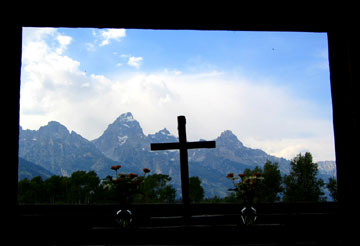
This picture is from the inside of the Chapel of the Transfiguration in Grand Teton National Park. A fitting image of peace, if you ask me. |
Prayer becomes the principle context in which this work of "mind-setting" occurs. In prayer we meditate upon God's mercy and love. In prayer we lay our worries at God's feet. You and I need to adopt Paul's advice to the Philippians as our own:
Don't worry about anything; instead, pray about everything. Tell God what you need, and thank him for all he has done. If you do this, you will experience God's peace, which is far more wonderful than the human mind can understand. His peace will guard your hearts and minds as you live in Christ Jesus.
Our individual experience of God's peace depends, to a great extent, upon our participation in the community of God's people. When we struggle with all those feelings that squelch God's peace within us, our brothers and sisters in Christ will listen to us, pray for us, and encourage us. If you want to know God's peace each day, make sure you don't seek it alone.
In a nutshell, the peace of God is a by-product of genuine koinônia. If you want to experience more peace, invest yourself more fully in intimate fellowship with God and God's people.
Becoming a Peacemaker: Some Practical Advice
Part 16 of the series -- Seeking the Peace of Christ: Christianity and Peacemaking
Posted for Tuesday, August 16, 2005
Once again I want to address a very practical question, the kind of query I get from people in my congregation who want to take God's truth and live it out in their real lives. So here's a question that I can imagine being asked by someone in my church: "Pastor, there are so many ways to be involved in God's peacemaking work that I feel overwhelmed. I don't even know where to start. I care about so many different issues. What should I do to begin living as a peacemaker?"
First, look at what is right in front of you. Chances are that you'll find numerous opportunities to be a peacemaker right in your own home, or in your classroom, or in your office, or in your neighborhood, or in your church. Ask the Lord to show you how you can share his peace with those who share your life each day.
Second, ask God for direction concerning which ministry of peacemaking to invest in. Beware of the tendency to get over-involved. Doing more than you have time to do will quickly steal away your inner peace, and thereby enfeeble your attempts to be a peacemaker for others. Frankly, I've watched too many well-meaning Christians exhaust themselves so much in various worthy causes that they have little time left for their own families. Not a good peacemaking plan!
Third, what is your passion? Often God directs us through our convictions and strong feelings. If you have an abiding concern about racial injustice, for example, that may be God's way of directing you to a ministry committed to racial reconciliation. When we act on our passions, we tend to have more energy and "stick-to-itiveness." My only word of warning is that sometimes people who are passionate about an issue can have such strong emotions that they don't think clearly about it.
Fourth, always seek God's will through studying and meditating upon Scripture. You may hear the Spirit's voice as you reflect upon what the Spirit has already said in the Bible.
Fifth, allow your Christian community to help you discern where to invest your energies as a member of God's peacemaking team. When your brothers and sisters listen to you and pray with you for guidance, they'll also help you to distinguish between God's call and your own immature enthusiasm. |
|
| |
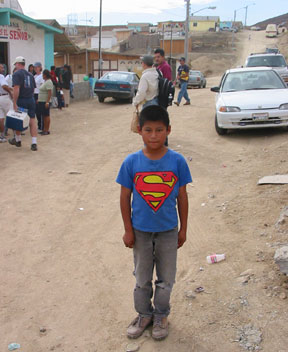
Many people in my church have become involved in a peacemaking effort in small village in northern Mexico called El Niño. We've built many small homes there, as well as a library for the local school. Currently we're sponsoring around 250 children so that they can go to school.
|
Sixth, don't just sit there, do something! Now I don't mean to suggest that you rush unthinkingly into some long-term commitment. But all too often well-intentioned people think about all the good they could do in the world without lifting a finger to make a real difference. So, even if you're not sure what you'd like to do for years and years, find some short-term cause and get busy.
Home |