Birth of Jesus; Christmas; Nativity Stories; Truth of Christmas; Birth of Jesus History
The Birth of Jesus:
Hype or History
by Rev. Dr. Mark D. Roberts
Copyright © 2004 by Mark D. Roberts
Note: Some of this material appears also in the series Sharing Laity Lodge
Note: You may download this resource at no cost, for personal use or for use in a Christian ministry, as long as you are not publishing it for sale. All I ask is that you give credit where credit is due. For all other uses, please contact me at mark@markdroberts.com. Thank you.
My Various Writings on Jesus
The Birth of Jesus: Hype or History?
Was Jesus Divine? The Early Christian Understanding
Why Did Jesus Have to Die?
Was Jesus Married? A Careful Look at the Real Evidence
What Was the Message of Jesus?
How Can We Know Anything about the Real Jesus?
What Languages Did Jesus Speak and Why Does It Matter?
Recovering the Scandal of the Cross?
The Passion of the Christ: An In-Depth Review
Book -- Jesus Revealed: Know Him Better to Love Him Better
The Birth of Jesus: Hype or History?
Part 1 in the series “The Birth of Jesus: Hype or History”
Posted at 10:00 p.m. on Thursday, December 9, 2004
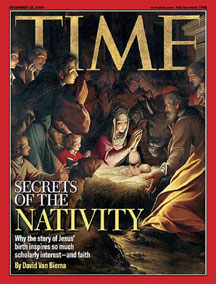
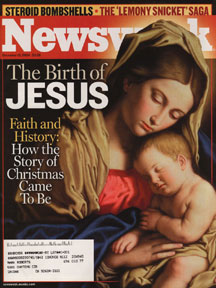
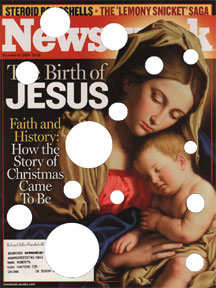
This week both Newsweek and Time feature the birth of Jesus on their covers. Newsweek’s cover story is entitled: “The Birth of Jesus – Faith and History: How the Story of Christmas Came to Be.” Time’s cover proclaims: “Secrets of the Nativity: Why the story of Jesus’ birth inspires so much scholar interest – and faith.” Both stories share many common themes. Among other things, they both argue that, although Christmas and its traditions are beloved among Christians, much if not all of the story of the birth of Jesus was an invention of the early Christian church rather than a chronicle of what really happened when Jesus was born.
If you’re a fairly conservative Christian, one who believes that the stories of the Bible, including the story of Jesus’s birth, are true, then the articles in Time and Newsweek may be upsetting to you. Then again, they may not be particularly troublesome. After all, they’re mostly just retreads of old ideas. If you’ve been reading secular accounts of Christmas for as long as I have, then you’re response to Time and Newsweek may be “Been there, done that.” Although both articles have a few novel insights, for the most part they repeat the sort of thing that has been appearing in secular media for years and years. You can count on the fact that when major Christian holidays approach, secular “news” sources will publish stories that seem to undermine the whole point of the holidays.
Now in fairness to the writers and publishers of such articles, I should add that they may not intend to be as corrosive of Christian faith as they seem to be at first glance. The authors, whose personal faith commitments are not obvious in their essays, are obviously at home in the worlds of secular biblical scholarship and liberal Christianity. In these worlds it’s commonplace to deny the historical accuracy of the biblical narrative without necessarily disparaging the perceived essence of Christian faith. One can believe that God truly loves humankind and has reached out to save us, it is assumed, without also believing that Jesus was actually born in a manger from a virgin mother. Whether, in the end, it makes logical sense to believe this way I’ll save for another series. My point, however, is that the people behind articles that seem to debunk Christian faith may not have this intention in mind. They may in fact see themselves as offering a genuinely faithful alternative for those who can’t quite stomach the miraculous and exclusive claims of Christian orthodoxy. As I read the articles in Time and Newsweek, this is the impression I received. |
|
|
| |
One of the greatest things in both magazines is their use of classic Christian art, not only on the cover, but throughout the articles.
|
|
| |
My main concern about articles such as these is that they certainly appear to undermine classic Christian belief, even though they acknowledge the pervasiveness of this belief and don’t directly condemn it. Nowhere do they actually say: “Though many Christians believe the Christmas stories are true, in fact they’ve been duped, both about the stories and about Christian faith.” But, although many believers who read these cover stories will chalk them up as “same ol’, same ol’,” others may be worried. Perhaps, some Christians may wonder, what we believe about Christmas really was made up by the early church. Perhaps the Christmas story is really nothing more than a collection of pious and propagandistic legends.
Furthermore, stories like we find in Time and Newsweek stoke the fires of unbelief. When read by a non-Christian person, they may confirm the suspicion that Christian orthodoxy has no grounding in actual historical events. Thus the story of Jesus is not the story of God’s entry into human experience, but simply one story among many religious and philosophical options. After all, if the baby Jesus was really God in the flesh, then all people ought to take him seriously whether they’d like to or not. But if the account of his miraculous birth was fabricated by early Christians to compete with Roman emperor worship, then non-Christian folk can feel free to continue to ignore Jesus.
In this post I want to begin a short series that examines the articles in Time and Newsweek, using this examination to speak more broadly on the issues of history, scholarship, faith, and Christmas. I don’t envision this series as a systematic attempt to deal with the birth of Jesus (as I have done with several other Jesus series, for example: Was Jesus Divine? The Early Christian Perspective). Rather, I want to use the recent articles as jumping off points for a more informal conversation. The form of this series will be a critical commentary on the articles themselves. I will cite various passages from the articles and then offer my critique.
Before I do this, however, I want to note that much of what is contained within these articles is both true and helpful. I haven’t actually counted the words, but I’d expect that I agree with well over eighty percent of what is found in each article. In my commentary I will note some of my agreements with the articles, but for the most part I want to focus on places where I differ from the articles. I will begin by focusing on the Newsweek piece because it is, in my opinion, less supportive of traditional Christian faith and understanding.
One final point: Though orthodox Christians believe that the accounts of Jesus’s birth are historically accurate, we don’t use these accounts as compelling arguments for Christian faith. This stands in contrast to the case for the resurrection of Jesus, for which there is strong historical evidence, and which Christians often use to persuade others of the reasonableness of Christian faith. When it comes to the Christmas stories, however, we don’t have the kind of historical data that we have for the resurrection. Thus, while many Christians can say, “The gripping evidence for the resurrection of Jesus helped me to become a believer,” virtually none would say, “The overwhelming historical proof for the virgin birth led me to faith in Jesus.” Belief in the virginal conception of Jesus comes as a result of our belief in Jesus and in the essential trustworthiness of the New Testament gospels, not the other way around. Thus most Christians would say something like this: “Because I believe Jesus is the divine Son of God, and because I believe that the gospels accurately tell the story of Jesus, therefore I accept the Christmas stories as factually true.”
Yet, as the articles in Time and Newsweek inform us, some scholars assert that the birth narratives themselves are rife with problems that demonstrate their legendary nature. To this assertion and others like it I’ll turn in future posts. Though I can’t prove that the Christmas stories really happened – which, by the way, is the case for the rest of ancient history as well – I can show that it’s reasonable to accept the biblical narratives as historically reliable accounts. Therefore, we can have confidence that the traditional celebration of Christmas is not only spiritually moving, but also grounded upon what really happened 2000 years ago.
Home
Colossal Controversy or a Tempest in a Teapot?
Part 2 in the series “The Birth of Jesus: Hype or History?”
Posted at 10:00 p.m. on Friday, December 10, 2004
Yesterday I began a new series, “The Birth of Jesus: Hype or History?” In this series I will offer a critical response to the recent Time and Newsweek cover stories on the birth of Jesus. As I mentioned yesterday, I’ll begin with the Newsweek piece because it is less supportive of Christian orthodoxy. I figure I might as well take on the toughest challenge first.
Excerpt #1 from Newsweek: Complexity and Controversy
Jon Meacham, the author of the Newsweek article “The Birth of Jesus,” begins by describing the experience of Mary, the mother of Jesus, as she first heard from the angel that she would bear a child. After a brief retelling of this story from Mary’s perspective, Meacham observes:
Now, at the beginning of the 21st century, some scholars treat the Christmas narratives a first-century inventions designed to strengthen the seemingly tenuous claim that Jesus was the Messiah.
And so the story of the birth of Jesus of Nazareth is, fittingly, as riven with complexity and controversy as Christianity itself. This month more than a billion Christians will commemorate their Lord’s Nativity. Amid candlelight, carols and the commingled smells of cedar and incense, the old tale will unfold again: Gabriel’s visitation, the journey to Bethlehem, the arrival of the baby in a stable, the glorious announcement to the shepherds in the night, the star in the East, the mission of the Magi.
My Comment: Notice carefully what Meacham claims here. First he says that “some scholars” consider the Christmas narratives to be “first-century inventions.” This is true. Yet from this observation he concludes that the story of Jesus’s birth is “as riven with complexity and controversy as Christianity itself.” Does this conclusion follow from the evidence, or is it an enormous exaggeration?
If you’ve studied much church history, you know that Christianity is filled to the brim with complexity and controversy. Yet not when it comes to the story and meaning of Christmas! The vast majority of Christians throughout the world, including thousands of Christian scholars, believe that that Christmas story is basically true. According to Meacham’s own figures, this year more than a billion Christians will celebrate the simple yet profound truth that God became human in Jesus. Believers from Roman Catholic, Eastern Orthodox, mainline Protestant, Pentecostal, and independent churches throughout the world will experience extraordinary unity in their understanding and celebration of Christmas. In fact there may be little else in Christendom upon which more Christians experience more unity than their understanding of the birth of Jesus.
So where is the Christmas “complexity and controversy” that is equal to that in all of Christianity? For Newsweek, it’s in the fact that “some scholars” treat the biblical narratives as first-century inventions. From Meacham’s perspective, the opinions of “some scholars” counterbalance the overwhelming unity of almost all Christians when it comes to Christmas. But does this make any sense? I don’t think so. Suppose, for the sake of argument, that there are 1,000 scholars who actively dispute the historicity of the birth narratives. (My guess is that the actual number is far less than this.) This means that for every single disputatious scholar there are one million faithful believers. To put it differently, 99.9999% of people who care about Christmas agree on the basics, while .0001% of them hold an opposing viewpoint. Does this constitute a major controversy in Christendom, as Meacham alleges? Or is it, rather, a tempest in a teapot?
| I vote for tempest in a teapot. In fact, the only place one finds much “complexity and controversy” concerning the birth of Jesus is among a certain swath of scholars, those who tend to approach the biblical records with extreme skepticism. Many highly educated biblical scholars – who happen to be orthodox Christians – recognize the complexity of the biblical narratives, but continue to accept them as basically accurate and trustworthy historical accounts. Of course Meacham doesn’t quote one of these scholars, or even acknowledge their existence. |
|
| |
|
I should mention, by the way, that I lived in Meacham’s scholarly teapot for several years while in graduate school, and I still make a return visit every now and then. The “teapot” is the world of secular or liberal biblical scholarship. I studied New Testament at Harvard, ultimately earning my Ph.D. there. Several of the scholars cited in the Newsweek and Time articles were my colleagues. We shared the same classes, libraries, teachers, and dissertation advisors. We employed – and still do employ – many of the same scholarly tools in our study of the New Testament. But we differed largely with respect to the assumptions we brought to our academic efforts, assumptions about the role of the supernatural, the nature of historical inquiry, and the extent to which extreme skepticism is warranted when dealing with canonical documents.
You may be surprised to learn that some of my doctoral classmates were both critical scholars and orthodox Christians, and they continue to teach and publish today as excellent scholars who are also faithful Christians. Yet their perspectives aren’t represented in Meacham’s article. It’s hard to know from the article whether he is ignorant of non-liberal forms of biblical scholarship, or whether he intentionally suppresses his knowledge of scholarly diversity in order to strengthen his argument. In either case, however, his perspective is unduly narrow, and gives an unbalanced picture of scholarship, not to mention Christianity in general.
Meacham would have been more accurate if he had written:
Now, at the beginning of the 21st century, some scholars treat the Christmas narratives a first-century inventions designed to strengthen the seemingly tenuous claim that Jesus was the Messiah. And, at the same time, other scholars have judged these narratives to be essentially accurate as historical records of the birth of Jesus.
And so the story of the birth of Jesus of Nazareth is, in certain scholarly circles, riven with complexity and controversy. But most of this never impacts the vast majority of Christians, including many scholars, who are strikingly united in their understanding of the events and meaning of Christmas. [italics are my additions]
In conclusion, let me summarize:
1. Meacham vastly overstates the extent to which the story of the birth of Jesus is actually controversial among the people for whom it matters.
2. In so doing, Meacham shows his hand, as it were. He gives the opinions of non-orthodox scholars extraordinary weight, while completely ignoring the views of orthodox Christian scholars, and while minimizing the beliefs of a billion Christians. Thus Meacham’s colossal controversy is, indeed, little more than a tempest in a tiny academic teapot.
In my next post I’ll continue to examine the Newsweek article.
Home
Facts, Faith, and False Dilemmas
Part 3 in the series “The Birth of Jesus: Hype or History?”
Posted at 10:00 p.m. on Saturday, December 11, 2004
Yesterday I began my critical examination of the recent Newsweek cover story: “The Birth of Jesus – Faith and History: How the Story of Christmas Came to Be.” I demonstrated how this article greatly exaggerates the controversy of Christmas because it gives extraordinary weight to the opinions of hypercritical biblical scholars. Today I’ll show how Jon Meacham, author of the Newsweek piece, commits a classic logical fallacy several times over, thus weakening his argument and distorting even his main thesis.
Excerpt #2 from Newsweek: Either . . . Or
This is what Meacham writes:
Yet, as with so many other elements of faith, the Nativity narratives are the subject of ongoing scholarly debate over their historical accuracy, their theological meaning and whether some of the central images and words of the Christian religion owe as much to the pagan culture of the Roman Empire as they do to apostolic revelation.
The clash between literalism and a more historical view of faith is also playing out in theaters and bookstores. . . .
Comment: In my last post I claimed that Meacham completely ignores the work of respected critical New Testament scholars who affirm the basic trustworthiness of the Christmas narratives. I wondered whether he is unaware of such scholarship, or knows about it but intentionally suppresses this information in order to exaggerate the “scholarship vs. faith” theme of the article. When Meacham says that “the Nativity narratives are the subject of ongoing scholarly debate over their historical accuracy,” this seems to answer my question. Yes, Meacham knows about scholarship that offers a more traditional view on the reliability of the Christmas stories, but he chooses neither to describe these scholarly views nor to quote any prominent conservative scholars. This seems more like suppression of relevant information than ignorance of that information. Meacham appears not to want the uninformed reader to know that many credible scholars see lots of history in the gospel accounts of Jesus’s birth.
Yet you can see what Meacham actually thinks of conservative biblical scholarship if you pay close attention to what he writes. After speaking about the “ongoing scholarly debate” over the historical accuracy of the Nativity narratives, Meacham goes on to say, “The clash between literalism and a more historical view of faith is also playing out in theatres and bookstores.” Notice: “is also playing out . . . .” And where is the earlier instance of the playing out between literalism and a more historical view of faith? In context, it clearly is none other than the “ongoing scholarly debate.” In other words, from Meacham’s point of view, conservative scholars are mere literalists. Liberal scholars alone seek “a more historical view of faith.” |
|
| |
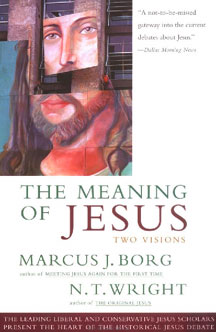
In case you’re wondering, one example of a highly regarded critical scholar who takes the historicity of the birth narratives seriously is N.T. Wright. Wright is one of the most prolific and influential of biblical scholars today. You can find a short, readable account of his views on the birth of Jesus in Chapter 11 of the book, The Meaning of Jesus: Two Visions. This book, co-written by N.T. Wright and Marcus J. Borg is an excellent introduction to current scholarly debates about Jesus. Borg is a leading member of the liberal Jesus Seminar and author of several bestselling books on Jesus. Wright is a scholar who has taught at Oxford and other universities, and has written extensively on Jesus. He is currently the Bishop of Durham. |
This, I must say, is pure poppycock. If you’ve read even ten pages of N.T. Wright, not to mention other leading conservative critical scholars such as F.F. Bruce, Richard B. Hays, James Dunn, Ben Witherington, etc., you know that they take a very historical view of faith. In fact, if you compare Wright’s work on Jesus with that of Marcus Borg, you’ll find that Wright is a far more exacting historian than Borg . . . far more! Just try sometime to wade through the historical references in Wright’s endnotes. Yikes!
Lest you think I’ve exhausted my critical examination of the passage cited above from Newsweek, let me admit that I haven’t even got to my main point yet. Meacham wonders “whether some of the central images and words of the Christian religion owe as much to the pagan culture of the Roman Empire as they do to apostolic revelation.” Here he makes a classic logical mistake, employing the fallacy of the False Dilemma. According to Meacham, the elements of early Christian thought must derive either from pagan Roman culture or from apostolic revelation. In his mind, cultural engagement and revelation are distinct. You must choose one or the other.
But this is a false dilemma. It could very well be the early accounts of Jesus’s birth are simultaneously a product of Roman cultural engagement and divine revelation. Revelation, you see, doesn’t come outside of culture. It happens within culture, using the language and thought forms of a given culture.
I would argue that Matthew and Luke, for example, were fully inspired by God and, at the same time fully engaged with the cultures in which they lived. Consider the analogy of preaching. When I preach, I try to connect the truth I convey with the concerns and values of the culture in which I live. I’m only successful when I communicate God’s truth in a way that makes sense in my culture. So, if Luke’s account of Jesus’s birth seems to use some of the images and terms that can be found in Roman biographies, this doesn’t tell us anything about whether Luke was relating what really happened or not. But it does tell us that Luke was a careful writer and an effective communicator.
One further example of Meacham’s fallacious framing of the debate: he writes, “The clash between literalism and a more historical view of faith . . . .” Stop! Notice the assumption here. One who takes the biblical narratives at face value is not being historical. One who doubts the literal facts of the narratives, however, is being more historical. But these statements are only true if one assumes that the narratives are, in fact, unhistorical. Meacham hasn’t even begun to argue this point yet. He simply establishes another false dilemma, this time between “literalism” and “historicism.”
Clearly there are other alternatives that Meacham should have considered. If a text intends to relate what really happened, even if the text shapes that event in terms of the author’s perspective, then a literal reading of the text might in fact be the most historical reading. When I read an account of the latest Dodger game in the newspaper, am I being unhistorical if I take it literally? No. (Unless of course I know that it was written by a Giant fan. Then extreme skepticism is warranted.)
Finally we get to the most fundamental mistake in Meacham’s whole approach to the Nativity narratives. You can see it right there in his subtitle: “From Mary to the manger, how the Gospels mix faith and history to tell the Christmas story and make the case for Christ.” Notice: “how the Gospels mix faith and history.” Faith and history are, for Meacham, two distinct realities. Frequently in his article they stand in contradiction to each other, and the faithful Christian ends up choosing faith over the hard facts of history.
But this is greatly to oversimplify matters. Faith and history are not separate or conflicting realities, but overlapping and symbiotic aspects of Christian theology. Faith doesn’t stand apart from history, but takes shape within history and is shaped by history. History doesn’t enjoy some privileged position of objective authority over faith because all scholars, no matter what they believe, are influenced by their fundamental beliefs as they spin their historical webs.
The multiple false dilemmas in Meacham’s article (there are more than I have noted here) not only invalidate his argument, but they keep him from discussing the birth narratives with the kind of precision and insight that would have been much more illuminating.
In my next post I’ll continue my analysis of the Newsweek article.
Home
A Telling “Perhaps” and the Jesus Seminar
Part 4 in the series “The Birth of Jesus: Hype or History?”
Posted at 11:00 p.m. on Sunday, December 12, 2004
Today I continue my critical examination of the recent Newsweek cover story: “The Birth of Jesus – Faith and History: How the Story of Christmas Came to Be.”
Excerpt #3 from Newsweek: “Perhaps” and Jesus Seminar
A NEWSWEEK Poll found that 84 percent of American adults consider themselves Christians, and 82 percent see Jesus as God or the son of God. Seventy-nine percent say they believe in the virgin birth, and 67 percent think the Christmas story – from the angels’ appearance to the Star of Bethlehem – is historically accurate.
Others, though perhaps fewer in number, are equally passionate about their critical understanding of the faith. The Jesus Seminar, a group of scholars devoted to recovering the Jesus of history, is a battalion in this long-running culture war.
Comment: First of all, let me note one more instance of the logical fallacy of the False Dilemma. From Meacham’s point of view, the vast majority of American believe the biblical story of Jesus, including Nativity narratives. Then there are “others” who are passionate about their critical understanding of the faith. So you must choose between traditional belief about Jesus and a critical understanding of the faith. But this is a false dilemma. I would claim to believe that the biblical story of Jesus is true. And, at the same time, I am passionate about a critical understanding of the faith. By “critical” I don’t mean that I am judging Christianity negatively. Rather, I mean that I use critical, rational, scholarly tools to examine the faith. I have spent much of my life developing and using those tools. And, lo and behold, these tools have strengthened my commitment to orthodox Christian faith. Go figure!
To Meacham’s credit, he faithfully recounts the extent to which most Americans believe, not only in Jesus, but also in his virgin birth. If you take the current population of the United States (294 million), the numbers are impressive:
246 million Americans claim to be Christian
241 million Americans view Jesus as God or the son of God
232 million American believe Jesus was born of a virgin
196 million Americans accept the Christmas story as history
But, once again, watch closely how Meacham continues. “Others, though perhaps fewer in number, are equally passionate about their critical understanding of the faith.” Stop. This is a telling statement in which Meacham once again shows his unbalanced bias. For one thing, if the vast majority of Americans believe what Meacham has just said they believe, then it’s disingenuous to say “perhaps fewer in number” are passionate about their critical understanding of the faith. There’s no perhaps about it. Even if every single person in American who doubts the historicity of the Christmas story were passionate about this doubt – which is highly unlikely – they would still be outnumbered by over 100 million!
Am I’m being too picky about Meacham’s words here? No, I don’t think so. Someone who writes a cover story for a magazine such as Newsweek ought to pay close attention to every word. (Moreover, Meacham’s article was surely edited by several top editors who should have caught his biased statements.) I’m paying close attention to Meacham’s words because here you can find his bias, his unexpressed assumptions. When he writes that there are perhaps fewer who are passionate about their critical understanding of the faith, he shows that he is, once again, wildly exaggerating the significance of the opinions of those who doubt the Christmas story. He’s trying once more to turn the Christmas controversy into a national hurricane when it really is, as I said two posts ago, just a tempest in a teapot.
Meacham correctly makes a connection between the Jesus Seminar and those who do not buy into the historicity of the birth narratives (though a small minority of fellows of this seminar are conservative scholars). But his description of the Jesus Seminar perpetuates the myth of its objectivity. Meacham calls the Seminar “a group of scholars devoted to recovering the Jesus of history.” This is what the Jesus Seminar has promoted itself to be. But the truth lies elsewhere.
I don’t have time to lay out in depth the true mission of the Jesus Seminar. But let me simply say that it was founded by Robert Funk with a specific purpose, to rewrite the story of Jesus. This new story would be stripped of its biblical moorings: a God who creates the universe and who brings all things to conclusion at some time in the future. Moreover, no longer would the story of Jesus be tied to the idea of divine revelation. If you don’t believe me, let me quote from Robert Funk’s opening remarks at the first meeting of the Jesus Seminar in 1985:
What we need is a new fiction that takes as its starting point the central event in the Judeo-Christian drama [Jesus] and reconciles that middle with a new story that reaches beyond old beginnings and endings [creation and eschatology]. In sum, we need a new narrative of Jesus, a new gospel, if you will, that places Jesus differently in the grand scheme, the epic story.
Not any fiction will do. . . . The fiction of Revelation keeps many common folk in bondage to ignorance and fear. We require a new, liberating fiction, one that squares with the best knowledge we can now accumulate and one that transcends self-serving ideologies.
This doesn’t exactly sound like the beginning of an objective quest for the historical Jesus, does it? In fact in that same lecture Funk said this about what his Seminar fellows would experience:
What we are about takes courage, as I said. We are probing what is most sacred to millions, and hence we will constantly border on blasphemy. We must be prepared to forebear the hostility we shall provoke.
Even before the Jesus Seminar examined one saying of Jesus, Funk already knew that its findings would “border on blasphemy” and provoke hostility from believing Christians. How did Funk already know that the “objective” conclusions of the Seminar would be so hostile to traditional faith? Because he stacked the deck from the beginning. Funk filled the Seminar with hyper-skeptical scholars who shared both his scholarly and his theological biases. So even before the Seminar began its work, Funk was assured of the results he wanted.
In case you’re wondering about Funk’s own theology (if you can call it that), let me quote a few of his theses from an article called “The Coming Radical Reformation”:
The God of the metaphysical age is dead. There is not a personal god out there external to human beings and the material world.
The deliteralization of the story of Adam and Eve in Genesis brought an end to the dogma of original sin as something inherited from the first human being. Death is not punishment for sin, but is entirely natural.
|
|
| |
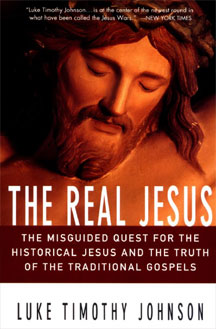
If you're looking for an critical analysis of the Jesus Seminar from a top-notch New Testament scholar, you'll find it in The Real Jesus by Luke Timothy Johnson. Johnson is a highly regarded academic who teaches at Emory University, having once been on the faculty at Yale. |
Prayer is meaningless when understood as requests addressed to an external God for favor or forgiveness and meaningless if God does not interfere with the laws of nature. Prayer as praise is a remnant of the age of kingship in the ancient Near East and is beneath the dignity of deity.
We should give Jesus a demotion. It is no longer credible to think of Jesus as divine. Jesus' divinity goes together with the old theistic way of thinking about God.
The virgin birth of Jesus is an insult to modern intelligence and should be abandoned. In addition, it is a pernicious doctrine that denigrates women.
This is what Robert Funk, founder of the Jesus Seminar, believes. He convened the seminar to “give Jesus a demotion” and he formed its membership and method to guarantee this result.
In fairness to Meacham, his statement that the Jesus Seminar is “a group of scholars devoted to recovering the Jesus of history” is not unusual. It’s typical of things said by the secular media when reporting on the Seminar. Meacham, like so many other reporters, bought the Seminar’s spin hook, line, and sinker, never bothering to investigate its true purpose.
Actually, however, Meacham adds a truly insightful comment when he notes that the Jesus Seminar “is a battalion in this long-running culture war.” Here is a helpful way to view this Seminar, not as a group of objective scholars seeking truth about Jesus, but as a brigade in the cultural battle raging in our society today. The Jesus Seminar folk are fighting against the values and morals of traditional, orthodox Christianity. According to founder Robert Funk in “The Coming Radical Reformation,” “The Bible does not contain fixed, objective standards of behavior that should govern human behavior for all time. This includes the ten commandments as well as the admonitions of Jesus.” So he and his Seminar are seeking to set us free from the constraints of biblical ethics and orthodoxy. Let me quote a bit more of a passage I cited earlier from Funk’s inaugural address to the Seminar: “We are probing what is most sacred to millions, and hence we will constantly border on blasphemy. We must be prepared to forebear the hostility we shall provoke. At the same time, our work, if carefully and thoughtfully wrought, will spell liberty for other millions. It is for the latter that we labor.” Liberty? From what? Funk supplies the answer: From a sovereign, personal God who guides our lives through revealed truth, and who was incarnate in Jesus Christ. Liberty from the theology and ethics of Scripture. Liberty from orthodox Christianity and all that it entails.
Given the cultural and theological agenda of the Jesus Seminar, is it any wonder that the majority of its scholars undermine the credibility of the biblical narratives? Is it a surprise that their Jesus turns out to be, not God incarnate, but simply a man who was dressed up by the early church in the costume of a pagan god-man?
I have spent so much time on the Jesus Seminar because it’s obvious that Meacham has been enchanted by the views of its fellows (and like-minded skeptical scholars). The basic direction of the Newsweek article mirrors the trajectory of Jesus Seminar thinking. In my next post I’ll examine further Meacham’s claims about how the birth narratives came into existence, and explain why a reasonable person can consider these narratives as historically trustworthy.
Home
Are the Birth Narratives Historical? Section A
Part 5 in the series “The Birth of Jesus: Hype or History?”
Posted at 11:00 p.m. on Monday, December 13, 2004
Today I continue my critical examination of the recent Newsweek cover story: “The Birth of Jesus – Faith and History: How the Story of Christmas Came to Be.” Throughout the Newsweek article, author John Meacham refuses to regard the New Testament gospels as historical sources for information about the birth of Jesus. Though he acknowledges that “the Nativity saga is neither fully fanciful nor fully factual but a layered narrative of early tradition and enduring theology,” in fact Meacham leans strongly in the “mostly fanciful, minimally factual” direction. When discussing the visit of the Magi in Matthew 2, for example, Meacham states, “There is no historical evidence of such a visit.” No historical evidence? Doesn’t this negatively beg the question of Matthew’s historical reliability? It would be correct to say, “There is no historical evidence outside of Matthew of such a visit.” But, obviously Meacham has so little regard for the historical reliability of Matthew that he doesn’t even have to qualify his statement about the Matthew and the Magi.
Why does he view Matthew as unhistorical? In fact, Meacham makes almost no argument for his thesis. He doesn’t show where Matthew makes historical errors or simply makes things up. He does seem to take the fact that Matthew’s story of Jesus’s birth has unusual features, like the visit of the Magi, as evidence for its unhistorical character. But this is a peculiar perspective, indeed. The fact that Matthew alone tells us about the Magi does mean that we can’t test his story against other evidence. But it doesn’t in any way imply that Matthew has made up the story. Throughout ancient history we are often confronted with events that are narrative in only one source. Yet classical historians don’t summarily reject single sources as fictitious. Hyper-critical biblical scholars do, however, without apology.
Once more, Meacham seems to have fallen into the fallacy of the False Dilemma. Again and again in his article he shows (rightly, I might add) that the birth narratives in Matthew and Luke reflect themes and passages from the Hebrew Scriptures. From this insight he infers that the elements of the narratives were made up to conform to the Old Testament. But he never shows why we should think they were actually made up. Wouldn’t it make just as much if not more sense to believe that the early Christians mined the Old Testament for passages that connected thematically with what they believed actually happened in the life of Jesus?
Meacham does provide an argument from analogy to explain why he believes the gospel writers invented stories about Jesus. In this analogy, the gospels are like classical biographies. “Writers like Plutarch invented details or embellished traditions when they were reconstructing the lives of the famous,” Meacham writes, “and the Christmas saga features miraculous births, supernatural signs and harbingers of ultimate greatness similar to those found in pagan works. If we examine the Nativity narratives as classical biographies, then the evangelists’ means and mission – to convey theological truths about salvation, not to record just-the-facts history – become much clearer.”
I actually think the analogy between the gospels and ancient biographies has much to commend it. But, yet again, Meacham sees an unwarranted chasm between theology and history. No biblical scholar I know, conservative, liberal, or otherwise, believes that the gospel writers were intending to “record just-the-facts history.” The gospel writers themselves make their pastoral and theological intentions quite clear (see, for example, Luke 1:1-4). But it’s also clear that they intend to relate, not made up fictions, but events that really happened, from their point of view. Luke claims to have carefully sifted through both written sources and oral testimonies as he prepared to write his gospel (1:1-4). Thus we aren’t faced with a choice between history and theology, as Meacham assumes. Rather, the gospels give us history that is shaped – but not made up – in light of the writer’s theological purpose. And part of that purpose, let’s be clear, is to tell the story of how God really entered human history through the baby Jesus.
If Meacham merely infers without direct statement that Matthew is not a reliable historical source, he is even blunter when it comes to Luke. “Almost nothing in Luke’s story,” he claims, “stands up to close historical scrutiny.” |
|
| |
For an in-depth study of the similarities between the biblical gospels and Roman biography, see the excellent book by Richard A. Burridge, What Are The Gospels? A Comparison with Graeco-roman Biography. |
What is Meacham’s evidence for this claim? He cites a negative comment by the critical scholar Raymond Brown and then adds, “Augustus conducted no global census, and no more local one makes sense in Luke’s time frame.” Period. That’s all the evidence against Luke’s historical reliability that Meacham can muster. Now I’ll freely admit that Luke’s discussion in 2:1-2 of Augustus, Quirinius, and the worldwide registration does not obviously fit with what we know from other historical sources. There was a governor of Syria named Quirinius who conducted a census about a decade after the birth of Jesus. The historical record outside of Luke is silent about another census ten years earlier. Skeptical scholars are quick to accuse Luke of confusing the facts. But scholars who don’t jump to negative conclusions have found several ways to make good historical sense of Luke’s narrative. The original Greek of Luke 2:2 might very well mean that Jesus was born “before” Quirinius was governor of Syria, not “while” as it’s often translated. There is also tantalizing but inconclusive evidence for an earlier governorship of Quirinius. At any rate, Meacham’s assertion that “almost nothing in Luke’s story stands up to close historical scrutiny” once again reveals his bias. Meacham has taken the ball from hyper-critical scholars and runs with it without even realizing that there’s another team in the game, a team that accepts the same basic facts and uses the same scholarly methods, but without skeptical prejudice, and runs the ball in the opposite direction from the hyper-critical team, in the direction of historical reliability.
Yet, you might wonder, is there any reason to believe that Matthew and Luke got the history right? Is there any way to evaluate their efforts as historical sources? Indeed, I believe the answer is “yes” to both questions. I’ll explain why tomorrow.
Home
Are the Birth Narratives Historical? Section B
Part 6 in the series “The Birth of Jesus: Hype or History?”
Posted at 11:55 p.m. on Tueday, December 14, 2004
Yesterday I began to answer the question: Are the gospel accounts of Jesus’s birth historical? For centuries almost everybody answered this question in the affirmative. But more recently, and especially among hyper-critical New Testament scholars, the answer has been “no.” The recent cover story on “The Birth of Jesus” in Newsweek, under the influence of such scholars, casts doubt upon the historical trustworthiness of the gospel accounts of Christmas. They were, according Newsweek writer Jon Meacham, invented by the early church for a variety of apologetic and evangelistic reasons.
Meacham assumes without much argumentation that the gospel accounts of Jesus’s birth are mainly fictitious, though he does point out a couple of historical problems in Luke’s account. One who reads Meacham’s article with an open mind might well wonder if, given the negatives alleged by the author, there are any reasons to put confidence in the historical reliability of Matthew and Luke. Even if Meacham’s argument is full of holes and fallacies, as I have shown, one could still ask if there is a positive case for taking the birth narratives as historically accurate.
I should note that, for the moment, I am not arguing for the reliability of the gospels on the basis of their divine inspiration. Though I take the Bible to be fully inspired by God, a premature appeal to revelation can shortchange valuable historical inquiry, even giving the false impression that the gospel narratives can’t stand on their own as reliable historical sources. I believe they can, whether or not they were inspired by the Holy Spirit. |
|
| |
Here is a visual representation of the argument of the Newsweek article. Like Swiss cheese, it's full of holes. |
Let me admit, once again, that we confront two major hurdles when considering the historicity of the gospel accounts of Jesus’s birth. The first hurdle is the prevalence of the miraculous. The biblical accounts of Christmas include angelic visitations and physical miracles, most of all the birth of Jesus to a virgin. If your worldview does not have a place for a God who does miracles, then you’ll be unable to consider the Nativity narratives as historically reliable. This explains why many, though not all, liberal scholars treat the birth stories with extreme skepticism. For them, the legendary quality of the material lies right on the surface: “A baby born of a virgin? Nonsense. This story must have been made up for some reason.” But if one believes in a god who is anything like the biblical God, and if one believes that the miracles of gospels, including the resurrection of Jesus really happened, then one is in a position to evaluate the birth narratives as potential historical records.
The second hurdle we must surmount when considering the historicity of the Nativity narratives has to do with the lack of evidence for the events of Jesus’s birth outside of the New Testament gospels. Unlike in the case of Jesus’s crucifixion, for example, we cannot test what we find in the gospels with extra-biblical sources, either archeological or literary. We just don’t have a stone engraving written by a shepherd outside of Bethlehem that confirms Luke’s account.
But, nevertheless, we do have a significant historical test available to us, one that Meacham and other writers often minimize or ignore. The fact is that we have in Matthew and Luke two independent accounts of the birth of Jesus. The vast majority of scholars, both conservative and liberal, believe that these gospels writers were not familiar with each other’s work. So we can test the historical accuracy of Matthew by comparing it with Luke, and vice versa.
At this point in the argument skeptical scholars get overly excited about the differences between Matthew and Luke. David Van Biema, author of the Time magazine cover story, writes, “And despite agreeing on the big ideas, Matthew and Luke diverge in conspicuous ways on details of the event. In Matthew’s Nativity, the angelic Annunciation is made to Joseph, while Luke’s is to Mary. Matthew’s offers wise men and a star and puts the baby Jesus in a house; Luke’s prefers shepherds and a manger. Both place the birth in Bethlehem, but they disagree totally about how it came to be there.” Notice carefully what Van Biema says here. First, “despite agreeing on the big ideas . . . .” Stop. Let’s rephrase that more clearly. According to Van Biema, Matthew and Luke in fact agree on the big ideas. They agree on the main points of the Nativity story. So we’ve got two independent sources in fundamental agreement on the things that matter most in the Christmas story. Don’t you think this should count for something? Yet for Van Biema it’s worth merely an aside, “despite . . . .” Meacham doesn’t even mention this fundamental agreement at all.
What exactly do Matthew and Luke agree upon? you might wonder. Here are seventeen common elements of their narratives:
1. Jesus had two human parents named Mary and Joseph (Matt 1:18; Luke 1:27).
2. Mary and Joseph were engaged (but not married) when Mary became pregnant with Jesus (Matt 1:18; Luke 1:27).
3. Joseph was a descendant of King David of Israel (Matt 1:20; Luke 2:4).
4. Mary conceived and became pregnant while she was still a virgin (Matt 1:18; Luke 1:27, 34).
5. The Holy Spirit of God was the cause of Mary’s conception (Matt 1:18; Luke 1:35).
6. The news of Mary’s pregnancy was initially unexpected and troublesome (to Joseph in Matthew; to Mary in Luke).
7. Mary and Joseph remained together in spite of her premarital pregnancy (Matt 1:24:25; Luke 2, where marriage is not mentioned, but is surely implied).
8. An angel visits Jesus’s parents to reveal his divine origin (Matt 1:20-23; Luke 1:26-38).
9. An angel gives the baby the name “Jesus” (Matt 1:21; Luke 2:21).
10. Through angels Jesus is identified as the “savior” (Matt 1:21; Luke 2:11).
11. Jesus was born while Herod the Great was king of Judea (Matt 2:1; Luke 1:5).
12. Jesus was born in Bethlehem of Judea (Matt 2:1; Luke 2:4).
13. Jesus will be the king of the Jews (Matt 2:2; Luke 1:32-33).
14. Jesus is the Messiah (Matt 2:4; Luke 2:11).
15. Jesus’s birth is understood in light of Jewish prophecies (many times in Matthew and Luke).
16. Unexpected visitors are supernaturally summoned to visit Jesus (Matthew’s magi and Luke’s shepherds).
17. Jesus, though born in Bethlehem, was raised in Nazareth (Matt 2:23; Luke 2:39).
I’m going to stop blogging now to give you some time to reflect upon the list of common elements between Matthew and Luke. Tomorrow I’ll offer some of my own observations, giving further reasons for believing in the historical reliability of the birth narratives.
Home
Are the Birth Narratives Historical? Section C
Part 7 in the series “The Birth of Jesus: Hype or History?”
Posted at 11:00 p.m. on Wednesday, December 15, 2004
Yesterday I began to formulate a positive case for the historical reliability of the biblical stories of Jesus’s birth. I explained that in Matthew and Luke we have two independent sources that substantially agree about the main features of the Christmas story. For a list of the seventeen agreements between these two gospels, see yesterday’s post. I’ll summarize the list in narrative form:
A Jewish woman named Mary became pregnant. This was potentially scandalous, because she was not married. She was engaged to her fiancé, whose name was Joseph, and who was a descendant of King David of Israel. Because Mary and Joseph had not been sexually intimate, news of Mary’s pregnancy was unexpected and, initially, disturbing. In fact Mary was a virgin, which brought further perplexity. But an angel brought the good news that Mary’s pregnancy was a miracle, the result of the Holy Spirit of God, though the exact mechanism by which Mary became pregnant was not explained. In response to the angel’s news, Mary and Joseph remained together in spite of the unusual nature of her pregnancy.
When the angel visited one of Jesus’s parents, he not only communicated Jesus’s divine origin, but also gave him the name “Jesus” and identified him as the savior. Jesus was to become the rightful king of the Jews, the Messiah of Israel. This was confirmed by the fact that the birth of Jesus fulfilled many Old Testament prophecies associated with the coming of the Messiah.
Jesus was born in Bethlehem of Judea during the reign of King Herod the Great. Shortly after his birth unexpected visitors were supernaturally summoned to visit him. Though born in Bethlehem, Jesus was actually raised in Nazareth of Galilee.
(Note: If I’ve overlooked anything, or if I’ve smuggled anything into this account that isn’t in both gospels, please let me know so I can make the appropriate changes. Accuracy matters to me.)
If you were concerned that Matthew and Luke disagree about the birth story, what I’ve just summarized will surprise you. Contrary to what is sometimes stated by hyper-critical scholars, you can tell the whole Christmas story with all the key facts by using only what is common to both Matthew and Luke. This means that we have two, relatively early, independent accounts of the birth of Jesus that confirm each other’s reliability. They agree on the major characters, the major timing, the major places, and the major miracles of the Christmas story. Both accounts were written within about fifty years of Jesus’s death, maybe quite a bit less. And both, it is most likely, utilized older sources, written and oral, in their writing. Thus we have good reason to believe that Matthew and Luke were telling the story of what really happened in the birth of Jesus, at least in the main flow of their narratives. It’s therefore highly unlikely that either gospel writer made up the main elements of the story, even if you believe that they were creative about the details. (A hyper-critical scholar might object that the early church made this stuff up, and both Matthew and Luke used it. That’s possible, of course. But there’s no evidence for it. Moreover, this objection pushes the supposed invention of the birth narratives even further back in time, and makes influence from Roman paganism much less likely.)
| “Ah,” one might object, “so Matthew and Luke largely agree, but what about the disagreements between the two gospels? Aren’t these substantial? Don’t they disprove the historical believability of the gospel accounts?” These are sensible questions if you’ve read the articles in Newsweek and Time. For example, the Time article (subscription only, sorry) written by David Van Biema claims that Matthew and Luke “disagree totally about how [the birth of Jesus] came to be [in Bethlehem].” But do they really? To be sure they describe the Bethlehem events differently. In Matthew there is no journey to Bethlehem from Nazareth, as in Luke. And in Luke there is no hurried departure to Egypt because of Herod’s pending slaughter of the innocents. But in no place do Matthew and Luke actually disagree about any of the Bethlehem details. They simply narrate different aspects of the story from different perspectives. Yet Van Biema, like so many others who have been bewitched by hyper-critical scholarship, sees difference of content and emphasis as total disagreement. |
|
| |
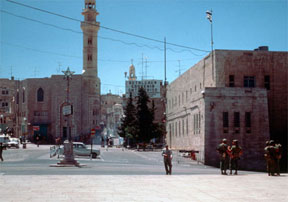
This is what Bethlehem looks like today from the Church of the Nativity, the site where Christian tradition holds that Jesus was born. The view today is different from what Mary and Joseph saw 2000 years ago. If you look closely, you can see: a Coca Cola sign, an Israeli flag, Israeli soldiers, a Muslim mosque, and a sign reading in English "Bethlehem Souvenir Enterprise," no doubt founded by the shepherds abiding in the hills. This picture is used courtesy of www.HolyLandPhotos.org. This website is an astoundingly helpful resource, which makes its images availabe for most uses free of charge.
|
This is a critical error, and I can illustrate it with an ironic illustration. The Time article and the Newsweek article have much in common. In fact they argue more or less the same point in more or less the same way, though the Time piece is more balanced and less skeptical. But there are many differences between the two articles. Meacham quotes several scholars; Van Biema quotes several others. Meacham focuses on points overlooked by Van Biema, and vice versa. Therefore I could try to invalidate their articles by labeling their differences as disagreement. I could say, “Meacham and Van Biema disagree totally about the historicity of the birth narratives.” But I would not say this because it isn’t true. They basically agree, though with many differences. Different points and different perspectives do not constitute disagreement.
Likewise with Matthew and Luke. Though their perspectives are different, not one thing in Matthew actually contradicts anything in Luke, and vice versa. In other words, both sources agree on the main points, disagree on nothing, and have different emphases when it comes to many minor points. This doesn’t lead to the conclusion that they are untrustworthy historical sources. Rather, it suggests the exact opposite.
For the sake of argument, let’s suppose for just a moment that Matthew and Luke had told virtually identical stories, a harmonized account such as will be played out in Christmas pageants throughout the world this month, with shepherds and wise men visiting the manager in close succession. Would such a harmony in the gospels satisfy hyper-critical scholars and the journalists captivated by them? Of course not. If Matthew and Luke were in substantial agreement, then the skeptical scholars would accuse them of collusion. We’d be told that the early church cleaned up divergent traditions about the birth of Jesus in an effort to present a unified front to the world. No matter what the actual facts may be, liberal scholars would find a way to undermine their reliability.
Yet, I would argue, the differences between Matthew and Luke actually show the tendency of the early church to preserve divergent stories without trying to iron out all of the differences. If the church was really in the business of making up and editing stories for apologetic and evangelistic purposes, doesn’t it seem likely that they would have doctored the birth narratives in Matthew and Luke to make them more unified?
And, for that matter, if the early church was so free in making up stuff about Jesus, don’t you think it could have done a better job with the birth narratives? After all, they’re pretty short and leave dozens of questions unanswered. Moreover, according to Meacham, they failed to do the very thing Meacham believes they were supposed to do. He argues that the Nativity stories were created so that Jesus could compete in the pagan world with divinized men like Augustus Caesar. Yet Meacham himself bears witness to the failure of the gospel accounts in this effort: “The virginity [of Mary] detail did not particularly help the [Christian] cause early on. To non-Christian Jews and pagans, the first Christians were superstitious and backward, a group of marginal people on the fringes of empire [sic] preaching an outlandish message.” I think Meacham is basically correct in this judgment. I know of no evidence that suggests that the stories of Jesus’s birth actually persuaded pagans in the Roman Empire to convert to Christianity. The death and resurrection of Jesus, backed up by their Spirit-filled life in community, were the mainstays of early Christian apologetics.
Yet, once again, the folly of Meacham’s conclusions is striking. He himself argues that the second-century opponents of early Christianity viewed Christians as “superstitious and backward, a group of marginal people on the fringes of empire preaching an outlandish message.” Yet he also believes that the early church made up stories about Jesus, stories that would have confirmed the pagan prejudice against Christians rather than erasing it. The birth narratives themselves would surely have been seen as superstitious in the eyes of the church’s opponents, even as is true today. Moreover, according to the Nativity stories, Jesus was born in a stable in some small village which, from the Roman point of view, had no significance whatsoever. Only a few lowly shepherds and a small cadre of astrologers paid him any notice. This would hardly get Roman pagans excited about Jesus. On the contrary, it would strengthen their prejudice against Christianity.
However, even though the birth stories seemed to have little evangelistic value in the second century, and even though they would have confirmed Roman prejudices, and even though they weren’t neatly harmonized or finely detailed, nevertheless the early church didn’t improve them. The early Christians let stand the stories that were both ineffective and potentially scandalous. They didn’t change details (like Bethlehem) that mattered only to Jews. Rather, they stuck by the stories they had. Why? The only answer that makes sense is this: Because they believed them to be true and worth preserving. The early church, far from being the creative think-tank envisioned by Meacham, Van Biema, and their academic models, was primarily concerned to preserve the truth that had been passed on about Jesus, even when this truth didn’t help their cause but may in fact have hurt it.
So, recognizing that the miraculous elements of the Christmas story do cause some historians to stumble, the fact is that the evidence of Matthew and Luke, and the way their accounts were treated in early Christianity, actually makes a strong case for the essential historicity of the Nativity narratives.
In my next post I’ll add a few more details, showing further why it is reasonable to accept the birth stories in the gospels as historically accurate.
Home
The “Birth” of the Virgin Birth Story
Part 8 in the series “The Birth of Jesus: Hype or History?”
Posted at 11:00 p.m. on Thursday, December 16, 2004
Where did the stories of Jesus’s virgin birth (strictly speaking, his virginal conception) come from? This question is central to the recent articles in Time and Newsweek, as well as to our understanding of the birth of Jesus itself. I’ll get to this question in a few moments, but first I need to say something about the use of the Old Testament in the Nativity narratives.
The Old Testament and the Genesis of the Nativity Narratives
If you are at all familiar with the Jewish Scriptures when you read the Nativity narratives in Matthew and Luke, you can’t help but be struck by the extent to which both writers connect the story of Jesus’s birth with Old Testament images and themes. Matthew is the most obvious. Four times in the forty-one verses that make up his Nativity story Matthews says something like: “This fulfilled the word of the prophet . . .” (1:22; 2:15; 2:17; 2:23; see also 2:5-6). Though Luke is more subtle, his account echoes Old Testament themes as much or even more than Matthew’s. This is especially true in the songs of Mary (1:46-55), Zechariah (1:68-79), and Simeon (2:29-32). Many other features in Matthew’s and Luke’s narratives reflect Old Testament stories, themes, and hopes.
The close connection between the Old Testament and the Nativity narratives has suggested to some scholars that the genesis of these stories lies in the Christian interpretation of and elaboration upon Scripture. At many points both the Time and Newsweek articles suggest if not state that Matthew and Luke creatively constructed their accounts on the basis of Old Testament passages. The authors of these articles, Meacham and Van Biema, are not themselves creative in advancing this thesis. They simply repeat what has become almost a scholarly given in some academic circles.
But not all academic circles. Other scholars remain unconvinced by the “they made it up on the basis of prophecy” thesis. Among their reasons you will find a strong critique of the likelihood that early Christians would actually end up with the Nativity narratives if all they had were a few Old Testament passages. If you start, for example, with the prophetic texts mentioned in Matthew (see above), it’s hard to imagine that you’d end up with the Christmas story. Moreover, Luke seems unaware of or uninterested in some key prophetic connections (like Bethlehem and Micah 5:2, for example).
It is much more likely that the gospel writers, and the Christians who preceded them, didn’t make up events to fit prophecy, but rather snatched up bits of prophecy that fit what they believed actually happened in the life of Jesus. In the end, you’ll need to come to your own conclusions about this. But, weighing both theories in light of the textual evidence, I find that the “snatched prophecies that fit the life of Jesus” approach makes far more sense than they “made it up on the basis of prophesy” theory.
Perhaps one of the clearest cases that favors the “snatch prophecy to fit Jesus’s life” theory is the virgin birth and its relationship to Isaiah 7:14.
The Birth of the Virgin Birth Story
Both the Time and Newsweek articles on the birth of Jesus devote a good bit of space to the question of the “birth” of the virgin birth story, and for good reason. This is the theological core of the Nativity narrative. It’s a biological way of talking about the theological centerpiece of Christmas: the incarnation of God in Jesus, the “Word made flesh” as John 1:14 puts it.
| In Matthew’s account of the angel’s visit to Joseph, the gospel writer adds an interpretive comment: “All of this happened to fulfill the Lord’s message through his prophet: Look! The virgin will conceive a child! She will give birth to a son, and he will be called Immanuel (meaning, God is with us” (Matt 1:22-23). Undoubtedly, Matthew is quoting Isaiah 7:14, which reads, “Therefore, the Lord himself will give you a sign. Look, the young woman [KJV, NIV “virgin”] is with child and shall bear a son, and shall name him Immanuel.” Matthew sees in Isaiah a prophecy of the virginal conception of Jesus. Or did he (or someone before him) make up the virgin birth of Jesus on the basis of Isaiah 7:14? |
|
| |
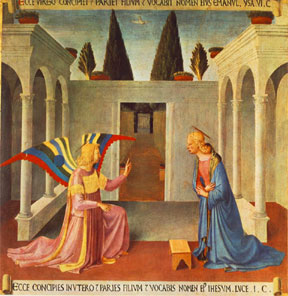
"Annunciation" by Fra Angelico (1450). Check out the wings on the angel! |
The arguments about Matthew’s use of Isaiah are complicated in the extreme. And the strangest thing of all is that people end up arguing a side which, in my opinion, is contrary to their own interests. Let me explain as briefly as I can.
The Hebrew text of Isaiah 7:14 uses a word ‘almah, which is translated as “virgin” or “young woman.” The debates about the “real meaning” of this word are endless, partly because we just don’t have conclusive evidence about its connotations. Remember, the Hebrew Bible was written in a time when virtually all young women were virgins and all virgins were young women, so it’s hard to get the precise nuance of the word. But it’s pretty clear that Isaiah wasn’t using ‘almah to speak of a woman giving birth before she had been intimate with a man. If he meant “virgin,” he probably envisioned the virgin getting married and having a child in the ordinary fashion. (Whether the Holy Spirit embedded another meaning in this verse is another story altogether.) We know what Isaiah meant, in part, because there is absolutely no evidence of any Jew before Matthew ever taking Isaiah 7:14 as a prophecy of a virgin birth. The standard Greek translation of Isaiah 7:14, however, used the word parthenos, which had a clearer connotation of “no sexual experience” than ‘almah (yet even parthenos could mean “young woman” or “unmarried woman” without a primary sense of “virgin”).
Some, generally on the liberal side, argue that Matthew used the Greek translation (or “mistranslation” as both Van Biema and Meacham call it), from which he got the idea of the virgin birth, which in reality had basis neither in history nor in the original text of Isaiah 7:14. Others, generally on the conservative side, fight for the original sense of “virgin” in Isaiah 7:14. They seem to fear that if Matthew saw in this verse something that Isaiah didn’t intend, then Matthew was somehow wrong. (It seems likely that Matthew may well have seen something more than Isaiah intended, as is often the case with Christian use of Hebrew prophecy.)
Here’s where things get a little strange. If Isaiah 7:14 really did refer to a virgin birth, as many conservatives argue, then it becomes more possible to believe that Matthew made up his story on the basis of Isaiah, as many liberals claim. But if Isaiah 7:14 really referred to a young woman, as liberals argue, then it becomes far less likely that Matthew (or any other early Christian) made up the virgin birth on the basis of Isaiah, which then supports the conservative side of the argument.
So what are we to make of all of this? Let me say two things.
First, the linguistic discussion of the meanings of ‘almah and parthenos has not been settled because we just don’t have enough evidence to settle it. Therefore the debate about meanings will continue on.
Second, the facts that: 1) no Jew prior to the birth of Jesus expected the Messiah to be born of a virgin, and that 2) Isaiah 7:14 begat no such hope among pre-Christian Jews, are most telling. They make it highly unlikely that Mathew (or his source) made up the virgin birth to fulfill prophecy. Let me quote N.T. Wright’s well-phrased insights:
Even assuming that Matthew or Luke regularly invented material to fit Jesus into earlier templates, why would they have invented something like this? The only conceivable parallels are pagan ones, and these fiercely Jewish stories have certainly not been modeled on them. Luke at least must have known that telling this story ran the risk of making Jesus out to be a pagan demigod. Why, for the sake of an exalted metaphor, would they take this risk – unless they at least believed them to be literally true? (from “Born of a Virgin?” in The Meaning of Jesus, p. 176).
Of course some scholars have claimed that the virgin birth was invented by early Christians to erase the scandal of Jesus’s illegitimate birth. Meacham writes, “If Jesus had been conceived by a human father before Joseph and Mary had begun their lives together as husband and wife (either by Joseph himself, a soldier or someone else), then the Holy Ghost would have provided a convenient cover story for the early church.” Yet does this make any sense? Would anyone accusing Jesus of being conceived outside of marriage be convinced by the claim that his mother was a virgin whom God made pregnant? As Wright notes, wouldn’t this run the risk of making matters far worse? Tod Bolsinger of It Takes a Church explains in a recent sermon, “That would be like using a story of aliens taking over your body as the excuse for cheating on a test.” Indeed! (In fact, the insinuation by non-Christians that Jesus was born illegitimately actually strengthens the case for antiquity and authenticity of the virgin birth story.)
The other potential source for the notion of a virgin birth is the folklore of the Greco-Roman world. In legends and autobiographies of great men, the gods frequently impregnate human women in some strange fashion, thus making their offspring both human and divine. Could this stand behind the creation of the story of Jesus’s virgin birth?
Yes, it could. But evidence for this is sorely lacking. There are significant differences between the pagan stories and the Christian one. Notably, only Jesus was alleged to be born of a virgin. The pagan stories always involved sexual relations between a god and a human. Moreover, the pagan tales were often generously exaggerated, while the Nativity narratives are curiously subdued. Finally, the theory of the pagan parentage of the virgin birth of Jesus forces us to believe a whopper of a historical tale. Once again I want to quote N.T. Wright. The passage is long, but well worth the effort:
What would have to have happened, granted the skeptic’s position, for the story to have taken the shape it did? To answer this, I must indulge in some speculative tradition history. . . . This is how it would look. (a) Christians came to believe that Jesus was in some sense divine. (b) Someone who shared this faith broke thoroughly with Jewish precedents and invented the story of a pagan-style virginal conception. (c) Some Christians failed to realize that this was historicized metaphor and retold it as though it were historical. (d) Matthew and Luke, assuming historicity, drew independently upon this astonishing fabrication, set it (though in quite different ways) within a thoroughly Jewish context, and wove it in quite different ways into their respective narratives. And all this happened within, more or less, fifty years. Possible? Yes, of course. Most things are possible in history. Likely? No. . . . This theory asks us to believe in intellectual parthenogenesis: the birth of an idea without visible parentage. Difficult. Unless, of course, you believe in miracles, which most people who disbelieve the virginal conception don’t. (from The Meaning of Jesus, p. 177).
This is “Wright” on target (sorry). Scholars and others can play around with Jewish and pagan parallels all they want, but at some point they’ve got to explain how things really played out in the thinking of the early church. The theory of a pagan conception for the virgin birth idea stretches the imagination at least as far as the notion of a real virgin birth.
If I had to come up with a theory for the genesis of the virgin birth story, a theory that assumed no such thing really happened, I wouldn’t turn to the pagan parallels. Rather, I’d argue that the virgin birth was a logical result of early Christian belief in the divinity of Jesus, a belief that was not based on the infancy narratives, but rather gave birth to them. This leads to the final point I want to make in this post.
The Secondary Nature of Belief in the Virgin Birth
Given how much scholars, clergy, and lay people alike have argued over the virgin birth – and how long this post is! -- you might think it was something that all people must believe before they become Christians. In fact the opposite is true. People put their faith in Jesus as Lord and Savior first. Then, in light of that faith, they come to believe that Jesus was in fact born of a virgin.
How do I know this? Well, I could point to the facts of contemporary Christian life. If you’ve ever gone to a Billy Graham Crusade, for example, you’ve heard lots about the death and resurrection of Jesus. You’ve heard an invitation to receive Christ as your personal Savior and Lord. But you’ve never heard Rev. Graham say: “Oh, and by the way, don’t come forward unless you believe that Jesus was born of a virgin.” This belief is plainly secondary.
Of course Billy Graham didn’t make up these priorities. We see them right in the New Testament. As far as we know, the Apostle Paul, the great evangelist of the first century, didn’t have much to say about the virgin birth. And we know for sure that he didn’t make belief in the virgin birth a prerequisite to faith in Christ (see Romans 10:9-10; 1 Corinthians 15:3-8). Even the gospels of Matthew and Luke, the only sources we have for the birth of Jesus, don’t suggest that Christian witness to Jesus meant convincing folks of his virgin birth.
Now I’m not saying that the virgin birth isn’t an essential aspect of orthodox Christian theology. It is. But I am saying that, with respect to one’s becoming a Christian, it is not essential first to believe in the virgin birth. In the New Testament, as in the Good News itself, the focus is on the death and resurrection of Jesus, not on his birth. Sometimes we forget this. It may have to do with the fact that in our experience, even in our church experience, Christmas is a much bigger deal than Easter. Good Friday barely gets a nod in some Christian contexts. So we can forget what matters most when it comes to beginning a relationship with God through faith in Christ.
Furthermore, though the virgin birth expresses eloquently the fact of Jesus’s nature as both divine and human, the early Christians did not base their belief in Jesus’s deity on their belief in his virginal conception. At least we have no evidence of this whatsoever. Rather, Christians came to see Jesus as God on the basis of what he did and said, in the light of the Old Testament. And then, once they saw him as God in the flesh, it wasn’t terribly difficult to affirm the stories of his virginal conception. (If you’re interested, I’ve written a whole series on this topic: Was Jesus Divine? The Early Christian Understanding. In this series I don’t even address the virgin birth, though I would have done so if the series had been much longer.)
If you’re a person who struggles with the whole notion of the virgin birth, know that you’re not alone. But, more importantly, know that acceptance of Jesus’s miraculous conception is a result of believing other things about him, notably, that he is Savior and Lord, and therefore truly “God with us.” When you believe this, you’ll find it easier and reasonable to believe that the Nativity narratives aren’t just pious fictions, but are carefully constructed accounts of how God actually entered this world through Jesus.
What I’ve just said raises lots of questions about history, evidence, proof, and faith, in relationship to the birth of Jesus. To these questions I’ll return in tomorrow’s post, which will be, I think, my final post in this series. Tomorrow I’ll also put up suggestions of several excellent resources if you’re wanting to study all of this in greater depth.
Home
Concluding Thoughts on Reason, History, and Faith
Part 9 in the series “The Birth of Jesus: Hype or History?”
Posted at 11:50 p.m. on Thursday, December 17, 2004
Proof, Evidence, and Reasonableness
In the past week I’ve received a few e-mails from people who have not been satisfied with my positions on the birth of Jesus. “But where’s the proof?” one man asked. Another said, “Your criticism of Meacham is valid. But you haven’t proved that the birth narratives are really true.”
This is a valid criticism, though I’d say that it assumes the impossible. For one thing, we’ve got the problem of the very nature of history. I can’t prove that Jesus was born in Bethlehem, but also I can’t really prove that Herod was king of Judea either. The best I can do is put forth evidence and argument. Proof is not to be had. (Of course there’s much more evidence for Herod’s kingship than for Jesus’s birth, but even this doesn’t amount to proof.)
David Van Biema, writing for Time, observes, “In the debates over the literal truth of the Gospels, just about everyone acknowledges that major conclusions about Jesus’ life are not based on forensic clues. There is no specific physical evidence for the key points in the story.” Van Biema is correct about the lack of physical evidence for Jesus. Remember, he wasn’t a great ruler who erected giant obelisks so people would remember him. His fame and influence were relatively modest until long after his death.
Yet Van Biema, and others like him, too often discount the gospel testimonies as reliable historical evidence. After all, testimonies are a crucial part of legal evidence in addition to physical forensic clues. One reason that hyper-critical scholars dismiss the gospels as historical sources reflects a mistaken belief that if a writer has an “theological agenda” then that person can’t be trusted as a historian. (For a critique of this idea and others in the Newsweek article, see this fine piece by James Arlandson.) But don’t we all have such agendas, even those of us who attempt to write reliable history? Thus to dismiss Matthew or Luke because they were advancing a theological agenda is a mistake, especially when we know that Luke’s agenda included checking sources so he could get the story of Jesus right (Luke 1:1-4). |
|
| |
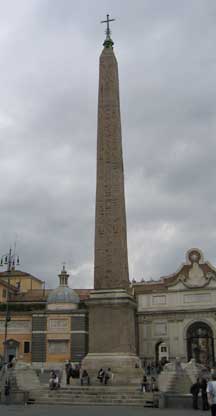
Here is an obelisk in Rome, erected by Augustus Caesar in honor of himself, with an inscription that claims he is the son of the deified Julius Caesar. |
For most hyper-critical scholars, the real problem in the birth narratives is the miraculous element. If Matthew and Luke had told their stories without angelic visitors, without a star guiding the Magi, and, most of all, without a virgin birth, then most scholars wouldn’t have much trouble with them. I have granted before that the supernatural element in the birth narratives poses a genuine problem for historians. And I don’t mind if someone says, “Look, I don’t believe that miracles happen, so I’m going to retell the story in a manner that dispenses with the supernatural parts.” But I do mind when a scholar predisposed to reject miracles doesn’t own up to this presupposition, but instead infuses his or her scholarship with unwarranted skepticism which, in the end, gets rid of the miracles by disingenuous means.
I have tried to show that belief in the historical accuracy of the Nativity narratives is reasonable. I would not claim to have proved the facts of the Christmas story. This simply can’t be done.
Moreover, as I mentioned previously, we have relatively little evidence pertinent to the birth of Jesus, much less, for example, than we have for the death of Jesus. In the case of his crucifixion, we have input from four gospels, from the earlier letters of Paul and the still earlier traditions they employ, and even from non-Christian historians. (For more on this, see my series “How Can We Know Anything About the Real Jesus?”) But for the birth of Jesus we have Matthew and Luke, and that’s it. Yet if one studies these documents carefully, and if one seeks to understand them in light of their historical and cultural context, I believe one can reasonably conclude that the Nativity accounts relate what really happened.
I am assuming, of course, that there is a God who is involved in human affairs and who could very well send angelic messengers or make a virgin pregnant. I do not mean to argue that my perspective is the only reasonable one. I simply want it to count as one reasonable option among many. My objection to Meacham’s article is that it seems to recognize only one reasonable conclusion, that the stories of Jesus’s birth were largely fictitious. The person who still believes them is acting in the realm of faith, according to Meacham, not history. This, as I’ve explained earlier, is far too simplistic, not to mention erroneous.
Faith and History
There are people, Meacham appears to be one, who are able to dismiss the historicity of the Nativity narratives (and much of the rest of the gospels as well), and still believe themselves to be faithful Christians. For them, the deeper truth of Christmas is not dependent on whether God really entered human life in the form of a baby or not. Rather, it’s in the spiritual meaning of the stories.
Consider the case of Marcus Borg, for example. He is one of the leading members of the Jesus Seminar, a prolific author, and the co-author of The Meaning of Jesus, along with N.T. Wright. Borg believes that he is a faithful Christian and I am not doubting what is in his heart. Here is his conclusion to his discussion of the Nativity narratives, in which he, like Meacham, argues that they were largely made up:
The truly important questions about the birth stories are not whether Jesus was born of a virgin or whether there was an empire-wide census that took Mary and Joseph to Bethlehem or whether there was a special star leading wise men from the East. The important questions are, “Is Jesus the light of the world? Is he the true Lord? Is what happened in him ‘of God’?” Answer these questions affirmatively lays claim to our whole lives. (The Meaning of Jesus, p. 186)
Now I passionately agree with Borg, to a point. I believe that the deeper meaning of the Christmas story does indeed center in Jesus and the questions of his identity and significance. But, unlike Borg, I cannot separate these questions from the questions of history. If Jesus was not, in fact, born of a virgin, then why should I consider him as light and Lord? Why should I take the “spiritual meaning” of the story when I can reject it’s historical meaning as fictional? Wouldn’t it make just as much sense to reject the spiritual meaning as well? If Matthew and Luke were free to make up their own Christmas stories and meanings, why can’t I?
I’ve been pondering these issues for over twenty-five years, ever since I was first exposed to them in graduate school. I’ve known many hyper-critical scholars who also claim to believe in Jesus in their hearts, though they wouldn’t use that language. Somehow they’ve been able to drive a wedge between faith and history, and even to believe in faith what their history denies. To me this just doesn’t make sense. Along with the vast majority of Christians throughout the world and throughout history, I believe there’s an indissoluble connection between what really happened and what I should believe. Like Marcus Borg, I acknowledge Jesus as the light of the word and as Lord. But I do so because his words, deeds, life, death, resurrection, and, yes, his birth, have convinced me that Jesus deserves such acclaim.
Unlike those who are satisfied with a wide gap between faith and history, I believe that true faith is a response to a God who has acted within history for our benefit. Therefore history matters to faith. Now I’m not talking about mere facts, of course, but facts interpreted in light of God’s revelation in Scripture and in Jesus Christ. To say that Jesus was born in Bethlehem is a statement of fact. To say that he was in fact the Word of God Incarnate depends, not upon what human can observe, but upon what God has revealed to us in Scripture.
Genuine faith doesn’t exist in some magic isolation booth safely protected from rational scrutiny and critique. Part of my objection to Meacham, you may recall, was his assumption that only hyper-critical scholars approach faith critically. He contrasts the majority of Americans, who believe in the virgin birth, with others who “are equally passionate about their critical understanding of the faith.” Here I object once again. I do have a critical understanding of the faith. Now I might be wrong in my critical perspectives. In fact I’m sure that I’m wrong in many things I believe. I just don’t know which ones they are. But it would be a mistake to assume that because I believe in the virgin birth therefore I am pre-critical in my understanding of faith.
In fact one of the main purposes of this website, and the reason I spend a goodly chunk of time each day blogging, is that I am passionate about examining faith and life from a rational, or one might say, a critical perspective. I want to analyze thoughtfully matters of faith, culture, philosophy, or whatever else seems worthy of careful reflection. My hope is that what I’m doing will encourage others to do the same, even others who disagree with me. Open and charitable disagreement is, after all, a crucial element of critical analysis.
If I believed as does Marcus Borg and others like him, that vast portions of the gospels, including the Nativity narratives, were made up, I honestly don’t know whether I’d still consider myself a Christian or not. And if I believed that the resurrection was merely a meaningful symbol and not a historical fact, as Borg believes, I expect that my faith would be insipid at best.
On Christmas Eve I will stand up before a packed sanctuary and proclaim the good news of Christmas. And what is this good news? It’s more than the virgin birth. It’s even more than the fact that Jesus is light and Lord. The core truth of Christmas is that God has entered human life in the baby Jesus. By a mysterious process that we won’t ever understand, and that Matthew and Luke don’t even try to explain, God became human in the womb of Mary.
This is the core truth of Christmas. If I didn’t think this really happened, if I thought that the early Christians invented this crazy idea, then I wouldn’t be able to preach the good news on Christmas Eve, or at any other time either. Of course I can’t prove that the Incarnation really happened, but I can show that it’s reasonable to believe it. Ultimately, however, it is a matter of faith, not faith without reason or faith opposed to reason, but faith informed by reason.
Why is God’s entry into human life such good news? Well, for one thing, it means that the God of the Universe really understands what it’s like to be human, to be like you and I. When we struggle with the challenges and discouragements of human life, we can be assured that God understands “from the inside.” But, more importantly, the fact that God became human in Jesus means that, in the end, God dealt with our fundamental human problem: sin. Because Jesus was both fully God and fully human, his death on the cross truly effected our salvation. The Incarnation alone didn’t do it. But the Incarnation made possible the saving power of the Crucifixion and Resurrection. Because of Christmas, there will be Good Friday. And because of Good Friday, there will be Easter. This isn’t just a nice story made up by some creative early Christians. It’s the true story of what God has actually done “for us and our salvation.”
Some Helpful Resources for Dealing with the Gospels and the Nativity Narratives
Commentaries on Luke that Deal in Depth with the Historical Challenges of Luke 2
Darrell Bock, Luke 1:1-9:50 (Grand Rapids: Baker Academic, 1994).
Frequently refers to the original languages, but with translation helps along the way.
I. Howard Marshall, The Gospel of Luke: A Commentary on the Greek Text (Grand Rapids: Eerdmans, 1978).
Frequent, untranslated references to original languages, but still useful to the non-specialist who wants careful detail.
General Discussion of the Gospels and Jesus
Mark D. Roberts, Can We Trust the Gospels? Investigating the Reliability of Matthew, Mark, Luke, and John (Crossway, 2007)
Craig L. Blomberg, The Historical Reliability of the Gospels (Downers Grove, Illinois: InterVarsity Press, 1987).
Blomberg is a scholar, but he has written this book for informed lay readers as well as academics.
Craig L. Blomberg, Jesus and the Gospels (Nashville: Broadman and Holman, 1997).
Helpful, readable overview and analysis.
Insightful Treatments of the Nativity Narratives
Ben Witherington III, “Birth of Jesus,” in Dictionary of Jesus and the Gospels, ed. Joel B. Green, Scot McKnight (Downers Grove, Illinois: InterVarsity Press, 1992), 60-74.
The best overview of the Nativity issues from a highly-regarded scholar who is both critical and conservative. Though not available online, this dictionary is well worth owning. It’s a treasure chest full of gems concerning Jesus and the gospels.
N. T. Wright, “”Born of a Virgin?” in Marcus J. Borg and N.T. Wright, The Meaning of Jesus: Two Visions (San Francisco: HarperSanFrancisco, 1999).
This short, readable article points out some of the major flaws in the approach of scholars who think the early Christians made up the virgin birth of Jesus. This book is one of the best introductions to the current debate about Jesus in general, not only his birth. Marcus Borg is a leading member and proponent of the Jesus Seminar. N.T. Wright is an outstanding scholar whose work takes him in a more conservative direction. Both of these scholars are able communicators with non-scholars.
Daniel B. Wallace, “The Birth of Jesus Christ”
A substantial, online discussion at www.bible.org.
 |
If you’re looking for an historically-accurate and personally-relevant treatment of Jesus, I’d recommend my book, Jesus Revealed: Know Him Better to Love Him Better. Each chapter examines one of the titles of Jesus (for example, Jesus, Lord, Savior, Son of Man, etc.), presenting the historical/theological meaning of the title and then drawing out personal implications for our relationship with Jesus. In an appendix to the book I deal with the question of whether Jesus was married or not, examining evidence from the New Testament and early non-canonical gospels. |
Home
|