| |
A Resource by Mark D. Roberts |
|
In a few seconds you will be transferred to
What Was the Message of Jesus?
http://www.patheos.com/blogs/markdroberts/series/what-was-the-message-of-jesus/
What Was the Message of Jesus?
by Rev. Dr. Mark D. Roberts March 2004
Copyright © 2004 by Mark D. Roberts
Note: You may download this resource at no cost, for personal use or for use in a Christian ministry, as long as you are not publishing it for sale. All I ask is that you give credit where credit is due. For all other uses, please contact me at mark@markdroberts.com. Thank you.
My Various Writings on Jesus
The Birth of Jesus: Hype or History?
Was Jesus Divine? The Early Christian Understanding
Why Did Jesus Have to Die?
Was Jesus Married? A Careful Look at the Real Evidence
What Was the Message of Jesus?
How Can We Know Anything about the Real Jesus?
What Languages Did Jesus Speak and Why Does It Matter?
Recovering the Scandal of the Cross?
The Passion of the Christ: An In-Depth Review
Book -- Jesus Revealed: Know Him Better to Love Him Better
Part 1: Introduction
Posted at 10:45 p.m. on Saturday, March 6, 2004
With The Passion of the Christ so much in our minds these days, I had planned to do some blogging on the question: Why was Jesus crucified? But as I pondered this question, I realized that my answer would only make sense in light of a prior answer to another question: What was Jesus' actual message? So I'll get to the reason for Jesus' crucifixion in a while. But first I need to lay a foundation for that reason by dealing with Jesus' message. This isn't quite so easy as it might at first seem. Yet the effort to grasp Jesus' actual message pays rich dividends, because it makes sense, not only of his life and ministry, but of his death and resurrection.
| If you were to ask the average person what Jesus' preached - even the average Christian - you'd no doubt hear something about love: "Jesus taught about love. He said we should all love each other." This perception of Jesus' teaching isn't wrong, let me hasten to add. Jesus did talk quite a bit about love. In fact he said that loving God is the greatest commandment and loving our neighbors is the runner up (Mark 12:29-31). So, to be sure, love figured prominently in the message of Jesus. |
 |
But love was not the core of his proclamation. And, to be sure, his preaching about love didn't get Jesus crucified. Neither the Romans nor the Jewish authorities would have been particularly bothered by a Jewish prophet who ran around telling people to love God and people. Quite a few Jews would have been distressed over the thought of having to love their enemies, however. But the Romans - the obvious enemies -- wouldn't have crucified someone whose main crime was telling Jews to love them and turn the other cheek! The core of Jesus' message must have been more contentious, indeed, more scandalous, than a call to love.
 |
It's common for people to reduce the message of Jesus to something all too simple and, I might add, all too similar to the biases of whoever is doing the reducing. You'll see this in many of the contemporary "scholarly" attempts to summarize the message of Jesus. The infamous Jesus Seminar, by the time it stones Jesus to death with its red, pink, gray, and black beads, ends up with a sage who speaks in esoteric riddles, hardly someone who would be put to death as a threat to Roman order in Judea. |
Whatever Jesus preached, it got people excited. Even the demons were riled up. And Jesus' message angered most of the religious leaders he encountered. In the end, it got him killed on a Roman cross. So what exactly was this inspiring, challenging, goading, and apparently subversive message of Jesus all about?
I'll begin to answer this question in my next post.
Part 2: What Was the Core of Jesus' Preaching?
Posted at 10:00 p.m. on Sunday, March 7, 2004
In my last post I began a multi-part series seeking to answer the question: What was the message of Jesus? I mentioned that many people would answer this question by saying something about love, because we rightly associate Jesus' teaching with love. But, as it turns out, love is not the core of his message, though it is close. What Jesus actually proclaimed, first and foremost, was not that we should love, but something else.
| We find a succinct summary of this "something else" in the first description of Jesus' ministry in the Gospel of Mark: "Now after John was arrested, Jesus came to Galilee, proclaiming the good news of God, and saying, 'The time is fulfilled, and the kingdom of God has come near; repent, and believe in the good news'" (Mark 1:14-15). Here, in a nutshell, is the message of Jesus: the kingdom of God has come near. |
|
| The Plain of Gennesaret, where Jesus began his ministry. Copyright © BiblePlaces.com |
The phrase "kingdom of God" appears 53 times in the New Testament gospels, almost always on the lips of Jesus. The synonymous phrase, "kingdom of heaven," appears 32 times in the Gospel of Matthew. Throughout the accounts of Jesus' ministry, he is always talking about the kingdom of God. Many of his parables explain something about this kingdom: it is like mustard seed, a treasure, a merchant looking for pearls, and a king who gave a banquet (Matt 13:44-47; 22:2). Jesus even defines his purpose in light of the kingdom: "I must proclaim the good news of the kingdom of God to the other cities also; for I was sent for this purpose" (Luke 4:43).
Given the centrality of the kingdom of God to the preaching, and, as we'll see, the actions of Jesus, it's strange that many Christians are relatively unfamiliar with what this phrase means. But if we want to understand the message of Jesus, not to mention his whole ministry, including his death and resurrection, then we must grapple with what he says about the kingdom of God. Gordon Fee, one of the wisest of New Testament scholars, once said in a lecture on Jesus: "You cannot know anything about Jesus, anything, if you miss the kingdom of God . . . . You are zero on Jesus if you don't understand this term. I'm sorry to say it that strongly, but this is the great failure of evangelical Christianity. We have had Jesus without the kingdom of God, and therefore have literally done Jesus in."*
If you've read this far, I'm assuming that you don't want to be zero on Jesus, and that you don't want to do him in, either. Neither do I. So we must work together to figure out what Jesus meant when he said "the kingdom of God has come near." For this was, indeed, the core of his message.
I plan to structure the rest of this blog series around basic questions having to do with the kingdom of God in the ministry of Jesus. These questions will include:
· What is the kingdom of God?
· How did Jesus proclaim the message of the kingdom?
· Where is the kingdom of God?
· When is the kingdom of God coming?
· What will life in the kingdom of God be like?
· Who will bring the kingdom of God?
· How is the kingdom of God coming?
| Answering these questions could very well fill a big, fat book. But my intent is to offer relatively bite-sized answers. If you're looking for more depth, I highly recommend the writings of N. T. Wright. He has written, not one, but three big, fat books on Jesus - and they are outstanding. But, if you're not ready to take on over 2000 pages of in-depth scholarship, then I'd also highly recommend Wright's more accessible overview in his book, The Challenge of Jesus. If you read only one book on Jesus, this is it. (Well, okay, I guess I'd like you to read my book too!) |
|
In my next post I'll take on the question: How did Jesus proclaim the message of the kingdom?
__________
*Gordon Fee, "Jesus: Early Ministry/Kingdom of God," lecture delivered at Regent College. Tape Series 2235E, Pt. 1. Copyright © Regent College, Vancouver, B.C., Canada.
Part 3: What is the Kingdom of God?
Part 3 of the series: "What Was the Message of Jesus?"
Posted at 10:35 p.m. on Wednesday, March 10, 2004
In my last post in the series, "What Was the Message of Jesus?", I explained that the core of Jesus' preaching was the good news of the kingdom of God. This is summarized succinctly in Mark 1:15, where Jesus proclaims, "The time is fulfilled, and the kingdom of God has come near; repent, and believe in the good news." Of course this summary leads to an obvious follow-up question: What is the kingdom of God? What is it that, according to Jesus, has drawn near?
The kingdom of God has been equated with all sorts of things in the last two millennia. Some have claimed that it is heaven, and that Jesus was saying, in so many words, "Now you can go to heaven when you die." Others have understood "the kingdom of God" as referring to the Church. From their perspective, Jesus announced the beginning of the age of the Church. Still others have seen the kingdom of God as a world infused by divine justice. They have taken Jesus' announcement as a call to social action. In recent times, New Agers have reduced the kingdom of God to inner awareness of one's divinity. Like the ancient Gnostics, they understand the good news of the kingdom to mean "You are divine."
None of these renditions of the kingdom of God hits a historical home run, although the first three are in the ballpark, at least. But all of them fail to take seriously both what Jesus actually says about the kingdom of God, and what his fellow Jews, especially the Old Testament prophets, had been saying about the kingdom for centuries.
Before we analyze Jesus' use of the phrase "the kingdom of God," we need to pay close attention to his use of the word "kingdom." When we try to understand Jesus' message of the kingdom, we easily stumble over a language gap. In everyday English, "kingdom" means a place where a king reigns. The Kingdom of Jordan, for example, is the place where King Abdullah II rules. But when Jesus spoke of the kingdom of God, he did not think in terms of locality, but authority. |
|
King Abdullah II, with Jordan in the background. |
In the New Testament gospels, Jesus uses the Greek phrase he basileia tou theou, "the kingdom of God." The word basileia could sometimes refer to a locale over which a king ruled, but it's primary meaning in the first-century was "reign, rule, authority, sovereignty." (The same was true of the Aramaic term, malku, the word actually spoken by Jesus.) We see this meaning clearly in one of Jesus' parables. He speaks of a nobleman who "went to a distant country to have himself appointed king and then to return" (Luke 19:12, NIV; the NRSV reads "to get royal power for himself"). The Greek of this verse reads, literally, "he went to a distant country to receive a basileia for himself." He didn't go to get a new region over which to rule, but rather to get new and greater authority over the place he lived.
We see this same meaning in the Hebrew Scriptures. In Psalm 145, for example, we read:
All your works shall give thanks to you, O LORD,
and all your faithful shall bless you.
They shall speak of the glory of your kingdom
[malkuth in Hebrew; basileia in Greek],
and tell of your power (10-11).
Here God's kingdom is parallel, not to the place over which God reigns, but to his divine power. God's faithful praise his sovereignty here, not the place over which God is sovereign.
| So when Jesus proclaims that the kingdom of God has come near, he doesn't mean that a place is approaching like the giant comet in the movie Deep Impact, but that God's own royal authority and power have come on the scene. "God's reign is at hand. God's power is being unleashed," Jesus says. "Turn your life around and put your trust in this good news." |
|
Of course Jesus' announcement of God's reign didn't come in a vacuum. It was both consistent with and a fulfillment of a central theme in the Hebrew prophets. In my next post I'll examine how these prophets spoke of the kingdom of God, and how this prepared the way for the message and ministry of Jesus.
Part 4 : What is the Kingdom of God? (cont)
Posted at 10:00 p.m. on Thursday, March 11, 2004
In yesterday's post I began to clarify the core message of Jesus: "the kingdom of God has come near" (Mark 1:15). Our word "kingdom," it turns out, misses the precise sense of Jesus' own language. What he proclaimed was not the approach of a place where God rules (our typical sense of "kingdom"), but rather the dawning of God's kingly authority on earth. Thus when we read the phrase "kingdom of God" in the gospels, we need to think in terms of God's reign, rule, authority, or sovereignty. This, according to Jesus, is what has come near.
In his proclamation of the reign of God, Jesus echoes the language and hopes of the Hebrew prophets. I have known this for over 20 years, but it was strongly impressed upon me three years ago as I was writing my book, Jesus Revealed. In preparation for this project, I re-read the Hebrew prophets, beginning with Isaiah and ending with Malachi. Time and again I ran into the language of God's kingdom as the Lord promised that, someday, he would return to rule over his people.
Consider, for example, the following passage from Zephaniah, who prophesied in the latter half of the seventh century B.C.: |
|
|
Sing aloud, O daughter Zion;
shout, O Israel! . . .
The LORD has taken away the judgments against you,
he has turned away your enemies.
The king of Israel, the LORD, is in your midst; . . .
a warrior who gives victory;
he will rejoice over you with gladness,
he will renew you in his love; . . .
I will deal with all your oppressors
at that time.
And I will save the lame
and gather the outcast,
and I will change their shame into praise
and renown in all the earth.
At that time I will bring you home,
at the time when I gather you;
for I will make you renowned and praised
among all the peoples of the earth,
when I restore your fortunes
before your eyes, says the LORD. (Zeph 3:14-20, emphasis added)
According to this prophecy, at the right time the LORD himself will be the "king of Israel." In this role he will give victory to his people, removing their oppressors, gathering their scattered exiles, and restoring their fortunes.
Consider one other passage from the Hebrew prophets, this one from Isaiah:
How beautiful upon the mountains
are the feet of the messenger who announces peace,
who brings good news,
who announces salvation,
who says to Zion, "Your God reigns."
Listen! Your sentinels lift up their voices,
together they sing for joy;
for in plain sight they see
the return of the LORD to Zion.
Break forth together into singing,
you ruins of Jerusalem;
for the LORD has comforted his people,
he has redeemed Jerusalem.
The LORD has bared his holy arm
before the eyes of all the nations;
and all the ends of the earth shall see
the salvation of our God. (Isaiah 52:7-10, emphasis added)
In this prophecy, God's reign includes peace, the return of the LORD to Jerusalem, joyful singing, comfort and redemption for Judah, and the impact of God's salvation upon the whole earth. The announcement of God's reign will be, indeed, "good news."
Now, with Zephaniah's and Isaiah's prophecies ringing in your ears, listen again to Mark's summary of Jesus' message: "The time is fulfilled, and the kingdom of God has come near; repent, and believe in the good news" (Mark 1:15). The prophetic echoes are unmistakable. But there are differences too. Whereas the prophets looked ahead to an undetermined time in the future when God would return to rule over his people, Jesus says, "The time is now. The reign of God has now come near. So turn your life around and live in light of this truth."
Now that we've identified the core message of Jesus - the proclamation of the kingdom - and clarified the basic meaning of this proclamation, we should pursue a bit further the means by which Jesus delivered his message. Yes, upon occasion he stood up and said, simply, "The kingdom of God is at hand." But that was just the beginning. In my next post I will answer the question: How did Jesus proclaim the kingdom of God?
Part 5 : How Did Jesus Proclaim the Kingdom of God?
Posted at 11:30 p.m. on Friday, March 12, 2004
So far I've shown that the central message of Jesus was: "the kingdom of God has come near" (Mark 1:15). This kingdom was not a place where God reigns, but rather the reign of God itself -- God's rule, authority, and power. The reign of God, Jesus says, is at hand.
But how does Jesus proclaim the kingdom of God? What are his means and methods?
Basic Statements of Fact. As we've already seen, at times Jesus simply and bluntly proclaims the presence of the kingdom without exceptional art or artifice. You can't get much simpler than "the kingdom of God has come near" (Mark 1:15).
Explanations. Although the New Testament gospels never provide a thematic outline of Jesus' teaching - such as I'm providing in this blog series - at times Jesus does explain some features of the kingdom of God. In Mark 10:14-15, for example, he says:
"Let the little children come to me; do not stop them; for it is to such as these that the kingdom of God belongs. Truly I tell you, whoever does not receive the kingdom of God as a little child will never enter it."
Although we might debate what exactly Jesus means here, his point - that one must receive the kingdom in a childlike manner - gives us a bit more information about the kingdom of God. Notice that the kingdom is not something we create by our own efforts, but rather something we receive. Christians sometimes speak of God's kingdom as something we produce by our own efforts. This misses the biblical point, which emphasizes the agency of God as that which inaugurates God's own reign.
Parables. Some of Jesus' explanations of the kingdom take the form of parables, which at times seem more like riddles than clarifications. For example, at one point Jesus says,
"With what can we compare the kingdom of God, or what parable will we use for it? It is like a mustard seed, which, when sown upon the ground, is the smallest of all the seeds on earth; yet when it is sown it grows up and becomes the greatest of all shrubs, and puts forth large branches, so that the birds of the air can make nests in its shade" (Mark 4:30-32).
|
|
Mustard plants in Southern California. Not the same variety as envisioned by Jesus. |
This parable, an animated simile, tells us about the kingdom of God by supplying a vivid picture of its paradoxical size. It begins as a tiny seed, but ends up as a giant plant. Whereas many Jews in the time of Jesus expected the reign of God to appear in its full grandeur, Jesus reveals that it begins as the smallest of seeds. The full extent of God's kingdom will only be revealed later.
Notice, once again, how Jesus' parable of the mustard seed coheres with Old Testament prophecy. Through Ezekiel God once said,
I myself will take a sprig
from the lofty top of a cedar;
I will set it out.
I will break off a tender one
from the topmost of its young twigs;
I myself will plant it
on a high and lofty mountain.
On the mountain height of Israel
I will plant it,
in order that it may produce boughs and bear fruit,
and become a noble cedar.
Under it every kind of bird will live;
in the shade of its branches will nest
winged creatures of every kind. (Ezek 17:22-23)
| Whereas Ezekiel spoke of a tiny cedar sprig that grew into a noble cedar in which birds would nest, Jesus used the mustard seed to make a similar point about God's kingdom. Though it begins humbly, in Jesus' own ministry, it will someday be gloriously large, a resting place for all creation. |
 |
|
To sum up what we've seen so far, Jesus announces the presence of God's reign through basic statements, explanations, and parables. Yet his words, as important as they may be, do not exhaust Jesus' means for proclaiming the kingdom. Alongside the words of Jesus we find his works, his actions that announced dramatically the coming of God's kingdom. To these actions I'll turn in my next post.
Part 6 : How Did Jesus Proclaim the Kingdom of God? (cont)
Posted at 10:10 p.m. on Saturday, March 13, 2004
In my last post I showed some of the ways Jesus used words to proclaim the kingdom of God. These included basic statements of fact, explanations, and parables. But Jesus "proclaimed" God's coming reign, not only in words, but also in works. These both illustrated the kingdom of God and demonstrated its presence. Without these works, Jesus' announcement of the kingdom would have fallen on deaf ears. People would have regarded him as a dreamer, perhaps as a deceiver or even a demoniac, but not as the divine envoy of the kingdom.
The works of Jesus that revealed the presence of the kingdom took various forms, including healings, exorcisms, nature miracles, and other symbolic gestures. Let me say a bit about each of these actions and their significance.
Healings. Throughout the gospels Jesus healed people of various diseases. His extraordinary popularity came, not simply from the authority of his preaching, but from his authority over human bodies. Yet healing was not an end in and of itself for those familiar with the Hebrew prophets. It was also a sign of the presence of God's reign on earth. In Isaiah 35, for example, God comes to save and redeem his people. In this context we find the following promise: "Then the eyes of the blind shall be opened, and the ears of the deaf unstopped; then the lame shall leap like a deer, and the tongue of the speechless sing for joy" (Isa 35:5-6). The fact that these things were happening in the ministry of Jesus proved the presence of the kingdom. Jesus himself said this when he was asked by the disciples of John the Baptist whether he (Jesus) was the one through whom the kingdom was coming. Jesus said, "Go and tell John what you hear and see: the blind receive their sight, the lame walk, the lepers are cleansed, the deaf hear, the dead are raised, and the poor have good news brought to them" (Matt 11:4-5). In other words, "Because the healings promised in Isaiah are happening in my ministry, yes, I am the one through whom God's kingdom has come."
Exorcisms. One of the most peculiar aspects of the gospels for North American readers is Jesus' repeated expulsion of demons. Most of us simply aren't familiar or comfortable with such things, unlike so many contemporary believers in the Southern Hemisphere. But, whether we like it or not, exorcisms are central to the ministry of Jesus, and, according to Jesus himself, clear evidence of the presence of the kingdom. In Matthew 12, for example, some of the Pharisees accuse Jesus of casting out demons with demonic power. He answers them, first by citing the now classic line about a house divided against itself being certain to fall (Matt 12:25). Then he adds, "But if it is by the Spirit of God that I cast out demons, then the kingdom of God has come to you" (Matt 12:28). Whatever we might think of Jesus' exorcisms, for him and his fellow first-century Jews they are a demonstration of the presence of God's reign.
| Nature Miracles. According to the gospels, Jesus multiplies food, walks on water, and stills the storm. Once again, these mighty works are associated with God's kingdom. In Psalm 89, for example, the Lord says, "I have made a covenant with my chosen one, I have sworn to my servant David: 'I will establish your descendants forever, and build your throne for all generations'" (Ps 89:3-4). Then, only four verses later the Psalm continues, "O LORD God of hosts, who is as mighty as you, O LORD? Your faithfulness surrounds you. You rule the raging of the sea; when its waves rise, you still them" (Ps 89:8-9). So Jesus' power over nature suggests that God's promised kingdom has arrived and, indeed, that God himself is mysteriously present in the ministry of Jesus. |
|
Rembrandt's "Christ in the Storm on the Sea of Galilee" |
I recognize that for many people today the miracles of Jesus are harder to swallow than a camel. In some circles and among quite a few New Testament scholars the miracles of Jesus are not considered as historical events so much as symbolic legends. Yet if you take away the miraculous from the message of Jesus, you severely truncate his announcement of the kingdom and, at the same time, you are left with a Jesus whom most people would have ignored. Even many skeptical modern scholars, therefore, believe that Jesus must have been a "healer" of sorts, one who used psychosomatic cures and the power of suggestion to help people feel better. At this point I'm not prepared to mount a defense for the genuineness of the miracle stories in the gospels. But, whether you believe that the miracles happened or not, they are clearly essential to the picture of Jesus painted by the gospel writers. The mighty works of Jesus, more than showing his love for people, are part and parcel of his announcement of the reign of God. Take away these works and there's no reason to believe his words.
Other Symbolic Gestures. Although the mighty works of Jesus persuaded people to take seriously his announcement of the kingdom, he did other things that illustrated the kingdom's presence and character. For example, Jesus ate with social and religious outcasts (tax collectors and sinners) as a sign of the unexpected inclusiveness of God's reign. Similarly, he embraced children, not only because he loved them, but also to teach something essential about the kingdom. "Let the little children come to me; do not stop them," Jesus said, "for it is to such as these that the kingdom of God belongs" (Mark 10:14). Like the Hebrew prophets, who often used symbolic gestures to communicate God's message, so did Jesus. Ultimately, some of his most powerful statements about the kingdom would come through symbolic actions: the cleansing of the temple, the Last Supper, and the crucifixion itself. I'll have much more to say about these actions later.
Part 7 : Where is the Kingdom of God?
Posted at 9:40 p.m. on Monday, March 15, 2004
So far in this series we've seen that Jesus proclaimed the kingdom of God using a variety of words and works. The essence of his message is summarized in Mark 1:15: "The time is fulfilled, and the kingdom of God has come near; repent, and believe in the good news."
Growing up as a Christian, I always read this verse as saying: "The time for your personal salvation has arrived. Be sorry for your sins and believe in Jesus as your Savior so you will go to heaven after you die." After having spent much of my life studying Jesus, I no longer believe this is what Jesus meant in Mark 1:15, though I still believe in the truth of what I once attributed to Jesus. Part of my problem in the past, however, was that I wasn't clear on the location of the kingdom of God.
The language of Mark 1:15 certainly suggests that God's reign is coming on earth. This fits, as we have seen previously (Series Part 4), with the promise found repeatedly in the Hebrew prophets: someday God will come to reign on earth, establishing justice and peace for his people and, indeed, for all nations.
The earthly location of God's reign is also revealed in one of the core teachings of Christian faith, that which we call "The Lord's Prayer." In Matthew 6 Jesus taught his disciples to pray:
Our Father in heaven,
hallowed be your name.
Your kingdom come.
Your will be done,
on earth as it is in heaven . . . . (Matt 6:9-10).
The parallelism of this prayer interprets "your kingdom come" as "your will be done on earth as it is in heaven." In other words, we are to pray that God's reign will be experienced on earth as it is right now in God's own heavenly presence. When God's rule is completely established in this world, then all things will be ordered according to God's perfect design.
It's fascinating to discover how much this prayer of Jesus is similar to the prayers offered up by faithful Jews in the first century. Consider, for example, the following prayer that many scholars believe to have been offered daily in the time of Jesus:
"May God establish his kingdom in your lifetime and in your days and in the lifetime of all the house of Israel, even speedily and at a near time." (Kaddish prayer)
Sounds quite a bit like, "Thy kingdom come", doesn't it?
Then there's the eleventh blessing of the so-called Eighteen Benedictions that were spoken during weekly synagogue services:
"Restore our judges as at the first, and our counselors at the beginning; and reign Thou over us, Thou alone. Blessed art Thou, O Lord, who lovest judgment!" (Benediction 11 of the "Eighteen Benedictions")
By proclaiming that the kingdom of God was near, Jesus was saying that these prayers were being answered. God was beginning to rule on earth as he did in heaven -- in the ministry of Jesus himself. |
|
|
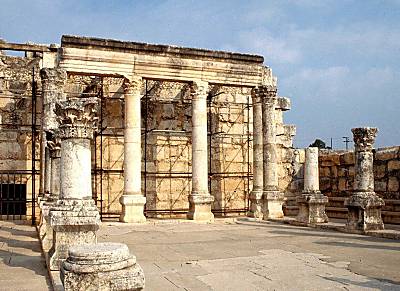
Ruins of ancient synagogue in Capernaum, where Jesus preached. These ruins are later than the first-century, but built upon the same location of the original synagogue. Picture from http://www.bibleplaces.com/. |
When I have taught before on the location of the kingdom of God, people sometimes remain unconvinced. "What about the kingdom of heaven ?" they wonder. "And didn't Jesus himself say his kingdom was not of this world? How do you explain these passages?" In my next post I'll address these questions.
Part 8 : Where is the Kingdom of God? (cont)
Posted at 9:20 p.m. on Wednesday, March 17, 2004
This post could be entitled "Where the Kingdom of God is Not." It deals with two common misunderstandings of the kingdom of God as proclaimed by Jesus. I'll address each of these by stating something that the kingdom is not, and then defending my statement with evidence from the gospels.
1. The kingdom of God is not what we call heaven.
In my last post I mentioned that, as a boy, I understood Jesus' proclamation of the kingdom to be an invitation to "get saved and go to heaven." If you had asked me "Where is the kingdom of God?" I would have answered "In heaven." This answer wouldn't have been completely wrong, because God does reign over heaven. But we miss Jesus' point if we think that his proclamation of the kingdom was telling us something about God's rule up in spiritual space or in the afterlife.
Part of our confusion comes from the fact that the Gospel of Matthew records Jesus as speaking about "the kingdom of heaven" rather than "the kingdom of God." Where Mark 1:15 reads "the kingdom of God has come near," Matthew 3:2 has "the kingdom of heaven has come near" (literally in Greek, "the reign of the heavens," he basileia ton ouranon, mirroring the Aramaic spoken by Jesus, malkuta' dishmaha'). Matthew's phraseology doesn't mean that the kingdom is literally up in the heavens. Rather, he is using a common circumlocution for God, much as my grandmother did when she said "Good heavens" rather than "Good God."
But even if we grant that the phrase "kingdom of heaven" refers to God's reign on earth, isn't this conclusion contradicted by Jesus himself when he tells Pilate, "My kingdom is not of this world" (John 18:36, NIV)? Doesn't Jesus mean "My kingdom is not here on earth, but up in heaven"? No, in fact this is not what Jesus means. Two pieces of evidence make this clear. First, the Greek of John 18:36 literally reads, "My reign is not from this world [ek tou kosmou toutou]." Second, the latter portion of John 18:36 explains, "But now my kingdom is from another place [ouk estin enteuthen]." Literally, this sentence reads, "Now my reign is not from here." Jesus is speaking, not of the location of his kingdom, but of the source of his authority. Unlike Pilate, he does not get his authority from an earthly source (Caesar), but from God. Now it's certainly true that Jesus was not seeking to use his divine authority to establish merely another political state on earth. Nevertheless, the kingdom he announces is, in a sense, heaven on earth, not heaven in heaven.
2. The kingdom is not merely in our hearts.
I cannot tell you how many times in the last twenty years I've heard people locate the kingdom of God in human hearts. Christians do it, and so do many New Agers. Their credo is "The kingdom of God is within you" (Luke 17:21). But they missed Jesus' own meaning by a mile.
Yes, to be sure, God's reign will touch human hearts. But it is not limited to some kind of internal, subjective experience. Yes, I know Jesus is quoted as saying that "the kingdom of God is within you," but this verse is usually wrenched way out of context. Let's return to the passage from which this line comes:
Once Jesus was asked by the Pharisees when the kingdom of God was coming, and he answered, "The kingdom of God is not coming with things that can be observed; nor will they say, 'Look, here it is!' or 'There it is!' For, in fact, the kingdom of God is entos hymon" (Luke 17:20-21).
I've left the original Greek untranslated for a moment so we can see the context of this phrase without prejudging its meaning. Jesus is speaking, not to his faithful disciples, but to a group of Pharisees. They expected the kingdom of God to come with great signs, most obviously the beginnings of a successful revolt against Rome. But Jesus says their expectations are misguided. In fact, the kingdom of God is entos hymon. Given what Jesus says about the hearts of the Pharisees elsewhere - that are "full of greed and self-indulgence" and "all kinds of filth" (Matt 23:25, 27) - it's unlikely that Jesus is telling the Pharisees to look within their hearts to find the kingdom. Rather, he is saying to them: The kingdom of God is right here, in your midst. The Greek phrase entos hymon can mean "among you," as it does in this instance. If the Pharisees want to find the kingdom, Jesus says, they should look, not into their own sinful hearts, but right in front of their eyes, at Jesus himself, at his words and works.
So, though God's reign embraces and transforms human hearts, it is not limited to some sort of interior experience. The kingdom of God impacts actions, thoughts, relationships, families, institutions, and governments. In the end, it will touch everything on earth, when God's will is done on earth "as it is in heaven." Yet this expansive kingdom has begun on earth in a most unexpected and unnoticed way - rather like a mustard seed -- in the ministry of Jesus.
If the kingdom of God is neither up in heaven nor limited to human hearts, but is something we ought to experience in all aspects of our earthly life, this points to another question: When is it coming? Did Jesus envision the kingdom of God as present reality? Or was it rather something that was coming in the future? In my next post I'll begin to deal with the question: When is the kingdom of God coming?
Part 9 : When is the Kingdom of God Coming?
Posted at 9:30 p.m. on Thursday, March 18, 2004
Jesus proclaimed that the reign of God was coming to earth, but when? Did Jesus preach the coming of the kingdom as a future reality? Or did he believe that the kingdom of God was truly present in his earthly ministry? In this post I want to lay out some of the basic evidence from the gospels. Then, in my next post, I'll try to make sense of this evidence.
The Future Kingdom
In many of his sayings, Jesus appears to state that the kingdom of God will come in the future. For example:
"Your kingdom come. Your will be done, on earth as it is in heaven" (Matt 6:10).
This line from what we call "The Lord's Prayer" implies that God's kingdom isn't present in the moment, but is something that will come in the future. As we saw earlier in this series, this echoes first-century Jewish prayers for the coming of God's reign.
"I tell you, many will come from east and west and will eat with Abraham and Isaac and Jacob in the kingdom of heaven, while the heirs of the kingdom will be thrown into the outer darkness, where there will be weeping and gnashing of teeth" (Matt 8:11-12).
Note that many "will come" to the great messianic banquet. They haven't yet arrived. Here Jesus draws on the prophetic hope of God's future kingdom as "a feast of rich food, a feast of well-aged wines" that the Lord will prepare "for all peoples" (Isa 25:6).
"I tell you, I will never again drink of this fruit of the vine until that day when I drink it new with you in my Father's kingdom" (Matt 26:29).
In this poignant line from the Last Supper, Jesus looks ahead to the time when he will share in the messianic banquet with his disciples. He draws from the eschatological language of the prophets in speaking of "that day" - the future day of the Lord (see Isa 25:9, for example).
| One could point to many other places in the gospels where Jesus implies that the kingdom of God will come in the future. This type of futuristic eschatology ("eschatology" = "doctrine of the end times") is familiar to many Christians in our time of history. When I was a young believers, my friends and I were enchanted by The Late Great Planet Earth, by Hal Lindsey. This book, which has sold over 35,000,000 copies worldwide, showed that the kingdom of God was coming in the future, and that it was coming soon, and how world events made all of this quite certain. But when Jesus didn't hurry back to earth in the 70's, for a while the eschatological fever broke. Yet in 1996 Tim LaHaye and Jerry B. Jenkins published Left Behind, the first volume in their fictionalized account of the end of human history and the beginning of God's eternal kingdom. Now, with over 55 million books sold, LaHaye and Jenkins are bringing out volume 12, the last book in the series. Why has this series drawn so many readers? When I asked a group of Left Behind fans about this, one woman informed me confidently: "Because these books tell us what's going to happen in the future." The others agreed. Future eschatology, with certainty, wow! |
|
|
The Present Kingdom
If Jesus had only spoken of the reign of God in a future tense, our task would be simple. Unfortunately for those of us who like things neat and tidy, Jesus also spoke of the presence of the kingdom. Here are some examples:
"The time is fulfilled, and the kingdom of God has come near; repent, and believe in the good news" (Mark 1:15).
Though one could argue that "has come near" isn't exactly the same as "is here," the sense of Greek is that the "coming near" of the kingdom has already begun to happen.
"But if it is by the Spirit of God that I cast out demons, then the kingdom of God has come to you" (Matt 12:28).
In response to those who accuse Jesus of casting out demons with satanic power, he points to the true source of his authority: the Spirit of God. The exorcisms of Jesus are not merely evidence of his compassion for demonized people, they are also evidence that the kingdom of God is already present.
"The kingdom of God is not coming with things that can be observed; nor will they say, 'Look, here it is!' or 'There it is!' For, in fact, the kingdom of God is among you" (Luke 17:20-21).
In a previous post I discussed this passage. Jesus is not saying to the Pharisees that the kingdom is in their hearts, but that it is in their midst. Where Jesus is doing the work of God, there is God's kingdom.
In certain quarters of Christendom the presence of the kingdom has been a popular theme. Whereas conservative Christians have tended to embrace the future kingdom, more liberal Christians have generally preferred the present kingdom. (There are exceptions on both sides of this rule, of course.) If God's reign is here, then so is God's justice and peace, at least in principle. The task of the believer is not to wait around for some dramatic act of God in the future, but to live out God's kingdom now by promoting divine justice in the world today.
Interim Conclusion
If you were to read through all four gospels, you'd find more evidence for the future and for the present kingdom. This presents us with a riddle. Which did Jesus proclaim? I'll attempt to solve this riddle in my next post.
Part 10: When is the Kingdom of God Coming? (cont)
Posted at 10:30 p.m. on Friday, March 19, 2004
I ended my last post with an apparent riddle. Throughout the gospels Jesus proclaims the kingdom of God, sometimes as coming in the future, and sometimes as a present reality. So which is it? How can we understand the apparently divergent themes in Jesus' preaching of the reign of God?
| Throughout the last 150 years, many New Testament scholars have cut this Gordian knot by claiming that some of what is attributed to Jesus in the gospels is not authentic, but was added by the early church. Ironically, depending on the preference of the scholar, the supposedly inauthentic portion of Jesus' teaching can be either the future kingdom or the present kingdom. Scholarly methodology bends freely to the whims of the individual scholar. So, for example, Marcus Borg, a prominent member of the Jesus Seminar and prolific author on Jesus, has repeatedly argued that Jesus did not expect God's kingdom to come sometime in the future. Gospel passages that suggest this were inserted by the early church, Borg claims, under the influence of Jewish eschatology. Yet, contradicting Borg, a cadre of contemporary scholars insists that Jesus did in fact present himself as an eschatological prophet who proclaimed the coming of the kingdom. John P. Meier is a highly-acclaimed advocate of this view, though he hasn't received as much popular attention as Borg, partly because Meier's writings are more scholarly and less sensationalistic than Borg's. |
|
How telling that the cover of Borg's book on Jesus (top) shows a distorted, unnatural Jesus, whereas Meier's book (bottom) pictures a Jesus who looks like an ordinary Jewish man. |
|
If you wade through the tangled bog of New Testament scholarship, as I have, you'll find circular arguments almost everywhere among those who try to slice and dice the teachings of Jesus. The Jesus Seminar is perhaps the most brazen in this regard, assuming from the outset that Jesus was a non-apocalyptic Hellenistic sage and then excising from the gospels anything that doesn't fit this assumption. Other scholars are more subtle. But, in the end, efforts to reduce Jesus' preaching to either an exclusively future kingdom or an exclusively present kingdom are unconvincing. The riddle of kingdom of God is too deeply imbedded in the gospel accounts to be amputated by responsible scholarship.
Could it be that Jesus simply contradicted himself? Did he speak of the kingdom as present and future without realizing his confusion? I doubt it. Even bracketing Jesus' unique identity for a moment, I'd argue that brilliant, influential thinkers are rarely so obviously confused. Moreover, they are rarely easy to fathom. Have you ever tried to simply Plato, or Augustine, or Calvin, or Kant, or Wittgenstein? Good luck! Thus, simply working with historical probability, it's likely that Jesus proclaimed the kingdom of God as somehow both future and present, and that he knew what he was doing at the time.
In my previous post I cited examples of Jesus' speaking of the kingdom of God as either future or present. In a few instances, however, he indicated that the kingdom has both present and future dimensions. Take this parable for example:
"With what can we compare the kingdom of God, or what parable will we use for it? It is like a mustard seed, which, when sown upon the ground, is the smallest of all the seeds on earth; yet when it is sown it grows up and becomes the greatest of all shrubs, and puts forth large branches, so that the birds of the air can make nests in its shade" (Mark 4:30-32)
Jesus invites us to look at the mustard seed from two perspectives. In the present - and it is really present - it is small and insignificant. In the future, however, the mustard seed will be great and notable. Similarly, God's reign has truly come on earth in the ministry of Jesus. When blind eyes are opened, when deaf ears hear, when demons are cast out, when the hungry are fed, when sinners are forgiven, the kingdom of God is truly present on earth. Yet it's relatively small, and won't reach it's full, glorious extent until later.
Many New Testament scholars today realize that Jesus proclaimed the kingdom as both present and future. You can find a refreshingly concise statement of this perspective in the now classic little book by G. E. Ladd, The Gospel of the Kingdom. Scholars who hold together both dimensions of the reign of God sometimes speak of it as "already and not yet." The kingdom is already present in the ministry of Jesus, and it is not yet fully present. If you read through the gospels with this thought in mind, much begins to make sense. The sayings of Jesus and his actions demonstrate both the real presence and the future glory of the kingdom of God.
But the whole idea of "already and not yet" may seem odd and hard to fathom. If you're accustomed to thinking of the kingdom as either future or present but not both, this new way of looking at Jesus can seem counter-intuitive. What sense does it make, you might wonder, to speak of something as "already and not yet" present?
| I have found that three analogies from contemporary life make this seemingly odd concept much easier to grasp. But, since this post is running on, I'll save these analogies for tomorrow, same bat time, same bat channel. |
 |
Part 11 : When is the Kingdom of God Coming? (cont)
Part 11 in the series, “What Was the Message of Jesus?”
Posted at 10:30 p.m. on Saturday, March 20, 2004
In recent posts I have shown that Jesus proclaimed the kingdom of God as something both present and future. Like the mustard seed, the kingdom is small in the moment, yet will be great in the future. The more we study Jesus’ ministry without chopping it into disconnected bits, the more we realize that he proclaimed the reign of God as something that was “already and not yet” present. It was already present in Jesus’ own ministry, but it was not yet fully present. Much more was still to come.
I have found that three analogies help people grasp the “already and not yet-ness” of the kingdom. You can probably think of others, but here are my three.
Engagement and Marriage
As a pastor I have the privilege of sharing with engaged couples as they prepare for marriage. When their wedding day arrives, most couples are well-prepared to commit their lives to each other. In the minutes before the ceremony begins, I visit with the bride and groom, praying with them for what lies ahead. If I were to ask them at that point, “Do you love your fiancé? Will you commit yourself completely to him or her?” they would answer “Yes. Yes.” Are they married at that point? No, not yet. Yet are they deeply committed to each other? Yes. Do they love each other profoundly? Yes. All that’s necessary for a marriage is present and ready to go. In many ways they’re already feeling as if they were married, and yet they aren’t married.
Pregnancy and Parenthood
| There’s just about nothing more exciting for a woman who wants to be a mother than being pregnant. From the moment she first hears the good news of her pregnancy, she starts preparing emotionally to be a mother. After just a few weeks she gets to hear the baby’s heartbeat during a visit to the doctor. Not long afterward she begins to feel the baby kicking and moving. By the time a woman is nine months’ pregnant, she has thought about her baby for thousands of hours. She has taken new baby classes. She has prepared a place for the baby, and usually chosen a name. She loves her baby intensely. So then, is a woman in her last weeks of pregnancy a mother? In so many ways the answer is “yes.” But most people would say that, however real her motherhood may be, something is lacking. The act of giving birth makes it all complete. (Well, actually, it’s just one big step forward in a lifelong enterprise of being a mother.) Is a woman a mother when she’s nine months pregnant? She is already, and not yet. |
 |
Completion and Graduation
I enrolled as a freshman at Harvard College in September of 1975. Sixteen and a half years later, in May of 1992, I faced the last challenge of my Harvard career: the oral defense of my Ph.D. dissertation. On that fateful day in early May, I sat in a room with four brilliant scholars and defended my academic work. Then they sent me out in the hall to sweat while they decided my fate. After about twenty minutes my advisor beckoned me back into the room. “We have voted unanimously to approve your dissertation,” he said. “Congratulations, Dr. Roberts!”
|
In order to make things official, I had to submit four copies of my doctoral thesis to the appropriate office and, of course, pay all of my outstanding bills. I did these things soon after my oral defense was over. And that was that! Done!
But was I really done? Could I truly claim to be Dr. Roberts? Well, not quite. Graduation wasn’t until early June. I wouldn’t hold my Ph.D. in my hand until them. So, was I Dr. Roberts in late May of 1992? In some sense, yes, I already was. And, in some sense, no, I wasn’t yet. |
Graduation at last! |
The Kingdom of God: Already and Not Yet
When Jesus began his ministry in Galilee, the reign of God had truly begun its appearance on earth. God’s power was present in Jesus, which explains why blind eyes were opened and demons fled. But the kingdom hadn’t fully come, even though it was already present. And Jesus, though he was announcing and inaugurating the kingdom, hadn’t finished everything for his graduation as messiah. This work, as it turned out, wasn’t just proclaiming the kingdom and demonstrating its presence through works of power and love. For the kingdom of God to come fully, Jesus had to do something else, something so radical, paradoxical, and unexpected that nobody anticipated it.
In my next post in this series I’ll begin to explore Jesus’ surprising action as I answer the question: “How is the Kingdom of God Coming?”
Part 12: How is the Kingdom of God Coming?
Posted at 9:45 p.m. on Wednesday, March 24, 2004
So far in this series “What Was the Message of Jesus?” we’ve seen that the core of Jesus’ proclamation was “the kingdom of God has come near” (Mark 1:15). In my most recent posts in this series I focused on the question of when the kingdom of God is coming. In fact Jesus proclaimed the kingdom as something both present and future, as something “already and not yet” here on earth. Like a mustard seed, God’s reign begins as something small and insignificant, but in time it will become great and glorious.
How will the kingdom of God come, according to Jesus? Before addressing this question, I want to survey other Jewish options in Jesus’ day.
There were a variety of answers to the question of how God’s reign would come on earth. Some Jews believed that the kingdom would come through a rebellion against Rome. The Zealots and others with a revolutionary bent continually plotted ways to undermine and ultimately depose the Romans. Others rejected this approach, preferring instead to wait for God’s dramatic intervention. The Essenes at Qumran had grand visions of an apocalyptic war between the sons of light and the sons of darkness, in which God would finally vindicate his people and restore both his temple and his kingdom. They were disinclined to look for human agents who might bring the God’s kingdom, probably because their experience of Hasmonean (Maccabean/Jewish) rule of Judea had been such a negative one.
| In many of the Jewish kingdom scenarios, God would act through a human being who would execute divine justice and restore divine rule over Israel. Only a few Jewish texts refer to this human as the Son of Man (literally in Hebrew/Aramaic, “the human being”). More commonly, however, the human agent of the kingdom was called “the anointed one” (in Hebrew, mashiach or “messiah”). There wasn’t one established set of expectations for the messiah, however. The Dead Sea Scrolls, for example, actually speak of multiple messiahs, including a priestly messiah and a royal messiah. |
|
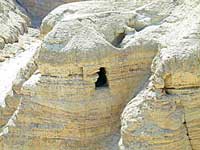
Cave 4 at Qumran near the Dead Sea. The source of many of the Dead Sea Scrolls. Picture from www.bibleplaces.com |
Common to every Jewish scenario of the coming to the kingdom was the expulsion of the gentiles who ruled over Judea. In Jesus’ day, of course, the Romans were the hated overlords whom, it was hoped, would someday be vanquished by the Lord and his anointed leader. One Jewish writer, perhaps a Pharisee, wrote a collection of psalms, one of which bears passionate witness to Jewish hopes for the coming kingdom:
See, Lord, and raise up for them their king,
the son of David, to rule over your servant Israel
in the time known to you, O God.
Undergird him with the strength to destroy the unrighteous rulers,
to purge Jerusalem from gentiles . . .
He will gather a holy people
whom he will lead in righteousness . . . .
And he will be a righteous king over them, taught by God.
There will be no unrighteousness among them in his days,
for all shall be holy,
and their king shall be the Lord Messiah. (Psalms of Solomon 17)
Jesus proclaimed the reign of God to a people who fervently hoped and prayed for its coming. Yet he did not affirm common Jewish expectations for how the kingdom would come. He didn’t raise up an army to wage war against Rome. And he didn’t promise that God would fight this battle himself in some imminent Armageddon. In fact Jesus’ answer to the question “How will the kingdom come?” was quite novel, elusive, and frustrating.
Now that I’ve established the Jewish context for Jesus’ explanation of how the kingdom will come, I’ll focus on Jesus in my next post.
Part 13 : How is the Kingdom of God Coming? (cont)
Posted at 9:40 p.m. on Thursday, March 25, 2004
In my last post I outlined some of the ways Jews in the time of Jesus answered the question: How is the kingdom of God coming? Though there were a variety of answers to that question, most all Jews in the first century agreed that the coming of God’s kingdom would include the expulsion of Rome from Judea. The Zealots and others of revolutionary ilk were convinced that this would happen as human beings did the heavy lifting, with some help from the Lord. Others preferred to wait for God to lead the charge. (In the end, the Zealot-option prevailed as the Jews waged war against Rome in A.D. 66-70. The end of this effort, of course, was the utter destruction of the temple and the devastation of the Jewish people.)
Jesus perplexed many of the Jews in his day by his unwillingness to support a revolt against Rome. He healed the servant of a Roman centurion (Matt 8:5-13), praising this leader in the oppressor’s army as a paragon of faith (v. 10). He hung out with Jewish tax collectors who had collaborated with Rome in order to become rich (Luke 19:1-10). He even appeared to support paying taxes to Rome (Matt 22:15-22).
| But, far more confusing than this was what Jesus said in the Sermon on the Mount. God will bless those who are meek, merciful, peaceful, and persecuted, not those who use human strength to fight against Rome (Matt 5:3-10). Moreover, Jesus taught that one should “not resist an evildoer. But if anyone strikes you on the right cheek, turn the other also; and if anyone wants to sue you and take your coat, give your cloak as well; and if anyone forces you to go one mile, go also the second mile” (Matt 5:39-41). More troubling still, Jesus called his fellow Jewish to love their enemies and pray for those who persecute them (Matt 5:44). In context, there could be no question in the mind of Jesus’ audience to whom he was referring in all of this: the Romans. Don’t fight against the Romans, he said, but love and pray for them. |
|
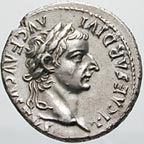
This is the kind of coin that Jesus used to make his point about giving to Caesar what is owed to Caesar, and to God what is owed to God. Curiously, the Latin around the head of Tiberius Caesar reads TI CAESAR DIVI AUG F AUGUSTUS, or Tiberius Caesar Divi Augusti Filius Augustus, in English, Augustus Tiberius Caesar the Son of the Divine Augustus. |
Can you imagine how controversial this must have been? Here was Jesus, proclaiming the kingdom of God, doing miraculous works to prove that God’s reign had arrived, and yet opposing what most of his peers believed to be an essential element of the kingdom’s coming – the expulsion of Rome and the punishment of all who had oppressed Israel.
For us this can seem very theoretical, far removed from real human experience and emotion. But suppose Jesus appeared on the scene right now in Israel. Suppose he went around telling Israeli fathers whose children had been killed in suicide bombings that they should turn the other cheek and love their enemies, and that this was somehow the way to peace. When we put matters in these terms, it's easier to understand not only why so many people were confused by Jesus, but also why many were so angry at him.
Jesus seemed to be saying that the kingdom of God would come, not through human strength, but through weakness, not through military victories, but through apparent defeat, not through hatred, but through sacrificial love. How could this be possible?
I’ll continue to work on this question in my next post.
Part 14 : How is the Kingdom of God Coming? (cont)
Posted at 10:30 p.m. on Friday, March 25, 2004
Any consideration of how the kingdom of God is coming must grapple with one of the most striking and surprising passages in the New Testament. The first chapters of the Gospel of Mark chronicle Jesus’ healings, exorcisms, parables, and controversies. Through his words and works, his true identity is seen, but not seen; it is revealed, and yet secret.
In Mark 8 Jesus asks his disciples “Who do people say that I am?” (8:27). Some think that Jesus is John the Baptist reborn. Others think he is Elijah, the prophet whose return signals the coming of the kingdom. Others regard Jesus as “one of the prophets” – a label Jesus himself accepts (see Mark 6:4; Luke 4:24; 13:33). After warming up his disciples with a safe question about what others think, he becomes much more direct and personal: “But who do you say that I am?” (8:29). Peter, always the impetuous one, sticks his neck out with a bold answer: “You are the Messiah” (8:29). In the amplified version we’d read, “You are the one anointed by God to establish the kingdom. You’re the one who will lead the Jews in expelling the Romans from Judea.” Finally the secret is out. Jesus is the Messiah. Peter hit the bull’s eye, well, sort of.
But, no sooner does Peter finish than Jesus shocks him and his colleagues with unprecedented news: “Then he began to teach them that the Son of Man must undergo great suffering, and be rejected by the elders, the chief priests, and the scribes, and be killed, and after three days rise again” (8:31). Peter is so unsettled by this that he actually takes Jesus aside, no doubt to keep Jesus from being embarrassed, and begins to rebuke him. Though Mark doesn’t provide the transcript of this conversation, it isn’t hard to imagine how it might have gone: “Now, c’mon Master. The Son of Man will bring God’s judgment upon the wicked and inherit God’s glorious kingdom (Daniel 7). No suffering and dying here. And the Messiah will lead us to victory over the Romans. Don’t talk about this suffering and dying stuff. It makes no sense.”
Jesus’ responds by rebuking Peter, and in language that is rather blunt, to say the least: “Get behind me, Satan! For you are setting your mind not on divine things but on human things” (8:33). Yeow! This is not what you’d want Jesus saying to you, that’s for sure.
It’s easy for us to look down on Peter as hard-headed, given what we know of Jesus and his ultimate fate. But we must be fair here. What Jesus said about the Son of Man was utterly unexpected. It seemed completely backwards to Peter and the other disciples. The glorious one to be humiliated? God’s victor to be killed? The healer to undergo great suffering? The king of the Jews to be rejected by the Jewish leaders? Peter’s response to Jesus wasn’t foolish or narrow-minded. In fact, it’s the response that I’m quite sure I would have made, if I’d even had the courage to speak up at all.
| Given how hard it is for us to grasp the radical and apparently ridiculous nature of what Jesus said about the suffering Son of Man, let me offer the following analogy. As you know, we’re already in the middle of a hot and heavy presidential election. For the next seven months we’ll hear two candidates flaunt their own distinctions while flogging the deficiencies of their opponent. That’s what candidates do ad nauseam, like it or not. But suppose that George W. Bush called together Karl Rove and his campaign staff. And suppose the President said something like this: “Friends, we’re going to run a very different kind of campaign this year. Instead of blasting away at my opponent, we’re going to praise him. We’re going to highlight everything good about him. Moreover, we’re going to admit all of my mistakes, without evasions or excuses. The best thing for the country will be doing everything we can to help John Kerry get elected.” Don’t you think at this point Karl Rove would take the President aside and rebuke him? Maybe suggest that he needs some serious rest, or perhaps electroshock therapy? This is akin to Peter's reaction to Jesus' incredible suggestion that his calling as Son of Man includes suffering and dying. |
|
|
Jesus appears to accept Peter’s confession “You are the Messiah,” even as he refers to himself as “The Son of Man.” But then Jesus redefines the mission of the Messiah/Son of Man in a radically new way. He will bring the kingdom of God, to be sure, but only through suffering and dying. This is how the kingdom will come.
But this answer begs another question: How will the death of Jesus be a pathway for the coming of the kingdom of God?
I’ll pick this up in my next post. Stay tuned . . . .
Part 15 : How is the Kingdom of God Coming? (cont)
Posted at 10:30 p.m. on Monday, March 29, 2004
In my last post in this series I examined the passage in Mark 8 where Peter confessed Jesus as the Messiah (Mark 8:27-30). But, when Jesus starting talking about the Son of Man suffering and dying, Peter rebuked Jesus, who in turn rebuked Peter for thinking in human, not divine terms (8:31-33). Peter, like most of his Jewish compatriots, expected the kingdom of God to come in power. The Messiah would lead this victorious charge and share in God’s glory, not suffer and die along in the process.
Peter was not the only one of Jesus’ disciples to be confused over the nature of his messianic calling. Two chapters later in Mark, Jesus once again informed his closest followers that he, as Son of Man, was going to be assaulted and killed (10:33-34). Immediately after Jesus said this James and John approached him and asked “Grant us to sit, one at your right hand and one at your left, in your glory” (10:37). Rather cheeky, don’t you think, not to mention obtuse. Jesus responded first by asking James and John if they were able to drink the cup that he drinks, and then by informing them that it is not his job to decide who gets to sit at his right or left hand (10:38-40). (The idea of the cup Jesus drinks deserves further attention, and will be the subject of my next post.) When the other disciples heard what James and John were plotting, they became angry. Jesus proceeded to rebuke the whole lot of them:
“You know that among the Gentiles those whom they recognize as their rulers lord it over them, and their great ones are tyrants over them. But it is not so among you; but whoever wishes to become great among you must be your servant, and whoever whishes to be first among you must be slave of all. For the Son of Man came not to be served but to serve, and to give his life as ransom for many.” (10:42-45)
The attitudes exhibited by James and John, and the rest of the disciples for that matter, are inconsistent with the way of Jesus, which leads to greatness but only through servanthood. The prime illustration of this paradox? Jesus’ own destiny as Son of Man. Here, for the first time, Jesus supplies a hint as to the reason for his imminent death. He is going to give up his life as a “ransom for many.”
Jesus wasn’t the first Jew in Second Temple Judaism to speak of giving up one’s life for the sake of others. A century and a half before, Mattathias, the father of Judas Maccabeus and his brothers, urged his sons to “show zeal for the law, and give your lives for the covenant of our ancestors (1 Maccabees 2:50). The Maccabean brothers were to fight to the death for the sake of their faith. Even closer to Jesus’ understanding of his sacrifice is a description of martyrdom found in 4 Maccabees: “[those who died] having become, as it were, a ransom [antipsychon] for the sin of our nation. And through the blood of those devout ones and their death as an atoning sacrifice, divine Providence preserved Israel that previously had been mistreated” (4 Macc 4:21-22). Here the willingness of Jewish people to suffer and die rather than compromise their faithfulness to God is seen as making up for the sin of the Jewish people, which in turn motivated God to preserve the nation.
These texts from the Maccabean literature and Jesus’ description of his own sacrifice in Mark 10 were inspired by two crucial chapters from the prophet Isaiah. These chapters begin with a hopeful vision of the coming of God’s kingdom:
How beautiful upon the mountains
are the feet of the messenger who announces peace,
who brings good news,
who announces salvation,
who says to Zion, “Your God reigns.” (Isa 52:7)
But then the passage takes an unexpected turn, picturing God’s servant as anything but attractive (52:14-53:2). Moreover,
He was despised and rejected by others
a man of suffering and acquainted with infirmity;
and as one from whom others hide their faces
he was despised, and we held him of no account. (53:3)
Yet this Suffering Servant endured such scorn for the sake of others:
Surely he has borne our infirmities
and carried our diseases; . . .
But he was wounded for our transgressions,
crushed for our iniquities;
upon him as the punishment that made us whole,
and by his bruises we are healed. . . .
Therefore I will allot him a portion with the great,
and he shall divide the spoil with the strong;
because he poured out himself to death,
and was numbered with the transgressors;
yet he bore the sin of many, . . . (53:4-5, 12)
Although this passage from Isaiah does not use the word “ransom” (lutron in Mark 10:45), it clearly conveys the idea of one who suffers for the sake of others, so that they might be made whole. Through his painful death, the Servant of God bears the sins of others. And somehow this is part and parcel of the coming of God’s kingdom announced at the beginning of Isaiah 52.
Of course what makes Jesus’ statement in Mark 10:45 so curious is that he doesn’t speak of the Servant of God giving his life as a ransom for many, but the Son of Man filling this role. There’s nothing in the Hebrew Scriptures to suggest that the Son of Man would bring the kingdom through some sort of sacrificial death. We don’t find this connection in the Maccabean literature or in other Jewish writings either. Jesus is weaving together disparate strands of Jewish tradition to create a unique tapestry of the coming kingdom. He, as Messiah and Son of Man, will bring the kingdom, but only by fulfilling the role of the Suffering Servant in Isaiah 52-53. For the first time in the gospels we see a part of Jesus’ rationale for suffering and dying. He will bear the sin of many in order to bring the healing and forgiveness of God’s kingdom.
In my next post I’ll examine in greater detail Jesus’ curious statement about drinking the cup (Mark 10:39). This, as it turns out, provides another window through which we can glimpse Jesus’ sense of his passionate destiny.
Part 16 : How is the Kingdom of God Coming? (cont)
Posted at 10:30 p.m. on Tuesday, March 30, 2004
In my last post I began to comment on the passage in Mark 10, where James and John ask Jesus: “Grant us to sit, one at your right hand and one at your left, in your glory” (10:37). Of course the fact that Jesus has just spoken for the second time about his imminent death doesn’t seem to have made much of an impression of these two disciples. Jesus responds by saying, “You do not know what you are asking. Are you able to drink the cup that I drink, or be baptized with the baptism that I am baptized with?” (10:38) James and John eagerly reply, “We are able” (10:39), to which Jesus adds, “The cup that I drink you will drink; and with the baptism with which I am baptized, you will be baptized” (10:39).
What is Jesus talking about? Do you feel rather like James and John at this point, not really knowing what this talk of a “cup” is all about? It’s worth understanding this allusion, not only to get the point of this passage in Mark, but also to get insight into Jesus’ understanding of his approaching death.
In several passages of the Old Testament, the cup is a symbol of God’s wrath. (By using the word “wrath,” I’m not referring to God’s anger alone, but also just judgment upon sin.) In Psalm 75, for example, we read:
For in the hand of the LORD there is a cup
with foaming wine, well mixed;
he will pour a draught from it,
and all the wicked of the earth
shall drain it down to the dregs. (Psalm 75:8)
Or, take the following passage from Isaiah, which appears shortly before the description of the suffering servant in chapters 52-53.
Rouse yourself, rouse yourself!
Stand up, O Jerusalem,
you who have drunk at the hand of the LORD
the cup of his wrath,
who have drunk to the dregs
the bowl of staggering. . . . (Isa 51:17)
In a similar passage, the Lord speaks to the prophet Jeremiah:
Take from my hand this cup of the wine of wrath, and make all the nations to whom I send you drink it. They shall drink and stagger and go out of their minds because of the sword that I am sending among them. (Jer 25:15-16)
In each of these passages, the “cup” is a symbol of God’s wrath. Drinking the cup is equivalent to receiving God’s righteous judgment.
| So when Jesus speaks to James and John of drinking from the cup, he is once again using the language of the prophets. He himself will drink from the cup of God’s wrath, though not because he deserves it. A few verses later, Jesus elaborates further by explaining his calling as Son of Man, namely, “to give his life a ransom for many” (10:45). In Jewish speculation, the Son of Man would come to execute God’s judgment upon the wicked gentiles. But Jesus redefines this mission. Now he will take God’s judgment upon himself. He will drink deeply of the cup of divine wrath, even dying so that others may live. |
|
In Mark 10 we find, not only Jesus’ second prediction of his imminent death, but also the beginning of a rationale for this seemingly paradoxical fate. Jesus will be killed, not only because of opposition from Jewish and Roman leaders in Jerusalem, but also, on a deeper level, because he is going to drink the cup of divine wrath. He is going to bear the sin of Israel, indeed, as we learn later on, the sin of the world. This is his unique and unexpected calling as Messiah and Son of Man. When human sin has been righteously judged, when Jesus has borne the penalty in his own person, then and only then will God’s kingdom be able to come on earth.
The imagery of the cup suggests another crucial scene in Jesus’ ministry, of course, the Last Supper. In my next post I’ll begin to examine this episode, which reveals even more profoundly the reason for Jesus’ death and its connection to the coming of God’s kingdom.
Part 17 : How is the Kingdom of God Coming? (cont)
Posted at 10:00 p.m. on Wednesday, March 31, 2004
In my last post I discussed Jesus’ rather elliptical response to James and John when they ask to sit alongside him in his glory. “You do not know what you are asking,” he says. “Are you able to drink the cup that I drink?” (Mark 10:38). The cup, following Old Testament usage, stands for God’s wrathful judgment upon sin. Jesus will drink the cup, bearing this judgment by suffering and dying. This, he believes, is part and parcel of his messianic calling, and necessary if the kingdom of God is to come in its fullness.
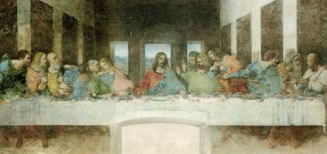
Jesus’ reference to the cup reminds us of another crucial incident in his ministry, one that perhaps more than any other reveals his own understanding of his imminent death. This incident, of course, is what we call The Last Supper: Jesus’ final meal with his disciples before he is betrayed and crucified.
In the Gospel of Mark, this final meal occurs on the occasion of the Passover, the great Jewish feast that commemorates the Exodus, when God delivered the Jews from bondage in Egypt. Jesus eats this meal, not with his natural family as would be typical, but with his “kingdom family,” if you will, his closest disciples. Here is Mark’s description of the key moments of this feast:
While they were eating, he took a loaf of bread, and after blessing it he broke it, gave it to them, and said, “Take; this is my body.” Then he took a cup, and after giving thanks he gave it to them, and all of them drank from it. He said to them, “This is my blood of the covenant, which is poured out for many. Truly I tell you, I will never again drink of the fruit of the vine until that day when I drink it new in the kingdom of God.” (Mark 14:22-25)
It’s all to easy for Christians to miss the potential scandal of Jesus’ action. He and his followers are remembering God’s salvation of Israel from Egypt, not to mention God’s faithfulness to his people throughout the ages. Jesus, as host, is directing the meal, when he makes a most unexpected pair of assertions. “This is my body” and “This is my blood of the covenant.” Until that moment in history, the Passover was preeminently about God, and secondarily about Israel. But now Jesus, an apparently faithful Jewish man leading a celebration of the Passover, says in so many words: “Really, this is all about me!” Astounding! Shocking!
If you have a hard time relating to the apparent offense of these statements, suppose that this Sunday when my church celebrates communion, instead of saying to the people, “This is the body of Christ, broken for you,” I were to say, “This is my body, the body of Mark Roberts. Here is God’s salvation, in me.” Blasphemy, you say!? Indeed! My future as pastor of Irvine Presbyterian Church would suddenly be in jeopardy, I can assure you.
| Yet this is more or less like what Jesus was doing with the Passover. Either he was struck by a fit of megalomania, or he was somehow telling the startling truth of his life and mission. Even as Passover was all about God’s salvation of Israel, now that salvation was being embodied in Jesus himself. |
 |
Jesus refers to the cup of wine as “my blood of the covenant, which is poured out for many” (Mark 14:24). This is an allusion to the story in Exodus 24, where the people of Israel endorse God’s covenant. Then Moses, having sacrificed many animals, “took the blood and dashed it on the people, and said, ‘See the blood of the covenant that the LORD has made with you in accordance with all these words’” (24:7-8). The new covenant will be ratified with blood, but in this case with the spilled blood of Jesus, who, like the lambs sacrificed in the first Passover, will give his life so that God’s people might be spared.
Jesus wasn’t the first one to connect the blood of the covenant with the coming of God’s kingdom. In fact the prophet Zechariah made this same connection in a passage we associate with Jesus’ triumphal entry into Jerusalem:
Rejoice greatly, O daughter Zion!
Shout aloud, O daughter Jerusalem!
Lo, your king comes to you;
triumphant and victorious is he,
humble and riding on a donkey,
on a colt, the foal of a donkey.
He will cut off the chariot from Ephraim
and the war horse from Jerusalem;
and the battle bow shall be cut off,
and he shall command peace to the nations;
his dominion shall be from sea to sea,
and from the River to the ends of the earth.
As for you also, because of the blood of my covenant with you,
I will set your prisoners free from the waterless pit. (Zech 9:9-11)
Because of God’s covenant with Israel, which was ratified with the blood of sacrificed animals, God’s king will rule over a global kingdom and God’s people will be redeemed from bondage. Jesus comes as the divinely-anointed king, not at first to lead Israel to victory, however, but to offer his own blood so that the new covenant and God’s universal kingdom might be inaugurated (see also Jeremiah 31).
Through the actions and words of the Last Supper, Jesus says:
Even as God once saved his people from slavery in Egypt, so God is now saving his people from slavery to sin through me.
Even as the blood of lambs once enabled death to “pass over” Israel, so my blood will lead to the forgiveness of sin.
Even as the first covenant was sealed with sacrificial blood, so the new covenant will be sealed through my blood, poured out for many.
I am choosing the way of death, Jesus says, so that the new life of the new covenant may come. My sacrifice will overcome the problem of sin, so that God’s kingdom may be established in all its fullness.
In the last line of The Last Supper in Mark’s gospel, Jesus himself points to the coming of the kingdom: “Truly I tell you, I will never again drink of the fruit of the vine until that day when I drink it new in the kingdom of God” (14:25). Though Jesus is about to die as a ransom for many, he has hope of a new day, when the kingdom will come and there will be a grand messianic banquet. Yet before this happens, Jesus must fulfill his unique calling by offering his body and blood for salvation.
Part 18 : How Does the Message of Jesus Lead to Crucifixion?
Posted at 9:45 p.m. on Thursday, April 1, 2004
In my last post I wrapped up an extended answer to the question: How is the kingdom of God coming? I showed that Jesus, contrary to the expectations of his disciples and, indeed, all other first-century Jews, believed that the kingdom of God would come as the Messiah drank the cup of God’s wrath, offering himself as a ransom for many (Mark 10:35-45). Jesus envisioned his role as Messiah – though he preferred the enigmatic title, Son of Man – as leading to his death in Jerusalem. During his last meal with his disciples, Jesus symbolized his death by recasting the imagery of the Passover meal to focus on himself and his sacrifice. Even as God once led the Israelites out of bondage in Egypt, so Jesus would lead God’s people out of bondage to sin and its consequences by taking the due penalty for sin upon himself.
| But, you might wonder, why would this sense of his calling get Jesus crucified? Surely what Jesus thought about his future was odd and unexpected, and quite disconcerting to some Jewish leaders, but was it a reason to have him put to death? In our effort to understand how the message of Jesus led to his crucifixion, we seem to be missing a crucial piece of the puzzle. And, indeed, we are. |
|
The missing piece is the other watershed event, in addition to The Last Supper, that happened in Jerusalem during the last week of Jesus’ life: the so-called cleansing of the Temple. It comes after Jesus’ grand entrance into the city, an entrance fit for a king – literally. No doubt many of those who welcomed Jesus with their hosannas expected him to go to the Temple, the center of Jewish life and faith, and announce the beginning of the end of Roman rule over Judea. But when Jesus entered the Temple, not only did he not do what was expected, but, once more, he did something utterly unexpected and, I might add, unappreciated. As Mark tells the story,
[Jesus] began to drive out those who were selling and those who were buying in the temple, and he overturned the tables of the money changers and the seats of those who sold doves; and he would not allow anyone to carry anything through the temple (11:15-16)
What rationale did Jesus offer for such shocking behavior? Marks adds,
He was teaching and saying, “Is it not written, ‘My house shall be called a house of prayer for all the nations?’ But you have made it a den of robbers. (11:17)
| The phrase, “den of robbers,” comes from the prophecy of Jeremiah (7:11), where God condemned the Israelites for being unfaithful to him, but believing that they could hide in the spiritual protection of the temple, just like thieves in their hideout. Jeremiah’s prophecy spelled doom for the temple, which God was about to destroy as a part of his judgment upon Israel (7:12-15). By using this passage, Jesus not only inferred that the temple authorities were dishonest thieves, but also that God was about to judge the temple and destroy it. Not exactly a way to win friends and influence people among the Jerusalem priesthood. |
|
A scale model of the Jerusalem Temple, displayed at the Holyland Hotel in Jerusalem. |
Jesus was not the only Jew in his day to criticize the Temple. Many of the common folk despised its heavy taxation and financial corruptness, while the Essenes from Qumran wrote it off completely as spiritually bankrupt. But Jesus action in the temple, combined with his citation of Jeremiah, was a frontal assault on the central institution of Judaism in his day. Moreover, he explicitly undermined the authority of the entrenched temple hierarchy. It’s no wonder that “the chief priests and the scribes,” when they heard what Jesus had done, “kept looking for a way to kill him” (Mark 11:18). A prophetic rabble rouser in Galilee could be ignored; one who defamed the temple itself needed to be dispatched quickly. The problem for the authorities, however, was the widespread popularity of Jesus. Now if they could only get the Romans to crucify Jesus . . . .
If you’ve been following my series on the message of Jesus, you can see that his action in the temple wasn’t merely a ploy to get himself killed. Rather, it was the logical conclusion to his proclamation of the kingdom of God – a kingdom in which forgiveness comes from Jesus directly, without the mediation of Temple, priest, or sacrifice. In the coming kingdom of God, in the new covenant inaugurated through Jesus’ own sacrifice, there is no need for a Temple in Jerusalem, or anyplace else for that matter. Instead, in the coming kingdom of God:
See, the home of God is among mortals.
He will dwell with them as their God;
they will be his peoples,
and God himself will be with them;
and he will wipe every tear from their eyes.
Death will be no more;
mourning and crying and pain will be no more,
for the first things have passed away. (Revelation 21:3-4)
In my next and final post in this series, I’ll tie up a few loose ends and suggest how the message of Jesus might be lived out among his people today.
Part 19 : Conclusions
Posted at 10:00 p.m. on Friday, April 2, 2004
Throughout this series on the message of Jesus I’ve attempted to answer the most common and central questions people have about his message. In this final post I want to review what we have learned by summarizing my answers succinctly.
What Was the Core of Jesus’ Message?
The core of Jesus’ message was the proclamation of the coming of the kingdom of God: “The time is fulfilled, and the kingdom of God has come near; repent, and believe in the good news” (Mark 1:14-15).
What is the Kingdom of God?
The English phrase “kingdom of God” translates a Greek phrase from the gospels that refers not so much to the place where God rules as to the presence and power of God’s actual rule. The kingdom or reign of God is here when God is exercising his authority on earth.
How Did Jesus Proclaim the Kingdom of God?
Jesus proclaimed the kingdom of God in words (basic statements of fact, explanations, parables) and in works (healings, exorcisms, nature miracles, other symbolic gestures). What Jesus said, he did. This not only illustrated the truth of his proclamation, but it also drew the people to him.
Where is the Kingdom of God?
Contrary to popular perceptions, the kingdom of God is not primarily in heaven or our hearts, but in all dimensions of reality. God’s reign impacts actions, thoughts, relationships, families, institutions, and governments.
When is the Kingdom of God Coming?
Jesus proclaimed the kingdom of God as something present in his ministry, and also as something that was still to come in glory. Thus the kingdom is not either present or future, but both present and future. It is the “already and not yet kingdom.” It’s is already here, and not yet fully here. Thus it is rather like an engaged couple, a pregnant mother, or a finished but not quite yet graduated doctoral student.
How is the Kingdom of God Coming?
According to Jesus, the reign of God will not come through a Jewish revolt against Rome. Though he agreed with his Jewish contemporaries who looked forward to the coming of an anointed deliverer, Jesus conceived of the work of the Messiah in radically unexpected terms. Rather than conquering the Romans through force, Jesus, as Messiah or Son of Man, would die on a Roman cross. Through this sacrificial action he would take God’s judgment upon himself, offering his life as a ransom for many. The new exodus, God’s new act of salvation, was taking place in Jesus, and would be culminated in his passion and resurrection.
How Does the Message of Jesus Lead to Crucifixion?
Throughout his ministry, Jesus consistently upset many of the religious and political leaders of the day. His proclamation of the kingdom through words and works made him a marked man, both because he contradicted many of the core values of his opponents, and because he undermined their popular impact. But when Jesus “cleansed” the Temple in Jerusalem, this was the last straw. He became a clear and present danger, not only to the Pharisees in Galilee, but to the priestly hierarchy in Jerusalem, and to the Temple, the core institution of Judaism, and to the fragile peace of Judea. Thus he threatened the social order so essential to Roman domination. The leaders in Jerusalem, both Jewish and Roman, sought to crucify Jesus, both to get him out of their way and to warn others not to follow in his footsteps.
Closing Thoughts: How Do We Follow Jesus?
If Jesus came to inaugurate the reign of God on earth, if he proclaimed this message in words and works, and if, in the end, this message led him to the cross, then how do we who believe in Jesus follow him today? Let me offer a few brief suggestions:
| 1. We should seek to live each moment in the reality of the kingdom of God. Jesus said, “The kingdom of God has come hear; repent and believe in the good news” (Mark 1:15). This call is still valid today. When we accept God’s rule over our lives, we adopt values and priorities that are radically different than those of the world. Thus we make a U-turn; we repent and live our lives in a brand new direction, pointing toward God’s kingdom. |
|
2. We live in the world as salt and light. Like Jesus, both our words and our works should proclaim the reality of the kingdom. We talk about the good news of what God has done in Christ, inviting others to accept this gospel and live under God’s reign. And we live out this reign each day by loving our enemies, healing the sick, confronting evil, feeding the hungry, forgiving those who wrong us, and living as a active member of the community of Jesus.
3. We take up our cross and follow Jesus each day. We who live in the community of Jesus must seek, not to dominate others, but to serve them. We live, not for our own glory, but for God, to whom belongs the kingdom, and the glory, and the power.
4. We live in the present power and the future hope of the resurrection. Although I have not spoken of the resurrection in this series on the message of Jesus, were it not for the fact that Jesus was raised from the dead on Easter, none of what I’ve said would have any value whatsoever. The message of Jesus would have been long forgotten as wishful thinking by one more failed Jewish messianic pretender. The resurrection of Jesus persuaded his confused and bereaved disciples that he was who he said he was, and that his paradoxical “program” for the coming of the kingdom had in fact been the right one. We who put our trust in Jesus today have access to same power that raised Jesus from dead – the Holy Spirit who dwells in and among us (Ephesians 1:17-23). Moreover, we believe that Jesus’ resurrection prefigures our own, and that one day we will live with him in the fullness of the kingdom of God (1 Corinthians 15). This hope sustains us as we live today in the ambiguity of the “already and not yet” kingdom. Someday the kingdom of God will come in full power; the mustard seed will be fully grown, and the victory of God will be complete. In that day, God will wipe away every tear and his dwelling will be here among us (Revelation 21). Then we will join the heavenly chorus in singing,
The kingdom of this world has become the kingdom of our Lord and of his Christ, and he shall reign forever and ever.
Hallelujah! Amen!

|