| |
A Resource by Mark D. Roberts |
|
Thanksgiving Reflections by Rev. Dr. Mark D. Roberts Copyright © 2006 by Mark D. Roberts
Note: You may download this resource at no cost, for personal use or for use in a Christian ministry, as long as you are not publishing it for sale. All I ask is that you give credit where credit is due. For all other uses, please contact me at mark@markdroberts.com. Thank you.
Note: This is a collection of my posts on the theme of Thanksgiving. I've organized them by year. Sometimes I'll re-use an older post, usually by editing it and/or adding to it.
Thanksgiving 2006 A Brief History of Thanksgiving 
Posted for Wednesday, November 22, 2006 It is my blogging tradition to put up a brief history of Thanksgiving right around the November holiday. The post you're about to read is an edited version of what I posted last year. A couple of years ago I asked my six-year-old nephew, “On Thanksgiving, to whom do we say thank you?” He quickly responded, “To the native Americans.” (No, I'm not kidding.) “Do we say thank you to anybody else?” I queried persistently. “To the Pilgrims.” “And to anybody else?” I prodded further. “To God!” he exclaimed.
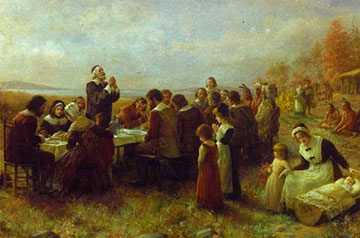
Well, though his order may be a little curious, that just about nails the historical roots of Thanksgiving. It’s common knowledge that the American celebration has its origin in 1621, as the Pilgrims invited the neighboring Indian tribes to join them in a feast of gratitude for God’s blessings. There’s no evidence, however, that they actually celebrated this on the fourth Thursday in November, or that it lasted only one day, or that they played a mean game of touch football after dinner. |
|
| |
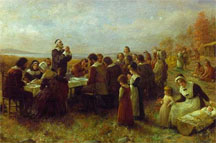
"The First Thanksgiving" by Jennie August Brownscombe (1914)
|
New Englanders remembered the Pilgrims’ effort for many years through regional celebrations of Thanksgiving. Sometimes American Presidents would set aside a day for the nation to be thankful. In 1789, for example, President George Washington proclaimed November 26th as a national day of thanksgiving. Here's the core of his presidential proclamation:
Whereas it is the duty of all Nations to acknowledge the providence of Almighty God, to obey his will, to be grateful for his benefits, and humbly to implore his protection and favor--and Whereas both Houses of Congress have by their Joint Committee requested me "to recommend to the People of the United States a day of public thanksgiving and prayer to be observed by acknowledging with grateful hearts the many signal favors of Almighty God, especially by affording them an opportunity peaceably to establish a form of government for their safety and happiness."
Now therefore I do recommend and assign Thursday the 26th day of November next to be devoted by the People of these States to the service of that great and glorious Being, who is the beneficent Author of all the good that was, that is, or that will be--That we may then all unite in rendering unto him our sincere and humble thanks--for his kind care and protection of the People of this country previous to their becoming a Nation--for the signal and manifold mercies, and the favorable interpositions of his providence, which we experienced in the course and conclusion of the late war--for the great degree of tranquility, union, and plenty, which we have since enjoyed--for the peaceable and rational manner in which we have been enabled to establish constitutions of government for our safety and happiness, and particularly the national One now lately instituted, for the civil and religious liberty with which we are blessed, and the means we have of acquiring and diffusing useful knowledge; and in general for all the great and various favors which he hath been pleased to confer upon us.
And also that we may then unite in most humbly offering our prayers and supplications to the great Lord and Ruler of Nations and beseech him to pardon our national and other transgressions--to enable us all, whether in public or private stations, to perform our several and relative duties properly and punctually--to render our national government a blessing to all the People, by constantly being a government of wise, just, and constitutional laws, discreetly and faithfully executed and obeyed--to protect and guide all Sovereigns and Nations (especially such as have shown kindness unto us) and to bless them with good government, peace, and concord--To promote the knowledge and practice of true religion and virtue, and the increase of science among them and Us--and generally to grant unto all mankind such a degree of temporal prosperity as he alone knows to be best.
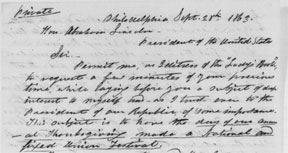
| The idea of a permanent, national celebration each November came 242 years after the first Pilgrim-Indian festival in the early 17th century. During the Civil War, many Americans clamored for some sort of national religious holiday. One of the most vocal was Sarah Josepha Hale (who, by the way, wrote “Mary Had a Little Lamb”). Hale used her clout as editor of the influential Godey’s Lady’s Book magazine to motivate President Lincoln to proclaim a national holiday. On September 28, 1863 she wrote a letter to the President encouraging him to “have the day of our annual Thanksgiving made a national and fixed Union Festival.” Five days later Lincoln issued the “Thanksgiving Proclamation of 1863” (which we’ll examine below). |
|
| |
The first part of Hale's letter to Lincoln. The underlined part reads "have the day of our annual Thanksgiving made a national and fixed Union Festival."
|
In his proclamation, Lincoln set apart the “last Thursday of November” as “a day of thanksgiving and praise to our beneficent Father who dwelleth in the heavens.” Throughout the next eight decades, all American Presidents followed Lincoln’s example. But during 1933, as the Great Depression raged, many merchants appealed to President Franklin D. Roosevelt to change the day from the last Thursday in November to the fourth Thursday. The reason for this request? November, 1933 had five Thursdays, which left the minimum number of shopping days between Thanksgiving Day and Christmas Day. Roosevelt denied this request, leaving the holiday on the last Thursday of the month.
But in 1939, the next five-Thursdays-in-November year, President Roosevelt gave in to the requests of business owners and established the fourth Thursday of November as Thanksgiving Day. National chaos ensued, with some states following Roosevelt’s lead and others sticking with the traditional last, and in this year, fifth Thursday. This meant, among other things, that families living in different states were in many cases unable to celebrate Thanksgiving together. The national controversy over the day of the holiday continued, until Congress passed a law on December 26, 1941, making the fourth Thursday of November the one, official, national day.
Recalcitrant Canada, I might add, does not recognize the fourth Thursday in November as Thanksgiving Day. I learned this the hard way while in college. Some friends and I decided to celebrate Thanksgiving by driving from Boston up to Montreal. It didn’t dawn on us that Canadians celebrate their Thanksgiving on the second Monday in October. This wouldn’t have been so bad, except that the restaurant in which we had our Thanksgiving dinner didn’t even have turkey on its menu. I had to settle for quiche, of all things. Now that’s a Thanksgiving travesty! |
|
| |
One of many critical communications Roosevelt received in light of his controversial Thanksgiving decision. This telegram, written in November 1940 by two restaurant owners reads: CONGRATULATIONS ON YOUR REELECTION. WHEN SHALL WE SERVE OUR THANKSGIVING TURKEY 21ST? OR 28TH? (For a larger telegram, click the picture.)
|
I want to close by printing the text of Lincoln’s original Thanksgiving proclamation. I won’t add my own comments. But I will italicize a few sections that strike me as especially profound. As you read this proclamation, you might ask yourself: What would happen if an American President used this kind of language today in an official proclamation? What in this statement speaks to the heart of our national crisis today?
Thanksgiving Proclamation of 1863
The year that is drawing toward its close has been filled with the blessings of fruitful fields and healthful skies. To these bounties, which are so constantly enjoyed that we are prone to forget the source from which they come, others have been added which are of so extraordinary a nature that they can not fail to penetrate and soften even the heart which is habitually insensible to the ever-watchful providence of Almighty God.
In the midst of a civil war of unequaled magnitude and severity, which has sometimes seemed to foreign states to invite and to provoke their aggression, peace has been preserved with all nations, order has been maintained, the laws have been respected and obeyed, and harmony has prevailed everywhere, except in the theater of military conflict, while that theater has been greatly contracted by the advancing armies and navies of the Union.
Needful diversions of wealth and of strength from the fields of peaceful industry to the national defense have not arrested the plow, the shuttle, or the ship; the ax has enlarged the borders of our settlements, and the mines, as well as the iron and coal as of our precious metals, have yielded even more abundantly than heretofore. Population has steadily increased notwithstanding the waste that has been made in the camp, the siege, and the battlefield, and the country, rejoicing in the consciousness of augmented strength and vigor, is permitted to expect continuance of years with large increase of freedom.
No human counsel hath devised nor hath any mortal hand worked out these great things. They are the gracious gifts of the Most High God, who, while dealing with us in anger for our sins, hath nevertheless remembered mercy.
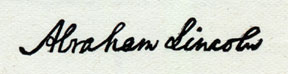
It has seemed to me fit and proper that they should be solemnly, reverently, and gratefully acknowledged, as with one heart and one voice, by the whole American people. I do therefore invite my fellow-citizens in every part of the United States, and also those who are in foreign lands, to set apart and observe the last Thursday of November next as a day of thanksgiving and praise to our beneficent Father who dwelleth in the heavens. And I recommend to them that while offering up the ascriptions justly due to Him for such singular deliverances and blessings they do also, with humble penitence for our national perverseness and disobedience, commend to His tender care all those who have become widows, orphans, mourners, or sufferers in the lamentable civil strife in which we are unavoidably engaged, and fervently implore the imposition of the Almighty hand to heal the wounds of the nation and to restore it, as soon as may be consistent with the divine purpose, to the full enjoyment of peace, harmony, tranquility [sic], and union.
In testimony whereof I have hereunto set my hand and caused the seal of the United States to be affixed.
Done at the city of Washington, this 3d day of October, A. D. 1863, and of the Independence of the United States the eighty-eighth.
|
 |
Thursday, November 19, 2006
Psalm 118:28-29
You are my God, and I will give thanks to you;
you are my God, I will extol you.
O give thanks to the LORD, for he is good,
for his steadfast love endures forever.
Prayer
On this day when our nation pauses to give You thanks, I add my gratitude to the chorus. Indeed, I thank You for all the blessings You have showered upon me: my family and friends, my church, my home and all my possessions, my health, my calling to serve You.
With my fellow citizens, I thank You for the freedoms we enjoy in this country, for opportunities to worship, to work, and to play. Thank You for the men and women who envisioned a country such as this, and for those who have fought and, indeed, given their lives for this vision. Thank You for those who serve even this day throughout the world, especially in the Middle East. May Your hand of blessing and protection be upon them.
Yet, even beyond more, I thank You for making Yourself known to me in Christ, through Your Word and Spirit, and through Your people. Thank You, dear Lord, for reaching out to me and drawing me to Yourself. How wonderful it is to be able to say with the psalmist, not only that You are God, but that You are my God. Indeed, You are good, good beyond all reckoning. All praise be to You, gracious, loving, excellent God!
Postscript
I put up the following last Sunday. If you haven't had the chance to give to help the poor this Thanksgiving, why not do so right now?
A plan for gratitude: I'm sure that many of you will be making special Thanksgiving gifts for the poor through your churches, and that's great. But if you haven't planned to give something extra this year, may I suggest a wonderful way to do it? World Vision is one of the world's leading organizations that is committed to caring for the poor and to bringing them out of poverty. What you give to World Vision won't be eaten up in administrative expenses, but will almost entirely go to people in need. There are lots of ways for you to designate your giving to World Vision. Their "Ways to Give" page presents a variety of options and giving levels. So if you don't have plans for charitable giving at Thanksgiving, why not make a real difference for the world's poor right now? (We do take a special Thanksgiving offering at my church, but I made a modest contribution to help the suffering in Sudan through the "Ways to Give" page. It takes about three minutes, or one minute if you have given to World Vision before and they have your personal data online.) |
|
| |
A child in the Sudan
|
Comment?
If you would like to add a comment on this post, click here.
The Daily Psalm
The Daily Psalm is my devotional website. Each day I put up a psalm, a prayer based on that psalm, and some additional input, like a brief commentary or a quotation. I use material from The Daily Psalm on markdroberts.com for Sunday inspiration.
|
|
|
Send an e-mail link of this page to a friend.
E-mail Mark D. Roberts
|
 |
Visit the guestbook.
Go to the homepage. |
2006 Thanksgiving Meditation
Delivered at Irvine Presbyterian Church, November 22, 2006
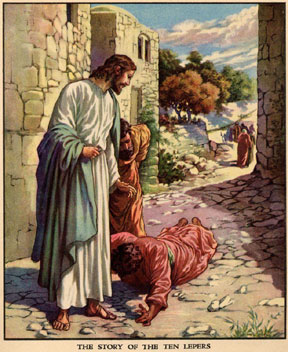
Posted for Friday, November 24, 2006 Scripture Passage: Luke 17:11-19 11 On the way to Jerusalem Jesus was going through the region between Samaria and Galilee. 12 As he entered a village, ten lepers approached him. Keeping their distance, 13 they called out, saying, "Jesus, Master, have mercy on us!" 14 When he saw them, he said to them, "Go and show yourselves to the priests." And as they went, they were made clean. 15 Then one of them, when he saw that he was healed, turned back, praising God with a loud voice. 16 He prostrated himself at Jesus' feet and thanked him. And he was a Samaritan. 17 Then Jesus asked, "Were not ten made clean? But the other nine, where are they? 18 Was none of them found to return and give praise to God except this foreigner?" 19 Then he said to him, "Get up and go on your way; your faith has made you well." Meditation This is one of those Bible stories I've heard since I was a preschooler. The main lines of the story are so familiar: Ten lepers call out to Jesus for mercy. He sends them to the priests and when they go they are miraculously healed. But only one of the men comes back to thank Jesus. The moral of the story? We should be like the man who came back. We should thank Jesus for His mercy in our lives. Now that's a fine moral. It's surely right. But I think it misses something wonderful. This story, I believe, isn't only about being thankful. Rather, it's an invitation to something even more wonderful. The ten lepers in this story did exactly what their culture demanded, keeping their distance from Jesus. Leprosy was a highly contagious disease, so they were right to stay away and call out for mercy. (Elsewhere in the gospels Jesus touches lepers, but not here.)
Jesus didn't immediately heal the lepers. Rather, he told them to go to the priests because He knew that they were about to be healed. According to the Jewish law, a priest had the authority to determine if and when a person with leprosy was made clean. If a priest found a person to be healed, then the priest would make sure the appropriate sacrifices were made. Moreover, the priest's endorsement allowed the cleansed leper to return to human society.
Notice that the lepers actually did what Jesus told them to do by going to the priest. This shows that they had quite a measure of faith in Jesus. If they didn't believe that He had the power to heal, they certainly wouldn't have gone to the priests. Moreover, the lepers obeyed Jesus. Sometimes we forget this when we read this story. But, in fact, the nine who were healed not only had faith in Jesus, but also they did what He had told them to do. Before we start criticizing the lepers for their selfishness, we should notice that they are examples of faith and obedience. |
|
| |
Public Domain. Found at:
http://thebiblerevival.com/clipart27.htm |
Yet, as the story develops, we realize that the nine lepers who believed and obeyed Jesus missed something essential. They missed the chance to say thanks to Jesus directly. They missed the relationship that should come in the context of believing and obeying Jesus. The nine who didn't return to Jesus might even have felt grateful for their healing. In fact, I expect they did. But what they missed was the intimate encounter with the Lord, the chance to fall at Jesus's feet and thank Him directly and personally, the chance to known Him personally. Can you see yourself in the nine lepers who didn't return? At least a bit? I certainly can see myself here. You see, like the nine, I have put my faith in Jesus. I have believed Him. And I do want to obey Him. If says something like "Go to the priests," then I'm on my way. Faith and obedience . . . these are central to my Christian faith. And surely they should be! But what can I miss sometimes? I can miss relationship with Jesus, the intimacy that comes from falling at His feet in gratitude. I can be so eager to charge on to the next act of obedience that I can forget about taking time just to be with Jesus. When this happens, I miss out on one of the greatest joys of life. And Jesus misses out on relationship with me. No doubt the story of the leper who came back reminds us to be thankful for God's blessings in our lives. By all means be sure to thank the Lord for His goodness to you. But this story also reminds us that the Christian life is more than accepting Jesus as Your Savior and then obeying Him, though these are absolutely essential, of course. Besides faith and obedience, Jesus invites us into a personal relationship with Him. Saying "Thank you" is more than something we should do to be polite. Indeed, thanksgiving opens up our hearts to know Jesus more truly and personally. When I take time to stop and think about what God has done for me, I find my heart softening. I find my love for Him growing. I find my desire to be with Him increasing. Gratitude, when I let it pervade my heart, leads to intimacy with the Lord. So, in this season of thanksgiving, let us indeed offer to the Lord the thanks He deserves from us. But let's also allow our thanks to draw us near to the heart of God. May our thanks lead us into praise. May it draw us to adoration. May this Thanksgiving be a time for you, not only to say "Thank You" to God, but also to enjoy His presence, even as He enjoys yours. May our gratitude fill us once again with love for God! Amen! Thanksgiving 2005 Thankful for People in Whom I've Experienced God's Grace
Posted for Wednesday, November 23, 2005 I want to share with you a recent experience I had of feeling grateful for God's grace at work in and through people in my life. Perhaps I can inspire you to express similar thanks to God for those who have been channels of God's grace to you.
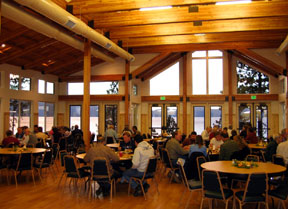
Last month I spoke at a conference of Presbyterian pastors from northern California. We gathered at Zephyr Point, the Presbyterian conference center on the shores of Lake Tahoe. It was an astoundingly setting, where the beauty of nature primed my pump for gratitude.
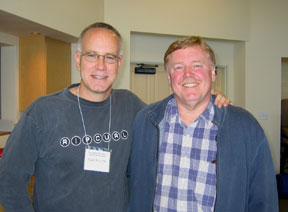
Among the pastors at this retreat were two men with whom I've shared quite a bit of history. One was Stan Henderson, pastor of Trinity Presbyterian Church in Oroville, California. Over 30 years ago, Stan was my counselor at junior high camp. Actually, he counseled me at many junior high camps (winter and summer).
Stan was the perfect counselor for junior high boys: calm, even, kind. Though he exercised firm discipline, I don't ever remember Stan ever raising his voice. Since we liked and respected him, we wanted to please him. |
|
| |
This is the dining room of the lodge in which I stayed at Zephyr Point. You can see Lake Tahoe in the background, through the windows.
|
Stan's solid faith positively influenced me in a crucial time of my personal development. But it wasn't only his ability to explain the truth that made a difference in my life. It was Stan's living out of his faith that made the most profound impact upon me.
Now I also owe to Stan one of the most important lessons I ever learned, though it didn't have much to do with faith. One summer my cabin mates and I began to be interested in girls. But we didn't have the faintest idea how to get girls to like us. So we asked Stan for help. We pestered him mercilessly during one lunch: "Stan, how can we get girls? What's your secret? Ya gotta tell us." Finally Stan relented. "Okay," he said, "here's something that will work. Girls like to be complemented. Tell them you like their hair, or their clothes, or something, and they'll like it. Maybe they'll even like you."
Immediately we put Stan's advice into practice, but to such an extreme that I think we put off every girl in camp. Obviously we hadn't yet learned the subtleties of male/female relationships. In time, thank God, I figured out how to be a little more judicious in my complements. |
|
| |
Here I am with Stan.
|
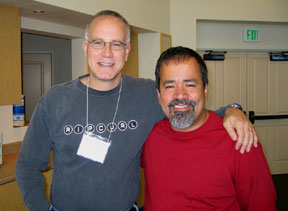
Another pastor at the retreat was a man named K.C. He's an associate pastor of Carmichael Presbyterian Church in Carmichael, California. I've known K.C. for almost as long as I've known Stan, though K.C. is probably ten years younger than I am. I first got to know him when I was a summer intern in the youth ministry at the First Presbyterian Church of Hollywood. At that time K.C. was, literally, a kid off the streets of Hollywood. He started coming to the church at the invitation of his landlord, who was an elder at Hollywood. At the church K.C. found a surrogate family. He was like our little brother in many ways. K.C. and I shared in several ministries during my years on the staff at Hollywood. And I was privileged to participate as a pastor in his wedding. I've always had a soft spot in my heart for K.C., who was one of the kindest and most dedicated Christians I ever knew.
| Well, K.C. went on to Princeton Seminary. He and Debbie had three children. A couple of years ago he received a call to become the youth pastor at Carmichael Pres: a great start for what I know will be a wonderful ministry. (K.C. is also a blogger. You should check out his site.)
One of my favorite moments at the pastors' retreat was being served communion from K.C. Here was this fine pastor, committed husband, and loving father. The one who once had received ministry from me was now serving me as a fellow pastor. In that moment I sensed the wonder of God's grace. |
|
| |
Here I am with K.C. |
At that pastors' retreat I felt grateful for Stan, who had made such a difference in my life at a crucial time. I also felt thankful for the chance to have made a difference in K.C.'s life, and to have had the precious privilege of getting to taste some of the fruit of my ministry as he ministered to me. Here, in microcosm, was the church throughout the ages: one generation passing on the faith to the next, and then to the next. So, on the day before Thanksgiving, here's my prayer of gratitude:
Thank You, gracious God, for Stan, who gave his time and himself when I needed someone like him. Thanks for his patience, wisdom, and consistent love. Thanks for the way he was an incarnation of Your grace in my life.
And thank You, dear Father, for K.C. What a joy to have been used by You to make a difference in his life. And how wonderful to see what You have done in and through him! Thanks, Lord, for the fine man he has become, and for a friend who is also a pastor who ministers to me. How grateful I am, Lord, to see Your grace alive in K.C.
Thank You, God of history, for the generations who have gone before us, whose faithfulness allowed us to know You. And thanks for the privilege and high calling of passing on the faith to those who come after us. Amen.
Wholehearted Thanksgiving
Posted for Thursday, November 24, 2005
Praise the LORD!
I will give thanks to the LORD with my whole heart,
in the company of the upright, in the congregation.
Great are the works of the LORD,
studied by all who delight in them.
Full of honor and majesty is his work,
and his righteousness endures forever.
He has gained renown by his wonderful deeds;
the LORD is gracious and merciful.
He provides food for those who fear him;
he is ever mindful of his covenant.
He has shown his people the power of his works,
in giving them the heritage of the nations.
The works of his hands are faithful and just;
all his precepts are trustworthy.
They are established forever and ever,
to be performed with faithfulness and uprightness.
He sent redemption to his people;
he has commanded his covenant forever.
Holy and awesome is his name.
The fear of the LORD is the beginning of wisdom;
all those who practice it have a good understanding.
His praise endures forever.
Psalm 111
After an opening salvo of praise, the Psalmist says, "I will give thanks to the LORD with my whole heart" (v. 1). This isn't the first time we read this sort of thing in the Psalms. Psalm 9:1 says: "I will give thanks to the LORD with my whole heart; I will tell of all your wonderful deeds." Similarly, Psalm 86:12 proclaims, "I give thanks to you, O LORD my God, with my whole heart, and I will glorify your name forever."
So here's my question: What does it mean to thank God with my whole heart? Then I have some follow up questions: How can I give thanks wholeheartedly if, in fact, my heart is heavy? What if I'm not feeling very thankful today? Surely I'm not supposed to fake gratitude, as if I could pull the wool over God's eyes. How can I be authentic before God and still give Him thanks with my whole heart?
We'll be able to answer these questions if we understand the Hebrew conception of the heart. We translate the Hebrew word leb as "heart," and there are places in the Old Testament where leb is connection with emotions. Psalm 13:5, for example, says, "My heart shall rejoice in your salvation." Yet the leb in Hebrew means far more than the usual sense of "heart" in English. The leb is not merely the seat of the emotions, but of the will, even the mind. The leb is the whole inner person: thoughts, feelings, choices, purposes. In particular, the leb is that which guides our actions. It's what we usually speak of in English as the will.
So, when the Psalmist says, "I will give thanks to the LORD with my whole heart," he's saying more than, "I will feel very thankful." Rather, he means, "I will choose to offer thanks to the Lord. I will choose to acknowledge God's goodness to me, and I will do this with all of my inner strength."
Thus, ironically, if you're feeling down, if you're not feeling thankful, then you're in a perfect place to thank the Lord with your whole heart, because you can choose to do this. Indeed, you must choose to thank the Lord, because your emotions alone won't get you there.
Now let me be clear. This doesn't involve pretending. When we say, "Thank you, Lord," we're not necessarily saying, "Oh, Lord, I feel so thankful today. I have all sorts of warm fuzzies inside." Warm fuzzies, lukewarm fuzzies, or no fuzzies at all, thanking God is saying "You did this, and it's good, and I acknowledge this." You may or may not feel thankful at the time, but you can always choose to thank God by telling Him the great things He has done.
Psalm 111 gives us plenty of help in this regard. Verse 2 reads, "Great are the works of the LORD, studied by all who delight in them." If you want to give thanks – indeed, if you want to feel grateful – begin by studying God's great works. Remember all of the wonderful things He has done, not only in your life, but also throughout history.
We will thank the LORD with all our hearts when we remember, not only what God has done, but also who He is. Verse 4 makes this clear: "He has gained renown by his wonderful deeds; the LORD is gracious and merciful." Did you see the transition there between what God has done – his wonderful deeds – and God's character – He is gracious and merciful. So we thank the Lord because of who He is, especially for His grace and mercy.
This points us to the center of our reason for wholehearted thanksgiving. As verse 9 reminds us, "He sent redemption to his people; he has commanded his covenant forever." The Psalmist was no doubt looking back to God's deliverance of Israel from Egypt, and to His establishment of the Mosaic covenant at Sinai shortly thereafter. When we read Psalm 111:9 as Christians, however, we have more to go on than the events of Exodus. We remember the redemption we have through Jesus Christ, whose death brought us out of bondage to sin and death. We celebrate the new covenant in the blood of Christ, through which we have forgiveness and eternal life.
Sometimes we feel joyful because of our salvation in Christ. That's one of the reasons we gather for worship, to remember so that we might rejoice. Yet no matter what we may be feeling at any given moment, we can always choose to thank God for what's true. And what is true? Because God is gracious and merciful, He has redeemed us through Jesus Christ. Moreover, it's true that God's mercies are new every morning as He continues to shower us with His good gifts.
And so we give thanks. We choose to say "thank you" to the Lord. Sometimes we do so when our hearts are soaring with gratitude. Sometimes we do so in the depths of despair. Wholehearted thanksgiving means choosing to remember what God has done and who He is, and to acknowledge His goodness no matter what we feel. Yet, as we do this, even when our hearts are heavy, the act of thanksgiving itself often lifts our hearts. But, even if it doesn't, we can still thank the Lord with our whole hearts because He deserves it, and because we need it.
May you have a blessed Thanksgiving, as you thank the Lord with all of your heart for His matchless goodness! |
|
 |
| |
 |
| |
 |
| |
 |
| |
 |
| |
 |
| |
 |
| |
 |
| |
 |
| |
 |
| |
A Brief History of Thanksgiving
Posted for Friday, November 25, 2005
(This is a new, improved, and expanded version of a piece I wrote last year.) Last year I asked my six-year-old nephew, “On Thanksgiving, to whom do we say thank you?” He quickly responded, “To the native Americans.” (No, I'm not kidding.) “Do we say thank you to anybody else?” I queried persistently. “To the Pilgrims.” “And to anybody else?” I prodded further. “To God!” he exclaimed.
| Well, though his order may be a little curious, that just about nails the historical roots of Thanksgiving. It’s common knowledge that the American celebration has its origin in 1621, as the Pilgrims invited the neighboring Indian tribes to join them in a feast of gratitude for God’s blessings. There’s no evidence, however, that they actually celebrated this on the fourth Thursday in November, or that it lasted only one day, or that they played a mean game of touch football after dinner. |
|
| |
"The First Thanksgiving" by Jennie August Brownscombe (1914) |
New Englanders remembered the Pilgrims’ effort for many years through regional celebrations of Thanksgiving. Sometimes American Presidents would set aside a day for the nation to be thankful. In 1789, for example, President George Washington proclaimed November 26th as a national day of thanksgiving. Here's the core of his presidential proclamation:
Whereas it is the duty of all Nations to acknowledge the providence of Almighty God, to obey his will, to be grateful for his benefits, and humbly to implore his protection and favor--and Whereas both Houses of Congress have by their Joint Committee requested me "to recommend to the People of the United States a day of public thanksgiving and prayer to be observed by acknowledging with grateful hearts the many signal favors of Almighty God, especially by affording them an opportunity peaceably to establish a form of government for their safety and happiness."
Now therefore I do recommend and assign Thursday the 26th day of November next to be devoted by the People of these States to the service of that great and glorious Being, who is the beneficent Author of all the good that was, that is, or that will be--That we may then all unite in rendering unto him our sincere and humble thanks--for his kind care and protection of the People of this country previous to their becoming a Nation--for the signal and manifold mercies, and the favorable interpositions of his providence, which we experienced in the course and conclusion of the late war--for the great degree of tranquility, union, and plenty, which we have since enjoyed--for the peaceable and rational manner in which we have been enabled to establish constitutions of government for our safety and happiness, and particularly the national One now lately instituted, for the civil and religious liberty with which we are blessed, and the means we have of acquiring and diffusing useful knowledge; and in general for all the great and various favors which he hath been pleased to confer upon us.
And also that we may then unite in most humbly offering our prayers and supplications to the great Lord and Ruler of Nations and beseech him to pardon our national and other transgressions--to enable us all, whether in public or private stations, to perform our several and relative duties properly and punctually--to render our national government a blessing to all the People, by constantly being a government of wise, just, and constitutional laws, discreetly and faithfully executed and obeyed--to protect and guide all Sovereigns and Nations (especially such as have shown kindness unto us) and to bless them with good government, peace, and concord--To promote the knowledge and practice of true religion and virtue, and the increase of science among them and Us--and generally to grant unto all mankind such a degree of temporal prosperity as he alone knows to be best.
| The idea of a permanent, national celebration each November came 242 years after the first Pilgrim-Indian festival in the early 17th century. During the Civil War, many Americans clamored for some sort of national religious holiday. One of the most vocal was Sarah Josepha Hale (who, by the way, wrote “Mary Had a Little Lamb”). Hale used her clout as editor of the influential Godey’s Lady’s Book magazine to motivate President Lincoln to proclaim a national holiday. On September 28, 1863 she wrote a letter to the President encouraging him to “have the day of our annual Thanksgiving made a national and fixed Union Festival.” Five days later Lincoln issued the “Thanksgiving Proclamation of 1863” (which we’ll examine below). |
|
| |
The first part of Hale's letter to Lincoln. The underlined part reads "have the day of our annual Thanksgiving made a national and fixed Union Festival."
|
In his proclamation, Lincoln set apart the “last Thursday of November” as “a day of thanksgiving and praise to our beneficent Father who dwelleth in the heavens.” Throughout the next eight decades, all American Presidents followed Lincoln’s example. But during the 1933, as the Great Depression raged, many merchants appealed to President Franklin D. Roosevelt to change the day from the last Thursday in November to the fourth Thursday. The reason for this request? November 1933 had five Thursdays, which left the minimum number of shopping days between Thanksgiving Day and Christmas Day. Roosevelt denied this request, leaving the holiday on the last Thursday of the month.
But in 1939, the next five-Thursdays-in-November year, President Roosevelt gave in to the requests of business owners and established the fourth Thursday of November as Thanksgiving Day. National chaos ensued, with some states following Roosevelt’s lead and others sticking with the traditional last, and in this year, fifth Thursday. This meant, among other things, that families living in different states were in many cases unable to celebrate Thanksgiving together. The national controversy over the day of the holiday continued, until Congress passed a law on December 26, 1941, making the fourth Thursday of November the one, official, national day.
Recalcitrant Canada, I might add, does not recognize the fourth Thursday in November as Thanksgiving Day. I learned this the hard way while in college. Some friends and I decided to celebrate Thanksgiving by driving from Boston up to Montreal. It didn’t dawn on us that Canadians celebrate their Thanksgiving on the second Monday in October. This wouldn’t have been so bad, except that the restaurant in which we had our Thanksgiving dinner didn’t even have turkey on its menu. I had to settle for quiche, of all things. Now that’s a Thanksgiving travesty! |
|
| |
One of many critical communications Roosevelt received in light of his controversial Thanksgiving decision. This telegram, written in November 1940 by two restaurant owners reads: CONGRATULATIONS ON YOUR REELECTION. WHEN SHALL WE SERVE OUR THANKSGIVING TURKEY 21ST? OR 28TH? (For a larger telegram, click the picture.)
|
I want to close by printing the text of Lincoln’s original Thanksgiving proclamation. I won’t add my own comments. But I will italicize a few sections that strike me as especially profound. As you read this proclamation, you might ask yourself: What would happen if an American President used this kind of language today in an official proclamation? What in this statement speaks to the heart of our national crisis today?
Thanksgiving Proclamation of 1863
The year that is drawing toward its close has been filled with the blessings of fruitful fields and healthful skies. To these bounties, which are so constantly enjoyed that we are prone to forget the source from which they come, others have been added which are of so extraordinary a nature that they can not fail to penetrate and soften even the heart which is habitually insensible to the ever-watchful providence of Almighty God.
In the midst of a civil war of unequaled magnitude and severity, which has sometimes seemed to foreign states to invite and to provoke their aggression, peace has been preserved with all nations, order has been maintained, the laws have been respected and obeyed, and harmony has prevailed everywhere, except in the theater of military conflict, while that theater has been greatly contracted by the advancing armies and navies of the Union.
Needful diversions of wealth and of strength from the fields of peaceful industry to the national defense have not arrested the plow, the shuttle, or the ship; the ax has enlarged the borders of our settlements, and the mines, as well as the iron and coal as of our precious metals, have yielded even more abundantly than heretofore. Population has steadily increased notwithstanding the waste that has been made in the camp, the siege, and the battlefield, and the country, rejoicing in the consciousness of augmented strength and vigor, is permitted to expect continuance of years with large increase of freedom.
No human counsel hath devised nor hath any mortal hand worked out these great things. They are the gracious gifts of the Most High God, who, while dealing with us in anger for our sins, hath nevertheless remembered mercy.
It has seemed to me fit and proper that they should be solemnly, reverently, and gratefully acknowledged, as with one heart and one voice, by the whole American people. I do therefore invite my fellow-citizens in every part of the United States, and also those who are in foreign lands, to set apart and observe the last Thursday of November next as a day of thanksgiving and praise to our beneficent Father who dwelleth in the heavens. And I recommend to them that while offering up the ascriptions justly due to Him for such singular deliverances and blessings they do also, with humble penitence for our national perverseness and disobedience, commend to His tender care all those who have become widows, orphans, mourners, or sufferers in the lamentable civil strife in which we are unavoidably engaged, and fervently implore the imposition of the Almighty hand to heal the wounds of the nation and to restore it, as soon as may be consistent with the divine purpose, to the full enjoyment of peace, harmony, tranquility [sic], and union.
In testimony whereof I have hereunto set my hand and caused the seal of the United States to be affixed.
Done at the city of Washington, this 3d day of October, A. D. 1863, and of the Independence of the United States the eighty-eighth.
|
Giving Thanks for People Who've Made a Difference, Part 1 The great thing about this question is that it's forcing me to think about people who have made a real difference in my life, and this is helping me – on Thanksgiving Eve – to feel grateful and to express my thanks to God. So, thanks to you too, Hugh, for unexpected Thanksgiving encouragement. The people to whom I owe the greatest thanks are those who have made the greatest difference in my life. I can think of many different categories of these "difference-making" people. Friends Friends go first on the list. I don't mean mere acquaintances, but friends with whom I shared my soul, and vice versa. I think especially of people who have been there for me in times of personal crisis, like the death of my father from cancer, or times of deep discouragement at work. For example, about ten years ago I was going through the darkest valley in my life as a pastor. I felt lots of despair and even some depression. I questioned whether I was the right person to pastor Irvine Presbyterian Church, and whether I should be a pastor at all. Out of nowhere a friend called up and invited me to coffee. When we met he listened to my tale of woe and then helped me to see all sorts of things I was missing, good things going on at the church. What he said did encourage me, but mostly it was his caring presence that made a real difference and kept me going. I could tell a hundred stories like this. Of course there are also the times when my true friends have challenged me to be a better Christian, or husband, or father, or human being. I remember a time many years ago when my wife and I were struggling in our marriage. I brought this up in my men's small group. My brothers in Christ didn't just pat me on the back. Rather, they kicked me in the "you know where." It was tough love, and I needed it. Thank you, Lord, for the friends through whom you have changed my life. Thanks for their faithfulness, their patience, their care, and their love – even tough love. Christian Leaders Okay, okay, I'm a pastor, so you'd probably expect me to say this. But I mean it, from the bottom of my heart. I remember, for example, the Sunday School teachers who helped me to learn the Bible and who were themselves incarnations of Christ's love. I remember Miss Kane (1st grade) and Mr. Morgan (2nd grade, Mr. Istanbulian (3rd grade) and Mr. Hughes (4th grade), Mr. Wherle (5th grade) and Mr. George (6th grade), Mr. Paddock (7th grade) and Mr. Essick (8th and 9th grade). I can't tell you much of what they taught me because, by now, that's become part of the fiber of myh being, but I can tell you how much they loved me. Then I remember my youth leaders. For example, Bill Wennerholm, my junior high director, helped me to feel wanted during a tough season of life. Moreover, he introduced me to ministry, bringing me slowly into leadership. More than any other person, Bill got me going as a Bible teacher. I also remember my faithful junior high camp counselor, Stan Henderson. I wrote a piece in gratitude for Stan on my own website today. In college I had several caring and inspirational leaders, including Steve Barker, Doug Whallon, and Jeannette Yep, all of whom were on the staff of InterVarsity Christian Fellowship. I also found great encouragement from the Rev. Peter Gomes, who was the campus minister at Harvard. These folks helped me get through the faith challenges at Harvard, not only with my faith intact, but also with a growing passion to serve Christ. Thank you, gracious God, for the outstanding leaders who helped me to grow in my understanding of the faith, and who embodied your grace and love for me. Wow. I'm just getting going here. I'll stop for now. More to come tomorrow. Giving Thanks for People Who've Made a Difference, Part 2 Yesterday I began remembering people in various categories for whom I feel especially grateful. I mentioned friends and Christian leaders. Today I'll add more categories and people to my list of gratitude. Mentors My mentors, as you might expect, are also Christian leaders. But I put them in a special category because they invested in me to help me be a better pastor. First on the list I'd put Lloyd Ogilvie, former Senior Pastor of the First Presbyterian Church of Hollywood, where I worked on staff for several years. During my tenure on the Hollywood staff, Lloyd was an example of the kind of pastor I want to be. I was especially challenged by his personal integrity. Moreover, Lloyd spent time personally with me, helping me to grow as a pastor (and a writer). While at Hollywood, I was blessed with a couple more wise pastors, Ralph Osborne and Jack Loo, who helped me immeasurably in my professional development. Encouragers Many of those I've already mentioned have encouraged me throughout my life. But some people seem to have gone out of their way to build up my spirit and to give me courage just when I need it. Some are friends; some are members of my church; some are colleagues in writing projects. I also want to acknowledge the dozens of people who have bothered to send me a note of thanks in response to my blog. When I feel overwhelmed and wonder if it's worth the effort, some e-mail will come at just the right time to keep me going. These have been wonderful gifts. People Who Have Made a Difference in the Lives of My Children This is a major category of gratitude for me. I'm thinking of my children's teachers in school, their Sunday school teachers, and others who've invested in them. Most of all, a woman who started babysitting my son when he was eight weeks old has remained our primary childcare worker for thirteen years. To call her my kids' babysitter is really a misnomer. She's their friend, mentor, teacher, co-adventurer, and spiritual guide. My personal gratitude for Beth is gigantic. Colleagues Throughout my tenure as a pastor, I've been blessed with some of finest colleagues ever. I won't even try to mention names, because the list would be long and relatively meaningless to you. But, to me, these colleagues have been channels of God's grace in my life. Medical Caregivers I am very grateful for the medical folk who have taken care of me and my family. We've been blessed with some great doctors, dentists, orthodontists, ophthalmologists, etc. etc. I once did a whole blog post in praise of my dentist. (No lie. Here's the link.) Others Whom I Don't Know Personally This is a long and diverse list. I won't include all of the folks, but just mention a few examples: Billy Graham (whose preaching drew me to faith in Christ); John Calvin (whose biblical interpretation has instructed and inspired me); J.S. Bach (whose music, especially his sacred music, has been a delight); N.T. Wright (whose biblical scholarship has instructed and challenged me); C.S. Lewis (whose writings have made me think and have helped me to be a child again); Henri Nouwen (whose writings on spirituality helped me go deeper in my faith); Victor Hugo (whose novel Les Misérables is a moving masterpiece). (Technical note: I actually met Billy Graham and Henri Nouwen, but I wouldn't really say I have known them personally.) Men and Women Who Have Served in the U.S. Armed Services The vast majority of people in this category are also folks I haven't known personally. I must confess that I wouldn't have included them in this list for most of my early life. Until I was thirty, I felt very little gratitude for the men and women in uniform. I was, after all, a child of Viet Nam. And I didn't know anybody who actually fought in that war, or who was killed there. During the first Gulf War everything changed for me because my brother-in-law was stationed in Bahrain as a member of the U.S. Air Force. I remember how scary it felt when we heard that Scud missiles were heading for where my brother-in-law was stationed. (Remember, we thought they might have been carrying chemical or biological warheads.) The experience of what my brother-in-law risked in war – his life -- heightened my awareness of the sacrifices made by U.S. servicemen and women. It also helped me to appreciate as never before my freedom and what it cost thousands upon thousands of people. Since 1991, my horizons have been broadened as I've come to know more people who have served or are currently serving in the military. This has increased my heartfelt gratitude, both for their service and for the benefit to my own life and that of my family. A Closing Prayer of Thanks Gracious God, all good gifts come from You. Among these gifts are those who have been my mentors and encouragers. I thank You for how they have helped me to be a better pastor. Thanks, too, Lord, for those who have made such a difference in my children's lives. Their contribution is priceless. Then there are my ministry colleagues. Dear Lord, you have richly blessed me through them. Thank you. And for the medical folk who have cared for me and my family so well, even more thanks, gracious God. Then there are a whole multitude of folks who have enriched my life even though I've never met them. Included among these are the thousands who have served in the U.S. military, risking or even losing their lives for my freedom. Thank you, gracious God, for their courage and sacrifice. Amen.
Thanksgiving 2004 Finding the Heart of Thanksgiving
Part 1 of the series “A Week of Thanksgiving”
Posted at 10:00 p.m. on Sunday, November 21, 2004
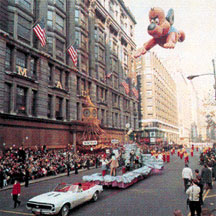
When you think of Thanksgiving, what images come to mind? Roast turkey? Pumpkin pie? Watching football with your family? Perhaps the Macy’s Thanksgiving Day Parade?
I grew up watching this parade on television, marveling at the giant helium balloon representations of Underdog and Bullwinkle, and waiting for Santa to appear to kick off the Christmas shopping season.
In 1982 I had the privilege of spending Thanksgiving Day in New York City. Of course I had to see the Macy’s Parade in person. There, standing alongside Central Park, I watched the bands and giant balloons from only a few feet away. I discovered that it was a lot colder watching the parade in person than from the comfortable vantage point of my living room. But plenty of hot coffee kept me going through the whole spectacle.
That evening some friends and I had Thanksgiving dinner at the Helmsley Palace Hotel. (Yes, the one once owned and managed by the infamous Leona Helmsley and her husband.) We arrived an hour before our prearranged sitting and enjoyed appetizers in the hotel bar. It was the most elegant place I had ever enjoyed a drink and some peanuts. And, believe me, I paid for every inch of elegance. Thanksgiving dinner was served in the fabulously ritzy dining room. It was one of the most over-the-top meals of my life.
But it still wasn’t quite right. After all, the heart of the Thanksgiving holiday isn’t going to parades or eating fancy meals. It’s about sharing a day with family, and mine was 3,000 miles away. The best tasting turkey in the most opulent dining room didn't satisfy the real longing of my heart – to be home.
I wasn’t the only one who felt such a longing. In fact the Thanksgiving weekend is the busiest travel weekend of the year. Something like 40 million people travel at least fifty miles to hang out with their relatives.
If you think about it, however, the actual events of Thanksgiving Day can be rather underwhelming. In addition to watching the Macy’s Parade, tens of millions of people (mostly men) watch football, while tens of millions of people (mostly women) cook mass quantities of traditional food. Then they all get together to eat more than they should, only to top off their gluttony with pumpkin or mince pie. Then there’s clean up, a bit more TV, and that just about sums up the day for many of us. It’s more about our stomachs than our hearts.
A college friend of mine named Jeff decided one year that his family’s Thanksgiving was far too secular. So Jeff, as a new Christian, volunteered to say the blessing before the meal. It was usually done perfunctorily by the most religious of the uncles, which wasn’t saying much in Jeff’s family. But Jeff was going to redeem Thanksgiving once and for all. So when it came time to pray, he started in thanking the Lord for the family’s many blessings. Then he turned to larger issues, expressing gratitude for freedom, for our country, and so on. Finally Jeff got explicitly religious, using his prayer as an opportunity to evangelize his godless relatives. After about five or six minutes, these godless relatives were about ready tar and feather Jeff. Finally his mother tapped his arm and said softly, “Honey, don’t you think it’s time to eat now?” In response to which the slightly religious uncle yelled, “Amen!” Jeff’s family immediately dug into the turkey, leaving Jeff somewhere mid-sentence.
Now I do not recommend Jeff’s evangelistic strategy. But I do appreciate his heart. Thanksgiving should be about more than a parade and pumpkin pie. In spite of the modern penchant for referring to the day as “Turkey Day,” it’s still meant to be a time for intentional gratitude. This was, as we’ll see, at the heart of Lincoln’s establishment of Thanksgiving Day as a national holiday in 1863.
Don’t worry. I’m not going to ask you to give up any of your prized Thanksgiving traditions. Go ahead and watch the parade and the games, if you wish. Drive several hours to grandma’s house and back. Eat way too much turkey. Take a long nap. Or whatever. These can be delightful traditions.
But I am going to ask you not to forget the heart of Thanksgiving. In fact, I’m going to encourage you to let Thanksgiving be more than just a day. Why not take time this whole week to remember God’s blessings? If your Thanksgiving Day is already full with family folderol, then set aside some time on the day before or the day after to remember all that God has given, and to say “Thank you.” Better yet, do this for several minutes each day this week. If you do, not only will you be doing the right thing, since God deserves thanks for all he has done for you, but also you will find that your celebration of Thanksgiving is richer and fuller than you have imagined it could be.
Expressing heartfelt gratitude to God is one of life’s greatest joys. It’s a joy that many of us rarely experience. And it is the true heart of Thanksgiving. So let me invite you – yes, urge you – to take time this week for real expression of gratitude to God. You’ll be glad you did. |
|
I thought it would be fun to include with this series lots of images of Thanksgiving.
|
|
Underdog flies over the Macy's parade
|
|
The bar in the former Helsley Palace
|
|
The dining room in what is now the New York Palace
|
|
The family that watches football together stays together, or something like that. Where are the women? Oh, yes, cooking!
|
|
Family and friends praying before the Thanksgiving feast
|
|
Of course the irony of this euphemism is that Thanksgiving isn't exactly a happy day for turkeys
|
|
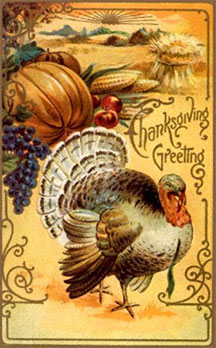
A traditional Thanksgiving card |
Home
American Thanksgiving: Familiar and Unfamiliar History
Part 2 of the series “A Week of Thanksgiving”
Posted at 10:00 p.m. on Monday, November 22, 2004
Yesterday I asked my six-year-old nephew, “On Thanksgiving, to whom do we say thank you?” He quickly responded, “To the native Americans.” “Do we say thank you to anybody else?” I added. “To the Pilgrims.” “And to anybody else?” I prodded further. “To God!” he exclaimed.
Well, though his order may be a little curious, that just about nails the historical roots of Thanksgiving. It’s common knowledge that the American celebration has its origin in 1621, as the Pilgrims invited the neighboring Indian tribes to join them in a feast of gratitude for God’s blessings. There’s no evidence, however, that they actually celebrated this on the fourth Thursday in November, or that it lasted only one day, or that they played a mean game of touch football after dinner.
New Englanders remembered the Pilgrims’ effort for many years through regional celebrations of Thanksgiving. Sometimes American Presidents would set aside a day for the nation to be thankful. (See, for example, Washington's Thanksgiving Proclamation of 1789.) But the idea of a permanent, national celebration each November came 242 years after that first Pilgrim-Indian festival. During the Civil War, many Americans clamored for some sort of national religious holiday. One of the most vocal was Sarah Josepha Hale (who, by the way, wrote “Mary Had a Little Lamb”). Hale used her clout as editor of the influential Godey’s Lady’s Book magazine to motivate President Lincoln to proclaim a national holiday. On September 28, 1863 she wrote a letter to the President encouraging him to “have the day of our annual Thanksgiving made a national and fixed Union Festival.” Five days later Lincoln issued the “Thanksgiving Proclamation of 1863” (which we’ll examine below).
In his proclamation, Lincoln set apart the “last Thursday of November” as “a day of thanksgiving and praise to our beneficent Father who dwelleth in the heavens.” Throughout the next eight decades, all American Presidents followed Lincoln’s example. But during the 1933, as the Great Depression raged, many merchants appealed to President Franklin D. Roosevelt to change the day from the last Thursday in November to the fourth Thursday. The reason for this request? November 1933 had five Thursdays, which left the minimum number of shopping days between Thanksgiving Day and Christmas Day. Roosevelt denied this request, leaving the holiday on the last Thursday of the month.
But in 1939, the next five-Thursdays-in-November year, President Roosevelt gave in to the requests of business owners and established the fourth Thursday of November as Thanksgiving Day. National chaos ensued, with some states following Roosevelt’s lead and others sticking with the traditional last, and in this year, fifth Thursday. This meant, among other things, that families living in different states were in many cases unable to celebrate Thanksgiving together. The national controversy over the day of the holiday continued, until Congress passed a law on December 26, 1941, making the fourth Thursday of November the one, official, national day.
Recalcitrant Canada, I might add, does not recognize the fourth Thursday in November as Thanksgiving Day. I learned this the hard way while in college. Some friends and I decided to celebrate Thanksgiving by driving from Boston up to Montreal. It didn’t dawn on us that Canadians celebrate their Thanksgiving on the second Monday in October. This wouldn’t have been so bad, except that the restaurant in which we had our Thanksgiving dinner didn’t even have turkey on its menu. I had to settle for quiche, of all things. Now that’s a Thanksgiving travesty!
I want to close by printing the text of Lincoln’s original Thanksgiving proclamation. I won’t add my own comments. But I will italicize a few sections that strike me as especially profound. As you read this proclamation, you might ask yourself: What would happen if an American President used this kind of language today in an official proclamation? What in this statement speaks to the heart of our national crisis today?
Thanksgiving Proclamation of 1863
The year that is drawing toward its close has been filled with the blessings of fruitful fields and healthful skies. To these bounties, which are so constantly enjoyed that we are prone to forget the source from which they come, others have been added which are of so extraordinary a nature that they can not fail to penetrate and soften even the heart which is habitually insensible to the ever-watchful providence of Almighty God.
In the midst of a civil war of unequaled magnitude and severity, which has sometimes seemed to foreign states to invite and to provoke their aggression, peace has been preserved with all nations, order has been maintained, the laws have been respected and obeyed, and harmony has prevailed everywhere, except in the theater of military conflict, while that theater has been greatly contracted by the advancing armies and navies of the Union.
Needful diversions of wealth and of strength from the fields of peaceful industry to the national defense have not arrested the plow, the shuttle, or the ship; the ax has enlarged the borders of our settlements, and the mines, as well as the iron and coal as of our precious metals, have yielded even more abundantly than heretofore. Population has steadily increased notwithstanding the waste that has been made in the camp, the siege, and the battlefield, and the country, rejoicing in the consciousness of augmented strength and vigor, is permitted to expect continuance of years with large increase of freedom.
No human counsel hath devised nor hath any mortal hand worked out these great things. They are the gracious gifts of the Most High God, who, while dealing with us in anger for our sins, hath nevertheless remembered mercy.
It has seemed to me fit and proper that they should be solemnly, reverently, and gratefully acknowledged, as with one heart and one voice, by the whole American people. I do therefore invite my fellow-citizens in every part of the United States, and also those who are in foreign lands, to set apart and observe the last Thursday of November next as a day of thanksgiving and praise to our beneficent Father who dwelleth in the heavens. And I recommend to them that while offering up the ascriptions justly due to Him for such singular deliverances and blessings they do also, with humble penitence for our national perverseness and disobedience, commend to His tender care all those who have become widows, orphans, mourners, or sufferers in the lamentable civil strife in which we are unavoidably engaged, and fervently implore the imposition of the Almighty hand to heal the wounds of the nation and to restore it, as soon as may be consistent with the divine purpose, to the full enjoyment of peace, harmony, tranquility [sic], and union.
In testimony whereof I have hereunto set my hand and caused the seal of the United States to be affixed.
Done at the city of Washington, this 3d day of October, A. D. 1863, and of the Independence of the United States the eighty-eighth.
|
|
|
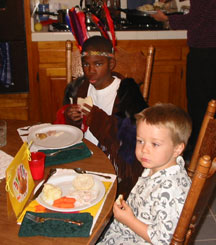
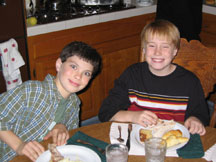
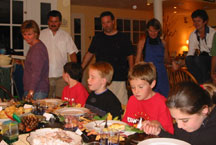
Two of my nephews enjoying Thanksgiving dinner in 2003. The one I interrogated is in the front.
|
|
"The First Thanksgiving" by Jennie August Brownscombe (1914)
|
|
The first part of Hale's letter to Lincoln. The underlined part reads "have the day of our annual Thanksgiving made a national and fixed Union Festival."
|
|
One of many critical communications Roosevelt received in light of his controversial Thanksgiving decision. This telegram, written in November 1940 by two restaurant owners reads: CONGRATULATIONS ON YOUR REELECTION. WHEN SHALL WE SERVE OUR THANKSGIVING TURKEY 21ST? OR 28TH? (For a larger telegram, click the picture.)
|
|
Well, they may have the wrong date, but at least the Canadians got the turkey part right.
|
|
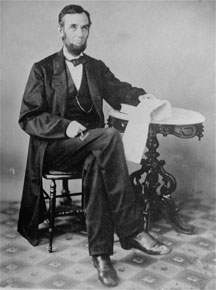
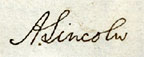
Abraham Lincoln in 1863
|
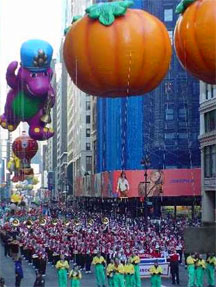 |
Several giant balloons in the Macy's Thanksgiving Day Parade in New York City. This may not have been exactly what President Lincoln had in mind. (Yes, that is a giant Barney wearing a hat. Sorry.)
|
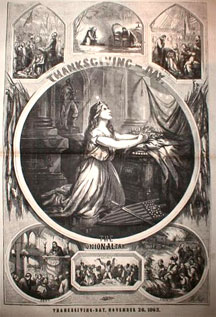 |
This illustration by Thomas Nast is entitled "Thanksgiving Day, November 26, 1863." Nast was an influential and famous illustrator, who, among other things, came up with our modern Santa Claus image, as well as the Democratic donkey and the Republican elephant. For a larger picture and more information on Nast, click here.
|
Home
“How Can I Be Thankful When . . . ?”
Part 3 of the series “A Week of Thanksgiving”
Posted at 11:40 p.m. on Tuesday, November 23, 2004
The Bible instructs us to be consistently thankful. In writing to the Thessalonian Christians, the Apostle Paul said, “Give thanks in all circumstances; for this is the will of God in Christ Jesus for you” (1 Thess 5:18). This sounds nice enough, until you find yourself in difficult, even painful circumstances. Then inspired biblical truth can feel like an insensitive platitude.
“How can I be thankful when . . . ?” Various scenarios complete the sentence. “How can I be thankful when this is the first Thanksgiving since my mother died? Or when my family is in such disarray? O when I’m in the middle of chemotherapy?” Throughout my years as a pastor, I’ve often heard this sort of question, especially as Thanksgiving Day draws near. People would really like to feel grateful, but their life circumstances seem to make genuine gratitude impossible. They feel stuck in discouragement and despair.
If we take the Psalms as a model for prayer, then we should certainly feel free, even obligated, to share with the Lord our frustrations and disappointments. Genuine prayer is not putting a happy face on our true feelings. If you’re grieving the loss of a loved one, or feeling afraid because you’re facing a serious illness, you should surely share these feelings with God in prayer. Being thankful in all circumstances does not mean pretending or denying.
But it does mean that we must look beyond our particular circumstances. Gratitude comes when we look at the bigger picture, when we remember the multitude of ways in which we are blessed, even if we’re also feeling sadness or fear or whatever else seems inconsistent with being thankful. For example, this will be my nineteenth Thanksgiving without my father, who died of cancer in 1986. Every year on the holiday I think about my dad. I miss him. I wish we could watch football together. I wish he were there to carve the turkey. Mostly I just wish I could be with him. So, ironically, on Thanksgiving Day I feel more sadness than usual over the loss of my father.
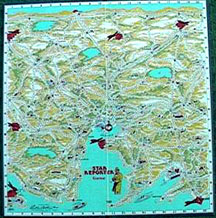
And yet I also feel thankful for him. Although I wish I could have had more time with my dad, I treasure the time I did have. I thank God for the hours my dad and I spent playing Candy Land and Star Reporter; and for his subtle sense of humor; and for his solid example of Christian faithfulness; and for his support when I desperately needed it. I am able to offer genuine thanks for my father, without denying the sadness I feel over his early death.
“But,” you may object, “you lost your father a long time ago. You still feel pain, but the wound isn’t fresh. What about people who are in the midst of suffering right now? Can they be truly grateful?” My answer is “Yes.” How do I know this? Because I’ve seen it time and again in my ministry. I’ve watched people in the midst of a crisis nevertheless be able to express authentic thanks to God.
When I think of gratitude in the face of suffering, I think of Martin Rinkart. He was a pastor in the city of Eilenburg, Germany during the first decades of the seventeenth century. If you remember your European history, this was during the so-called Thirty Years’ War. Eilenburg, as a walled city, was often overcrowded with refugees. This often led to famine and disease. Conditions were so horrible in Eilenburg that thousands of people died, and, for a season, Rinkart was the only minister in town. During this period of time he performed up to fifty funerals in a single day. Over his lifetime he officiated at over 4,000 funerals. We can only imagine the horrific suffering Rinkart experienced.
In the midst of this ordeal he wrote several hymns. One caught on among German speaking people and, in translation, among English speaking people as well. What was this popular hymn? In the original language it begins: “Nun danket alle Gott, mit Herzen, Mund und Händen.” In English translation the hymn is a Thanksgiving favorite:
Now thank we all our God
With heart and hands and voices,
Who wondrous things hath done,
In whom this world rejoices;
Who, from our mothers' arms,
Hath blessed us on our way
With countless gifts of love,
And still is ours today.
O may this bounteous God
Through all our life be near us,
With ever joyful hearts
And blessed peace to cheer us;
And keep us in God's grace,
And guide us when perplexed,
And free us from all ills
In this world and the next.
All praise and thanks to God,
Who reigns in highest heaven,
To Father and to Son
And Spirit now be given.
The one eternal God,
Whom heaven and earth adore,
The God who was, and is,
And shall be evermore.
I’ve always liked this hymn. But I had probably sung it fifty times before I learned about its background. Now it means so much more to me. Martin Rinkart was call for thanksgiving, not in a season of plenty, but in the midst of want. He was reminding us to look above our pain and to remember God’s “wondrous things” and “countless gifts of love.” The hymn acknowledges that we will sometimes be “perplexed” and suffer “all ills.” But by lifting our eyes above these immediate circumstances, we are able to give thanks to God. The last verse looks, not to the good things God has done for us, but to the very nature of our good God, who deserves “all praise and thanks.”
The ability to look beyond our immediate circumstances is itself a gift of God’s grace. If you’re struggling to be grateful, ask the Lord to give you a fresher and truer perspective on your life. Allow yourself enough time to remember and reflect upon God’s gifts. Most of all, think about who God is. Meditate upon his mercy and love. The more you do, the more you’ll find true gratitude flowing from your heart. |
|
|
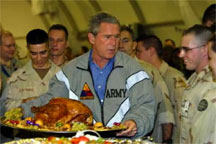
I've often wondered what it's like for military people to celebrate Thanksgiving, especially when they're in a dangerous place, and far away from home.
|
|
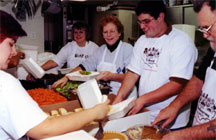
Many people extend themselves at Thanksgiving to care for others in need, doing things like feeding the homeless. Focusing on the needs of others often helps people to put their own struggles into a healthy perspective.
|
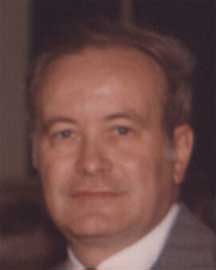 |
My dad in 1984, two years before he died of cancer.
|
 |
The box (above) and board (below) from the Parker Bros. classic game, Star Reporter. If you have an extra $100, you can buy the game from E-bay. (I wish I'd saved mine!) |
|
|
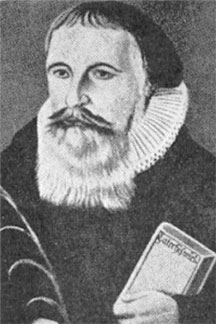 |
Martin Rinkart, pastor from Eilenburg, Germany
|
|
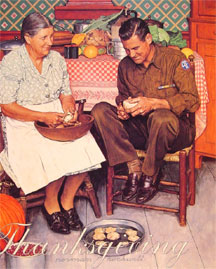
"Thanksgiving" by Normal Rockwell. A mother and son peeling potatoes. |
Home
Our Need for Gratitude
Part 4 of the series “A Week of Thanksgiving”
Posted at 11:40 p.m. on Wednesday, November 24, 2004
When my daughter was in kindergarten, her teacher planned to have the students celebrate Thanksgiving by making—you guessed it—painted turkeys. But were they going to use brushes to apply paint to paper? No, that would be far too neat. The teacher’s plan called for the children to paint their hands with poster paint and then press their goopy, multicolored hands onto white paper plates. The teacher, realizing that this assignment could prove to be tricky, asked for parental assistance. I offered my body as a living sacrifice for the sake of my daughter’s education.
My goal was to help the students create their turkey masterpieces without getting paint all over themselves. I quickly discovered, however, that kindergarteners don’t share my commitment to neatness. They rather enjoyed smearing paint, not only on their paper plates, but also on their clothing and even their parental assistant—me! It took all the leadership ability I could muster to keep the kids on task so they’d end up with brown, red, orange, yellow, and green turkeys—but not brown, red, orange, yellow, and green classmates. I was exhausted after just one hour of helping thirty youngsters complete their assignments and return to class relatively unscathed. And when it was over, I found that I had managed to avoid looking like the victim of a paintball massacre.
As I was escorting the last student back to her desk, she turned to me and said, “Thank you, Mr. Roberts.” I was startled, but somehow managed to mumble “You’re welcome.” Only then did it dawn on me that she was the only one of thirty students to thank me for my Herculean efforts. I couldn’t help but remember the occasion in Jesus’s ministry when he healed ten lepers but received thanks from only one. I wondered if Jesus felt a bit taken for granted, as I did.
I must confess that I am too often just like those ungrateful kindergartners. I can easily forget to say thank you to humans who assist me in life, and even to God who is the Source of every good gift in my life. Why, I wonder, is gratitude the exception rather than the rule in my life?
Can you relate to my question? Do you ever find yourself short on thanksgiving? Do you find it easier to complain about small things in life than to express gratitude to God for the greatest gifts of all?
Why should we tell God “thank you”? Well, the most obvious and most important reason is that God deserves it. The Lord showers blessings upon us, graciously and generously. Good manners alone demand appropriate thanks be rendered to God.
But today I stumbled upon another reason for gratitude. This one, I must admit, is rather self-centered, but it’s worth mentioning nevertheless. Recently I’ve been making my way through Gregg Easterbrook’s fascinating book, The Progress Paradox: How Life Gets Better While People Feel Worse (New York: Random House, 2003). Easterbrook fulfills the promise of the title, showing that, while life in America is better than any other time or place in history, in general people are less than happy. Toward the end of the book Easterbrook suggests ways we can increase both our well-being and our general happiness. One of these is gratitude. He summarizes many psychological studies that show that grateful people are happier and healthier. Thus, Easterbrook argues, for purely selfish reasons we ought to become regularly grateful people.
I’m not quite sure that selfishness can actually propel one to genuine gratitude. Something about this equation doesn’t quite add up for me. But it’s interesting to find a purely secular, even self-centered rationale for gratitude. Add this to the fact that God deserves our thanks, and that Scripture calls us to continual gratitude, and you’ve got a compelling formula for a fulfilling life.
On this Thanksgiving Day, may you find the time to reflect upon your many blessings and acknowledge the Author of those blessings. But, beyond this, may gratitude be for you, not a once a year exception to the rule of taking good things for granted, but a daily discipline and a daily delight. God deserves it, and you need it.
Happy Thanksgiving! |
|
|
Ah, now that's a turkey!
|
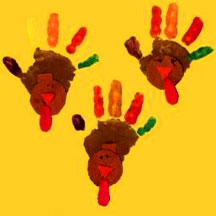 |
Funny how the turkey wattles end up looking like neckties.
|
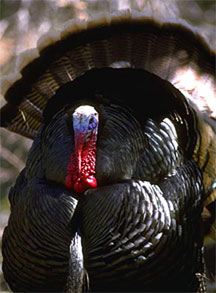 |
Here is a turkey with a real wattle. (Yes, that's what the red thing by the neck is called. The red thing by the beak is called the snood. Both of these help the male (Tom) turkey to be more attractive to a female. And you always thought women weren't attracted to rednecks!
|
 |
An interesting and challenging read by Easterbrook, who is a senior editor of the New Republic.
|
|
A Thanksgiving table ready for food and people. Now there's a reason to be grateful!
|
Home
And Don’t Forget to Thank Others Too
Part 5 of the series “A Week of Thanksgiving”
Posted at 12:30 a.m. on Friday, November 26, 2004
The primary purpose of Thanksgiving Day is to express gratitude to God for his many gifts. Although sometimes this gets forgotten in our secular culture today, still most people realize that our thanksgiving should be directed most of all in God’s direction. Though I’m a reticent Presbyterian, nevertheless I’d say “Amen!” to that.
However, this season of year also gives us a chance to say thanks to others, to the people in our lives for whom we are grateful, and who sometimes don’t get to hear this from us very much. As long as I’m thanking the Lord for my wife, my children, etc. etc., doesn’t it make sense to tell them? |
|
| |
Here are a couple of guys I'm thankful for, my son Nathan (right) and his friend Matt, as they enjoy Thanksgiving dinner together. |
We see an example of this sort of thing in the letters of the Apostle Paul. On several occasions he not only thanks God for his churches, but he tells them of it. Consider Paul’s letter to the Thessalonians Christians, for example. Here we read:
We always give thanks to God for all of you and mention you in our prayers, constantly. (1:2)
How can we thank God enough for you in return for all the joy that we feel before our God because of you? (3:9)
Imagine how you’d feel to hear this from someone important in your life. My guess is you’d feel honored, happy, maybe a bit embarrassed, and even thankful. It’s a wonderful thing to hear that someone is truly thankful for you. In fact it’s one of the best feelings in life.
Sometimes we need something to jar us out of our complacency so that we actually tell people we’re thankful for them. When my dad was fairly close to death, for example, I wrote him a letter, telling him all the things I appreciated about him. Or consider the example of General H. Norman Schwarzkopf. On January 17, 1991, he issued the order to begin the offensive campaign against Iraq, the start of Desert Storm. In the moments before the bombing began, the General retired to his office so he could write a letter to his family. Here’s what he wrote: |
|
|
General H. Norman Schwarzkopf, commander of the first Gulf War, Desert Storm |
My dearest Wife and Children,
The war clouds have gathered on the horizon and I have already issued the terrible orders that will let the monster loose. I wish with every fiber of my body that I would never have had to issue those commands. But it is now too late and for whatever purpose God has, we will soon be at war.
As a soldier who has had to go to war three times before, I want you to know that I am not afraid. I know that I might face death but you should know that I am far safer than most of the fine young men and women under my command. Some will die; many could die. I pray to God that this will not happen but if it does and if I am one of those chosen by God to sacrifice my life, I wanted you to know that my last thoughts before this terrible beginning are of you, my beloved family.
Brenda, I have never been very eloquent with words and far too guarded in expressing my love for you. I truly regret this but it is the way I am. That is why I wanted more than anything else to write to you tonight and tell you how much you mean to me. I cannot tell you how many times I have thanked God that I married you, nor can I adequately tell you how many times you have made me so proud that you are my wife. Especially during these past difficult five months it has given me great strength to know that you were there, always there, taking care of our family and so many others. Thank you for that and so many other things: the loving, the understanding, the forgiving, the helping, the caring, the supporting -- just being my Brenda Pauline.
Cindy, Jessica, Christian, I hope you know how much I love you. The three of you have become the most important reason to me for my being on this earth. I could lose everything I possess and if I still had you, life would be worth living; I could be rich and famous and have everything I desire but without you my life would be meaningless, my heart would be empty, and I would not want to live. The three of you are my immortality! You are the best thing I will leave behind when I leave this world. And you have each returned that love to me. I am a father who knows his children love him and that makes me a very lucky man! As I told you at Christmas, I am so proud of each of you for what each of you are. Be proud of yourselves for you are find human beings. Thank you for being my children; thank you for letting me be your father; thank you for loving me!
Take care of each other, love each other, and if it be God's will, we shall be together soon. If that should not happen, then know that wherever I am I will be with each of you every day, always!
Your loving husband and father,
H. Norman & DAD
Letter from General H. Norman Schwarzkopf, with Peter Petre, It Doesn't Take a Hero, (New York: Bantam Books, 1992), 412-413. |
What a moving letter! Every time I read this, I want to go hug my wife and children and tell them how much they mean to me. (Actually, right now they’re in bed sleeping, so I don’t think they’d appreciate the gesture very much.) Of course most of us will never face the kind of dangers General Schwarzkopf encountered. Yet this means we might not communicate our feelings of gratitude to those who have made such a difference in our lives.
 |
Thanksgiving provides a salutary occasion for saying thanks, both to the God from whom all blessings flow, and to those who are conduits of divine blessings in our lives. It’s a time to stop what we’re doing and say “Thank you” to the people in our lives who deserve to hear this from us. Even if you manage to thank only one other person this Thanksgiving, that small gesture can make a big difference in the life of that person.
So, even though the official day of Thanksgiving is over, and even though we’ve officially entered the Christmas shopping season, why not extend thanksgiving for just a little longer? Tell those who are close to you that you are thankful for them. Drop someone a note. Or make a short phone call. This will enrich your life as well as the lives of those for whom you are grateful. |
Here are many of the people I'm most thankful for, my immediate family (mother, brother, two sisters) and their spouses and children. We took this picture after our Thanksgiving meal at the home of my mother, my brother and his family.
|
|
Home
A Great Thanksgiving Tradition
Part 6 of the series “A Week of Thanksgiving”
Posted at 10:40 p.m. on Friday, November 26, 2004
In this post I want to tell you about a great Thanksgiving tradition. But I’ll admit to a not-so-hidden agenda. I want to commend this tradition to you as something you might wish to add to your yearly Thanksgiving repertoire. I guarantee that it will pay rich dividends in delight and expanded gratitude.
I can boast about this tradition without hesitation because it’s not something I invented. Rather, I inherited it when I came to Irvine Presbyterian Church. It was a choice fruit of the ministry of my predecessor, Ben Patterson. What am I talking about? A Thanksgiving Eve Worship Service. |
|
| |
The Thanksgiving Eve congregation singing our opening hymn and song. |
 |
When I was an associate pastor at Hollywood Presbyterian Church, we had a Thanksgiving day service. From 10:00 to 11:00 in the morning we gathered for prayer, song, and a sermon. Though I loved this service, the timing was inconvenient for many, who missed the service because they were cooking or driving to grandma’s house. Thus, in my first year as Senior Pastor of Irvine Presbyterian Church, I was pleased to experience the tradition of a worship service on the night before Thanksgiving.
For the past fourteen years I’ve participated in this service, and it’s one of my favorite events of the whole year. Why? Well, for one thing, because of the timing of the service, my celebration of Thanksgiving begins in earnest at 7:00 on Wednesday evening. Thus my celebration of Thanksgiving is longer and fuller. Moreover, I like beginning my personal Thanksgiving celebration by remembering God. I have nothing against watching the Macy’s parade, eating turkey, and getting together with my family, mind you. But I’m glad to give God first place in the festivities. |
Being led in worship songs by some of our high school students
|
|
Another thing I enjoy about our Thanksgiving Eve service is the multigenerational, family dimension. We include children from about four years of age on up. Many of them have a chance to participate, as I’ll explain in a moment. The presence of children means that we have to plan a service with their interests and capabilities in mind. We include music that they will know. The sermon is short and relatively child-friendly. It usually involves interaction with the congregation, sort of a whole-congregation children’s sermon, if you will. With children present, the sanctuary is a little noisier than usual. But there’s something wonderful about having the whole church family together on Thanksgiving Eve. The content of our Thanksgiving Eve service is pretty simple. In the hour-long service we sing hymns (including “Now Thank We All Our God” and “Great is Thy Faithfulness”) and songs (including Matt Redman’s “Blessed Be Your Name” and “Let Everything That Has Breath”). There are Scripture readings and prayers.
| Perhaps the central element of the service is an “open mike” time when we ask members of the congregation to share briefly that for which they are thankful. Children express their gratitude for their parents and pets. On the other side of life, this year one man thanked God for fifty years of marriage. Usually there are moments of laughter, like a few years ago when my five-year old daughter thanked God for paper. (She was serious, and upset when people laughed.) There are often tears as well, as when an elderly woman once thanked the Lord that her husband was in heaven and suffering no longer. |
|
| |
My daughter and her friends sharing their thanks |
 |
Our other special tradition involves writing on a small piece of orange paper shaped like a pumpkin. We receive our “pumpkin” when the service begins. Then, throughout the service, we write down on the paper things for which we are grateful. Near the end of the service we bring our pumpkins forward and place them on the communion table as part of a giant cornucopia. In this way every person participates in tangibly and actively in shared corporate gratitude.
Following the worship service we have an informal reception, with hot cider and snacks prepared by folks in the church. It’s a pleasant time of conversation and shared gratitude. |
Congregational members bringing forward their pumpkins and a special offering for needy folk and our mission partners
|
|
I would strongly recommend that all churches consider adopting the tradition of a Thanksgiving Eve service. I realize that some churches already do this. But many are missing out. If you’re a lay person in a church and you’d like to encourage your pastor to adopt the Thanksgiving Eve Service tradition, you might send this post to your pastor. If it turns out that your pastor is unable to do this service because of family plans or whatever, it could easily be led by others.
I’ve got lots of pastors who read this blog, so here’s my personal word to my colleagues: Our Thanksgiving Eve service is not only one of the best things we do as a congregation, but it’s also one of my favorite services of the year. I get out of it far more than I put into it (partly because my sermon is short, and partly because the service is so rich). Believe me, the last thing I want to do is to make your life busier and crazier. But I am convinced that a Thanksgiving Eve Service promises returns far greater than the investment of time required for planning and leading. If you have any questions, please e-mail me.
Happy Thanksgiving!! |
|
| |
The cornucopia with "pumpkins" of thanks after the service is over
|
Home
Home |