| |
A Resource by Mark D. Roberts |
|
How Does God Guide
Us? Divine Guidance. Spiritual Guidance. Guidance by the Holy
Spirit. How Does the Holy Spirit Guide Us?
How Does God Guide Us?
Section 1
by Rev. Dr. Mark D. Roberts
Copyright © 2007 by Mark D. Roberts
Note: You may download this resource at no cost, for personal use or for use in a Christian ministry, as long as you are not publishing it for sale. All I ask is that you give credit where credit is due. For all other uses, please contact me at mark@markdroberts.com . Thank you.
How Does God Guide Us? Introduction 
Part 1 of series: How Does God Guide Us? 
Posted for Tuesday, January 16, 2007
Recently I've been thinking about how God guides us. I've been motivated, in part, by some challenges facing the leaders of my church and me. As we seek to move forward in ministry, we're seeking to discern God's guidance, and often this isn't easy. I've also found myself in pastoral conversations with people who are asking me how they can know God's will for their lives. They aren't looking for easy answers, but for direction so they can follow Jesus more faithfully.
Of course the question of how God guides us isn't a new one for me as a pastor, or simply as a Christian. Ever since I first put my faith in Jesus Christ over 40 years ago, I've been more or less eager to do what God wants me to do . . . if I only knew what He wants! As hard as obedience can be at times, I've found that discerning God's will can be even harder.
I think back to the summer of my sixteenth year. My parents really wanted me to go to Malibu Club, a Young Life camp in Canada. I didn't want to go, partly because I didn't know anybody and felt pretty shy, and partly because I just wanted to hang out at home with nothing to do. But my parents were persistent, reminding me of the exceptional beauty of Malibu, which stands guard over a salt-water inlet on the Canadian coast a few hours north of Vancouver. As a lover of natural beauty, especially mountains, I must admit I was tempted. But still I didn't want to go.
Finally I decided to see if I could determine God's will for whether I should go to camp or not. After praying for a while, I didn't have any divine revelations. So I decided to do the only sensible thing. I told the Lord that I would go to camp if He wanted me to go, and that I would let the Bible give me His answer. So, picking up my Bible and closing my eyes, I let the Scripture fall open, and then put my finger on a passage. "God," I prayed, "if this passage tells me to go to camp, I'll do it. Otherwise, I'm staying home." I opened my eyes, looked down, and read: |

|
| |
Princess Louisa Inlet of British Columbia, with Malibu Club in the bottom center. This just may be the most beautiful place I have ever been. |
By awesome deeds you answer us with deliverance,
O God of our salvation;
you are the hope of all the ends of the earth
and of the farthest seas.
By your strength you established the mountains;
you are girded with might.
You silence the roaring of the seas,
the roaring of their waves,
the tumult of the peoples.
Those who live at earth’s farthest bounds are awed by your signs;
you make the gateways of the morning and the evening shout for joy.
(Psalm 65:5-8)
As I read about the farthest seas and the mountains, and about "earth's farthest bounds," I felt sure I had received God's answer. So I went to camp, and, to this day, it remains one of the highlights of my life.
Though I can't prove it, I still believe that God used my silly little divination game to get me to Malibu. In His grace, He determined to go along with my immature discernment scheme. But I do not believe that the "close-your-eyes-and-flip-to-a-Bible-passage" approach to spiritual guidance is God's recommended approach. In fact, I don't think I've ever used this mode of discernment ever again, for good reason.
Yet this still leaves us with the question: How does God guide us? In this blog series, I want to propose several answers to this question. Indeed, I believe that God guides us in a variety of ways, besides the "flip-to-a-Bible-passage" method.
If you're new to my blog, I should briefly explain my assumptions as I begin this series. I am a Christian who finds a theological home in the Reformed/evangelical tradition, though I've learned much from other Christian traditions as well. I believe, above all, that God has given us the Bible as our supreme guide in matters theological and practical. Thus I might be tempted to answer the "How does God guide us" question with a simple "Through the Bible." But this answer is too simple, since the Bible itself reveals a large number of ways through which God guides His people. So, as this series unfolds, You find that I turn to Scripture again and again for direction.
I should also mention that some of what you'll read in this blog series appeared in similar form in my book, After "I Believe." If you've read that book, you might recognize a few of my main points and illustrations. But I don't apologize for using an edited and expanded version of my earlier work. My guess is that less than 10% of my current blog readers have read After "I Believe." Moreover, the book is out of print today, so it seems right to make some of its insights available online.
Comments on How Does God Guide Us?
If you would like to comment on what I've written here, or to read other comments on this series, click here. (Note: You'll need to register to make comments. You can read anonymously.) |
Spirit Guide Silliness
Part 2 of the series: How Does God Guide Us?
Posted for Wednesday, January 17, 2007
Spiritual guidance is a marketable commodity these days. If you're willing to fork over a few bucks–sometimes, a few hundred–you can receive personal guidance from people who claim to have a special channel to "the spirit world." Many of these gurus hock their supernatural wares at expensive conferences and workshops. Others have turned to the Internet. Yes, you can visit websites where, for a fee, you will receive personalized guidance that purportedly comes from some immaterial being. This "spirit guide" may be an angel, or a departed loved one, or a person who lived thousands of years ago. (I'm not going to put up any links because I don't want to encourage use of such websites. But if you're curious, you can find them easily through Google.)
| Your spirit guide could even be the spirit of a plastic doll! Some years ago, Barbara Bell, an architectural illustrator from northern California (where else?), operated the world's only Barbie channeling service. For only $3.00, Bell summoned up the spirit of Barbie to solve the problems of those seeking her advice. "I appreciate and understand Barbie," Bell explains. "She has been forced to be shallow all these years, but underneath she's a profound person." And to think I never realized there was anything underneath her slick plastic exterior! (Little known fact: Barbie's last name is "Roberts." Truly, according to Barbie's creator, Ruth Handler. So Barbie must be one of my distant cousins.) |
|
| |
Barbie dolls come in many different forms. But as a spirit guide? Hmmmm. |
All of this talk about spiritual guidance from angels, dead people, and even dolls ought to give us pause as we consider the topic of spiritual guidance. Just because somebody claims to be guided by some supernatural being, even if this being is God, we ought not to believe the claim. Spirit guide silliness should make us careful, even if we're Christians who believe that God actually can and does offer supernatural guidance.
Sadly, however, some Christians have been caught in the current of spiritual silliness, claiming to be led by the Holy Spirit into all sorts of nonsense. I know a man who once claimed that God told him to have an adulterous affair with the wife of one of his best friends. Yikes!
Attributing one's peculiar behavior to God is nothing new. It's been going on for centuries. Over thirty years ago, for example, I found myself in Mrs. Poole's Sunday school class. She was a fine teacher, well-prepared, biblically-literate, and interesting even to a sixth-grade boy. Mrs. Poole's Bible lessons were almost always succinct and compelling. Almost always, I say, because every now and then Mrs. Poole would claim that the Holy Spirit led her to depart from her notes and launch into the stratosphere of more direct revelation. As she spoke under the impetus of the Spirit, I was struck by how had she was to follow and, frankly, how boring. If I took Mrs. Poole at her word, then I could only conclude that she was a much better a teacher than the Holy Spirit! Whereas she was succinct, the Spirit was long-winded. Whereas Mrs. Poole had a way of speaking right to the hearts of sixth-graders, the Holy Spirit could hardly keep our attention. Even then I suspected what I now believe to be the truth: Mrs. Poole was confused about the Spirit's guidance. Her ramblings may have contained grains of genuine inspiration, but they issued more from her exuberant imagination than from the Spirit of God. Though I can't claim to be the final authority on such matters, I have a sneaking suspicion that the Spirit actually inspired Mrs. Poole's careful preparation of lessons more than her spontaneous sermons.
These days religious people are claiming divine inspiration for all sorts of behaviors that are, not only nonsensical, but downright horrible. The most obvious case is that of Muslim extremists who kill innocent victims in the name of Allah, something that is contrary to the beliefs of most of the Islamic world. Christian extremism of this sort rears its ugly head every now and then, especially in some conflict-ridden sections of Africa. These examples have led some people to conclude that all spiritual guidance is nonsense, and even that the idea of God is both wrongheaded and dangerous.
I don't agree with this conclusion, of course. But I do take seriously the tendency for people, even good intentioned ones, to misconstrue God's direction. It's especially tempting for all of us to project our own desires onto God, reading them back as confirmation of what we ourselves want. So, we must approach this subject with due caution. At the same time, let's not shrink back from one of the most precious aspects of the Christian life: divine guidance through the Holy Spirit.
Comments on How Does God Guide Us?
If you would like to comment on what I've written here, or to read other comments on this series, click here. (Note: You'll need to register to make comments. You can read anonymously.) |
Guidance from the Holy Spirit
Part 3 of the series: How Does God Guide Us?
Posted for Thursday, January 18, 2007
The Bible reveals that the God guides His people. Scripture abounds with examples. Some are dramatic, as in the Book of Exodus. There, not only does God direct Moses by speaking through a burning bush that is not consumed, but also God guides Pharaoh to release his Israelite slaves by sending catastrophic plagues upon the whole nation of Egypt. Sometimes God's guidance is ironic, as when God guides Balaam through his donkey or Jonah through a giant fish (Numbers 22; Jonah 1-2). Often the Lord directs His people through the messages of the prophets.
In the New Testament, divine guidance comes through the agency of the Holy Spirit. In Luke 4:1 we read that "Jesus, full of the Holy Spirit, left the Jordan River. He was led by the Spirit to go out into the wilderness." Throughout the Book of Acts the Holy Spirit guides Jesus's followers by filling them, speaking to them, moving them around, giving them visions, and endowing them with spiritual powers (Acts 4:31; 8:29, 39; 10:9-16, 44-45).
The examples in Acts of spiritual guidance among the earliest Christians illustrates Paul's counsel in Galatians 5:25: "If we live by the Spirit, let us also be guided by the Spirit." When we put our faith in Jesus, the Holy Spirit comes to live within us. Moreover, we live in the Spirit, since the same Spirit who gave us new life in Christ continues to transform us. When we become children of God through faith in Christ, we are then ready to be led by the Spirit and not by our sinful nature (Rom 8:12-14). True spiritual guidance is Spirit-inspired. It comes, neither from an angelic guide, nor from a departed relative, nor even from the spirit of Barbie, but from the very Spirit of God.
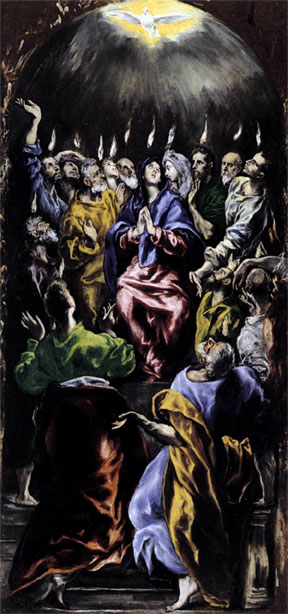
People in my branch of Christianity, the Reformed/Evangelical branch, sometimes get "weirded out" by too much talk of the Holy Spirit. Many of us have known other Christians who claimed to experience all sorts of questionable things under the inspiration of the Spirit. Some of these oddities appear in Scripture, such as speaking in tongues, and cannot therefore be easily dismissed. Others have been even more troubling. A few years ago, for example, some Christians claimed that the Spirit inspired them to do things in worship services like laugh hysterically or bark like dogs. These bizarre behaviors got quite a bit of press in some Christian circles, thus leading to the "weirding out" I mentioned earlier. |
|
| |
El Greco, "The Pentecost," 1596-1600.
|
It's been tempting, therefore, for some Christians to greatly limit the role of the Holy Spirit in guiding us today. I've heard fellow Christians for whom I have great respect argue that the only way the Spirit guides us today is through the biblical interpretation. Everything besides Bible study, Bible teaching, and preaching is suspect, and likely to be some sort of spiritual counterfeit.
This reaction to the excesses of some Christians seems to me an over-reaction, even though I can surely understand it. If we take Scripture seriously, however, then we have to acknowledge that the Spirit does more than interpret Scripture for us, even though I believe this particular work of the Spirit is both wonderful and essential, and it's the way I tend most frequently to receive God's guidance. Yet I don't believe it's wise to limit the way in which the Spirit guides us so as to rule out of bounds that which we find taught or exemplified in Scripture.
In my next post I'll examine one kind of spiritual guidance that is common both in Scripture and, I believe, in our experience.
Comments on How Does God Guide Us?
If you would like to comment on what I've written here, or to read other comments on this series, click here. (Note: You'll need to register to make comments. You can read anonymously.) |
Guidance Through Circumstances (Section A)
Part 4 of the series: How Does God Guide Us?
Posted for Friday, January 19, 2007
As I continue my series on spiritual guidance, I'm beginning with this post to address specific ways we are guided by the Spirit of God. Today I begin by noting how the Spirit guides through circumstances.
In Acts 16 the Apostle Paul and his colleague Silas are in Philippi, where they share the good news of Jesus with a man and his family (Acts 16:16-34). The whole household believes the message and all members are immediately baptized. How did Paul and Silas get to home of this man and his family? Not through inner spiritual guidance. Not through dreams or angelic visions. But through circumstances, rather odd circumstances at that. The man was a jailer who had been assigned to guard two prisoners, Paul and Silas.
The two missionaries got in trouble with the authorities when they cast an evil spirit out of a girl who had been used to make money for her opportunistic masters. Her spiritual freedom took away their source of income, so they grabbed Paul and Silas and accused them before the civic leaders of Philippi: "They are teaching the people to do things that are against Roman customs." The officials had the Christians beaten and thrown into prison, where they met the jailer, who had no idea what was about to happen to him and his family.
Around midnight, when the two prisoners should have been licking their wounds and bemoaning their fate, Paul and Silas were praying and praising God. All of a sudden a great earthquake shook the prison, knocking the chains off the prisoners. The poor jailer, supposing that his prisoners had escaped, was about to fall on his sword when Paul shouted: "Don't do it! We are all here!" In shock, the jailer fell instead at the feet of the missionaries. He then took them to his home, where they proceeded to convert him and his entire family. |
|
| |
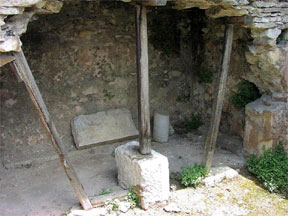
An actual remnant of a jail in ancient Philippi. Some think this was the very jail in which Paul and Silas were incarcerated, though there is no way to prove it one way or the other. ( Picture link.)
|
Given the whole tenor of Acts of the Apostles, we are surely meant to believe that the visit of Paul and Silas to the jailer's home was no mere coincidence. Though not identified explicitly in this passage, the Holy Spirit is directing the action of Acts 16, just as the Spirit oversees the mission of Christ throughout Acts. The Spirit gets Paul and Silas into the jailer's home by manipulating circumstances, some of which were obviously miraculous, others of which appeared on the surface to be both ordinary and distressing.
The Bible is full of stories in which God's guidance comes, not by word or vision, but through circumstances. Such stories also fill most Christian communities where people seek God's direction. We often don't realize the guiding hand of the Holy Spirit until we look back in retrospect. But later on we see how God wove events together to accomplish his will in our lives.
Of course the skeptic would deny that God was involved with such things. "Mere coincidence!" would be the claim. But sometimes the coincidences are so astounding that I find it very, very hard to believe anything other than that some Supreme Being is guiding events. In my next post in this series I share one of my own experiences about which I'm convinced God was guiding me.
Comments on How Does God Guide Us?
If you would like to comment on what I've written here, or to read other comments on this series, click here. (Note: You'll need to register to make comments. You can read anonymously.) |
Guidance Through Circumstances (Section B)
Part 5 of the series: How Does God Guide Us?
Posted for Monday, January 22, 2007
In my last post I explained that God guides us, in part, through circumstances. In this post I want to tell a story from my own life in which I experienced this sort of guidance. I've told this story before, so if it's familiar to you, feel free to skip down to my concluding paragraphs.
When I was a sophomore in college, I wanted to share my Christian faith with others. But, as an introverted person, I wasn't likely to walk up to a stranger or even a friend and get into a conversation about God. So I decided to pray and ask God to help me.
One brisk Saturday evening in October, I decided to go down to Harvard Square–which was always bustling with people–and see if I could share my faith with somebody. The Square was filled with students from all over the Boston area, and it seemed a likely place for God to drop a seeker into my lap. I prayed earnestly for God to guide me to someone with whom I could talk openly about Christianity. "Lord," I prayed, "you know I'm pretty shy about this. So it would be great if you'd work a little miracle here, and find me somebody with whom I could share. And if you could make it obvious, that would be really helpful." With this prayer in my heart, I set off for the Square.
I wandered around for a while, wondering where "my person" was. "Lord," I kept on praying, "please bring me somebody who wants to learn about You." Still nothing happened. After a half hour or so I began to feel both discouraged and silly. It almost seemed as if God was having a good laugh at my expense.
Just then, two young women approached me. "We're going to a party at Dunster House," they explained, "but we don't know how to get there. Could you help us?"
"Sure," I said. "Glad to." Meanwhile I thought to myself, "This is great. Not only has God brought these people into my life so I can talk to them about my faith, but they happen to be two attractive women. God, you've outdone yourself this time!" Dunster House was about a ten minute's walk from Harvard Square, so I figured this would be plenty of time to engage these women in a conversation about God.
| On the walk down to Dunster, I kept bringing up subjects that I felt sure would lead to a productive dialogue. "I'm majoring in philosophy," I said, "Are you interested in philosophy?" They weren't. "Sometimes I wonder why we're here on this earth? Do you every think about this?" They didn't. Basically, all they wanted to do that night was to party at Dunster House, not to reflect on the meaning of life with their overly-eager tour guide. For ten minutes I tried everything I could think of to get these women to talk about God. Nothing doing. Of the thousands of students in Cambridge that night, they were the least interested in God. |
|
| |
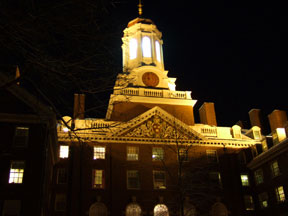
Dunster House at night |
When we got to Dunster House, I walked them to the door. They thanked me and left. I felt like a complete idiot. "Okay, God," I prayed, "I get the point. You've probably had a good chuckle over my silliness. Well, that's enough. I'm going home. This was a stupid idea." I left the entrance to Dunster House and headed back to my dorm.
Just then I passed a student I recognized as being a friend of a friend, somebody I had met briefly during my freshman year. He said "Hi" so I returned the greeting as we went off in opposite directions. All of a sudden he stopped, turned around, and called to me, "Hey, are you Mark Roberts?"
"Yes," I said, surprised that he knew my name.
"Well, I'm Matt. I'm a friend of your roommate Bob."
"Oh, yeah. Hello, Matt," I said.
"I've been wanting to talk to you," Matt said.
"Me?" I asked incredulously. "Why me?"
"Because I hear you're a Christian. I need to talk to you about God."
And so began a conversation that lasted well into the night. That conversation turned into a weekly Bible study, as Matt and I looked into the gospels to find out about Jesus. When we finished, Matt wasn't ready to give his life to Christ. But he was closer than he had been on that strange night when we met on the walk outside of Dunster House. End of story.
Now I suppose a skeptic could always say that my meeting with Matt was just an accident. But it seems to me much more likely that God used the rather strange circumstances of that evening to guide me–and to guide Matt –so that God's work would be done in our lives. I could tell a dozen more stories like this, hundreds if I drew from the experiences of people in my church. There is no doubt in my mind that the guidance of the Holy Spirit often comes through the circumstances of our lives.
But there is a downside to this kind of guidance. How can we be sure that our interpretation of our circumstances is correct? Suppose I had been so convinced that God wanted me to share my faith with the two young women on their way to the party that I managed to worm my way into the festivities, spending the whole night beating my head against the rock of their disinterest, and thereby missing that providential meeting with Matt. Spiritual guidance through circumstances is great, but it's usually ambiguous. What will help us sort out the circumstances of our lives so as to discern God's guidance with confidence?
I'll tackle this question in the next post in this series.
Comments on How Does God Guide Us?
If you would like to comment on what I've written here, or to read other comments on this series, click here. (Note: You'll need to register to make comments. You can read anonymously.) |
Guidance Through Scripture (Section A)
Part 6 of the series: How Does God Guide Us?
Posted for Tuesday, January 23, 2007
In my last two posts I explained that God can guide us through shaping the circumstances of our lives. But I admitted that this sort of guidance is often ambiguous. Circumstances may appear to point in more than one direction at the same time. Or different circumstances might seem to contradict each other. So we need to be able to weigh the events of our lives to determine with greater precision how God may be guiding us.
I would suggest that Scripture often serves in this crucial role. Now before I go further, I should mention that I am a Reformed evangelical Protestant with a strong commitment to the authority of Scripture. I believe that the Bible is God's Word given to us in human words that are, like Christ Himself, both divine and human in a mysterious way. I don't have time here to explain in detail what I mean by this or even to defend it. But I should fess up so as to make sense of what I'm about to say about Scripture.
There are people, including some Christians, who look to the Bible for guidance even though they don't believe it's inspired by God in an usual way. They view Christian Scripture as a source of wisdom similar to other sources, like the plays of Shakespeare or Gandhi's The Story of My Experiments with Truth. Without denigrating the wisdom found in such writings, I believe that the Bible is uniquely inspired and, therefore, authoritative.
How Does the Bible Guide Us?
The Bible provides a reliable yardstick by which to measure our claims to be guided by the Holy Spirit through circumstance or feeling. If, for example, you think that the Spirit is leading you to do something the Bible prohibits, you can be sure that your spiritual lenses have become foggy. Throughout history people have committed blatant sins under the claim God's guidance. But since the Spirit inspired the writers of Scripture, that same Spirit can be guaranteed not to lead us to contradict the plain direction of Scripture.
| Many years ago a good friend of mine became intimately involved with the wife of another man. This friend, I'll call him Bill, claimed that God had brought him and this woman together to deliver her from a terrible marriage. I think Bill actually believed this, and that God intended for him and the woman someday to be married. Unfortunately, Bill's defense of adultery contradicted the clear teaching of Scripture in many places, including such "minor" passages as the Ten Commandments and the Sermon on the Mount. No matter how much circumstances seemed to weigh in Bill's favor, and no matter how much his feelings led him towards adultery, he was misconstruing God's guidance. According to Scripture, adultery is wrong, plain and simple. |
|
| |
Mt. Sinai, where God revealed the Ten Commandments
|
There is a positive side to scriptural discernment of circumstantial guidance. If events in your life seem to point in you in a certain direction, you can be more confident about that direction if it leads you to do that which Scripture strongly affirms. There's no guarantee, of course. If you find a plane ticket to Indonesia you probably shouldn't interpret that as proof that God wants you to evangelize in that country, even though sharing the gospel is consistent with God's Word. It's much more likely that God wants you to turn in the ticket so the rightful owner can use it. But if, on the other hand, events in your life give you an opportunity to share your faith with your neighbor, the fact that Scripture teaches you to do this very thing makes the probability of divine guidance in that direction more likely.
The Bible gives us much more than the ability to evaluate the spiritual significance of circumstances. It is the primary source for divine guidance in our life. Period. The Spirit who inspired the biblical writers also works in our hearts to help us understand what God wants to say to us through the Bible. One of the chief functions of Scripture is to reveal God's will for our lives.
Often when folks say "I am seeking God's will for my life" they refer to God's specific will, whether to marry a certain individual, or to take a job offer, or to go on a mission trip. But the Bible usually refers to God's will in a more general sense, as that which we all should do with our lives. For example, Paul writes: "For this is God's will, that you be fully set apart from this world to live for him, that you keep away from sexual immorality" (1 Thessalonians 4:3, my translation). If you are tempted with sexual sin, you really don't have to spend too much time wondering which partner God wants you to fornicate with. Scripture has made God's will abundantly clear: don't do it!
In another place Paul writes, "No matter what happens, always be thankful, for this is God's will for you who belong to Christ Jesus" (1 Thessalonians 5:18). Through this verse, the Spirit of God is guiding all of us to be thankful in prayer. Given the fact that there are thousands of imperatives in the Bible–thousands of actions God wants us to do–we can't read too far without encountering divine guidance for our lives.
If we take Scripture seriously, therefore, we can know that it's God's will for us to worship Him, praise His name, give thanks for His gifts, pray for His help, love God and our neighbors and our enemies, feed the poor, seek justice for the oppressed, invite the homeless into our homes, be faithful to our spouses, tell others about Jesus, gather with other Christians on a regular basis for fellowship, and so on and so on.
I realize that what I've just said may not satisfy the person who is asking: "But is it God's will for me to do this particular thing?" I do in fact believe that sometimes we receive more specific guidance through Scripture, and I'll say more about this in my next post. But I also believe that if we do the things that are clearly commended in Scripture, our minds and hearts will be shaped by the Spirit so that we are more apt to correctly discern God's specific will in specific situations.
Next time I'll explain further how God can guide us in such situations through Scripture.
Comments on How Does God Guide Us?
If you would like to comment on what I've written here, or to read other comments on this series, click here. (Note: You'll need to register to make comments. You can read anonymously.) |
Guidance Through Scripture (Section B)
Part 7 of the series: How Does God Guide Us?
Posted for Wednesday, January 24, 2007
In my last post I began to discuss different ways God guides us through Scripture. I focused especially on the sort of general guidance for our lives that is present throughout the Bible. From Scripture we know that we should love God, love our neighbors, love our enemies, etc. etc. etc.
But what about when we're facing decisions in which general biblical teaching doesn't seem to make a difference? The clear call to love my neighbor, for example, doesn't tall me exactly how to do this, or exactly which neighbors of the hundreds in my life deserve the bulk of my time and attention.
The Holy Spirit can also give quite specific direction as we encounter the text of the Scripture, taking that which is true for all Christians and applying it to our particular lives and situations. This sort of thing happens all the time in personal Bible study, and in group studies, and when God's Word is preached. This is one major reason, by the way, that I am a preacher. I've seen God change lives through the power of His proclaimed Word.
For example, several years ago in a sermon I mentioned an Old Testament passage in which the Lord says, "I hate divorce" (Malachi 2:16). I connected this passage to the teaching of Jesus on marriage, calling my congregation to a new commitment to marriage. As I greeted folks after service, I heard the usual collection of "Nice sermon, pastor" comments. |
|
| |
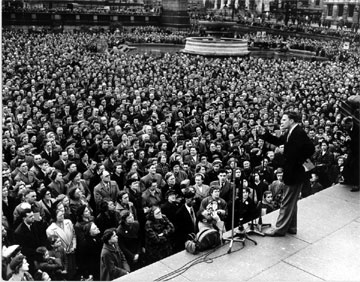
Talk about preaching that connects with people's lives! Billy Graham has been used by God to communicate with millions upon millions. In the picture above, he's speaking in Trafalgar Square in London in 1954. ( Picture from the Billy Graham Center of Wheaton College.) |
The next morning I received an altogether different kind of response. A man I'll call Jeff called me at church. He had been in worship the day before and had a desperate need to speak with me. He didn't want to elaborate, but said it had to do with my sermon. I rearranged my schedule so I could visit with him over his lunch hour.
"Your sermon really upset me," Jeff began.
Oh no, not a great start to this conversation, I thought quietly as I steeled myself for his criticism.
"What you said about marriage and divorce has completely messed me up," he continued. He then told me his story. A couple years ago, he had begun an affair with a coworker. When his wife discovered his unfaithfulness, Jeff left his wife and two small children and moved in with his girlfriend. Shortly thereafter, he began divorce proceedings. At the time of our lunch meeting, everything was final, except one last signature. With the sweep of a pen, Jeff's marriage would be completely over.
Until the day before when I mentioned that God hates divorce, Jeff had never really questioned the morality of his actions. He was sorry to hurt his wife's feelings and especially those of his children. But he was tired of his marriage and in love with his coworker. Then, owing to a number of "coincidences," Jeff had visited our church the day before, only to hear my sermon on marriage and divorce. (This, by the way, illustrates quite wonderfully how the Spirit can use both circumstances and Scripture to guide us.)
"For the first time I'm wondering what God thinks about what I've done,” Jeff continued. “Maybe I shouldn't get divorced. Maybe I should try to get back with my wife, though by now she hates my guts. I don't know what to do. What do you think I should do?"
I tried in a gracious way to explain to this man what God intended for marriage and God's consequent hatred of divorce (even though it is something God has allowed in some circumstances and which God forgives even when it is completely wrong). I agreed that Jeff's wife might very well have no interest in reconciliation, but encouraged him to talk with her. She was a Christian, I discovered, as was Jeff, though he had not been living in fellowship with God for many years. As Jeff and I prayed together, I pleaded with God for help. Neither of us felt a lightening bolt from heaven that promised healing for his marriage, but we sensed God's support for an effort to reconcile.
Ten months later, I found myself praying with Jeff once again. But the context was very different. The intervening months had been an emotional roller coaster for him and his wife. At first she laughed off his offer to reconcile. But, after a while, she sensed a change in Jeff's heart, especially when he terminated his extra-marital relationship. Lots of counseling, prayer, and support from other Christians slowly brought healing to their broken marriage. Ten months after my first meeting with Jeff I was praying with him . . . and with his wife, as they stood at the altar to renew their marital vows. God had brought them both through an astounding process of reconciliation. Before family and friends they testified to the power of the Scripture to change our lives for the better, by helping us to confront what is wrong and by teaching us to do what is right.
Jeff's case marvelously illustrates the guidance of the Spirit through Scripture. But, I'll freely admit, things don't always happen this way or end this happily. In my next post I'll include some warnings about the potential for misconstruing God's will through the misuse of Scripture.
Comments on How Does God Guide Us?
If you would like to comment on what I've written here, or to read other comments on this series, click here. (Note: You'll need to register to make comments. You can read anonymously.) |
Guidance Through Scripture (Section C)
Part 8 of the series: How Does God Guide Us?
Posted for Thursday, January 25, 2007
In my last two posts I've been arguing that God guides us through Scripture. For the most part, I'm referring to the way the Bible provides basic truths by which to order one's life. For example, in many passages Scripture tells us to forgive people, and therefore when we have been wronged by someone, we can know that it's good to forgive that person.
Unfortunately, people can indulge in silly and self-serving interpretations of biblical texts, such as one I heard from a man teaching on Matthew 6:33: "Seek first [God's] kingdom and his righteousness, and all these things will be given to you as well" (Matt 6:33, NIV). "Do you want an expensive car? A large home? A financially prosperous life?" he asked, "Jesus promises to give you 'all these things'!" Of course he took "all these things" completely out of context, turning Jesus's promise of basic necessities into a guarantee of opulent living.
It seems so obvious that this man's values were far too worldly, yet we all read the Bible from our own worldly perspectives to one extent or another. No Christian is immune from this disease, including me and you. This means that we will tend to mold both the meaning of Scripture and the guidance of the Spirit to fit our preconceived molds. You can see this in all sorts of situations. Republicans tend to find their political views upheld in Scripture, while Democrats find their convictions in the Bible. People who oppose the ordination of women see Scripture as lined up on their side, while those who support it believe that their view is biblical. Etc. etc. etc. One basic rule of thumb to remember is this: If your reading of the Bible completely confirms your pre-existing beliefs, you may well have projected those beliefs into Scripture.
If we seek to discern God's guidance correctly, our very way of seeing and thinking needs to be changed, and Scripture plays a giant role in this process. This is exactly what Paul urges upon us in Romans 12: |
|
| |
Now this is what you need if you want a serious rule of thumb. |
Don't be conformed to this world, but keep on being transformed through the renewing of your minds, so that you might discern what the will of God is, that which is good and pleasing and complete (Rom 12:2; my translation).
As our minds are made new through the work of the Spirit, we will be better equipped to determine God's will for our lives. Notice that this transformation is an ongoing process, something Paul accentuates with his choice of Greek verb forms: "keep on being transformed." Such transformation begins in conversion and continues throughout our lives. The Bible is one of the chief tools employed by the Spirit in this work of mental remodeling. The more we internalize God's Word, the more we will be able to determine God's will because our powers of discernment will be formed and energized by the Holy Spirit.
By the combination of Word and Spirit God guides us. But too often Protestant evangelicals like me envision this guidance individualistically. By so doing we misunderstand God's intentions for us and often misconstrue His guidance for our lives. I'll explain more of what I mean in my next post.
Comments on How Does God Guide Us?
If you would like to comment on what I've written here, or to read other comments on this series, click here. (Note: You'll need to register to make comments. You can read anonymously.) |
Guidance Through Community (Section A)
Part 9 of the series: How Does God Guide Us?
Posted for Friday, January 26, 2007
So far I've shown that the Spirit of God guides us through circumstances and Scripture. But, as I have admitted, both circumstances and Scripture can be variously interpreted, and we all have a tendency to shape our interpretations to fit our personal biases. If I really want something, then I'm apt to see God's blessing in circumstances and Scripture, even when it's not there at all.
I used to be in a group of Christian men and women that prided itself on deep relationships as we held each other accountable in the nitty-gritty stuff of life. Yet, every now and then, a couple in the group would proudly surprise us with their joyous announcement: "We are engaged to be married." The rest of us would be shocked, since we hadn't even known that the couple had been dating, let alone considering such a monumental decision as marriage. Their behavior communicated a not-so-subtle message: the input of the community is just fine for most things, except in matters of the heart. These are private, and we can discern God's guidance without the help of anyone else, thank you very much.
By way of contrast, I once had two Christian friends who, after a long, deep relationship, informed me of their desire to marry. "We're not engaged yet," Ben and Sue explained, "because the elders of our church haven't considered our request yet."
"What request is that?" I queried. "A request to use the church for your wedding?"
"Oh, no!" they laughed. "In our church we have to get the permission of the elders in order to marry. We won't get married unless they give their blessing to our relationship."
I was floored. At that time in my life I could hardly imagine letting other people have such authority over a personal decision like this. But, for Ben and Sue, it was a normal part of committed Christian fellowship.
As I look back on their situation, I can certainly see the potential dangers in giving away so much personal freedom to a Christian community. In the best case scenario, the elders would give godly, gracious, helpful direction. In the worst case scenario they would be hard-headed, hard-hearted, and downright harmful. But I am still moved by Ben's and Sue's willingness to submit such a personal matter to others for guidance. Their behavior seems to me far more consistent with biblical teaching than what I had experienced from the folks who made surprise announcements to their supposedly close Christian family.
Even those who have a deep knowledge of Scripture and whose minds are well along in the process of spiritual transformation can misconstrue the Holy Spirit's guidance. That's one of the main reasons God places us in Christian community. When we come together in Christ, when we seek divine guidance together, when we are open to the Spirit's leading, the odds of correct discernment increase exponentially.
Near the end of his first letter to the Thessalonians, Paul advises his young church to engage in a communal process of spiritual discernment:
Do not stifle the Holy Spirit. Do not scoff at prophecies, but test everything that is said. Hold on to what is good. Keep away from every kind of evil (1 Thess 5:19-22).
| Paul assumes that the Holy Spirit will be active in the church. Here he mentions prophecies, occasions when Christians speak forth God's messages directly. In another of his letters Paul includes many more ways the Spirit speaks and acts within the church (see 1 Corinthians 12-14). But just because someone claims to have a message from the Spirit, that doesn't guarantee the correctness of the claim. The community needs to "test everything," to discern whether the message is from the Holy Spirit or some other source. If something is truly from God, then it should be embraced. If something is found to be evil, it should be rejected. |
|
| |
The agora (marketplace) of ancient Thessalonica as it looks today. Picture thanks to Holy Land Photos. |
Analogously, if you believe that the Holy Spirit is guiding you in some specific area of your life, you ought to submit your conviction to your Christian siblings for help with discernment. In my case, I would share it with a more mature Christian whose wisdom I respect, or with my small group, or with my wife, or, in all likelihood, with all of the above. It's scary to do this, of course, because those around us are generally more open to God's will for our lives than we are, and would be less likely to project our desires onto God than we would be.
I'll continue this conversation in my next post in this series.
Comments on How Does God Guide Us?
If you would like to comment on what I've written here, or to read other comments on this series, click here. (Note: You'll need to register to make comments. You can read anonymously.) |
Guidance Through Community (Section B)
Part 10 of the series: How Does God Guide Us?
Posted for Monday, January 29, 2007
In my last post I began to explain how God guides us through Christian community. This sort of discernment happens especially in the context of intimate relationships: small groups, prayer partnerships, or spiritual direction relationships.
For example, several years ago my wife and I were going through a difficult time in our marriage. Linda was pretty unhappy with our relationship. I, on the contrary, was fairly satisfied with how things were going, except for her unhappiness. If she would just cheer up, I thought, we'd be doing fine. Linda, however, wanted outside help. She asked if we might go to a Christian marriage counselor together. I rejected her request, arguing my case with an impressive array of facts and theories: not really needed; not enough time; can't afford it; can't find a good counselor, etc. (Of course I wasn't willing to admit that my real hesitations were pride and fear.)
| I won the argument, not by convincing Linda of the folly of seeking counseling, but by virtue of the fact that if I wouldn't go with her, we weren't going at all. But then I made the "mistake" of sharing my victory over Linda with my small group of Christian men. After I finished my proud tale they asked simply, "Why don't you just go to counseling with her?" Again I paraded my arguments, which they shot down with ease. I knew I was dead when my best defense, "I'm not sure we can afford it," was shattered with their offer, "Oh, we'll pay for you to go if that's the problem." The jig was up. My goose was cooked. My friends were able to discern, with far greater accuracy than I, what the Holy Spirit had been saying to me all along. If my marriage was important, which it was both to me and to the Lord, then I should have been willing to swallow my pride and get help when my wife was unhappy. |
|
| |
A picture of my wife and me around the time of my story. Yes, I was wearing those giant glasses and that stylish moustache. And, yes, I was wearing shorts that short. I'm glad some things change, though I'd be happy to have all that brown hair again.
|
Looking back on that experience, I now know where it led. Linda and I did see a wonderful Christian counselor. Not only did he help us develop a much healthier and happier marriage, but also he was used by the Holy Spirit to bring healing to deep wounds within my soul, wounds that hindered far more than my capacity for intimacy in marriage. I continue to overflow with thanks to God for those three brothers in Christ who helped me to discern God's will when I was so blind and hard-hearted.
Often the discernment of community does not involve the discomfort of the experience I just related. It can be an occasion for excitement as dear Christian friends seek God's guidance together. Several years ago my friend Nick, a businessman with a wife and two children, began to sense God's call to full-time, ordained ministry. He shared this feeling with his small group, who began praying with him for divine direction. One of the greatest hurdles Nick faced was his lack of a seminary education. How would he be able to support his family while attending seminary, not to mention paying for tuition and books? As he and his group prayed, they felt strongly that God was calling Nick to be a pastor, and therefore to attend seminary. So strong was their conviction together that they pledged to help Nick pay for school and support his family. With their discernment and tangible support, Nick was able to complete his seminary education, and he is now an ordained pastor.
Now I know plenty of stories that show the dangers inherent in discernment through community. People can be motivated by their own personal agendas rather than the Lord when giving advice. They can even use their influence to keep people from knowing or doing God's will. I'm certainly not suggesting that the guidance offered through community is inerrant. But, from my observation as a pastor, I'd say that more often than not people go astray because they receive too little guidance from their brothers and sisters in Christ, rather than too much. If there's any need in the life of most Christians, it's a need for deeper relationships with their spiritual siblings, relationships in which people can seek through prayer, discussion, Bible study, and careful reasoning to discern God's will.
Yes, I did just mention careful reasoning. I believe that this contributes much to spiritual discernment. I'll say more about this next time.
Comments on How Does God Guide Us?
If you would like to comment on what I've written here, or to read other comments on this series, click here. (Note: You'll need to register to make comments. You can read anonymously.) |
Guidance Through Reason
Part 11 of the series: How Does God Guide Us?
Posted for Tuesday, January 30, 2007
So far I've shown that God guides us through circumstances, Scripture, and community. In my last post I added that we can be guided through careful reasoning. I want to explain what I mean in this post.
Because the Spirit's guidance can be so marvelously miraculous at times, we can overlook or even disparage so-called "normal" processes of reasoning. Sometimes we even sit around like spiritual couch potatoes, waiting for some special gift of guidance while failing to use the gift of our minds, one of God's most amazing endowments to human beings.
God has given us powers of reason to be used for his purposes. Whether we utilize these powers to make medical discoveries, to teach Sunday school, or to discern God's will, God is honored when we use His good gifts for His glory. Moreover, the Spirit of God works in and through what can seem to us so natural and normal.
Some Christians assume a false dichotomy between natural and supernatural activities, believing that God's hand can be seen only in the supernatural or the extraordinary. But this distinction underestimates God's presence throughout the natural world. The Son of God, through whom God created the world, "sustains the universe by the mighty power of his command" (Heb 1:3). The Lord is present and active in the "normal" affairs of the universe, in that which seems ordinary to us, even as He is present and active in that which is spectacularly unusual. So, when we use our ordinary human reasoning for the purpose of seeking God's will, the Spirit can and does guide us.
The problem with this facet of spiritual guidance lies in the sin-induced corruption of our natural reason. Before we knew Christ, we were "alienated from God and enemies of God in our thinking" (Col 1:21, my translation). When we were reconciled with God through Christ, our sin was forgiven and our minds began to be renewed. But that renewal is an ongoing process that continues throughout our lives as we learn to think in new ways. No longer are we stuck in futile, human ways of thinking (Eph 4:17, Col 2:18). We can begin to think in godly ways because we have been given the "mind of Christ" (1 Cor 2:16). When we allow the Spirit of God to be active in every facet of our lives, then our thinking will also be guided by the Spirit (Rom 8:5-6).
As we devote ourselves to the key relationships of the Christian life, spending time in fellowship with God and God's people, we will start to think more like God and less like a captive of our corrupt culture. As God's written Word permeates our minds and hearts, we will treasure the things of God and think the thoughts of God. As we prayerfully ask the Lord to inspire our thinking, the Holy Spirit will lead us. Then we can have even greater confidence that our human reasoning, transformed by the Spirit to be more like what God intended it to be, will guide us in God's paths.
When our reasoning receives input from Scripture, and when it is something done in the context of Christian community, then the possibility of discerning God's will is greatly increased. Reason often allows us to make connections, taking in the various kinds of input that God is supplying. I would never suggest that reason alone is adequate for spiritual discernment, but it does supply a crucial link in the chain of divine guidance.
Comments on How Does God Guide Us?
If you would like to comment on what I've written here, or to read other comments on this series, click here. (Note: You'll need to register to make comments. You can read anonymously.) |
Guidance Through Dreams and Visions
Part 12 of the series: How Does God Guide Us?
Posted for Wednesday, January 31, 2007
So far in this series I've shown that God guides us through circumstances, Scripture, community, and reason. Those who especially like my last post on reason might find themselves a bit uncomfortable with today's post.
As I begin, I must admit that the subject of guidance through dreams and visions does not reflect my personal experience to any great extent. In fact, I feel most comfortable among Christians who are guided by thinking, not by visions and dreams. But as a biblically-committed Christian, I must not limit God's activity by my own limited experience, no matter how tempting that may be. Rather, I must let the Bible speak. For this reason I recognize the possibility of spiritual guidance through dreams and visions. Whether we are sleeping or awake, the Holy Spirit can reveal God's will to us through inspired visual images.
Throughout the Bible God communicates with his people through visionary experiences. In Genesis 15 the Lord speaks to Abraham in a vision (Gen 15:1). A few chapters later God speaks to the gentile king Abimelech in a dream (Gen 20:3). So it goes throughout the Old Testament stories. The New Testament begins on a similar note, with an angel appearing in a dream to Joseph, telling him that his fiancée is pregnant by the Holy Spirit (Matt 1:20). Not long afterwards Joseph receives direction to go to Egypt as, once again, an angel speaks to him in a dream (Matt 2:13).
If we were to think that things like this happened only for biblical characters, the promise of Joel corrects that misconception. Several centuries before Christ, the Lord spoke through this Jewish prophet:
Then after I have poured out my rains again, I will pour out my Spirit upon all people. Your sons and daughters will prophesy. Your old men will dream dreams. Your young men will see visions. In those days, I will pour out my Spirit even on servants, men and women alike (Joel 2:28-29).
Seven weeks after Jesus's resurrection, God poured out his Spirit as promised by Joel. Peter, preaching the first Christian sermon on the Jewish festival of Pentecost, quotes from Joel's prophecy to explain what has happened to the followers of Jesus who have just received the filling of the Spirit (Acts 2:16-21). The fulfillment of this prophecy at this time implies that Christians, both old and young, will experience divine guidance through dreams and visions.
The rest of the book of Acts illustrates this implication as the Holy Spirit guides the early Christians through extraordinary visual experiences. In Acts 16, for example, the Spirit at first speaks to Paul and Silas, telling them not to evangelize in the Roman provinces of Asia and Bithynia. Then Paul has a vision in the night, in which a man from northern Greece asks him, "Come over here and help us." The evangelists quickly leave for that region, believing that God has called them to preach there (Acts 19:6-10). Later on, when Paul's ministry in Corinth brought on Jewish wrath, God inspired and affirmed Paul through another vision:
One night the Lord spoke to Paul in a vision and told him, “Don’t be afraid! Speak out! Don’t be silent! For I am with you, and no one will harm you because many people here in this city belong to me.” So Paul stayed there for the next year and a half, teaching the word of God (Acts 18:9-11)
Of course, as we have noted with respect to other forms of guidance, that which we derive from dreams and visions must also be tested by Scripture in the context of prayerful, reasonable Christian community. Throughout history, heretical theologies have often originated in the visions of their founders, visions inspired by something other than the Holy Spirit. The New Testament letter from Jude refers to false teachers as "dreamers" (Jude 1:8). But, for those of us inclined to exalt rationality far above visions, I daresay that most modern heresy stems from thinking, not dreaming.
I know a woman named Sandy who, years ago, had a dream in which she and her husband were missionaries in a city she had never heard of, in a country on the other side of the globe from where they were presently living. As she shared this dream with her husband and with her church, they all began to believe that Sandy had indeed heard from the Holy Spirit, even though she and her husband were not missionaries and the city revealed was in a country that prohibited the entrance of all missionaries. Years of patient discernment followed, as this couple sought to follow God's leading. He confirmed what Sandy had dreamed in hundreds of ways. Many, many years later, through a most amazing series of divine interventions, the dream was fulfilled, as they began to minister in the very city whose name had once revealed in a dream. A skeptic would scoffingly say that this was a self-fulfilling prophecy. But, knowing the journey of Sandy and her husband, I stand amazed at the grace of God who still speaks to us, as promised, through dreams and visions.
Yet this isn't all. In my next post I'll explore still another way in which God guides us.
Comments on How Does God Guide Us?
If you would like to comment on what I've written here, or to read other comments on this series, click here. (Note: You'll need to register to make comments. You can read anonymously.) |
Guidance Through Divine Whispering (Section A)
Part 13 of the series: How Does God Guide Us?
Posted for Thursday, February 1, 2007
The Old Testament book of 1 Kings contains one of the most dramatic stories in all of Scripture (1 Kgs 18-19). Israel was languishing under the corrupt leadership of King Ahab and Queen Jezebel. The royal couple had led the nation into the worship of the pagan gods, Baal and Asherah. The king and queen had killed the prophets of God, replacing them with hundreds of pagan psychics. Only Elijah remained faithful and alive as a spokesman of the true God.
Empowered by the Lord, Elijah confronted King Ahab and his multitude of prophets, challenging them to a "my God is bigger than your god" kind of duel. Both sides would build altars on Mt. Carmel and prepare sacrifices on the altars. But they would not set fire to the sacrifices, as usual. Instead, they would wait for fire from heaven. Whichever deity consumed the sacrifice would be the winner. That god would be recognized as the true God.
The prophets of Baal went first, preparing a bull, placing it on their altar, and calling out to their god. When Baal failed to answer, they began dancing wildly around the altar, crying out for a miracle. As Elijah taunted them, they even engaged in ritual self-mutilation in an attempt to motivate Baal's response. But the fire didn't fall. Baal was still and silent.
Then Elijah repaired the altar of the Lord that had been torn down by the pagans. He prepared his sacrifice and then, just to make things a lot more difficult for God, Elijah drenched everything with buckets of water until the ditch around the altar was filled to the brim. When all the preparations were completed, Elijah prayed a simple prayer, asking the Lord to demonstrate his sovereignty. God's response was stunning:
Immediately the fire of the Lord flashed down from heaven and burned up the young bull, the wood, the stones, and the dust. It even licked up all the water in the ditch! And when the people saw it, they fell on their faces and cried out, “The Lord is God! The Lord is God!” (1 Kgs 18:38-39).
In the wake of victory, Elijah zealously killed the vanquished prophets of Baal. But when Queen Jezebel heard what had happened, she sought Elijah's life, forcing him to flee to wilderness.
Several weeks later he found himself cowering in a cave in the desert, crying out to God for help. Then God instructed Elijah to stand outside of the cave and watch.
And as Elijah stood there, the Lord passed by, and a mighty windstorm hit the mountain. It was such a terrible blast that the rocks were torn loose, but the Lord was not in the wind. After the wind there was an earthquake, but the Lord was not in the earthquake. And after the earthquake there was a fire, but the Lord was not in the fire. And after the fire there was the sound of a "gentle whisper" (1 Kgs 19:11-12).
The God who had done such wonders on Mt. Carmel, the same God who controls the awesome power of wind, earthquake and fire, chose to speak to Elijah through the "sound of a gentle whisper," what the King James Version of the Bible calls "a still, small voice." The contrast between God's mighty power and his quiet voice couldn't be more stark. Though we might expect or even prefer dramatic demonstrations of divine guidance that knock us off our feet, the Holy Spirit often speaks in a gentle whisper that brushes our hearts like a soft spring breeze.
The thought of the Spirit whispering to us sounds wonderful, but it isn't without complications. I'll address a couple of these in my next post.
Comments on How Does God Guide Us?
If you would like to comment on what I've written here, or to read other comments on this series, click here. (Note: You'll need to register to make comments. You can read anonymously.) |
Guidance Through Divine Whispering (Section B)
Part 14 of the series: How Does God Guide Us?
Posted for Friday, February 2, 2007
In my last post I related the moving Old Testament story of Elijah who, after confronting the prophets of Baal on Mt. Carmel, retreats to the wilderness where he hears the "gentle whisper" or "still, small voice" of God. I suggested that we too can hear that quiet voice as the Spirit of God speaks even today.
Unfortunately, a multitude of contemporary Christians have trivialized this ministry of the Spirit. "God spoke to me" has become a virtual replacement for "I thought," except that by saying "God spoke to me" a person avoids having to take responsibility for his or her actions. After all, if God told me to upgrade my computer software, who are you and who am I to question God's command? Claiming God's authority for my own thoughts not only appears to protect me from being corrected, but it also gives an added punch to my own preferences.
While recognizing that the Spirit will speak to us, we must also acknowledge our tendency to misinterpret what we hear, or to mistake our own inner voice for the voice of God. My friend Dave was a pastor to young adults in a large church. Energetic, handsome, godly, and obviously single, Dave found that many of the women in his group were interested in more than just his Bible teaching. Every now and then one of them would approach him with exciting news, "God has told me that we're going to get married," she'd announced happily. At first Dave didn't know quite what to say to this unwelcome and unlikely bit of divine direction. But over time he developed an appropriate response: "Well, that could be great news. Thanks for sharing it with me. Now, just as soon as God tells me that we're going to get married, then we'll do something about it." Oddly enough, God never told Dave what his young fans had purported to hear from the Spirit. He ended up marrying a wonderful woman who, ironically enough, hadn't heard God whisper Dave's name in her ear.
Stories like this make it easy for those of us who are more intellectually oriented to discount hearing from God altogether. I've heard a few Christians even deny that the Spirit still speaks to our hearts in any direct way. But this extreme view opposes both the biblical record and the testimony of thousands of wise, balanced Christians who are not inclined to conjure up divine voices.
I have another pastor friend whose experience of the Spirit's guidance for his marriage was quite unlike Dave's. Greg, a scholarly Presbyterian minister, was teaching an adult Sunday school class one day. In the midst of his lecture, a woman entered and sat in the back of the class. Greg, who had never seen her before, barely took notice of her entrance until he heard an inner voice say distinctly: "You are going to marry that woman." Not one to have such experiences, Greg just about fell over on the spot. Somehow he managed to finish his lesson. Many months later he did in fact marry that woman, but not because he clobbered her with a claim to spiritual guidance. First he introduced himself to her. As a friendship developed, they both began to sense what Greg suspected from the beginning. Along with their Christian community, they discerned God's guidance with all the tools available to them. Indeed, they did marry. Once again, a skeptic could chock up Greg's experience to overactive libido or simply good luck. But as one who knows his spiritual integrity, I believe that the Holy Spirit spoke to Greg's heart in order to accomplish God's will in his life.
The possibility of the Holy Spirit whispering to us may lead us to wonder: How can I develop a wise, appropriate sensitivity to the Spirit? I'll address this question in my next post in this series.
Comments on How Does God Guide Us?
If you would like to comment on what I've written here, or to read other comments on this series, click here. (Note: You'll need to register to make comments. You can read anonymously.) |
Home |