| |
A Resource by Mark D. Roberts |
|
What is a Church? What is the Church? Church Basics. Basic Ecclesiology. Introduction to the Church.
What
is a
Church?
Biblical
Basics
for
Christian
Community
|
|
|
by Rev. Dr. Mark D. Roberts
Copyright © 2006 by Mark D. Roberts
Note: You may download this resource at no cost, for personal use or for use in a Christian ministry, as long as you are not publishing it for sale. All I ask is that you give credit where credit is due. For all other uses, please contact me at mark@markdroberts.com. Thank you.
v
What is a Church? Introduction 
Part 1 of series: What is a Church? Biblical Basics for Christian Community 
Posted for Monday, October 2, 2006
"What is a church?" Now that seems like a easy question, the sort of question one might answer in an simple sentence or two. "A church is a building in which Christians meet for worship," is one obvious possibility. "A church is a group of Christians who gather for religious purposes" is another. These sentences aren't bad for quick answers, but they don't take us very far if we want to understand truly what a church ought to be.
You'll notice that I moved from the descriptive – what a church is – to the evaluative – what a church ought to be. This wasn't accidental on my part. In this series on the church I'm not so much interested in what churches actually are, or in what people think churches are, as I am in what churches should be. When I ask "What is a church?" I'm wondering about the ideal rather than actual.
My subtitle reveals the perspective from which I intend to address this question. I plan to discuss the nature of the church from a biblical perspective. That's the sort of thing that evangelical Protestants like me tend to do, so I expect this is no surprise. I believe that Bible is God's inspired Word, and therefore is to be our chief guide both for faith and life. In my opinion, nothing in this world tells us more authoritatively what the church ought to be than Christian Scripture.
Roman Catholic and Eastern Orthodox believers would agree with me up to a point. They affirm the authority of Scripture as God's Word. But they add the parallel authority of tradition, especially as embodied in the creeds and historic teachings of the church, and in the bishops who guard and pass on this tradition. I believe that Christian tradition ought to be taken very seriously. We Christians have much to learn from our brothers and sisters who have gone before us and who have sought to understand and to be the church. But, ultimately, I'm convinced we should weigh their convictions and practices in light of biblical teaching. For me as for millions of Protestants across the globe, Scripture trumps church tradition though without denying the value of tradition.
I also think it's important to pay close attention to how Christians throughout the world interpret Scripture when it comes to the nature of the church. We all tend to read the Bible in light of our own cultures. We all project our meanings and values into the text. Careful interpretation of Scripture can help us see what is really there and not be tricked into thinking our projections are God's revealed Word. But even then we can't escape completely from our own worldviews and biases. Listening to what Christians from other cultures hear the Bible saying (and not saying) can help us interpret Scripture more accurately. But, even then, I believe Scripture stands authoritatively above the experience of all Christians. It's always possible to say, "I see how you understand this text, but I believe your reading isn't quite right." Of course someone who disagrees with my experience might very well say the same thing.
At this point I won't go on and on talking about the interpretation of Scripture. I mostly want to clarify "where I'm coming from" in this series, as we'd say in California. My main starting points are these:
1. Though I take seriously both Christian tradition and the experience of contemporary Christians throughout the world, I believe Scripture has the final word when it comes to matters of faith and practice, including the question of what a church should be. Therefore, the best way to discover what a church should be is by a careful study of Scripture.
2. One way we can get to the true meaning of the biblical text is by reading it in light of its own cultural setting. If we want to understand the writings of the Apostle Paul, for example, we would do well to see them in light of his Greco-Roman-Jewish world. Doing this will help us avoid projecting our meanings and biases into the text.
If you've done some reading in theology, you'll recognize that I'm going to address questions of ecclesiology (from the Greek words ekklesia, meaning "assembly, church" and logos meaning "thought, word, principle"). I'm not planning to engage in a technical conversation, however, one suitable only for theologians. Rather, I want to write for the ordinary reader, especially the average Christian who wonders "What is a church, really?"
Note: If you're looking for a more theologically-oriented approach to the church than I will offer here, but one that is suitable for well-educated lay readers, I highly recommend It Takes a Church to Raise a Christian: How the Community of God Transforms Lives, by Tod Bolsinger. This award-winning book explains the nature of the church in light of the triune character of God, with lots of compelling illustrations and practical implications.
Before we launch our investigation into biblical texts that reveal the nature of the church, I want to explain why I'm doing this series at this time. I'll take this on in tomorrow's post.
Comments on What is a Church?
If you would like to comment on what I've written here, or to read other comments on this series, click here. (Note: You'll need to register to make comments. You can read anonymously.) |
Why This Series?
Part 2 of series: What is a Church? Biblical Basics for Christian Community
Posted for Tuesday, October 3, 2006
This is the second post in a series I'm calling: What is a Church? Biblical Basics for Christian Community. Yesterday I explained that I'm planning to answer this question from a biblical point of view, though without denying the value of church tradition and Christian experience. I believe that, in the end, however, Scripture is the most authoritative guide for matters of faith and practice, including questions of ecclesiology (the study of the church).
One additional point of clarification might be helpful here. Notice that I'm asking "What is a church?" rather than "What is the church?" I'm more concerned in this series about the nature of a particular Christian community than the whole configuration of Christians throughout the world and/or throughout the cosmos. Of course these issues of local church/global church are interrelated. But my primary focus is on an individual Christian community, a church, if you will, rather than the church.
Why This Series?
I'm taking on this series at this time for a variety of reasons. Mostly it is an outgrowth of my ministry as pastor of Irvine Presbyterian Church. In fact, I plan to use this series as a resource within my own church, especially as I teach our new members classes and as I work with my leaders. I'm finding that folks often have differing visions of what a church should be, and that these differences can be either enriching of our corporate life or debilitating, or both. If, for example, people join our church with a particular image of what a church should be, but it turns out that we are not what they had imagined, then it's likely they will become disillusioned and start looking for another church that offers what they want. Nobody wins when this happens. If, on the other hand, members of my church have a clear, common vision of what a church is, then their experience will be more positive. If our leaders share this vision together, then our church will be healthy and growing in the right direction.
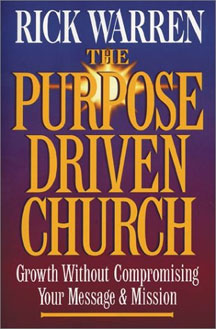
| As I write this series, there are lots of competing visions of the church in the marketplace of religious ideas. Rick Warren's The Purpose-Driven Church has had a major impact on Christian thinking about the church, not to mention the practice of individual churches. This book has helped thousands of churches clarify their mission and focus more intentionally upon it. Younger Christians (and a few not so younger ones) tend to be influenced more by an amorphous configuration of ideas and practices known as "the emergent church" or "emerging movement" or something like this (see, for example, The Emerging Church by Dan Kimball or Scot McKnight's excellent collection of blog entries on The Emerging Movement). Of course there are dozens of other visions of the church floating around in the Christian atmosphere, ranging from home-based Pentecostal communities to more traditional churches that emphasize Reformed theology and the regular administration of the sacraments. Moreover, many evangelical Christians continue to be drawn to more liturgical churches of the Eastern Orthodox and Roman Catholic variety. Talk about a wide range of perspectives on the church! |
|
|
Then you can throw into the mix the crises in which many of the well-established American denominations find themselves, including my own, the Presbyterian Church USA. Though our potentially-schismatic squabbles don't have to do primarily with the nature of the local church, they have touched upon this issue, especially with respect to who actually owns the property of a particular church. Many Presbyterians, Episcopalians, Lutherans, and others have been asking what it means for a local church to be connected to a larger body of believers. Is this essential? Or optional? Should such connections ever be broken? And if so, when? Though I don't intend to address these questions much in this series, they do loom over this investigation to some extent.
I determined to do an extended series on the question "What is a church?" a couple of weeks ago. Since we at Irvine Presbyterian Church need to focus again on the biblical basics of Christian community, I figured this might be true of other Christians and churches also. This hunch was confirmed today by an article on the Christianity Today website . The title of this article reads, "What's Next: Local Church." The subtitle explains: "We asked 114 leaders form 11 ministry spheres about evangelical priorities for the next 50 years. First up: Fresh basics for the local church." There you have it: fresh basics for the local church! So it appears that a series on biblical basics for the local church might in fact be helpful to others outside of my own church.
I'm particularly eager to help well-meaning Christians overcome some of the confusion they feel about what the church should be. Even in one particular church, even among leaders who share a common heart for Christ and a common commitment to Scripture, you'll find a wide range of visions of a church. Some of these visions are derived from Scripture and to that extent are helpful. Others come from a wide variety of other sources. In my next post I want to consider where people get their ideas of what a church should be.
Comments on What is a Church?
If you would like to comment on what I've written here, or to read other comments on this series, click here. (Note: You'll need to register to make comments. You can read anonymously.) |
Where Do People Get Their Ideas of Church?
Part 3 of series: What is a Church? Biblical Basics for Christian Community
Posted for Wednesday, October 4, 2006
People today have a wide variety of ideas about what a church should be. If you ask a dozen people you'd probably get a dozen different answers.
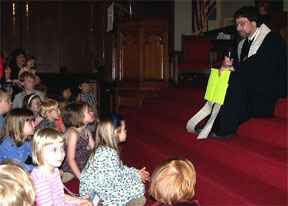
| One of my favorite answers came during a children's sermon preached by a young seminarian. This story was related to me by someone who was in the congregation that fateful day. For those of you unfamiliar with this genre, a children's sermon comes in a worship service when the folks twelve and under are brought forward for a sermonette by the pastor or some other church leader. Often the sermon begins with a question like, "What is God?" The preacher gets a bunch of funny – and incorrect – answers, and then offers the right answer, sometimes with a visual aid. |
|
| |
A typical childrens sermon |
At any rate, a young man was doing his seminary internship at a church. As low man on the totem pole, he got tabbed for the children's sermon, and decided to talk about what the church really is. He gathered the children together in the front, and began with his question: "So, boys and girls, what is a church?" He fully expected that the kids would say a church is a building and so forth. He'd get to wrap up with the correct answer, that the church is not the building but the people. As soon as the seminarian uttered his question, one of the boys shot his hand into the air.
"Yes," the young preacher said, "what is a church?"
"The gathered assembly of believers in Jesus Christ," was the boy's answer.
The seminarian was speechless, not knowing where to go from here. The kid had said exactly what the preacher was going to reveal at the end of a three-minute dialogue. From his point of view, there wasn't anything more to say. So after a few seconds of embarrassed silence, he thanked the boy and dismissed the children. (What the seminarian did not know was that the theologically-sophisticated boy was the son of a seminary professor in the congregation, and should never have been called on first!)
Most people don't get their ideas of church from seminary professors, however, or even from their fathers. Rather, then get them from a wide variety of sources. At a recent meeting of leaders from my church, I asked, "What shapes people's expectations of church? Where do people get their ideas of what a church ought to be?" Their answers were revealing:
1. People get their ideas of church from their past experience of church.
Indeed, this is surely true for people who have some past experience of church. These days, more and more people come to church with no religious background whatsoever. But most folks still have at least some prior history of church, even if it's limited to weddings and funerals. As a pastor, I've found that people usually have both positive and negative experiences from which to draw. They want a church to be like what they've experienced in some ways, but not like other aspects of previous churches where they've been involved.
Many people look upon their past church experience through the rose-tinted glasses of nostalgia. I've had people from my church, for example, complain about some innovation in worship and talk about how wonderful their church was growing up. When I ask if their church helped them to know Christ, to grow as His disciple, or to have a desire to worship God, they'll say something like, "No, but that's not the point." Looking back, they love what they remember about worship in their childhood church. But, in point of fact, that church did not actually teach them to know and love the Lord, and it didn't even help them want to worship God when they were young.
In tomorrow's post I'll discuss three other ways people get their ideas of what a church should be.
Comments on What is a Church?
If you would like to comment on what I've written here, or to read other comments on this series, click here. (Note: You'll need to register to make comments. You can read anonymously.) |
Where Do People Get Their Ideas of Church? Section B
Part 4 of series: What is a Church? Biblical Basics for Christian Community
Posted for Thursday, October 5, 2006
Yesterday I began considering the sources of people's ideas about church. To review, here is my first point:
1. People get their ideas of church from their past experience of church.
Today I'll explore three other common sources.
2. People get their ideas of church from pop culture.
| Even folks who've never stepped into a church might have seen the television show 7th Heaven (about a minister and his family) or The Simpsons, which frequently portrays The First Church of Springfield with its lovingly hypocritical pastor, the Rev. Timothy Lovejoy. Countless millions of people have seen the church through the lens of The Da Vinci Code, with its deluded believers and diabolical bishops. On a happier note, millions of others have read about the exploits of Father Tim, the beloved, Episcopal priest in Jan Karon's Mitford Series. Here there are no sinister plots in church, only a bunch of ordinary, small-town folk sharing life together in a traditional, small-town church. One of my favorite series of novels, The Starbridge Series by Susan Howatch, explores the psychological, theological, and spiritual struggles of religious leaders in the Anglican church. Of course there are dozens of other images of the church in pop culture. These often shape the expectations of Christians and non-Christians alike. |
|
| |
The Rev. Timothy Lovejoy |
3. People get their ideas of church from the news.
Much of the time, I'm sad to say, what people get from the news isn't all that positive. Church scandals tend to make headlines, deservedly so. Churches that are faithfully living out the Christian life usually fly under the media radar, however. There are exceptions to this rule, however. A couple of days ago the Los Angeles Times ran a fine piece on the recognition of World Communion Sunday in many churches. (As you may have noticed, recently I came down pretty hard on the Times for its reporting of the All Saints vs. IRS battle. But the Times often does refreshingly excellent work reporting on local churches, synagogues, and mosques. Here's another recent example.)
4. People get their ideas of church from a projection of their personal needs and preferences.
Some years ago a man started attending Irvine Presbyterian Church faithfully. He and I had lunch together, and during that lunch he laid out his vision for how our church could get involved in his personal mission. His was a valid mission to be sure, involving the expansion of ethics education in schools. I explained to him that our church would be glad to support him in this mission, but that it wasn't going to be our primary focus. He proceeded to lecture me on what the church ought to be, and how our church was falling short of this calling. In a nutshell, we needed to join him in his ethics crusade as our number #1 priority. For a while he tried to reshape our church according to his vision. When this didn't happen, eventually he left in anger and disappointment, believing that we weren't what a real church should be. (Ironically, this man didn't even profess to be a believing Christian!)
I've seen this sort of thing happen in people time and again. They have a need and figure the church is the sort of place that should meet this need. Sometimes it’s the desire to expand ethics education. Sometimes it's the need for friendship, or financial assistance, or political activism, or, well, you name it. Folks take their needs and project them onto the church.
To be sure, the church does meet many needs. And often people are drawn to church because of felt needs that aren't the church's main business. For example, someone might come to church hoping to make new friends. She finds these friends, indeed, but also much more than she bargained for, like friendship with Jesus, for example. Rarely do people come to church because they feel a need to worship the living God or grow as disciples of Christ.
In my next post I'll address one more source from which people get their ideas of what a church should be. This one, I believe, is often one of the most influential.
Comments on What is a Church?
If you would like to comment on what I've written here, or to read other comments on this series, click here. (Note: You'll need to register to make comments. You can read anonymously.) |
Where Do People Get Their Ideas of Church? Section C
Part 5 of series: What is a Church? Biblical Basics for Christian Community
Posted for Friday , October 6, 2006
In my last two posts I began exploring various sources from which people get their ideas of what a church should be. These included:
1. Past experience of church
2. Pop culture
3. The news
4. A projection of their personal needs and preferences
Today I want to explore one other source, a source that has a powerful influence on the way people think about the church.
5. People get their ideas of church from analogous institutions.
People often expect the church to be like some similar organization or event. For example, some people expect a church to be like a concert. When you go to a concert, you file into an auditorium. You sit in rows and watch something happening on the stage up front. If the concert is any good, you feel lots of positive emotions. At times you might even get into the act, but just a bit. You leave feeling uplifted and satisfied by the performance. Church, for many people, is just like this, only better, because you don't need a ticket, and don't even have to pay anything if you don't want to.
Others think of church like a school. They come for religious education. In my community, dozens of young parents start attending our church each year because they want their children to receive moral training. And we do provide this sort of thing. Children gather in age-grouped classes. They have curriculum and teachers. They do learn, or at least that is our hope. We also have lots of classes for adults. And we do hope to educate people. In many ways, we are like a school.
For others, a church is like a club, perhaps a social club or a service club. We have regular meetings. We have members and a process for joining. Members can become leaders in the church. We do lots of different things together, including service projects and social gatherings. At church, as in a club, we make friends and find a center for our socializing.
Many people today see the church as some kind of store. Small churches are like neighborhood markets; large churches are like department stores. Both churches and stores "sell" products. Both have professional staffs. Both "market" their wares in the community, hoping to attract interested "consumers." Larger churches, like larger stores, offer a wide array of "products." Smaller churches, like small stores, offer more personal service but fewer "products." If the church you attend provides what you're wanting to consume, you continue to go there. If that church stops meeting your needs, you think nothing of finding a better church, just as you might switch markets or clothing stores.
| It's also common for people to see the church as something like a hospital. When you're physically sick, you go to a hospital to get well. Similarly, churches promise to help you overcome your spiritual ailments. Both hospitals and churches have professional experts to help you heal (doctors, pastors). Both hospitals and churches offer specialized treatments for particular ailments (in churches: singles groups, AA groups, etc.). Both hospitals and churches are staffed by people who care, or at least that's the way it should be. Many churches and hospitals even share similar names: St. Luke's Hospital/Church, Hoag Memorial Hospital Presbyterian, etc. |
|
| |
Hoag Memorial Hospital Presbyterian in Newport Beach, California, where both of my children were born |
All of these analogous institutions – concerts, schools, clubs, stores, and hospitals – are like churches in many ways. Thinking of a church in these categories makes sense, to a point. But to the extent that people see a church exclusively in light of these analogies, to that extent they misunderstand essential aspects of church life. For example:
• A church is like a concert, but it's better to see a worship service as a concert in which God is the audience and the worshippers are they performers, turning the concert imagery upside down.
• A church is like a school, but a church offers much more than religious and moral education. It seeks to transform people's hearts and lives, not just to educate their minds. And it seeks for join people together in life-changing community.
• A church is like a club, but unlike most clubs, membership isn't a privilege, but a gift, and non-members are welcome to participate in virtually every aspect of "club" life. A church, unlike a club, exists not just for its members, but especially for its non-members.
• A church is like a store, but it ought to do far more than offer "products" for consumption. A church will thrive only if its members are committed to the church in a way far beyond consumer loyalty.
• A church is like a hospital in that it offers healing to those who are spiritually sick, just like Jesus did. But a church is not like a hospital because it seeks, not only to get "patients" well, but also to enlist them on the caring team. When you go to a hospital, you're not expected to become a doctor or a nurse. When you got to a church, you should join the care-giving team as well as receive care.
Ironically, biblical teaching on the church is rather like what I've just laid out. Scripture uses analogies to reveal the essence of the church. Each analogy has certain strengths; each analogy also has certain limitations. So, for example, we'll soon see that the church is meant to be like a human body. But it is not meant to grow old and die in three or four generations. So it is both like a body and unlike a body. In the posts that will follow in this series I'll try to unpack the biblical analogies for the church. Taken together, these will reveal the true nature of the church from God's point of view.
Comments on What is a Church?
If you would like to comment on what I've written here, or to read other comments on this series, click here. (Note: You'll need to register to make comments. You can read anonymously.) |
When a Church is not a Church, Section A
Part 6 of series: What is a Church? Biblical Basics for Christian Community
Posted for Tuesday, October 10, 2006
When I was young, I learned the little rhyme that goes like this:
Here is the church,
Here is the steeple,
Open the doors,
See all the people.
|
|
|
Of course it didn't dawn on me at the time that I was getting deficient theology. Only later in life did I realize that I should have learned a better rhyme:
Here is a building,
On top there's a steeple,
Open the doors,
The church is the people!
In my life I've probably heard a hundred sermons or teachings on the church. I've probably given a hundred more of my own. In virtually every one of these talks the same point is made: "The church is not a building. It's the people of God." Of course in common speech we refer to the place where Christians gather as a church. But this has nothing to do with biblical theology, and runs the risk of fostering a profound and detrimental misunderstanding.
Nowhere in the Bible is the place where Christians meet referred to as a "church." This word appears around 75 times in our English Bibles, depending on the translation (around 110 times if you include the plural). In almost every instance "church" is a translation of the Greek ekklesia (from which we get words like "ecclesiastical" and "Ecclesiastes"). Never does ekklesia refer to a building in which people gathered, for worship or for any other purpose. (In fact, the earliest Christians didn't even have special buildings in which to meet during the period in which the New Testament was written. This came much later. For the most part, the first Christians met in private homes.)
At this point you're probably commending me for my grasp of the obvious, or perhaps thinking about skipping this blog post altogether. But now's the time I take an unexpected turn. For I would argue that the use of "church" in our English New Testaments as a translation for ekklesia is problematic at best, and probably wrong. Yes, that's right. I'm saying that the word "church" should not appear 75 times in our Bibles, or 110 times including the plural. This, I fear, is a potentially misleading translation.
Now you might really be thinking even more seriously about skipping this blog post, since I'm now arguing a minority position versus almost every English Bible translation and Greek-English dictionary. But before you dismiss me as hopelessly eccentric, please allow me to defend myself.
No matter what connotation for the English word "church" you prefer, either the architectural one, the congregational one, or the institutional one, one thing is clear: "church" has religious connotations. A church is either a building used for religious purposes, or it is a group of people who have gathered for religious purposes, or it is a larger configuration of people who have been organized for religious purposes (i.e. the Roman Catholic Church). Say the word "church" and anyone who understands English will think "religious entity."
This was not the case for ekklesia in first-century Greek parlance. If, for example, a Christian traveler showed up on the streets of Corinth in the first-century A.D. and asked for the location of the ekklesia, nobody outside of the tiny Christian community there would direct him to a religious building or gathering. Nobody would think he was asking about anything that had to do with the gods or with religious practices. An ekklesia wasn't anything like a church. Greek had words for religious gatherings, words such as thiasos (cultic society) or synagoge (Jewish gathering). But ekkelsia wasn't one of these words.
Ironically, one might same the same thing for the use of the word ekklesia in the Greek translation of the Old Testament (the Septuagint, abbreviated as LXX). This word appears about 100 times in the LXX, almost always translating the Hebrew term qahal. Both words, ekklesia and qahal, have the basic meaning of "assembly" or "gathering." They can be used to describe a gathering for religious purposes, but the words themselves don't have religious connotations. They need something like "of the Lord" to make the religious setting clear.
So, if "church" in English always suggests something religious, whether buildings or gatherings of people or organizations, and ekklesia does not have this meaning in the time when the New Testament was written, then translating ekklesia by "church" almost certainly leads to some level of misunderstanding on the part of the reader. When it comes to the vocabulary of the New Testament, truly "a church is not a church."
So, then, what is the New Testament understanding of ekklesia? If this word isn't equivalent to "church," what other English word or words might better render the sense of ekklesia? To these questions I'll turn in my next post.
Comments on What is a Church?
If you would like to comment on what I've written here, or to read other comments on this series, click here. (Note: You'll need to register to make comments. You can read anonymously.) |
When a Church is not a Church, Section B
Part 7 of series: What is a Church? Biblical Basics for Christian Community
Posted for Wednesday, October 11, 2006
In my last post I argued something fairly commonplace: that the word "church," understood theologically, does not refer to buildings but to the congregations who use them. Then I argued something fairly unusual: that the English word "church" is a poor translation of the Greek word ekklesia, the word that is almost always rendered as "church" in English translations of the Bible. I explained that ekklesia in standard first-century Greek did not have a religious connotation, and therefore "church" smuggles in meaning that was not present in ekklesia. So, you might wonder, if "church" isn't the best translation of ekklesia, what might be better? I'll try to answer this question, first by looking at the ordinary meaning of the word ekklesia.
The Ordinary Meaning of Ekklesia
Almost all New Testament uses of ekklesia are distinctive in comparison to secular Greek, since ekklesia is almost always used to denote an usual gathering, that is, of believers in Jesus. In Acts of the Apostles, however, this term is used three times in a more or less ordinary sense, though perhaps ironically.
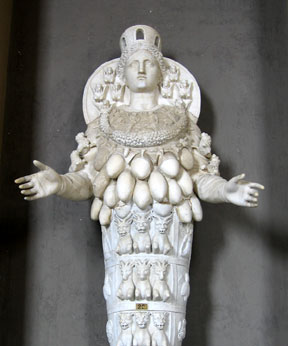
The context for this usage is Paul's ministry in Ephesus (a city in what is now western Turkey). For two years he preached the gospel, with considerable success. Many residents of Ephesus put their faith in Jesus and rejected their pagan practices. This led to a sharp decrease in the sales of little silver trikets of one of the most popular pagan gods, Artemis. Those who made their living by making and selling these souvenir idols became enraged, fearing the loss of their livelihood. So they stirred up their fellow Ephesians, who all rushed together to the theatre at the center of town, dragging a couple of Paul's companions with them. Acts tells us that the assembly in the theatre was in great confusion. The Greek word translated as "assembly" is ekklesia (Acts 19:32).
When one man tried to address the gathering, he was shouted down because the pagan Ephesians were biased against him owing to his being Jewish. Finally one of the civic leaders of Ephesus managed to quiet the people down. He told them not to worry about the worship of Artemis, and to follow appropriate legal actions if they had been wronged by Paul and his retinue. The leader concluded by saying, "If there is anything further you want to know, it must be settled in the regular assembly [ennomoi ekklesiai, literally, the lawful ekklesia or assembly]" (19:39). Then, Acts tells us, the official "dismissed the assembly [ekklesian]" (19:40). |
|
| |
A statue of Artemis in the Vatican Museum
|
From this story in Acts we can learn several things about the word ekklesia. Most simply, it meant "assembly" or "gathering." It referred to some sort of meeting of people who had come together for a particular purpose. In Greek society, the ekklesia was the assembly of full citizens in a particular city. (Most residents were not full citizens at that time.) Thus the ekklesia was rather like the city council in a modern American city in terms of its authority.
Etymologically, the word ekklesia was derived from the verb ek-kaleo, which meant "to call people together" or "to summon" them. This does not mean, however, that ekklesia really meant "the called-out people," as is sometimes claimed by preachers. Those who wrote the New Testament and those who read what they had written would not have thought of ekklesia in light of its etymological roots. For them, the word meant "assembly" without a hint of whether those who gathered had been called out or not. It's like when you hear the word "microwave." This word denotes a certain kind of oven. You and I don't think of the fact that "microwave" was derived from the combination of "micro" and "wave," and uses high-frequency electromagnetic waves. Rather, "microwave" means "that white oven over there in which I warm up my leftover pizza."
Ekklesia was a common Greek word for a gathering of people. It came to have a special meaning in reference to the assembly of the voting citizens of a city. In this sense it was the "regular assembly" referred to in Acts 19:39. But, as we saw in Acts 19:32 and 40, ekklesia could also be used to describe an unplanned and unruly crowd of people (perhaps ironically).
As I mentioned in my last post, ekklesia was not used specifically for religious convocations, not did it have religious overtones. The first-century Greek speaker would not thought of the gods or of a religious gathering when hearing the word ekklesia. Thus if I were a Bible translator, I'd opt for "assembly" or "gathering" rather than church for most New Testament instances of ekklesia. What gives the Christian ekklesia its distinctiveness is not the fact that it is an ekkelesia, but the fact that it is an ekklesia in God. More on this later.
All of this raises some fascinating questions about the meaning of ekklesia in early Christianity, and why the early Christians chose this particular word to describe their meetings. I'll try to answer these questions in my next post.
Comments on What is a Church?
If you would like to comment on what I've written here, or to read other comments on this series, click here. (Note: You'll need to register to make comments. You can read anonymously.) |
When a Church is not a Church, Section C
Part 8 of series: What is a Church? Biblical Basics for Christian Community
Posted for Thursday, October 12, 2006
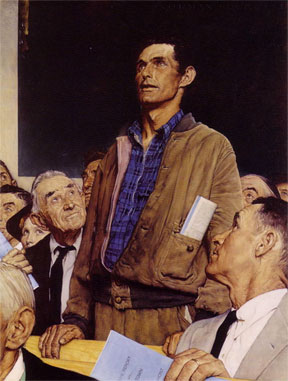
In my last two posts I've suggested that the Greek word ekklesia, which is usually translated as "church" in our English New Testaments, did not have the religious overtones we naturally hear when "church" is spoken. Because of this, I've even suggested that "church" is not the best translation for ekklesia. "Assembly," it seems to me, is better, even though it doesn't quite represent the nuances of ekklesia. You may recall that ekklesia had a common and quite specific meaning. It denoted the gathering of citizens in a Greek city, those who had authority over the city much like a city council might today. (In actuality, the ekklesia would be like a peculiar combination of the voters in a city and the city council. Perhaps the town meeting in a small New England town would be the closest modern equivalent.)
The Earliest Usage of Ekklesia in the New Testament
Unquestionably, the earliest written use of ekklesia in the New Testament comes from the letters of Paul. Scholars differ on which of Paul's letters was the earliest. Some opt for Galatians; while others prefer 1 Thessalonians. I'm in the "others" group for reasons I won't go into here. When Paul wrote his first letter to the Christians in Thessalonica (in Macedonia, an area of northern Greece), he began in this way: |
|
| |
Norman Rockwell's classic "Freedom of Speech" painting portrays the reality of the American town meeting.
|
Paul, Silvanus, and Timothy, To the ekklesia of the Thessalonians in God the Father and the Lord Jesus Christ (1 Thes 1:1)
Presumably, of course, he had taught the Thessalonian Christians to think of themselves as an ekklesia, so they would know what he was referring to when he used this word.
The phrase "ekklesia of the Thessalonians" would have had an established, commonly-understood meaning in this city. It denoted the gathering of citizens to govern the city. But Paul qualified his use of this phrase and therefore limited misunderstanding by adding "in God the Father and the Lord Jesus Christ." The Christians gathered in Thessalonica were not equivalent to the civic ekklesia. Rather, they were an alternative assembly, one that met "in God" and "in Christ." "In" means something like "by the work of" or "under the authority of" or "for the sake of."
Given what we've seen earlier about the meaning of ekklesia, it's quite likely that Paul was referring to the actual gathering of Christians in Thessalonica. He envisioned that his letter would be read in this gathering, and he was addressing the people who were in fact there. There's no evidence that he was thinking, as we might think, of all the members of the Thessalonian church, whether they were present for the reading or not. Paul was addressing a real assembly, and actual gathering of people. These were the ekklesia.
Support for this understanding of church comes also from Paul's letter to Galatians. He addresses this letter to: "The churches [ekklesiais] of Galatia" (1:2). The use of the plural is telling here. When Paul writes a letter to the Christians in the region of Galatia (in the center of modern Turkey), he does not think of them as some sort of spiritual group that could be called a single ekklesia, even though it never gathered together in the same place. Rather, they were a bunch of ekklesiai, "assemblies" in the plural.
It may well be that in some of Paul's later writings, notably Colossians and Ephesians, he expands the sense of ekklesia beyond this basic sense. I'll discuss this later. For now, however, I want to make the simple point that the basic meaning of ekklesia includes the notion of an actual gathering of real people. Paul wouldn't know what you meant if you said, "The Thessalonian ekklesia didn't meet today." From his point of view, there would still have been a few dozen Christians in Thessalonica, and they would still have had many ties together in Christ and in the Spirit, but they wouldn't have been an ekklesia if they didn't actually meet.
It may seem like I'm make an academic and linguistic point here that is of interest to scholars but otherwise of little practical value. On the contrary, I think what I've just said has giant implications for our actual understanding and practice of church today. I'll explain this in tomorrow's post.
Comments on What is a Church?
If you would like to comment on what I've written here, or to read other comments on this series, click here. (Note: You'll need to register to make comments. You can read anonymously.) |
When a Church is not a Church, Section D
Part 9 of series: What is a Church? Biblical Basics for Christian Community
Posted for Friday, October 13, 2006
In yesterday's post I explained that the earliest Christian usage of the word ekklesia, which is normally translated as "church" in English Bibles, referred to an actual gathering of believers in Jesus. The ekklesia in Thessalonica didn't exist, therefore, unless the Thessalonian Christians were actually together. So when Paul wrote a letter to this ekklesia, he didn't mean "all the Christians in the city wherever they might happen to be." Rather, he meant "all the Christians in the city who were gathered together at a certain time."
I realize that this might sound rather trivial, the sort of thing that advances academic careers while boring ordinary people to death. But there are, I believe, important implications of the meaning of ekklesia for our understanding of what a church is.
Implications for our Understanding of Church
Once we get beyond the "church is a building" mistake, we tend to think of a church as "all of the members of a particular Christian institution, whether they are present in the gathering or not." If you ask me, "How big is Irvine Presbyterian Church?" I'll say, "Oh, we have about 750 members." I do not mean by this that we ever have all 750 in the same place at the same time. This almost never happens because we don't have a room large enough for this number of people. In common speech, Irvine Presbyterian Church is composed of those who have decided to this particular group of people their religious home, whether they show up very much or not. |
|
| |
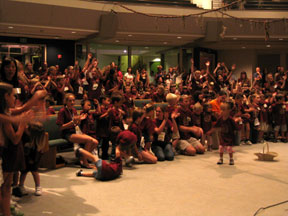
A Vacation Bible School worship service in my sanctuary. Now that's what I call an ekklesia!
|
This understanding of church has some benefits, to be sure. It means that you're still a member of the church if you're sick on a Sunday and can't show up for worship. This is comforting, to be sure. But there is a downside to thinking of a church as a collection of people who may or may not ever actually be together. This downside is illustrated in a conversation I had with somebody not long ago. She was talking about her church, so I asked, "Oh, are you a member of Anonymous Presbyterian Church." "Yes," she answered, "I'm a member there. But I don't attend very often."
I'm sure you've heard this sort of thing before. Maybe you've said it yourself. You can be a member of a church in good standing and not be physically present in the regular gatherings very often. But from a New Testament point of view, this is peculiar indeed. One was part of the ekklesia in Thessalonica if one was part of the real gathering because, indeed, ekklesia meant "gathering." To say, "I'm a part of a church but I don't attend very often" would be rather like if you invited me to a party at your house on Sunday evening, "I'm having a little gathering of friends on Sunday night. Can you come?" and I answered, "Sure, I'll be a part of your gathering, but I won't be able to attend." You'd be downright confused by my answer, because being a part of a gathering means being physically present.
I'm belaboring this point because one of the major problems in with our churches today is that many of our members don't actually participate very much. I saw a survey not long ago that found average church attendance in America to be 30-40% of membership, and this includes non-member visitors. It's likely, therefore, that only about one-third of people who associate themselves with a particular church actually associate in reality with that church on a regular basis. To put it negatively in the vernacular, about two-thirds of church members don't regularly go to church. But if the ekklesia is meant to be the actual gathering of people, not some ethereal club, then something is terribly wrong when the majority of so-called church members aren't regularly present with the church.
Please understand, I'm not necessarily blaming church members for this problem, though they surely contribute to it. Churches and church leaders have much to do with the problem of inactive members. Among other things, we have perpetuated that notion that church is about joining something where literal attendance isn't assumed. Moreover, we have often made the content of our assemblies so boring and irrelevant that I can't blame folks for attending irregularly. All pastors need to ask themselves: Would I show up on Sunday morning at my church if I didn't have to?
To sum up: When is a church not a church? If we take seriously the New Testament sense of ekklesia, then our answer is: When the church is not gathered together. To translate a bit more literally, The assembly is not the assembly when it isn't assembled. Now I certainly believe there's a sense in which we can be the church when we're scattered in the world, and I'll have more to say about this later. But, for now, it's important to note that there's something extremely important, and, indeed, essential about the actual gathering of Christians. Though there may be a derivative sense in which the church can be scattered, the regular assembly of believers is absolutely crucial to the health, if not the essence of a church.
Comments on What is a Church?
If you would like to comment on what I've written here, or to read other comments on this series, click here. (Note: You'll need to register to make comments. You can read anonymously.) |
When a Church is not a Church, Section E
Part 10 of series: What is a Church? Biblical Basics for Christian Community
Posted for Wednesday, October 18, 2006
Let me begin with a brief review. In my last few posts in this series I've been exploring the meaning of the Greek word ekklesia, which is ordinarily translated as "church." This translation, however, is not necessarily the best because the English word "church" always has religious connotations, whereas ekklesia was a secular word that meant "assembly" or "gathering." When it was used in the phrase "ekklesia of God" it referred to a Christian assembly, but the religious sense came from "of God," not from ekklesia. Moreover, in the common Greek of the New Testament era, ekklesia denoted one particular kind of assembly, the gathering of citizens in a city to do civic business. In this sense, ekklesia had a meaning rather like that of the classic New England town meeting.
With this review in mind, I want to ponder a bit further some implications of ekklesia for our understanding of Church.
Implications for our Understanding of Church (continued)
My last post focused on the implications of the broadest sense of ekklesia. If an ekklesia is an actual meeting of people, then a "church" exists when Christians gather together. The physical meeting of believers is essential to a right understanding of church. This stands as a critique, I suggested, of the American tendency to downplay the importance of church involvement. In our speech and practice, one can be a member of a church without showing up for the gatherings. This, however, runs against the current of the basic notion of ekklesia.
In this post I want to begin to work on the implications of the more specific meaning of ekklesia: the gathering of citizens of a particular city. Consider the following thought experiment:
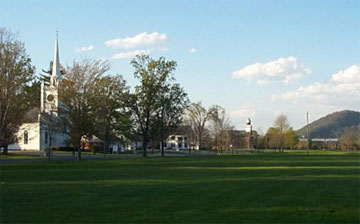
Suppose I were to move to New Hampshire in order to plant a new church there. I find a small town that has only one small, lifeless church, and decide to set up shop there. This town, Athens by name, is governed, in typical New England fashion by a town meeting that gathers periodically to oversee civic affairs. I begin my ministry with a Bible study in my home. After I have about twenty regulars, I decide to offer weekly worship services in the local school gymnasium. So I pass out flyers throughout the town. They proclaim: "Come to the Town Meeting of Athens in God."
| How do you think the locals would respond to the name of my church? It isn't hard to imagine their confusion, and probably their ire. "Why are you calling yourself 'the Town Meeting of Athens' when we already have one?" they would ask. "What are you suggesting about our local government? Are you planning to replace our official town meeting? Are you a subversive? Or are you merely rude? We don't need your kind around here!" |
|
| |
|
Of course we can't know for sure that the citizens of Thessalonica reacted this way when they heard about the "ekklesia of the Thessalonians in God," but it's likely they were at least confused if not a bit miffed. Surely Paul and the other early Christian church planters knew what they were getting into by calling their gatherings ekklesiai (plural of ekklesia). No doubt they realized that referring to the Christian meetings as thiasoi (religious clubs) or synagogai (assemblies, synagogues) would be less troublesome. Yet they chose ekklesiai nevertheless.
It would seem that the early Christian use of ekklesia was indeed meant to be a bit seditious, but not in the ordinary manner. The first followers of Jesus were not intending to overthrow the established ekklesia of their cities. Yet they were setting up an alternative society which, as it grew, would indeed upset the apple cart of civic life throughout the Roman Empire. The Christian ekklesia was not some little religious club off in a corner, or some innocuous gathering fit nicely into Greco-Roman society. Rather, it was a thumbnail sketch of the kingdom of God. It was a foretaste of the new creation yet to come.
Tomorrow I'll explain in more detail how this looked in the first century, and how it might look in ours.
Comments on What is a Church?
If you would like to comment on what I've written here, or to read other comments on this series, click here. (Note: You'll need to register to make comments. You can read anonymously.) |
When a Church is not a Church, Section F
Part 11 of series: What is a Church? Biblical Basics for Christian Community
Posted for Thursday, October 19, 2006
In yesterday's post I was reflecting on the practical implications that follow from the earliest meaning of "church," ekklesia in Greek. I ended up by suggesting that the early Christian use of ekklesia did, in some sense, undermine the social order of the Greco-Roman city, with its ekklesiai (plural of ekklesia, town meeting-like gatherings to do city business). The Christian ekklesia was meant to be an alternative society, a thumbnail sketch of the kingdom of God.
So, for example, in the ekklesia of God, Jews and Gentiles, so often separated in Roman society, shared life together as brothers and sisters. Slaves could also be full participants in the Christian gatherings, enjoying equality in Christ with non-slaves, even with their masters. Women could actively participate in the gatherings just as long as they didn't engage in the scandalous behavior of the pagan cults. The theological truth that in Christ "there is no longer Jew or Greek, there is no longer slave or free, there is no longer male and female" was lived out in the Christian assemblies (Galatians 3:28). They were, indeed, a kind of alternative society, one that implicitly rejected the domineering, separatistic, and elitist values of the Roman world.
Could it be said that the church in America today is also an alternative society? Perhaps, in some places and at some times, but I fear these are the exceptions to the rule. The church in our culture tends to play a very different role than what was once envisioned by Paul and the earliest Christians. On the one hand, we often reflect the fallen values of our society rather than the holy values of God's kingdom. For example, put a church in the middle of a materialistic culture and, odds are, the church will be materialistic too. On the other hand, we have often been satisfied to play a comfortable religious role in society, offering a spiritual narcotic to soothe jangled nerves rather than an alternative way of living under God's rule. We don't want to rock the social boat. We want to find our niche in society so that society will smile upon us. Of course there are some Christians, who, like the Amish, withdraw from society in order to live as God's chosen people. But they hardly reflect the reality of what the Christian ekklesia ought to be in the world.
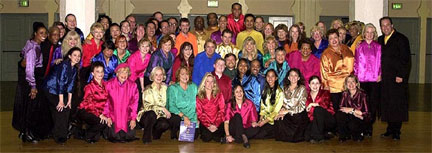 |
The Mass Choir of the First Presbyterian Church of Hollywood is truly and joyously an "alternative society." Directed by Patrick Hare, this group, with people from across the socio-economic spectrum, embraces a wide variety of ethnicities, ages, and physical abilities. |
Christians who are active in politics, whether on the left or right side of the political spectrum, may see themselves as the rightful heirs of the early Christian ekklesia. Indeed, their desire for God to make a difference in this world does reflect what we see in the New Testament understanding of church. But nowhere in Scripture do we get the idea that the role of the ekklesia is to directly influence (or replace) the civic ekklesia. Nowhere is it suggested that the Christian assembly should "speak truth to power." Rather, the power of the ekklesia to change society comes from the authenticity of its corporate life. In the New Testament, the ekklesia offers, neither a prophetic critique of the civic ekklesia, nor political advice to the members of the civic ekklesia, but rather a whole new way of living, one that reflects the kingdom of God rather than the empire of Caesar.
I come from a denomination that has often seen itself as a counselor to the federal government and other leaders. We pass motions and write position papers, recommending to our leaders what courses of action they should take on a variety of issues. There is a sad irony in all of this, because, on the one hand, I don't think many of our national leaders care one bit about what we recommend. On the other hand, our efforts to "speak truth to power" often end up dividing us and impoverishing our own fellowship. The very thing that should be making a difference in society – our life together as an alternative community – is hampered by our misdirected efforts to make a difference in society. How I wish we'd stop trying to recommend to our government how it should act and start, instead, trying harder to get our own act together.
What would this mean, in practice, for my denomination? It would care much less about our national meetings and pay much more attention to the regular and real gatherings of our ekklesiai. It would mean that our denominational bodies would put much more energy into nurturing healthy ekklesiai than we do today. It would mean that we would strive harder to be an alternative society through our ekklesiai, one that truly reflects the gospel of Jesus Christ, one that shines as a light into our dark world. It would mean that we would see our gatherings as essential, not only to our congregational life, but also to the health of our cities. It would mean that our congregations would embrace our identity as "missional churches," fellowships sent by God to proclaim and live out the reality of His kingdom. We'd be less committed to our own self-preservation and more committed to offering our neighbors the good news of Christ, both in word and in our shared life together.
Comments on What is a Church?
If you would like to comment on what I've written here, or to read other comments on this series, click here. (Note: You'll need to register to make comments. You can read anonymously.) |
When a Church is not a Church, Section G
Part 12 of series: What is a Church? Biblical Basics for Christian Community
Posted for Friday, October 20, 2006
Before I finish my discussion of the meaning of the word ekklesia – usually translated as "church" – in the New Testament, I need to say something about the use of ekklesia in Paul's letters to the Colossians and the Ephesians.
Curiously, neither of these letters are addressed to an ekklesia or to a group of ekklesiai as is the case in Paul's letters to Corinth (both letters), Galatia, and Thessalonica (both letters). Colossians is addressed to "the saints and faithful brothers and sisters in Christ in Colossae" (Col 1:2), while Ephesians was sent to "the saints who are in Ephesus and are faithful in Christ Jesus" (Eph 1:1). The greetings at the end of Colossians reflect the sort of tangible, actual-gathering quality of ekklesia that we have seen before in Paul. He greets "Nympha and the ekklesia in her house" as well as the "ekklesia of the Laodicieans" (4:15-16).
Yet earlier in Colossians we find a different nuance of ekklesia. Let me quote several verses from the first chapter of this letter:
15 [Christ] is the image of the invisible God, the firstborn of all creation; 16 for in him all things in heaven and on earth were created, things visible and invisible, whether thrones or dominions or rulers or powers—all things have been created through him and for him. 17 He himself is before all things, and in him all things hold together. 18 He is the head of the body, the church; he is the beginning, the firstborn from the dead, so that he might come to have first place in everything. 19 For in him all the fullness of God was pleased to dwell, 20 and through him God was pleased to reconcile to himself all things, whether on earth or in heaven, by making peace through the blood of his cross. (1:15-20; emphasis added)
A few verses later Paul underscores this new sense of ekklesia:
I am now rejoicing in my sufferings for your sake, and in my flesh I am completing what is lacking in Christ’s afflictions for the sake of his body, that is, the church. (1:24)
Ephesians takes this ball from Colossians and runs with it far upfield. In the first chapter, God raised and exalted Christ,
22 And he has put all things under his feet and has made him the head over all things for the church, 23 which is his body, the fullness of him who fills all in all. (1:22-23)
In Ephesians 3, God reveals His wisdom "to the rulers and authorities in the heavenly places" "through the church" (Eph 3:10). He concludes the chapter with a stirring benediction: |
|
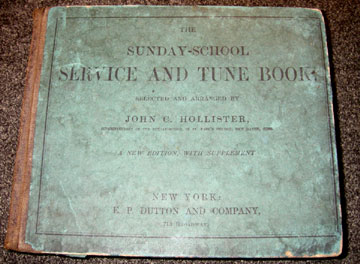 |
I'm a now and then collector of old hymnals. I was glancing through my collection recently to see if I could find any interesting hymns about the church. I did indeed find a curious selection in The Sunday-School Service and Tune Book. It's called "Beautiful Church," by Rev. E. L. Drown. I find his vision of the church – and here we're talking largely in terms of an actual gathering – quite fascinating.
"Beautiful Church" by Rev. E. L. Drown
Beautiful Church of Christ below,
Beautiful in this world of woe,
Beautiful Gate to Heaven above,
Beautiful House of God I love;
He, who was slain on Calvary,
Has built this beautiful Church for me.
Beautiful Round, our Festival year,
Beautiful all its scenes appear,
Beautiful Feast, when Christ was born,
Beautiful light the Easter morn;
With Christmas wreaths, and Easter Flowers,
Thank God, this beautiful Church is ours!
Beautiful Baptism, Christ its light,
Beautiful Infants, robed in white,
Beautiful Chants, we love to sing,
Beautiful Hymns to Christ our King;
The path that Saints and Martyrs trod,
The Church that leads us home to God.
Beautiful Church of Christ, our King,
Beautiful offerings let us bring,
Beautiful lives, the Church to adorn
Beautiful love, to Heaven's First-born;
With hearts of faith the Saviour see.
Come to this Beautiful Church with me.
From The Sunday-School Service and Tune Book, ed. John C. Hollister (New York: E. P. Dutton & Co., 1863) p. 155. |
|
20 Now to him who by the power at work within us is able to accomplish abundantly far more than all we can ask or imagine, 21 to him be glory in the church and in Christ Jesus to all generations, forever and ever. Amen. (3:20-21)
Then, in Ephesians 5, ekklesia shows up six times. Christ is "the head of the church, the body of which he is the Savior" (5:23). The church "is subject to Christ" (5:24). Christ "loved the church and gave himself up for her" (5:25). Christ seeks "to present the church to himself in splendor" (5:27). He nourishes and tenderly cares" for the church (5:29). Finally, like the unity between husband and wife, so it is with Christ and the church, something Paul refers to as "a great mystery" (5:32).
The meaning of ekklesia in Colossians and Ephesians has clearly moved far beyond the literal gathering of Christians in some location. Now the ekklesia is the body of which Christ is the head. It appears to be some cosmic reality that transcends ordinary space and time, and that encompasses far more than a single gathering of believers. Paul seems to be envisioning some sort of "gathering," now used metaphorically rather than literally, of all Christians on earth and in heaven. This ekklesia has permanence in time like an actual body. An ekklesia in its regular meaning may come and go, but a body remains intact over time.
The relationship of the church/body in Colossians and Ephesians and the local church is not spelled out clearly. Though Paul uses ekklesia in a new and greatly expanded sense, he can still refer, as I mentioned earlier, to the ekklesia in Nympha's house (or that meets at her house, Col 4:15) and to the ekklesia of the Laodiceans (4:16). His specific instruction that his letter be read "in the ekklesia of the Laodiceans" suggests that Paul can still use ekklesia in the sense of the tangible gathering. Yet, at the same time, the ekklesia is also a much larger and more permanent reality. It is something that can be spoken of as a body, with Christ as the head.
The use of ekklesia in Colossians and Ephesians offers a fitting segue to the next image I want to investigate in this series on the church, the image of the body. To this I will turn in my next post.
Comments on What is a Church?
If you would like to comment on what I've written here, or to read other comments on this series, click here. (Note: You'll need to register to make comments. You can read anonymously.) |
Click here for Section 2 of this series
Home |