| |
A Resource by Mark D. Roberts |
|
Churches, Elections, and the IRS
by Rev. Dr. Mark D. Roberts
Copyright © 2005, 2006 by Mark D. Roberts
Note: You may download this resource at no cost, for personal use or for use in a Christian ministry, as long as you are not publishing it for sale. All I ask is that you give credit where credit is due. For all other uses, please contact me at mark@markdroberts.com . Thank you.
A Disturbing Headline 
Part 1 of the series: Churches, Elections, and the IRS 
Posted for Tuesday, November 8, 2005
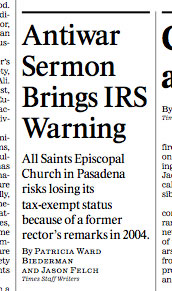
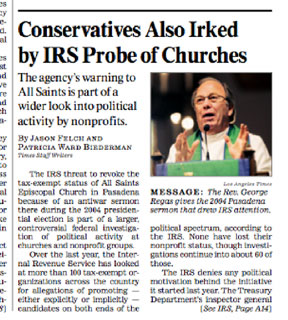
This morning a disturbing headline on the front page of the Los Angeles Times caught my eye: "Antiwar Sermon Brings IRS Warning." Oh no, I thought, another move by the government to squelch the freedom of the church. The subheading intrigued me further, "All Saints Episcopal Church in Pasadena risks losing its tax-exempt status because of a former rector's remarks in 2004." I'm quite familiar with All Saints in Pasadena, having several friends and family members who have attended there over the years. Plus, All Saints is well known in Southern California for its social action on the liberal/progressive side of the spectrum. It worried me to think that the church's opposition to the Iraq war would bring on some sort of IRS reprisals.
The article explained that the IRS's concern focused on a sermon preached by the Rev. George F. Regas, former rector (head pastor) of All Saints. According to The Times, on October 31, 2004, two days before the last presidential election, Regas preached a sermon in which he imagined a debate between John Kerry, George W. Bush, and Jesus. The content of this debate, according to the IRS, amounted to advocacy for Senator Kerry, which violated the tax-exempt status of the All Saints Church. According to the law, churches are not allowed to endorse or to oppose political candidates under any circumstances. |
|
|
As it turns out, the IRS's source was not by some right-wing group, but the Los Angeles Times itself, which, in an article on November 1, 2004, described Regas's sermon as "a searing indictment of the Bush administration's policies in Iraq."
The Times went on to explain that current rector of All Saints, J. Edwin Bacon, denied the IRS's charges: "We are so careful at our church never to endorse a candidate." He told his congregation last Sunday, "It's important for everyone to understand that the IRS concerns are not supported by the facts."
Rev. Regas, whose sermon has caused this crisis for his former parish, said in an interview that he was "surprised by the IRS action." He became suspicious that the IRS was "going after a progressive church person." According to The Times, Regas denied explicitly that he was trying to influence the congregation's vote in his October 31, 2004 sermon.
The Times reported that Regas said in his sermon that "good people of profound faith" could vote either for Bush or for Kerry. Moreover, the sermon was described as admonishing both Bush and Kerry. If this is accurate, then it makes the IRS appear badly mistaken in their action against All Saints. I'm no big fan of the IRS, let me tell you, but it seems odd that they'd pursue such a lost cause.
As I finished The Times article, something smelled fishy to me, but I wasn't sure where the odor was coming from. All Saints is very smart and experienced in political matters. I'd be shocked if they allowed one of their preachers, even the former rector, to be openly partisan two days before an election. And Rev. Regas himself has plenty of political and media savvy. It didn't make sense to me that he'd put his former church in such a difficult position by openly endorsing John Kerry. Yet it also made no sense that the IRS was chasing after wind so confidently. Something is rotten in the city of Pasadena.
In order to comment helpfully on this story, I sought out two kinds of information and found both of them online. First, I found some information on the tax code as it relates to churches and partisan activity. Second, I found a transcript of Rev. Regas's controversial sermon. This would allow me to analyze what he actually preached, not just what The Times reported or what he claimed to have preached.
What the Tax Code Actually Says (and Means)
The crucial portion of the Internal Revenue Code for the issue of churches and partisan politics is section 501(c)(3). Section 501 deals with exemption from tax on corporations; (c) provides a list of exempt organizations; (3) deals specifically with the issue of political campaigns. In 501(c)(3) a corporation is exempt from income tax if it "does not participate in, or intervene in (including the publishing or distributing of statements), any political campaign on behalf of (or in opposition to) any candidate for public office."
The origin of this bit of tax code is ironic. It was added by the motion of Senator Lyndon B. Johnson and a voice vote of the Senate in 1954. There were no congressional hearings to debate the merits of Johnson's amendment. He made it, apparently, because he was tweaked about the use of funds from a tax-exempt organization being used to support a political opponent. For Johnson it was sweet revenge; for churches and the IRS it was the beginning of a mess.
The IRS website provides an authoritative interpretation of what this means in practice for churches and other 501(c)(3) organizations:
Under the Internal Revenue Code, all section 501(c)(3) organizations are absolutely prohibited from directly or indirectly participating in, or intervening in, any political campaign on behalf of (or in opposition to) any candidate for elective public office. Contributions to political campaign funds or public statements of position (verbal or written) made on behalf of the organization in favor of or in opposition to any candidate for public office clearly violate the prohibition against political campaign activity. Violation of this prohibition may result in denial or revocation of tax-exempt status and the imposition of certain excise tax. (italics added)
So, the issue at hand with respect to All Saints Episcopal Church is this: Did the Rev. George Regas, in his sermon of October 31, 2004, directly or indirectly participate in, or intervene in, the political campaign for President of the United States? Regas and the church say he did not. The IRS says he did. Tomorrow I'll analyze the sermon to see who's right, or, as if often the case, if right falls somewhere in between the two extremes.
The Contested Sermon, Section 1
Part 2 of the series: Churches, Elections, and the IRS
Posted for Wednesday, November 9, 2005
Yesterday I began investigating a distressing face-off between the IRS and All Saints Episcopal Church in Pasadena, California. According the the IRS, a sermon preached in 2004 by the Rev. George Regas amounted to involvement in the presidential election. All Saints and Rev. Regas have denied this charge, arguing that the sermon was non-partisan, and it was simply a proclamation of "core moral values." If the IRS is correct, however, All Saints is in jeopardy of losing its tax-exempt status, since tax-exempt organizations are prohibited by law from "directly or indirectly participating in, or intervening in, any political campaign," according to the IRS website.
I will leave for later consideration of whether the tax code is morally correct. It may well be that the law is wrong and should be changed to allow churches to take part more directly in elections. But my concern at the moment is with whether the contested sermon by Rev. Regas did involve language that could reasonably be understood to endorse either John F. Kerry or George W Bush for President. The sermon is rather short, and you may want to read it (in a PDF format) before continuing with my analysis. Or you can download the sermon later to check and see if my analysis is accurate.
Examing the Sermon
The sermon begins: "If Jesus debated Senator Kerry and President Bush . . ." (p. 1). In fact Jesus doesn't debate either candidate in this sermon, since the candidates never speak. A more accurate title would be, "If Jesus scolded Senator Kerry and President Bush," because the sermon contains lots of reprimanding by Jesus and that's about it. Jesus never affirms either man.
The rest of the introduction to the sermon seems as if it would completely exonerate Rev. Regas from the IRS's charge. He says:
"Jesus does win! And I don't intend to tell you how to vote." (p. 1, emphasis added)
"Good people of profound faith will be for either George Bush or John Kerry for reasons deeply rooted in their faith. I want you to hear me on this." (p. 1)
Then Rev. Regas adds:
"Yet I want to say as clearly as I can how I see Jesus impacting your vote and mine."
There seems little doubt, therefore, that on October 31, 2004 Rev. Regas was intending to impact the way the congregation would vote two days later in the presidential election. The question remains, however, whether the sermon advanced the cause of one candidate more than the other, and with sufficient obviousness to constitute a violation of the tax code. |
|
| |
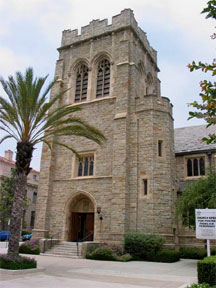
All Saints Episcopal Church contributes significantly to the life of Pasadena, California, both through its marvelous architecture and through its many programs. See, for example, the ministries of the Office for Creative Connections. |
On the most obvious rhetorical level, throughout the rest of the sermon Jesus scolds both Kerry and Bush. Rev. Regas includes the following lines:
. . . I believe Jesus would say to Bush and Kerry. (p. 1)
Jesus confronts both Senator Kerry and President Bush. . . . (p. 2)
"President Bush, Senator Kerry: will you save us from all this suffering" (p. 2)
If Jesus debated President Bush and Senator Kerry, he would say to them: "Why is so little mentioned about the poor?" (p. 3)
But Jesus enters the debate and says to President Bush and Senator Kerry: "Poverty is a central issue in this political campaign." (p. 4)
Jesus would say with absolute clarity to Senator Kerry and President Bush: "There is something decadent about a Nation that denies human solidarity, that's more interested in private wealth than public wealth." (p. 4)
Six times in his sermon Rev. Regas has Jesus speaking to both Bush and Kerry, in every case bringing a word of rebuke. Again, this appears to be balanced and non-partisan. But if we look a little more closely, the balance soon disappears. Consider this passage of the sermon, for example:
Yet I believe Jesus would say to Bush and Kerry: "War itself is the most extreme form of terrorism. President Bush, you have not made dramatically clear what have been the human consequences of the war in Iraq . . . . Oh, the cost of your war." (p. 1)
Although Jesus began by speaking to Bush and Kerry, he focused his criticism on Bush, calling the war "your [Bush's] war."
A few paragraphs later, however, Jesus "confronts both Senator Kerry and President Bush," saying: "I will tell you what I think of your war." Jesus seems to be include Kerry in the criticism. But a few sentences later Jesus adds, "Mr. President, your doctrine of preemptive war is a failed doctrine. . . ." Once more, a criticism that is apparently leveled at both candidates becomes focused only on President Bush.
According to Rev. Regas, after Jesus calls both Bush and Kerry to be peacemakers, he
turns to Presdient Bush again with deep sadness. "Is what I hear really true? Do you really mean that you want to end a decade-old ban on developing nuclear battlefield weapons . . . . Are you really going to resume nuclear testing? That is sheer insanity. . . . This is morally indefensible." (pp. 2-3).
Before summing up this section on war, Rev. Regas adds in his own voice,
The nuclear bomb is the most outright evil thing that human beings ever created. What does it say about the moral values of a nation that puts its security in nuclear weapons that are morally outrageous?
Then he concludes:
When you go to the polls on November 2nd – vote all yours values. Jesus places on your heart this question: Who is to be trusted as the world's chief peacemaker?
Now before I move on to the rest of the sermon, I want to pause for a moment and consider what we have seen. On a superficial level, Rev. Regas has Jesus rebuking both Bush and Kerry. Yet three times Jesus censures Bush alone, while never saying anything negative to Kerry in particular. Bush is primarily responsible for a war that exemplifies "the most extreme form of terrorism" (p. 1). His doctrine of preemptive war is "a failed doctrine" that has "led to disaster" (p. 2). And President Bush's policy with respect to nuclear weapons amounts to "sheer insanity" and is "morally indefensible." In fact, according to Rev. Regas, Bush is promoting "the most outright evil thing that human beings ever created."
So, after having Jesus blast away at President Bush, while Senator Kerry emerges virtually unscathed, Rev. Regas asks "Who is to be trusted as the world's chief peacemaker?" Even if Rev. Regas isn't all that excited about Senator Kerry, whom Jesus never commends, I don't think there's much doubt about the person Jesus would trust as the world's peacemaker. Even if Kerry isn't all that great, at least he hasn't promoted the most extreme form of terrorism, a failed doctrine that led to disaster, and the use of nuclear weapons that is morally indefensible insanity.
If you were listening to this sermon on October 31, 2004, would there be any question in your mind about whom the Rev. George Regas is telling you to vote for? I rather doubt it. It's hard for me to imagine how any objective person could deny that Rev. Regas is encouraging people to vote for Senator Kerry, or at least strongly discouraging them from voting for President Bush.
As the sermon continues, however, things get a little more complicated and, in my view, a little more interesting. I'll explain tomorrow.
The Contested Sermon, Section 2
Part 3 of the series: Churches, Elections, and the IRS
Posted for Thursday, November 10, 2005
Yesterday I began examining the sermon by the Rev. George Regas that has placed in jeopardy the tax-exempt status of All Saints Episcopal Church in Pasadena. Since the story broke on Monday in the Los Angeles Times, the Times has run two related pieces, a front-page article on how evangelicals are supporting All Saints, and an op-ed piece by George Regas defending his actions. I'll get to these articles soon, but first I want to finish my examination of the sermon by Regas. The crucial question is whether or not that sermon can reasonably be understood to have been an effort by Regas to influence the presidential election of 2004. The IRS says "yes"; Regas and All Saints say "no." But at least we have the sermon so we can draw our own conclusions.
In my last post I showed that in Part I of the sermon, Regas's "Jesus" is peeved with both Senator Kerry and President Bush. Yet Jesus is especially and openly critical of Bush, while he has nothing negative to say about Kerry alone. So, one-third into the sermon, it seems pretty clear that Rev. Regas, though he may not be especially excited about Kerry, is urging the All Saints congregation not to vote for Bush. I don't know how one could draw any other conclusion from Part I of the sermon.
In Part II, however, Jesus seems at first more balanced in his criticism of both candidates. The issue is poverty, and Jesus begins by saying to both Bush and Kerry, "Why is so little mentioned about the poor?" (p. 3). Yet, once again, Jesus criticizes Bush explicitly but not Kerry: |
|
| |
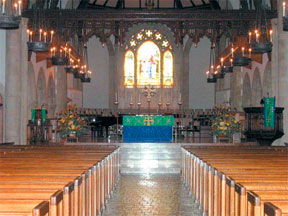
The reverent and peaceful sanctuary of All Saints Episcopal Church in Pasadena.
|
"And in the midst of [the poor getting a bad deal], President Bush asks and gets income tax reductions where 50% of the tax savings goes to the top 1% of the wealthiest Americans, those averaging $1,200,000 a year in income." (p. 3)
So the pattern we have seen earlier, with a general criticism of both candidates but then specific ire for Bush alone continues in Part II of the sermon.
After adding some choice words of criticism of the "Religious Right," who "have drowned out everyone else," and who, incidentally, were supporters of Bush in 2004, Jesus gets back on track by saying to both candidates,
"Poverty is a central issue in this political campaign. . . . This is not a partisan issue. But your [Bush's and Kerry's] failure and the failure of so many political leaders to help uplift those in poverty here and around the world – this will be judged a moral failure." (p. 4)
No doubt this statement, standing alone, is non-partisan.
At this point in the "debate" between Jesus, Bush, and Kerry, Rev. Regas interrupts things to speak in his own voice:
"Now as your preacher, I want to stay with the issue of poverty – but go to another level. I want to say a few words about abortion and reproductive choice." (p. 4)
He appears to think that abortion is a not good thing, though he never criticizes it explicitly. But Rev. Regas does have many negative things to say about those who would are on the "against abortion" side of things. (Regas does not speak of someone being "pro-life" but "against abortion.") Here are some of his statements:
Whether you are pro choice or against abortion, you do not have the right in this diverse, pluralistic society to force your beliefs and opinions on others. Nor does the President of the United States. There can never be a just law requiring uniformity of behavior on the abortion issue. (p. 4)
There is something vicious and violent about coercing a woman to carry to term an unwanted child. To force the unwanted on the unwilling, to use a woman's body against her will and choice, is morally repugnant. (p. 4)
Under George W. Bush the number of abortions increased substantially. [This is a result of the administration's economic policies.] Abortions increased because many more prospective mothers cannot afford the costs of hospital and of caring for a child. (p. 5)
So, according to Rev. Regas, President Bush's stand on abortion is "morally repugnant," and his policies have in fact contributed to the rise of abortions. Pretty stiff criticism. And, predictably, there is not a word of rebuke for John Kerry.
Now Jesus returns to the debate and says,
"Shame on all those conservative politicians in the nation's Congress and in State legislatures who have for years so proudly proclaimed their love for children when they were only fetuses – but ignored their needs after they were born." (p. 5)
"It is the cruelest irony how so many of these anti-abortion politicians have no interest in the things that make a newborn child healthy and beautiful. It violates every standard of decency to force a poor woman to have a child, and then deny her good prenatal care." (p. 5)
Then, speaking in his own voice, Rev. Regas continues:
All of this needs to be part of our thinking on November 2nd. Conservative politicians with the blessing of the Religious Right have strongly advocated the dismantling of social programs that provide a decent life for children once they enter this world. . . . .
No matter what rhetoric is used, any public policy that makes a child's life more miserable is an abomination before God. ¶ On November 2nd vote all your values. Bring a sensitive conscience to that ballot box.
So, Jesus has just blasted "conservative politicians." Regas has added that the policies of the Religious Right are "an abomination before God." Then he tells the congregation to vote their conscience. Honestly, I don't quite understand how Rev. Regas can see his sermon as non-partisan.
Part III of the sermon is a short conclusion, in which Rev. Regas, speaking in his own voice, encourages people to "hold on to hope that your life and witness count" (p. 6) To bolster his point, he includes a quotation from Senator Bobby Kennedy,
"Let no one be discouraged by the belief that there is nothing one man or one woman can do against the enormous array of the world's ills, against misery and ignorance, injustice and violence . . . . Few will have the greatness to bend history itself, but each of us can work to change a small portion of events, and in the total of all those acts will be written the history of our generation" (p. 6).
Other than quoting a Democratic icon, there is nothing in Part III that is partisan, or that even mentions Bush or Kerry. The sermon concludes with this exhortation:
When you go into the voting booth on Tuesday, take with you all that you know about Jesus, the peacemaker. Take all that Jesus means to you. Then vote your deepest values. Amen.
Out of context, this is clearly a non-partisan statement. But given what Regas and Jesus have said about peacemaking, and given Jesus's strongly worded condemnations of Bush, and the fact that Jesus says nothing negative about Kerry to balance several rebukes of the President, and that Regas has censured the Christian Right and those who are, like the President, anti-abortion, placing the preacher's words in context makes it pretty hard to see anything here other than strong encouragement to vote for Senator Kerry because that's what Jesus would want.
It would be more accurate to say that this sermon is aggressively anti-Bush than pro-Kerry. Regas and Jesus have nothing positive to say about Senator Kerry: no words of commendation or encouragement. But when the sermon repeatedly and strongly condemns President Bush for a variety of serious offenses, without saying one negative word about Senator Kerry in particular, it's hard to see this as a non-partisan effort.
Yet Rev. Regas has claimed, most recently in an op-ed column in the Los Angeles Times, that he did not violate the law in this sermon. In my next post I'll examine the case made by Rev. Regas.
The Won't-Be-Bullied Pulpit
Part 4 of the series: Churches, Elections, and the IRS
Posted for Friday, November 11, 2005
On Wednesday the Los Angeles Times published an op-ed piece by the Rev. Dr. George Regas called "The Won't-Be-Bullied Pulpit." The former rector of All Saints Church in Pasadena was responding to allegations by the IRS that a sermon he preached on October 31, 2004 may have violated the prohibition of church intervention in a political campaign.
Much of Rev. Regas's column deals with the larger issues of the role of church in society, especially as this impinges on issues of morality and politics. I resonate with much of what he writes, both as a Christian and especially as a preacher. So in my next post in this series I plan to deal with these larger and ultimately more important issues. But I should begin with the narrower question of whether or not the sermon preached by Rev. Regas on October 31, 2004 violated section 501(c)(3) of the Internal Revenue Code.
Rev. Regas strongly denies that his sermon violated the tax code. In this sermon, he writes,
I took great care to say that I did not want to tell people how to vote, but that I was challenging them to go into the voting booth on Tuesday taking with them all that they knew about Jesus, the peacemaker. To take all that Jesus meant to them and then vote their deepest values.
|
|
| |
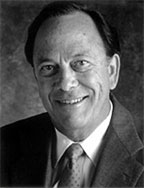
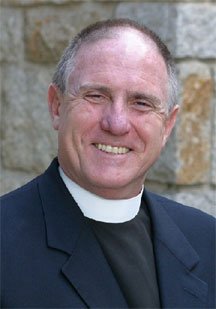
The Rev. Dr. George Regas
|
Then, later in the piece he observes:
My sermon did not cross the line that violates the tax laws governing churches. The IRS apparently is making a subjective determination that I implicitly opposed one candidate and endorsed the other. Its analysis ignores the fact that I explicitly stated that I was not advising anyone how to vote.
Before I respond to Rev. Regas's claims, I should say that I do not know him personally, even though our pastorates in Southern California have overlapped by twenty years. I do, however, know quite a bit about Rev. Regas's ministry and the All Saints Church that he pastured for 28 fruitful years. A couple of facts stand out in my mind. First, Rev. Regas and All Saints are openly liberal, both in theology and in politics. This is not secret. In fact, it's probably better to say they are proudly and passionately liberal. Second, Rev. Regas and All Saints are known for a high level of personal and ecclesiastical integrity. Although I am not liberal in my theology, so I have lots of differences of opinion with Rev. Regas about lots of things, I have every reason to believe he's a truthful and trustworthy person.
So, when he says that he was not intending to tell people how to vote in the presidential election, I take him at his word. The problem, I think, is that sometimes our intentions don't end up being clearly communicated when we speak. As a preacher, I know that sometimes my best efforts just aren't reflected in my words. Sometimes I have to go back and clarify or correct things I've said in the past. Even if you're not a preacher, you can probably relate to what I'm saying. If you're married, for example, you know what it's like not to intend to hurt your spouse with your words, but to end up hurting him or her anyway.
The issue at hand, from my point of view, isn't about Rev. Regas's integrity or his intentions, but rather whether what he actually said in his sermon could be reasonably understood to constitute an intervention in the 2004 presidential election.
If you've read my last two posts, in which I analyzed Rev. Regas's sermon quite carefully, you know what I think about this. Yes, he certainly did state clearly that he was not intending to tell people how to vote. And he did indeed urge people to vote according to their conscience and deepest values. Yet this isn't all he said. He also explained that he was preaching on "how I see Jesus impacting your vote and mine." (p. 1). Then he went on to show several ways in which Jesus was displeased with both Bush and Kerry.
Yet four times Rev. Regas, either in his own voice or speaking as if he were Jesus, strongly criticized President Bush (about the Iraq war, the doctrine of preemptive war, seeking tax reductions for the rich, and economic policies that have increased abortions). Additionally, Rev. Regas blasted the Religious Right (for its economic policies) and "conservative politicians" (for caring only about fetuses and having "no interest in the things that make a newborn child healthy and beautiful"). It's pretty obvious, considering the context, that in condemning the Religious Right and "conservative politicians," Rev. Regas was also taking a swipe at President Bush.
So I count six strident criticisms, either from "Jesus" or Rev. Regas, of President Bush and his political associates. Yet there isn't one explicit criticism of Senator Kerry, except when he's lumped in with President Bush. Thus the impression left is that both Bush and Kerry have some flaws in common, but that Bush is far less moral, far less wise, and unworthy to be President.
Moreover, as I illustrated in my last two posts, Rev. Regas doesn't mince words in his denunciation of President Bush. For example:
• Bush, by waging war on Iraq, has supported "the most extreme form of terrorism" (p. 1).
• Bush's doctrine of preemptive war "is a failed doctrine." (p. 2)
• Bush's view of nuclear weapons is "sheer insanity" and "morally indefensible." (p. 3)
• The conservative view of abortion, such as held by Bush, "is something vicious and violent" and "morally repugnant." (p. 4)
• Politicians who oppose abortion, which includes Bush, "violate every standard of decency." (p. 4)
• "Any public policy that makes a child's life more miserable," which is how Rev. Regas describes the conservative policy he associates with Bush, "is an abomination before God." (p. 5)
My point in laying out these quotations is that Rev. Regas didn't just imply that core moral values are not consistent with President Bush's policies. Nor did he gently suggest that President Bush has made many mistakes. The Los Angeles Times's description of Regas's sermon as a "searing indictment" of Bush seems accurate to me.
Thus I don't agree with Rev. Regas in his supposition that the IRS "is making a subjective determination that I implicitly opposed one candidate and endorsed the other." It is objectively demonstrable and, I think, rather obvious that Rev. Regas explicitly opposed one candidate. His denunciation of President Bush and his allies was so strong and one-sided that it did implicitly endorse Senator Kerry, even though Rev. Regas never said anything positive about Kerry and did say that he wasn't advising people how to vote.
Given what Rev. Regas appears to believe about many key issues – war, terrorism, nuclear weapons, poverty, and abortion – it makes perfect sense to me that he would oppose the candidacy of George W. Bush for President, and that he would connect this opposition to his understanding of Jesus. What I don't quite understand, honestly, is why Rev. Regas believes that he was not influencing the presidential election of 2004 with his sermon. And, given his experience in matters both ecclesiastical and political, I'm also perplexed over why he would have been so one-sided in his criticism of Bush and conservatives in a sermon, given his knowledge of the tax code and the policy of All Saints. Surely Rev. Regas knew that the Internal Revenue Code 501(c)(3) explicitly forbids intervening in "any political campaign on behalf of (or in opposition to) any candidate for public office" (emphasis added). And surely he must have known that his sermon, though not openly supportive of Kerry, was obviously in opposition to Bush.
It seems, however, that both Rev. Regas and All Saints do not see the sermon as I do. (I rather hate the fact that I may be siding with the IRS against a church in this case, to tell you the truth.) For this reason they're planning to fight the IRS action, at least so far. According to the first Times story, the IRS had offered to drop the case if All Saints offered "a confession of wrongdoing." The church declined the offer. So it seems like they're planning to argue that Rev. Regas's sermon was not a violation of the tax code, even to the extent of putting their tax exempt status on the line.
This seems to me to be a mistake, though of course there is much that I don't know about this case. But, given my limited knowledge, it seems to me that Rev. Regas could honestly say, "It was not my intention to influence the election, but I can see how my rhetoric gave this impression, and I am sorry." And it also seems to me that the All Saints officials could truly say, "We have a policy and a long tradition of not taking partisan stands in elections. We can see that Rev. Regas's sermon went over the line by criticizing President Bush repeatedly without offering any balanced critique of Senator Kerry. This was wrong and inconsistent with our policy." (The All Saints policy is available online in a PDF format.)
I admit there are problems with this approach, however. For one thing, Rev. Regas appears not to be sorry. And the leaders of All Saints appear not to believe that his sermon went over the line. I do hope that before they decide to die on this legal hill, the All Saints leaders take time to analyze Rev. Regas's sermon closely. Of course another problem with what I'm suggesting is that Rev. Regas would end up with egg on his face. I expect that even if he deserves this, his former church would be reticent to pursue this course of action. Nevertheless, I hope that some kind of compromise between the IRS and All Saints can be realized. It would be truly sad, in my opinion, if the church as a whole were to be punished for the indiscretions of a former pastor serving as a guest preacher.
Of course the other information that I lack is knowledge of how the courts have applied the Internal Revenue Code 501(c)(3) in cases like this one. It may well be that Rev. Regas's sermon falls within what the law allows as it has been interpreted by the courts. If so, then All Saints is probably pursuing a prudent course.
I have not yet commented on the larger issues raised by this particular case. These have to do with:
1) The role of the church in society, especially concerning morals and politics. Here I'm especially interested in how Rev. Regas talks about this role in his Times op-ed piece.
2) The rightness of IRC 501(c)(3). Many have argued that the law that is being used to harass Rev. Regas is flawed, or outright wrong. Many national leaders, both religious and political, believe that the 501(c)(3) limitations on churches should be removed, and that the status quo is both unconstitutional and immoral.
In future posts I'll take up these two fascinating issues.
What is the Role of the Church in Society? Section 1
Part 5 of the series: Churches, Elections, and the IRS
Posted for Monday, November 14, 2005
So far in this series I've been commenting on the situation involving All Saints Episcopal Church in Pasadena, California and the IRS. The former rector of All Saints, the Rev. George Regas, preached a sermon on October 31, 2004, two days before the last presidential election, that the IRS thinks may have violated the prohibition of churches influencing elections. Both Rev. Regas and All Saints disagree.
So far I've weighed in on the basic issues and examined the contested sermon in depth. In my last post in this series I responded to the Los Angeles Times op-ed piece by George Regas. I closed that conversation by promising to look at some of the wider issues raised by Rev. Regas, including the role of the church in society. In this post I want to comment on some of what Rev. Regas wrote about this crucial topic. I'll quote from his piece (in a sans serif font) and then add my own comments.
Rev. Regas writes:
During my 28 years as rector of All Saints Church, I often preached sermons that touched upon what some would characterize as "political" issues. So many of the political issues that we confront today coincide with deeply held, core religious beliefs: issues relating to marriage, family, community, and yes, even war and foreign policy.
As a preacher at Irvine Presbyterian Church for the last 14 years, I could say much the same thing as Rev. Regas. I have also preached on deeply held, core religious beliefs that spill over into political issues, including marriage, family, community, and war. I don't know that I've addressed U.S. foreign policy explicitly, though talking about the kingdom of God in the ministry of Jesus gets me into this general ball park.
I'm quite sure, though, that Rev. Regas feels much surer than I do about the explicit political implications of his theological convictions. This is obvious in his controversial sermon of October 31, 2004, where he has Jesus criticizing several aspects of President Bush's policies quite specifically. It takes a lot of guts to put such explicit politics on the lips of Jesus, and confidence in one's own theological judgment. Honestly, I find it much harder, given the complexity both of Scripture and of contemporary politics, to speak authoritatively as a pastor about the details of politics.
Of course the irony in Rev. Regas's statement is that it could equally have been said by folks on the religious and political right. This is part of what gives me pause, since wise Christians often come down in such different places when it comes to the political issues of our day. There's no question in my mind, for example, that Christians should be deeply committed to care for the poor and to helping to create a just world that minimizes poverty. Yet I'm not convinced that one can derive from Scripture what this means for political structures and actions. (I've written quite a bit about this in my series, The Church and Politics in America.) |
|
| |
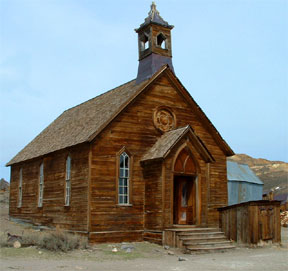
If the church ever stops talking about issues that have political implications, we'll end up like this church in Bodie, California . . . dead and empty.
|
Rev. Regas writes:
It seems to me that fundamentally moral issues, such as peace and the alleviation of poverty, are indisputably the province of church pulpits, regardless of which politicians are debating that week or where a Sunday happens to fall in an election cycle.
I strongly agree. But I also think one can preach strongly and truly about the issues of peace and poverty without necessarily running right up to (or over) the line that prohibits churches from influencing elections. If I want to keep my church as a tax exempt institution, then there are many, many things I can say about peace, for example, and some things I ought not to say in my pastoral role. And I do think that what a preacher ought to use careful judgment concerning what to preach two days before a contentious election.
When it comes to the issue of peace, I've written an extensive series on the broad dimensions of Christian peacemaking. It's called: Seeking the Peace of Christ: Christianity and Peacemaking.
Rev. Regas writes:
Some fear that the threats of the IRS and the publicity surrounding my sermon will have a chilling effect on other churches that would like to speak out for peace in this war-fractured world. Perhaps it will for a few. ¶ But I think many more will take courage from this story and find ways to be true to the core values of their faith. They will find creative ways to proclaim that religious communities must stop blessing war and violence. I am heartened by the outpouring of support that All Saints has already received from many in the faith community whose beliefs span a wide spectrum. They realize this matter involves 1st Amendment principles we all hold dear.
Rev. Regas is right that All Saints has received support "from many in the faith community whose beliefs span a wide spectrum." This was reported in the LA Times, and I plan to comment on it soon. The irony in this is that many of those churches and Christians who are supporting All Saints have endorsed the war in Iraq and support the President's policy there. And, even more ironically, they do so believing that they are promoting peace. So, some Christians will "find ways to be true to the core values of their faith" as they "find creative ways" to support the U.S. effort in Iraq.
Surely one of the greatest things about our country is the First Amendment and the freedom this gives to churches and individuals. Surely one of the most confusing things about Christianity is the fact that so many committed Christians can come up with such diverse political agendas.
I'm not through commenting on Rev. Regas's op-ed piece. Some of this most provocative statements come near the end, which I'll address tomorrow.
What is the Role of the Church in Society? Section 2
Part 6 of the series: Churches, Elections, and the IRS
Posted for Tuesday, November 15, 2005
Yesterday I began reflecting on the role of the church in society, especially in the complex realm of politics. My reflections were based on an op-ed piece by the Rev. George Regas, the preacher whose sermon riled up the IRS. In today's post I want to continue using Rev. Regas's thoughts as a jumping off point for some of my own ruminations. As I did yesterday, I will quote a portion of the op-ed column and then comment upon it.
Rev. Regas writes:
Some might argue that religious communities should stay out of politics altogether. But that would render our message of core moral values — the values that Jesus taught us — irrelevant. The fact is, all life is arguably political. For example, Jesus says to us: "Heal the sick." Thus, when we address the desperate health needs in the nation and across the planet, this is at once a moral and a political issue.
Again, I am in strong agreement with Rev. Regas, though the "all life is arguably political" line could allow a church or a preacher to defend actions or statements that might not have been especially wise. The crucial issue, I think, is not "Should churches be involved in politics?" but rather "How should churches, as churches, be involved in politics?" I would not suggest that there is one right answer to this question. In fact, I think there are dozens of possible right answers, depending especially on a church's core theology. But sometimes people confuse the role of the church as a church and the role of the church as a bunch of citizens who act individually in the world.
I think it's crucial for a church to distinguish how it should be involved in politics as a whole church body, versus how it should be involved through the individual efforts of its members. For example, we recently had a special election in my area for an open congressional seat. It was vacated when Christopher Cox became the chair of the Securities and Exchange Commission. In this election two candidates from my church were on the ballot, one as a Republican, one as a Democrat. I strongly applaud and endorse both of their efforts to make a difference in government. I speak from the pulpit of the importance of being active as citizens of our country. But I do not believe it would be appropriate for our church, as a church, to endorse either candidate. I'm not evening thinking here about the tax code issues.
I concur with Rev. Regas that Jesus's statement "Heal the sick" ends up forcing us to confront political issues. I'm not so sure, though, that one can necessarily derive a particular health care policy from "Heal the sick" without importing a whole bunch of other political and practical opinions, none of which were plainly taught by Jesus. |
|
| |
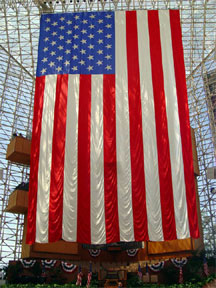
A patriotic celebration in the Crystal Cathedral, where Robert Schuller is the senior pastor. This is one way for a church to express it's political sentiments. |
Moreover, I'm concerned about the tendency of some Christians to take statements like "Heal the sick" and wrench them out of their biblical context in order to use them as a mantra for their political agendas, right, left, or middling. The larger context for "Heal the sick" in Matthew 10:5 is Jesus's sending out of His disciples to their fellow Jews. He says, "As you go, preach this message: 'The kingdom of heaven is near.' Heal the sick, raise the dead, cleanse those who have leprosy, drive out demons. Freely you have received, freely give." (Matt 10:7-8, NIV). Before we jump to the implications of "Heal the sick" for health care, we had better consider the connections of this imperative to the kingdom of heaven.
Also, we'd better ask ourselves whether we're faithfully living out the command of Jesus before we start telling the government what it should be doing. In particular, we must ask ourselves if somewhere along the way we lost the supernatural dimensions of life under God's kingdom. Sometimes, I think, Christians on all sides of the political spectrum try to get the government to do through law what the church should be doing through the power of the Holy Spirit. Of course the two aren't mutually exclusive. But I often wish the church would focus more on its primary ministry of the kingdom of God and less on trying to advise the kingdoms of this world, as if they actually cared what we think. My own denomination, the Presbyterian Church U.S.A., has often gotten itself in a mess of trouble when we try to play adviser to governments. This trouble has distracted us from our primary calling to proclaim and embody the kingdom of God.
Rev. Regas concludes his op-ed piece with this paragraph:
The rightful role of communities of faith is not to speak and act as though God is in the pocket of the Democratic or Republican parties. Our role is to boldly proclaim the biblical themes of justice for all, peace on Earth, the sacredness of all life and the preciousness and fragility of the environment.
This, I think, is a marvelous statement. I also find it both ironic and suggestive of something quite wonderful.
The ironic part is that this statement by Rev. Regas, who clearly aligns himself on the liberal side of things, both theologically and politically, is very similar to the sentiments of a recent evangelical statement on political involvement. For the Health of the Nation: An Evangelical Call to Civic Responsibility, was published in the last year by the National Association of Evangelicals. (For a PDF of this statement, click here. For my extensive review, see my series: Evangelical Christians and Social Activism.) This statement contains sentences such as:
The Bible makes it clear that God cares a great deal about the well-being of marriage, the family, the sanctity of human life, justice for the poor, care for creation, peace, freedom, and racial justice.
We call all Christians to a renewed political engagement that aims to protect the vulnerable and poor, to guard the sanctity of human life, to further racial reconciliation and justice, to renew the family, to care for creation, and to promote justice, freedom, and peace for all.
It is ironic that Rev. Regas sounds as if he's picked up his talking points directly from the NAE statement, even though this is highly unlikely, given his theological convictions.
Why do I think the overlapping concerns of Rev. Regas and the National Association of Evangelicals are "suggestive of something quite wonderful"? Because I continue to have this idealistic hope that somehow the church could be a place where people of widely differing political viewpoints might come together in mutual respect and learn from one another. All too often Christian leaders on the right or the left take the easy road of slinging barbs at the other side from the safety of their pulpits. Insulated by their politically uniform communities of faith, they never really have to talk with fellow Christians who see the political world a whole lot differently. This lack of substantive political discourse within the larger, politically-diverse church impoverishes both the church and the world in which we are to be salt and light.
For example, it would be fascinating and instructive if Rev. Regas, who affirms the sacredness of all life and yet is openly pro-choice and quite critical of those he calls "anti-abortion," would sit down with some of those who drafted the ESA statement, which also affirms the sacredness of life and is openly pro-life. Perhaps these conversations have already happened and my hopes are really just old news. But I think we Christians have much to learn, not only from others in this world who do not share our faith, but especially from other believers who share our faith but work out the implications of faith quite differently from ourselves. This is surely true when it comes to the relationship between the church and politics.
On Preachers and Politics, Section 1
Part 7 of the series: Churches, Elections, and the IRS
Posted for Wednesday, November 16, 2005
I have heard a fair amount of political preaching in my day, by preachers who span the theological and political spectrum. Most of my exposure to the liberal side came during my days at Harvard and in some Presbyterian church gatherings. I've listened to politically conservative preaching largely on Christian television. Of course, like most Americans, I've also heard more than enough from the reverend talking heads, folks like the Rev. Al Sharpton, the Rev. Jesse Jackson, the Rev. Jerry Falwell, and the Rev. Pat Robertson.
So here's my gut reaction to preachers getting involved as preachers in partisan politics: I don't like it. More often than not, I find myself embarrassed when my fellow preachers try to wax political, especially when they get embroiled in partisan issues. There are many reasons for my shame. Let me cite a few.
Though many preachers have genuine expertise in matters of religion, few really know what they're talking about when it comes to the complex world of politics. There are exceptions to this rule, of course, like the Rev. John Danforth, former U.S. Senator from Missouri and Episcopal priest. But, for the most part, when preachers talk about political issues, I feel like I'm watching a re-run of the Amateur Hour. (Note: I'm not suggesting, by the way, that I could do any better. But at least I know the limits of my wisdom, and therefore I try not to speak authoritatively as a preacher outside of these limits.)
Preachers are used to speaking authoritatively in public settings. We do so because we're passing on the inspired truth of God as it's found in Scripture. Yet preachers sometimes carry over the same kind of confidence and clarity into political discourse, where authoritative lecturing sounds bombastic, and apparent clarity sounds simplistic. Or, worse yet, preachers can sound just like one more partisan sound-bite spinner. Talk about a way to lose your trust as a preacher! Yikes! |
|
| |
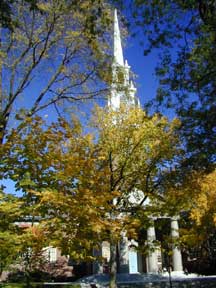
As you could well expect, there's quite a bit of liberal preaching that goes on in Harvard's Memorial Church, especially at chapel and when guest preachers fill the pulpit.
|
Furthermore, preachers who delve into partisan politics often fail to recognize that they are no longer articulating what can be plainly known from Scripture, but rather that which depends on a host of other political and economic ideas. Let me provide an example I've used before. I can with great confidence call my congregation to care for and seek justice for the poor because Scripture, both Old and New Testaments, is abundantly clear about such things. I stand on solid ground when I preach that God cares for the poor and that we much be committed to working for a world in which there is less poverty, both in our country and throughout the world. I can applaud efforts our church makes to alleviate poverty in places like northern Mexico and Swaziland.
But if I were to begin to advocate specific economic and political solutions to the problem of poverty – more government aid, free trade agreements, redistribution of American wealth to other countries, the expansion of capitalism in the third world, or whatever – then I would have imported a whole bunch of economic and political theories into my equation. Thus I would have greatly muddied the water, while losing the moral clarity and authority that comes from the trustworthy and obvious exposition of Scripture.
It also seems to me that when preachers address partisan issues, they often do so in partisan language that dilutes their moral influence and alienates people who don't share their particular agenda. Take, for example, the sermon by the Rev. George Regas that has him in hot water with the IRS. In this sermon Rev. Regas says that "good people of profound faith will be for either George Bush or John Kerry for reasons deeply rooted in their faith." This is a fine, non-partisan start. Yet later in the sermon his language sounds like it was crafted by Democratic speech writers. For example:
The poor are getting poorer, the health care crisis is getting worse, the income of the typical household is stagnating, the average weekly wages have fallen, and the safety net for the unemployed and the casualties of the American system has been shredded. And in the midst of all that, President Bush asks and gets income tax reductions where 50% of the tax savings goes to the top 1% of the wealthiest Americans, those averaging $1,200,000 a year in income.
I’m not pro abortion but pro choice. There is something vicious and violent about coercing a woman to carry to term an unwanted child. To force the unwanted on the unwilling, to use a woman’s body against her will and choice, is morally repugnant.
Yes, yes Jesus admonishes us. “It is the cruelest irony how so many of these antiabortion politicians have no interest in the things that make a newborn child healthy and beautiful. It violates every standard of decency to force a poor woman to have a child, and then deny her good prenatal care.”
I don't even want to deal with the question of whether these statements are true or fair. My point is simply that if a preacher uses this sort of language, people will tend to hear the sermon as if they're listening to Al Franken or Rush Limbaugh, rather than a thoughtful expositor of God's Word. The church's prophetic voice will be lost in the rhetoric of partisan spin.
If I seem to be picking on Rev. Regas, it's only because I have his sermon right in front of me. I'm sure many preachers on the right side of the political spectrum sound just as typically Republican as Rev. Regas sounds typically Democrat.
Speaking of the religious/political right, I want to share a very strange and curiously relevant story with you, but it will have to wait until tomorrow.
On Preachers and Politics, Section 2
Part 8 of the series: Churches, Elections, and the IRS
Posted for Thursday, November 17, 2005
Yesterday I confessed that I'm mostly uncomfortable when preachers start pontificating about politics, especially when it comes to complex and/or partisan issues. Today I'll begin with another confession. It concerns the Rev. Jerry Falwell.
I've never been terribly fond of Rev. Falwell. When I was at Harvard, one of my liberal professors knew the man and said that he was pleasant in person. But I never had the opportunity to meet Rev. Falwell. All I knew of him was what I read in the news and saw on TV. And this I didn't like.
When Jerry Falwell founded the Moral Majority in 1979, and when he was the leading spokesman for the religious right, I was about as liberal as they come politically. During those days I couldn't stand Jerry Falwell, either his ideas or his attidudes, and it really bugged me that he was my brother in Christ because I felt guilty disliking him so much. (In fact, Christians are also not to hate non-Christians, but let's not get confused with the biblical facts here.) |
|
| |
The Rev. Falwell in action.
|
Years later, when my political views became more centrist (and often both more complex and more confused), I wasn't quite so horrified by Rev. Falwell's ideas, but I found his pompous pundit persona to be offensive. He always seemed to have a tone that suggested those who disagreed with him were complete idiots.
Plus, Jerry Falwell often said things that seemed foolish to me. No doubt you'll recall his infamous gaffe on The 700 Club following 9/11, when he said that God had allowed this tragedy as a punishment for America. Then he proceeded to name those who were morally responsible for 9/11, including: the ACLU, the federal courts, the abortionists, the pagans, the feminists, the gays, the lesbians, and the People for the American way. Curiously enough, Osama bin Laden escaped Rev. Falwell's tirade unscathed. After mentioning all of bad folk who turned God against the U.S., Rev. Falwell said: "I point the thing in their face and say 'You helped this happen.'" Later Jerry Falwell apologized, but, nevertheless, what he had said didn't exactly endear him to me or make me glad that he was such a prominent spokesman for the church in America. I saw a lot of stupid things too, but I try to keep them to myself.
Given all of this, I don't get warm fuzzies when I see the Rev. Falwell on Meet the Press, or even when I happen to catch a moment of The Old Time Gospel Hour, his popular religious broadcast.
With this confession in mind, let me tell you what happened last Sunday evening. I was doing some late night channel surfing when I happened upon the broad face of Jerry Falwell. He was preaching, so I thought I'd linger for a moment to see if he was saying anything foolish. (Yes, I know this isn't a very Christian way to think, but sometimes I don't think very Christianly.) What I heard, however, was startlingly wise. Rev. Falwell was talking about things he had learned as "a fourth quarter saint," which I took to mean an experienced, older Christian. There was lots of wisdom here. In fact, some of what Rev. Falwell said about a pastor giving priority to his family actually struck my heart.
So I kept listening to the sermon. As it turns out, it was a message he had delivered at the "SuperConference 2005" sponsored by the Thomas Road Baptist Church. (If you're interested in this message, you can download it from the SuperConference website. It's the Tuesday AM message by Dr. Falwell.) Rev. Falwell was addressing several thousand people, most of whom seemed to be young adults.
I didn't agree with everything in this sermon. But if found myself agreeing with more than I would have imagined, and actually feeling personally challenged and encouraged. Given my negative attitude toward Jerry Falwell, you can imagine that this was an unsettling and humbling experience.
When the sermon was over, I realized that I needed to repent of some of what I had thought and felt about Rev. Falwell. Though I don't agree with many things he's said in his public ministry, I have to admit that he's also said and done many very good things as a pastor. (One of those was to challenge me to spend more time with my wife and children.)
But when the sermon was over, I also felt sad, sad that a preacher with a good chunk of biblical wisdom and a genuinely caring heart had said so many things in his public ministry that were unkind and, frankly, unwise. Now I think Jerry Falwell was right to bring his religious convictions into the socio-political realm. We need Christians of all theological persuasions to extend the kingdom of God into all facets of our world. But I also think Rev. Falwell, as a preacher, overstepped some appropriate bounds, thereby weakening his impact and undermining his message. Honestly, I'm not sure I can define precisely where these appropriate bounds lie, and I'm not especially comfortable letting the IRS do it for us, but I think this issue deserves serious attention from any preacher before holding forth in the public arena.
I am not saying that preachers shouldn't deal with political topics. I don't think we can truly preach God's Word without getting into matters political. But I do think preachers need to think very carefully about what and how we speak when it is explicitly political and partisan. I think we need to discern what we should say as preachers and what we should say as private citizens. I also think we need to distinguish carefully between what we can say on the authority of God's Word, and what we can't say without lots of input from our personal political philosophy. It's too easy for us to jump from A (God opposes poverty) to Z (the Congress should vote for this particular legislation) without realizing that many of the letters from B to Y aren't taught in Scripture so much as in poli-sci and economics classes.
Finally, we preachers are a talkative lot. Mostly this is good. But I think we need, sometimes, just to shut up. So I'll take my own advice and stop right now.
Interim Conclusions on Preachers and Politics: Section 1
Part 9 of the series: Churches, Elections, and the IRS
Posted for Friday, November 18, 2005
One of the fascinating things about blogging is receiving varied responses from my readers. I'm getting around 2,500 visitors each day to my website. And, given the e-mail I get from them, I know I've got a pretty diverse audience, including both liberals and conservatives, people of faith and secularists, hardcore Catholics and hardcore Protestants, and even a few Jews and Muslims. Thus folks tend to respond quite differently to my blogging.
This recent series has been no exception. I've been scolded by some readers for failing to see that the Rev. George Regas was simply telling the truth in his sermon, not saying anything especially partisan. And I've been chided by others for being too charitable to him. One of my regular, long-time readers told me a recent post was his all-time favorite. And another faithful reader observed that I seem to be lost in this series, and that I'm struggling.
It is true that this series is more on the rough, cutting edge of my thought, rather than the smooth, solid center. When I write about the New Testament, for example, I'm dealing with subjects that I've studied for 30 years, in which I earned a Ph.D., and which I've taught in seminary classes. But when it comes to the issues of church and society or preachers and politics, my thinking is less well-formed. To some this may seem like I'm lost. To others it may appear refreshingly candid. The truth is, whether you like it or not, this series is a work in progress.
Since the common thread of my last several posts has been the issue of preaching and politics, I want to try at this point and draw some interim conclusions. I reserve the right to change my mind about these down the road. For that matter, I reserve the right to be flat out wrong. But here's what I currently believe about preaching and politics.
1. The issues associated with preaching and politics are not nearly so clear as some preachers, on both the right and the left, think they are.
Ironically, many of the preachers on the far right would agree with many preachers on the far left concerning political preaching, though they would differ dramatically over what ought to be preached.
2. I'm concerned at the moment with what preachers say in their official roles, not what they do or say as private citizens.
Preachers, as private citizens, have all the freedoms given to other citizens. We may, of course, freely choose not to exercise all of our freedoms because doing so might hamper our pastoral effectiveness. There have been a few times, for example, when I wanted to write a letter to the local paper concerning a political issue in my city. But I did not write the letter because I realized that, by doing so, I'd potentially alienate folks in my congregation who needed to see me as their trustworthy pastor, not their political opponent.
3. Too many preachers, it seems to me, cavalierly wax political without having thought through what's appropriate for a preacher to say as a preacher and what's not.
I'm making an assumption here. Perhaps they've thought all of this through carefully. But I rather doubt that's true for most preachers, especially those who are relatively new to political involvement. It wouldn’t surprise me, however, if the Rev. George Regas, who got me into this whole conversation, has done lots of thinking about what he should preach and not preach, because he's been politically involved as a pastor for more than three decades. Ironically, the same might be true of the Rev. Jerry Falwell. (I'd pay good money to see these two preachers have a conversation – not a debate, but a conversation – about preaching and politics.)
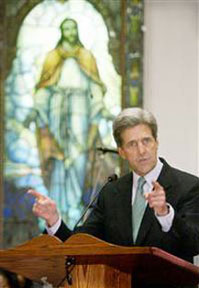 |
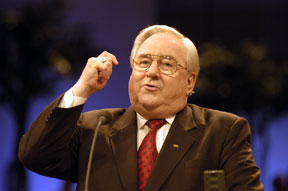
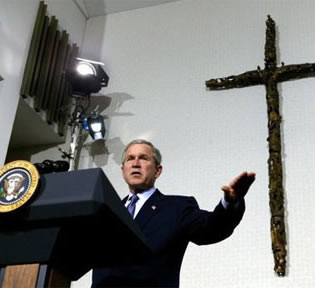
I wonder if these two preachers have figured out how the pulpit and politics go together. Of course I have a sneaking suspicion that they're not really preachers, but politicians in disguise! |
|
4. Determination of what's appropriate in preaching depends on many factors, including: one's ecclesiology (theology of church); one's theology of preaching; one's theology church and society.
The fact that these issues are complex helps to explain why "preachers and politics" questions cannot be easily answered.
5. Basically, preaching is proclaiming God's truth as it's revealed in Scripture, and making meaningful connections between that truth and contemporary living.
Of course you see my Protestant, Reformed, evangelical bias here. Those with a higher view of tradition would see preaching somewhat differently. (Though I must add that the sermons of Pope John Paul II and Pope Benedict XVI have impressed me because they are solidly based on Scripture.) Those who have a lower view of the authority of Scripture than I do would obviously feel greater freedom to depart from biblical teaching and "go with the Spirit." Yet I think almost all preachers would agree that preaching involves proclaiming God's truth, however we get it, and making connections to real life today.
I've got a few more interim conclusions on preaching and politics. So I'll keep going on this subject in my next post in this series.
Interim Conclusions on Preachers and Politics: Section 2
Part 10 of the series: Churches, Elections, and the IRS
Posted for Sunday, November 20, 2005
In my last post in this series I began trying to draw together my thoughts about preachers and politics. Though claiming the freedom to change my mind, I suggested five interim conclusions. Here they are (without the commentary in my last post):
1. This issues associated with preaching and politics are not nearly so clear as some preachers, on both the right and the left, think they are.
2. I'm concerned at the moment with what preachers say in their official roles, not what they do or say as private citizens.
3. Too many preachers, it seems to me, cavalierly wax political without having thought through what's appropriate for a preacher to say as a preacher and what's not.
4. Determination of what's appropriate in preaching depends on many factors, including: one's ecclesiology (theology of church); one's theology of preaching; one's theology church and society.
5. Basically, preaching is proclaiming God's truth as it's revealed in Scripture, and making meaningful connections between that truth and contemporary living.
In today's post I want to offer three additional conclusions, with more to follow tomorrow.
6. God's truth, as revealed in Scripture, touches upon matters we would call "political." Therefore, biblically-based preachers will inevitably address political matters in preaching.
Examples of biblical themes with political implications would include: the kingdom of God (the central message of Jesus); the Lordship of Christ; the pervasiveness of human sin; the reality of principalities and powers; God's care for the poor; God's call to do justice; the nature of government according to Romans 13; the nature of government in the Book of Revelation; the call to pray for rulers; the notion of shalom, Jesus's call to peacemaking; the vision of a world without violence; Jesus's command to love your enemies; the call to "honor the emperor;" God's creation of man as male and female; Jesus's instruction to "render unto Caesar that which is Caesar's"; etc. etc. Though preaching on one of these themes doesn't require commentary on the hottest issue in Washington, it will touch upon how we live our lives in the public arena, including government.
7. The closer preachers remain to the clear and immediate meaning of biblical truth, the more authoritatively they can preach and with a greater likelihood of faithfully conveying God's truth.
| Jesus said, "Love your enemies and pray for those who persecute you" (Matthew 5:44). In order to understand what it means for us to love our enemies, we need to begin with Jesus's own setting: the Roman occupation of Palestine during the first century A.D. Then we need to begin to work on what it might mean for us to love our enemies. One can take this in many different directions politically. For example, one could argue that love for enemies means that the United States should not seek to kill Osama bin Laden, since it would never be loving to kill one's enemy. This is an implication of Jesus's teaching that deserves careful scrutiny, especially in balance with other biblical principles (the role of government and "the sword," the meaning of divine justice, love for neighbors who might be killed by Osama bin Laden's people, etc. etc.). A preacher can say with full authority, "We need to love our enemies." The personal implication, "If you have enemies, you need to love them" can also be confidently preached. But relating "Love your enemies" to the United States and Osama bin Laden involves leaving the realm of biblical clarity and certainty. Jesus wasn't addressing a situation that's anything like one in which a terrorist has threatened to kill thousands of innocent people, and has proven his intentions by doing it in the past. |
|
| |
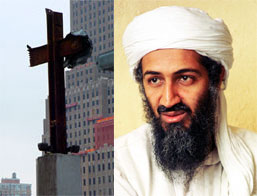
It isn't easy to know what how to think about these images when they are juxtaposed. Easy answers won't work.
|
Now it's certainly right for preachers to reach beyond biblical clarity, upon occasion, but they need to know when they're doing it and, in my opinion, make sure their congregations know it too. For me, this means there are times when I'll say something like, "This is what the Bible says for sure. Now I'm going to work on some implications. I think what I'm going to tell you is correct, but you'll need to weigh it in light of Scripture. This is 'Mark's best bet' not 'God's certain Word.'"
8. Preachers need to be especially aware of when they are pressing biblical truth through the grid of extra-biblical theories, so that they don't confuse God's truth with their own interpretations.
Consider a non-political illustration. Jesus said, "You shall love your neighbor as yourself" (Matthew 19:19). Now I've heard plenty of Christian teaching on this verse that runs it through the grid of modern psychotherapy. The conclusions sound like this, "If you're going to be able to love others, first you have to love yourself. You need good self-esteem, and this can be found through Christ, who helps you to feel good about yourself because He loves you and died for you." I don't mean to suggest that these conclusions are wrong (or right). But they are clearly interpretations based upon something other than the plain teaching of Jesus. After all, He said, "Love your neighbor as yourself," not "Until you love yourself, you can't love your neighbor." Even if I have a lousy self-image, I'm still called to actively love my neighbor by doing what's best for him or her. I can't excuse my lack of love for others on the basis of my lack of love for myself, and then claim Jesus as my alibi. This ends up turning the plain teaching of Jesus on its head.
Similarly, when preachers apply the biblical priority of peace to today's world, they should be aware of what else they're assuming besides what Scripture teaches. One preacher might say, "God wants peace. Therefore the U.S. should immediately end the war in Iraq, and seek non-military solutions to the problems of the Middle East." Another preacher might say, "God wants peace. Therefore the U.S. should win the war and the 'peace' in Iraq so that country can experience peace and promote it in the Middle East." Neither preacher gets the implications of divine peace from Scripture alone. Both are basing their conclusions on a host of other beliefs. It's not wrong to do this, of course. But, in my opinion, it is wrong to do this without acknowledging it and without making it clear to one's congregation what's going on.
In tomorrow's post I'll finish up this part of my series by offering a few more interim conclusions. Then, on Tuesday, I'll reflect upon the issue of whether churches and preachers should be free from the limitations of the tax code, and should be permitted to say or do whatever their convictions require without be threatened with the loss of tax-exempt status.
Interim Conclusions on Preachers and Politics: Section 3
Part 11 of the series: Churches, Elections, and the IRS
Posted for Monday, November 21, 2005
In my last two posts I've been putting up some interim conclusions on preaching and politics. In case you missed these posts, I'll review what I've concluded so far. If you want to commentary, you can scroll to get it.
1. This issues associated with preaching and politics are not nearly so clear as some preachers, on both the right and the left, think they are.
2. I'm concerned at the moment with what preachers say in their official roles, not what they do or say as private citizens.
3. Too many preachers, it seems to me, cavalierly wax political without having thought through what's appropriate for a preacher to say as a preacher and what's not.
4. Determination of what's appropriate in preaching depends on many factors, including: one's ecclesiology (theology of church); one's theology of preaching; one's theology church and society.
5. Basically, preaching is proclaiming God's truth as it's revealed in Scripture, and making meaningful connections between that truth and contemporary living.
6. God's truth, as revealed in Scripture, touches upon matters we would call "political." Therefore, biblically-based preachers will inevitably address political matters in preaching.
7. The closer preachers remain to the clear and immediate meaning of biblical truth, the more authoritatively they can preach and with a greater likelihood of faithfully conveying God's truth.
8. Preachers need to be especially aware of when they are pressing biblical truth through the grid of extra-biblical theories, so that they don't confuse God's truth with their own interpretations.
Here are the rest of my interim conclusions, at least for now.
9. As a preacher, I should be especially cautious when I'm planning to preach on a political issue, and when I'm going to attribute to God my own political views.
Let's face it. All preachers are human. We all have subjective tendencies. We all tend to project our values and beliefs onto Scripture. So, knowing this, and desiring to preach, not my own bias, but God's truth, I must be especially careful when my sermon and my politics are too neatly aligned. It's always possible, of course, that what I believe is fully in concord with God's will. But it's also possible, indeed, I would argue quite likely, that I have let my own bias influence my sense of God's will.
10. As a preacher who sometimes wades into the murky waters of politics, I need to be in regular conversation with fellow Christians who don't share my political views.
It's way too easy for preachers, just like the rest of us, to surround ourselves with people who see everything just the way we do. This can lead to narrow-mindedness and to demonizing those who don't share my politics. But if I can sit down with wise Christians who see things differently and have an open, respectful conversation, then I'll have the opportunity to hone my own views, and it will be hard for me to stereotype those who disagree with me. Who knows? I might even be persuaded that what I once believed to be true is wrong!
11. When it comes to preaching and politics – or any sort of preaching, for that matter – humility is a good thing.
| I didn't make this up. It's all over Scripture. We're to live as Christians "with all humility and gentleness" (Ephesians 4:2). We're to "do nothing from selfish ambition or conceit, but in humility [we should] regard others as better than [ourselves]" (Philippians 2:3). How can we preachers be humble? It begins with humbling ourselves before God. It continues as we realize the huge responsibility we have to convey God's truth accurately. It grows as we realize our own limitations, not to mention our sinfulness. Humility increases over the years as we acknowledge our mistakes, recognizing when we've missed God's truth or miscommunicated it. Humility in preaching about matters political expands further when we recognize the complexities of our world and our own inability to master these complexities. |
|
| |
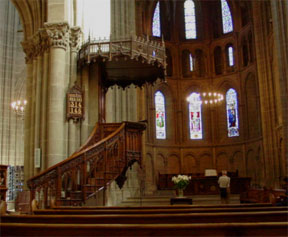
This is the pulpit in the Cathédrale St-Pierre in Geneva, Switzerland, from which John Calvin preached. The raised pulpit reminds both the preacher and the congregation of the heavy responsibility born by every preacher who dares to speak as if for God. |
12. Preachers should generally avoid partisan spin and sound-bites.
I've already talked about this in this series. When the Rev. Regas refers to himself as pro-choice and his opponents as anti-abortion, he's gone too far in the direction of partisanship, in my opinion. So have the conservative preachers who insist on referring to the other side as "pro-abortion." Now I'm fully aware of the importance of rhetoric for politics, and I see why each side wants to win the language game. But I think preachers, when they preach, or when they speak in the public forum representing their churches, and not simply as private citizens, should try to avoid obviously partisan language. When I talk as a pastor about abortion, for example, (as I did just a couple of days ago in my Thursday Bible study), I'm always careful to use the language preferred by each side, namely "pro-choice" and "pro-life."
13. Preachers should keep in mind that their fundamental calling is to proclaim the gospel of Jesus Christ – the good news of God's kingdom – and the implications of this gospel.
There's no doubt in my mind that the gospel of the kingdom impacts our world in all sorts of ways, including those we would call label "political." But sometimes preachers on all sides of the political and theological spectrum spend a whole lot of time on subjects that have little to do with the gospel, thus distracting people from their central message and purpose.
Perhaps my greatest disappointment as a Christian preacher in Rev. Regas's controversial sermon did not have to do with his political comments, but with his conclusion. His final section was meant to encourage people to remain hopeful. This was fine. But, according to Rev. Regas, their basis for hope was supposed to be: a quotation from Bobby Kennedy to the effect that each person can make a difference; awareness that hopelessness will kill any movement for change; and the memory of former dreams for a better world. All of this is fine. But what I missed was any distinctive Christian hope, hope that is based in Jesus Christ, hope that rests upon the faithfulness of God. What I missed, in a nutshell, was the gospel, the good news of the kingdom of God.
14. Preachers need to decide what to do about the IRS restriction on influencing political campaigns.
This brings me to the final focus of this series on Churches, Elections, and the IRS. In my next post I want to address the issue of how preachers and churches might respond to the IRS restrictions. I also want to consider whether the tax code is wrong, and should be rewritten to allow churches to say whatever they wish and still remain tax-exempt institutions.
Should Preachers Be Allowed to Endorse Candidates?
Part 12 of the series: Churches, Elections, and the IRS
Posted for Tuesday, November 22, 2005
This series began in response to an article in the Los Angeles Times that had a chilling headline: "Antiwar Sermon Brings IRS Warning." Of course, as it turns out the headline was quite misleading. It was not the anti-war sentiments of the Rev. George Regas that got him in trouble with the IRS, but rather the fact that he expressed those sentiments in a strident, one-sided denunciation of President Bush two days before the 2004 presidential election. A more accurate headline would have been: "Anti-Bush Sermon Brings IRS Warning."
The day after it ran this article, the Times incluced a follow-up story on page one: "Conservatives Also Irked by IRS Probe of Churches." This story quoted from the Rev. Ted Haggard, Senior Pastor of the New Life Church in Colorado Springs and head of the National Association of Evangelicals. Haggard, admitting that as a supporter of the Iraq war and President Bush he would not agree with the content of Rev. Regas's sermon, nevertheless said, "It is a violation of the Constitution for the IRS to threaten that church. It may not be a violation of IRS regulations, but IRS regulations have been wrong." |
|
Nobody questions the fact that the existing tax code prohibits churches and preachers from endorsing (or opposing) political candidates. There is quite a lot of debate, however, about what exactly might constitute endorsement or opposition. Rev. Regas and the All Saints Church, apparently with the support of the conservative Rev. Haggard, believe that the October 31, 2004 sermon in which Rev. Regas repeatedly denounced President Bush without ever directly criticizing Senator Kerry did not violate the tax code. The IRS seems to disagree. Regretfully, after examining Rev. Regas's sermon quite closely, I have to side with the IRS on this one. I just can't see how the sermon was anything other than an effort to get people to vote for Kerry, in spite of Rev. Regas's claims to the contary. (My examination of the controversial sermon can be found in earlier posts of this series, beginning with: The Contested Sermon, Part 1.)
But whether it is morally right for the IRS to have the legal right to go after Rev. Regas and All Saints, now this is another thing altogether. In fact, there is a bill that has come before the Congress that seeks to change the IRS code to allow churches and preachers to speak freely with regard to candidates and elections. The bill, currently known as "The Houses of Worship Free Speech Restoration Act" would add the following subjection to the Internal Revenue Code:
(p) An organization described in section 508(c)(1)(A) (relating to churches) shall not fail to be treated as organized and operated exclusively for a religious purpose, or to have participated in, or intervened in any political campaign on behalf of (or in opposition to) any candidate for public office, for purposes of subsection (c)(3), or section 170(c)(2) (relating to charitable contributions), because of the content, preparation, or presentation of any homily, sermon, teaching, dialectic, or other presentation made during religious services or gatherings.
This bill, sponsored by Congressman Walter B. Jones of North Carolina, has over 100 co-sponsors. But, in the past, the Congress has rejected similar legistlation, allowing the IRS code to stand with its prohibition of church involvement in elections.
So then, should the law be changed to allow preachers to speak plainly of their support or lack thereof for particular candidates?
Honestly, I'm of two minds in response to this question. A part of me says, "Of course! Isn't that obvious?" And a part of me says, "But wait! Consider the downside. Do you really want a society in which churches have this freedom?"
Before I explain my double-mindedness, I must note that churches and pastors are legally free to influence elections if they're willing to give up their tax exempt status. I realize that's a heavy price to pay. But some of the rhetoric concerning this issue makes it sound like the government is directly forbidding religious free speech. This isn't true, though the importance of a tax exempt status to a church is such that the Internal Revenue Code is effectively limiting free speech, even if it isn't strictly doing so.
My gut reaction to the IRS code is one of dismay. That the IRS would claim the authority to tell preachers what they can and cannot say in the pulpit sounds unconstitutional and, frankly, un-American. Given that two of our most cherished rights in this country are freedom of speech and freedom of religion, at first glance the tax code seems bizarrely illegal and obviously immoral. Practically speaking, the danger of the IRS being an agent of persecution of those who disagree with the government looms large. This seems to be what many in the All Saints congregation believe is behind the IRS move against their church and Rev. Regas. He preached against Bush's war, and the IRS came down on him. (The IRS denies this charge, and claims to be monitoring over a hundred similar situations without regard to political views.)
So, at first, I would argue that the tax code should be changed, and that churches should be able to support or to criticize any political candidate without threat of penalty. But when I follow the logic of this position forward, I get worried. Suppose Congress did in fact vote to change the tax code. Now preachers would be free to influence elections. I expect most preachers wouldn't do things much differently, though some on the far right and the far left would probably be much more vocal about their partisan preferences.
But if preachers could openly support candidates, and if churches remained tax exempt institutions, I fear we'd see a widespread co-opting of the church in America. Suppose an election is coming up. And suppose you strongly support one particular candidate. Rather than forming some sort of PAC that receives taxable contributions, wouldn't you be inclined to found a "church"? Or, if you didn't start a new church, wouldn't you look for a church that shared your political views, and then use that church to advance your agenda? The contributions to your cause would be tax free, unlike contributions to other political organizations. What a mess this would be! We'd have, in effect, thousands of "churches" that were in reality little more than political action committees, not to mention real churches that could get way off track. This would be terrible, I think, both for the church and for our country.
I'm more than happy to be told that my reasoning in this last paragraph is flawed, or that the law could be written so as to preclude what I fear, because I'd like to see the church have more freedom. But if what I've laid out in the last paragraph has any plausibility, then I'd be very nervous about opening up such a can of worms by changing the tax code.
I finish this series feeling quite unsettled, because I seem to be supporting the IRS in its harassment of a church, and because I seem to be agreeing that limiting the freedom of the church is a good thing. Perhaps folks much smarter than I will be able to come up with a better solution to the problem of churches, elections, and the IRS, one that gives more freedom to preachers without creating an even worse problem down the road for church and society. In the meanwhile, I find myself unhappily aligned with the IRS and the tax code. Go figure!
The IRS vs. Freedom of Speech and Religion? An Update
Part 13 of series: Churches, Elections, and the IRS
Posted for Monday, September 18, 2006
| Note: I'm leaving my series on 9/11 and Faith for a couple of days to address an issue from Saturday's news. |
The front page of Saturday's Los Angeles Times (print version) featured a story with this headline: "Sermon Moves IRS to Act." The subtitle read: "Antiwar remarks at All Saints in Pasadena were made two days before the 2004 election. The church is ordered to hand over records."
The story describes the latest salvos in a battle between the IRS and All Saints Church. It all began, according to the Times article, with "antiwar remarks" in a sermon by Rev. George Regas, the former rector of All Saints Church. The Times goes on to describe the sermon in this way:
All Saints came under IRS investigation shortly after Regas delivered a guest sermon that depicted Jesus in a mock debate with then-presidential candidates George W. Bush and John F. Kerry.
The sermon, which did not endorse or oppose any of the candidates, addressed the moral and religious implications of various social issues facing the nation at the time.
Given this description, it's no wonder that people are upset, fearing a government crackdown on the freedom of speech and religion. The Times quoted California State Representative Adam B. Schiff, who said,
"I don't want religious organizations to become arms of campaigns . . . But they should be able to talk about issues of war and peace without fear of losing tax-exempt status. If they can't, they'll have little to say from the pulpit." [MDR aside: Now that's an interesting view of preaching, don't you think? Yikes!]
|
|
| |
The beautiful All Saints building in Pasadena, California |
The Times also quoted Rev. Bob Edgar, general secretary of the National Council of Churches, who said:
"I'm outraged. . . . Preachers ought to have the liberty to speak truth to power. . . . There is a lot more to be done about this, and it may include some actions of nonviolent civil disobedience."
The Rev. Ed Bacon, current rector of All Saints, sees the current crisis as a major threat to freedom of religion in our country:
Bacon said the IRS' renewed investigation raises concerns that it may reflect an attempt to quash the church's discussions of "fundamental religious issues with policy implications before the midterm elections, and in a way that intrudes into core religious practices."
Summing up, Bacon said,
"There is a lot at stake here . . . . If the IRS prevails, it will have a chilling effect on the practice of religion in America."
Because he and the other leaders of All Saints see the IRS action in these terms, they are seriously considering not complying with the IRS's order for All Saints to turn over various kinds of information that would be relevant to their investigation. The All Saints congregation will make this judgment in one way or another, according to Bacon.
How Should We Respond to This Article?
If this is your first exposure to this story, and if you're inclined to take the Los Angeles Times at face value, then we do indeed have a very distressing situation here. A preacher preached a sermon critical of the war in Iraq, being careful not to endorse or oppose any candidates, which would be illegal. Rather, the preacher focused only on moral and religious matters, yet his church stands to lose its tax exempt status. This sounds like the Administration is violating the Constitution in an effort to silence dissent and influence the upcoming elections, doesn't it? If this scenario is indeed accurate, then we – especially religious people – have reason to be afraid, and to use whatever influence we have to stop government intrusion into our religious freedom. Lest you think that only liberals are standing alongside All Saints in this battle, in fact religious and political conservatives have supported All Saints against the IRS, according to a story in last year's Times (free summary here).
So what should we think of this situation? Should we be alarmed? Is it time to take up arms, metaphorically speaking, against the IRS? Should All Saints risk its tax-exempt status and spend a great deal of time and money fighting the IRS? Is it time for Christians to engage in non-violent civil disobedience, as suggested by Rev. Bob Edgar?
My answer to all of these questions is a simple "No." I believe the Los Angeles Times has misrepresented the facts of the case in an egregiously lopsided story. In fact, the author of the most recent Times article seems not even to have read earlier pieces in his own newspaper, stories that would have helped his reporting to be more accurate. Tomorrow I'll show you what I mean, and explain why I believe the IRS action with respect to All Saints is not the threat it appears to be.
Did the All Saints Sermon Endorse a Political Candidate?
Part 14 of series: Churches, Elections, and the IRS
Posted for Tuesday, September 19, 2006
Yesterday I began responding to a recent front-page story in the Los Angeles Times that focused on an IRS investigation of All Saints Episcopal Church in Pasadena. According to this article, an anti-war sermon preached in 2004 shortly before the presidential elections has led to an IRS crackdown, even though this sermon "did not endorse or oppose any of the candidates, addressed the moral and religious implications of various social issues facing the nation at the time." Thus, according to the current rector of All Saints, the Rev. Ed Bacon, "If the IRS prevails, it will have a chilling effect on the practice of religion in America."
I must admit that, in general, I'm no fan of the IRS. In fact, I have personally experienced something that seemed to verge on anti-religious bias in my own experience with this intimidating governmental agency. Many years ago my wife and I were audited by the IRS. Their main complaint was that our charitable giving, to our church and to several other religious organizations, was suspicious. When we showed the IRS the official receipts we received at the end of the year from the organizations we supported, the IRS wouldn't accept this information. They demanded a canceled check from every single contribution we claimed. After investing a good chunk of time and money to supply these canceled checks, finally the IRS backed off. As you can well imagine, none of this endeared me to the IRS.
So, in November 2005, when I first heard about the situation at All Saints, my sentiments were strongly on the side of the church and its preacher. But then I began to do a bit of investigation. I read, for example, an article in the Los Angeles Times that was published on November 1, 2004, one day after the controversial All Saints sermon. (You car read a free abstract of this article here. For the whole article you'll have to pay.) Here's how it described the events at All Saints:
At All Saints Church in Pasadena, a liberal Episcopal congregation of 3,500 members, Rector Emeritus George Regas began by telling congregants: "I don't intend to tell you how to vote. We can just agree to disagree. You go your way and I'll go God's way," he said, provoking laughter from the crowd.
Then Regas delivered a searing indictment of the Bush administration's policies in Iraq. He criticized the drive to develop more nuclear weapons, and described tax cuts, which he said benefited the rich, as inimical to the values of Jesus.
In a sermon titled "If Jesus Debated Sen. Kerry and President Bush," Regas imagined Jesus would call war "the most extreme form of terrorism," and would equally mourn the U.S. soldiers and Iraqis who have died since the U.S. invasion.
This offers a different spin on Regas's sermon, does it not? If this sermon did indeed offer a "searing indictment" of the Bush Administration's war policy, also criticizing other aspects of Bush's presidency, then it becomes harder to see the sermon as not endorsing or opposing any candidate, unless, of course, the sermon included more or less equal criticism of John Kerry (which it did not).
In order to see for myself what was true about the controversial sermon, I found the sermon transcript at the All Saints website (PDF version only). What I read was startling, in that it seemed to be so obviously meant to influence people's votes that I couldn't understand why any of the leaders of All Saints, or anyone else who actually read the sermon, for that matter, would claim otherwise. Last November I offered an in-depth analysis of this sermon on my website. You can find this examination beginning here. |
|
| |
The Rev. George Regas |
I found that this sermon did claim not to be influencing people's vote, and that it did not include an endorsement of John Kerry. In fact, at points Kerry gets linked into Rev. Regas's criticism of Bush. But I also found that the Times' description of this sermon as a "searing indictment" of aspects of Bush's policies to be accurate. And there was no indictment, searing or otherwise, of anything that was distinctively Kerry's.
Specifically, here are some of things I found in Regas's sermon:
• Bush, by waging war on Iraq, has supported "the most extreme form of terrorism" (p. 1).
• Bush's doctrine of preemptive war "is a failed doctrine." (p. 2)
• Bush's view of nuclear weapons is "sheer insanity" and "morally indefensible." (p. 3)
• The conservative view of abortion, such as held by Bush, "is something vicious and violent" and "morally repugnant." (p. 4)
• Politicians who oppose abortion, a group that includes Bush, "violate every standard of decency." (p. 4)
• "Any public policy that makes a child's life more miserable," which is how Rev. Regas describes the conservative policy he associates with Bush, "is an abomination before God." (p. 5)
Obviously, this was far more than an "anti-war sermon," as it is described in the recent Los Angeles Times cover story.
John Kerry emerged from the "debate with Jesus" relatively unscathed, while George Bush took a major beating. These is absolutely no way one could have heard Regas's sermon as anything other than a call to oppose George Bush, and, by implication, to vote for John Kerry. Anybody who claims otherwise, in my opinion, hasn't looked closely at the text of the sermon. Thus, I'd be surprised if the writer of the recent Los Angeles Times story bothered to read the original sermon for himself. My guess is that he took the descriptions by those who oppose the IRS action at face value, thus misrepresenting the real issues at stake here.
I believe that All Saints Church is in a mess of trouble here, because, their claims to the contrary, a close reading of the sermon by Rev. Regas leads to the conclusion that he was attempting to influence an election, and not merely to "speak truth to power" (Rev. Bob Edgar) or address "the moral and religious implications of various social issues facing the nation at the time" (Times, 9/16/2006).
Will All Saints Fight the IRS?
Part 15 of series: Churches, Elections, and the IRS
Posted for Wednesday, September 20, 2006
Monday's Los Angeles Times included a follow-up story to the one about the IRS demanding financial records from All Saints Episcopal Church in Pasadena, California. This story focused on the possibility that All Saints will fail to comply with the IRS, thus moving the controversy into court.
According to the rector of All Saints, the Rev. Ed Bacon, "[The people in the congregation] are offended. . . . Freedom of speech and freedom of religion have been assaulted by this act of the IRS, and I think my people want to be heard in court." Supporting Rev. Bacon, the Times quoted an All Saints parishioner who said, "I believe we should respectfully decline to produce the documents. . . . Being passive plays into the culture of oppression." |
|
| |
The beautiful sanctuary of the All Saints church. |
Yet other church members aren't convinced about what course is best for All Saints. One said to the Times, "It's a very tough call we have to make. . . . But we're at the point where they really are trampling on our constitutional rights. We can't just roll over, but we also don't want to spend all our resources. But beyond all that, I still can't believe we got stuck in the middle of all this after one sermon on a special occasion by a guest speaker."
Once again, the Times described the offending sermon in a way that was woefully inadequate. As I've shown before in this series, the sermon delivered by the Rev. George F. Regas two days before the 2004 election was far more than merely an "antiwar guest sermon," as the Times alleges. It included, to use the phrase of an earlier and more accurate Times story, a "searing indictment" of the President and his policies, not only in Iraq, but in a number of domestic issues as well. John Kerry or his views were never individually criticized by Rev. Regas, except when he was linked implicitly to George Bush.
Notice what else the Times says about the sermon and its impact:
All Saints came under IRS scrutiny shortly after Regas, the church's former rector, delivered a sermon that depicted Jesus in a mock debate with then-presidential candidates George W. Bush and John F. Kerry. The sermon did not endorse either candidate.
Regas' suggestion that Jesus would have told Bush his preemptive war strategy in Iraq "has led to disaster" prompted a letter from the IRS in June 2005 stating that "a reasonable belief exists that you may not be a tax-exempt church."
Two points of critique:
1. Though the sermon didn't explicitly endorse John Kerry, it slammed George W. Bush at every turn. If you were to ask those who heard the sermon, "Whom does Rev. Regas want you to vote for on Tuesday?" I'm sure that every single person, no matter their political persuasion, would have answered, "John Kerry." I continue to wonder if the Times reporters have bothered to read the sermon at all, or if they, like other pundits, have simply bought the spin that Regas's sermon was merely an "antiwar sermon" that endorsed no candidate.
2. The second paragraph quoted above is an egregious misstatement of facts. It was the whole sermon that prompted the IRS letter, not simply the statement that the war in Iraq "has led to disaster." The writers of this Times article and their editors should be ashamed of themselves.
Why, you might wonder, am I getting so worked up about the Times' misleading reporting of the All Saints situation? Partly my concern is simply for the truth, and I fear the Times is obscuring rather than clarifying it. But, beyond this, I'm afraid that the All Saints church is going to charge up this particular hill to do battle with the IRS. Then, when they get to the top of the hill, and when the actual contents of Rev. Regas's sermon are examined, the folks at All Saints will realize they chose the wrong hill to die on. But by then compromise with the IRS will be much harder to come by, and the church will have wasted lots of time and money in legal battles they shouldn't have fought in the first place.
A few paragraphs above I quoted a member of All Saints who said, "I still can't believe we got stuck in the middle of all this after one sermon on a special occasion by a guest speaker." Indeed! Of course it wasn't just any guest speaker we're talking about here, but the former rector of All Saints. Yet all of this mess could have been cleared up if, when the IRS first approached All Saints, the leaders had been willing to admit that Rev. Regas's sermon went over the line. According to a Times article from last year (November 7, 2005), the IRS had offered to drop the whole thing if All Saints offered a confession of wrongdoing, but the church declined. So now, what one guest speaker happened to say seems to be something the church believes is okay, while the IRS believes it adds up to seeking to influence an election. If the church had said, "Our guest speaker messed up," it appears this would have ended the whole controversy. But this didn't happen, and it still isn't happening. If anything, Rev. Bacon seems to have turned up the heat through his fiery accusations against the government.
Tomorrow I'll offer some unsolicited advice to folks involved in this hullabaloo. If you don't like it when people stick their noses into other people's business, you might want to skip tomorrow's post. But, then again, what is blogging, but sticking one's nose into other people's business?
Unsolicited Advice for the LA Times and All Saints
Part 16 of series: Churches, Elections, and the IRS
Posted for Thursday, September 21, 2006
So far I've been describing the current battle between the IRS and All Saints Episcopal Church in Pasadena, California. Although I've chimed in with a few opinions along the way, I've mostly kept my advice to myself. Now, however, I'm going to risk a more audacious approach.
In my experience almost nobody likes unsolicited advice. I know I don't, though every now and then it pays off. A couple of years ago I was trying to turn around a travel trailer in a very tight space. A man came to help mw out. Now usually such help is almost worthless. But in this case it was priceless. This man gave specific instructions, like: "Turn your steering wheel to four o'clock. Now to nine o'clock. Etc. etc." It was like magic. When the trailer was finally turned aright, I asked the man how he learned to do that. "Well, twenty years driving an eighteen-wheeler truck taught me a few things about how to back up." Indeed!
I can't say that I'm an expert in Constitutional law, or in the niceties of IRS policy, so please read my advice with this in mind. Moreover, nobody at the Los Angeles Times or at All Saints Church has asked for my counsel in this matter. But I'm going to offer it anyway. Think me arrogant if you wish, or naïve, or as somebody who hopes that he might be able to make some slight difference for the good.
Advice for the Los AngelesTimes:
Do your homework! Have your reporters go and read Regas's sermon before they write another word about this story. Or, better yet, assign this story to some of the religion reporters at the Times who do consistently excellent work (like William Lobdell; K. Connie Kang). Please stop simplifying and misrepresenting the issues at stake here.
Late note: In today's Times there was an article on the current rector of All Saints, Rev. Ed Bacon. I thought this was a fine article. And the writer, who also wrote the pieces about which I've been complaining, did a somewhat better job describing the controversial sermon:
The IRS contends All Saints violated tax laws two days before the 2004 election by allowing Regas, who was a guest speaker, to deliver a sermon that was critical of Democratic presidential candidate John F. Kerry but heaped particular scorn on President Bush and the war in Iraq.
I still think "critical of John F. Kerry" doesn't quite represent the actual sermon, which never criticized Kerry except when linking him with Bush, but this is a whole lot better than "an antiwar sermon." |
|
| |
Rev. Ed Bacon seems like a fine and fascinating man, whether you agree with his political and religious views or not. |
Advice for All Saints:
Before you take on the IRS, go back and read Rev. Regas's sermon. Pay close attention to what he said and didn't say. Forget, for a moment, that he's your beloved former rector. Forget, for another moment, your opposition to the war in Iraq, your pro-choice stance as a church, and similar views reflected in the sermon. Put your personal affection and political commitments aside long enough to decide whether you truly believe that Rev. Regas's sermon was not meant to influence how people were going to vote. (For what it's worth, as a preacher who has read that sermon maybe a dozen times, I just can't see any other reason to preach it other than to influence voters. Good preachers preach to influence the thoughts and actions of their listeners.)
You might also want to review the IRS policy on such matters:
Under the Internal Revenue Code, all section 501(c)(3) organizations are absolutely prohibited from directly or indirectly participating in, or intervening in, any political campaign on behalf of (or in opposition to) any candidate for elective public office. Contributions to political campaign funds or public statements of position (verbal or written) made on behalf of the organization in favor of or in opposition to any candidate for public office clearly violate the prohibition against political campaign activity. Violation of this prohibition may result in denial or revocation of tax-exempt status and the imposition of certain excise tax. (italics added)
With this statement in mind, and after a close reading of Rev. Regas's sermon, if you continue to believe that the IRS is out of line, then by all means stand up for your convictions. Fight the good fight, as it were. But if, like me, you believe that Rev. Regas either went over the line, or danced on the line to an unwise degree, then you might want to see if the IRS is still willing to compromise.
Maybe All Saints believes that the IRS restriction on preachers and elections is, in fact, unconstitutional. If so, you may want to take on the larger legal issues here. I must confess, however, that I fear the result for both church and state of allowing preachers to endorse candidates, or to criticize them to the extent that Rev. Regas did in his controversial sermon. (I wrote about this topic earlier in this series.)
Well, that's enough unwanted advice for one day. Tomorrow I'll wrap up my discussion with a few more observations.
Preaching as Speaking Truth to Power
Part 17 of series: Churches, Elections, and the IRS
Posted for Friday, September 22, 2006
One of the major concerns among those who have taken the side of All Saints Episcopal Church in its fight with the IRS relates to the freedom of the church to speak prophetically within our society. According to this view, the church has the moral duty and should also have the legal right to disagree with the government when needed and/or to confront the government with divine truth. The Los Angeles Times quoted the Rev. Bob Edgar, general secretary of the National Council of Churches, as saying in response to the IRS case against All Saints, "I'm outraged. . . . Preachers ought to have the liberty to speak truth to power."
I want to reflect a bit on the role of church and preacher when it comes to "speaking the truth to power." This phrase, it appears, comes from the Friends (Quaker) tradition, and in this context it refers to sharing deeply held convictions with those in power, including both elected officials and ultimately the American people as a whole. One of these Quaker convictions was a thoroughgoing commitment to non-violence, often including thoroughgoing pacifism. |
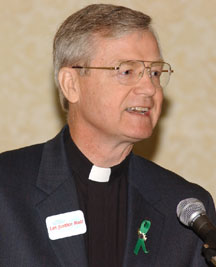
|
| |
The Rev. Robert Edgar speaking at a Presbyterian gathering. He was once a six-term Congressman from Pennsylvania. |
I've heard many people outside of the Quaker tradition use the phrase "speaking the truth to power" to describe what might elsewhere be called the church's prophetic role within society. As bearers of God's truth, as people called by Jesus to be salt and light within the world, and as seekers after God's kingdom and justice, the church is called to speak, not only to itself, but also to the world, including those in positions of power (political, economic, educational, etc.). I recognize that some Christians don't agree with what I've just said, but I think that, if nothing else, the Christian obligation to love one's neighbor often calls forth prophetic speech. For example, if I see my neighbor being hurt by unjust laws, love would compel me to speak out in favor of my neighbor.
So I would agree with those that claim the church has the responsibility to "speak the truth to power." Of course what this means in practice isn't all that simple because sometimes it's hard to figure out which truth ought to be spoken to power, and because the church has a much broader mission than this alone. Besides "speaking the truth to power, " we also need to preach the good news, form healthy churches, worship God in spirit and truth, pass on the faith to our children, heal the sick, feed the hungry, bind up the brokenhearted, and so forth. There are churches which, in my opinion, have let "speaking the truth to power" become the tail that wags the dog. This is true, by the way, on both the right and the left.
Yet, just because I agree that in certain contexts the church should "speak the truth to power," I'm not at all convinced that the Rev. Edgar is correct to associate this so closely with preaching. Certainly preachers ought to be speaking the truth. I have no disagreement with Rev. Edgar here. But I'm not sure that the "speaking the truth to power" ministry of the church belongs in sermons, although this is a common place for it to show up.
Preachers, it seems to me, are called to speak God's Word first and foremost to their own congregations. When I get up to sermonize, I should be focusing on what God wants my people to hear. What do they need to understand about God's Word? What do they need to believe? What do they need to experience? What do they need to do in response to God's truth? Although I must be aware of the larger world in which my congregation lives, I should not be preaching as if that world were my primary audience. After all, the world isn't there to hear me, and it isn't especially inclined to believe me even if it were.
I've found that most mature preachers understand this. So, though they preach "with the Bible in one hand and the newspaper in the other," they are consciously aware of their congregations and preach mainly to them. Younger preachers, on the other hand, often see themselves as speaking to the church in general and/or world at large. I remember a time, for example, when one of my former associate pastors took several minutes of a sermon to blast away at what he perceived to be theological errors of Charismatic Christians. Later I asked him if he thought any of these errors were present in our congregation.
"No," he answered.
"Then why did you preach this to us?" I asked. "Did we need to hear this?"
At that point this young preacher admitted that he had been preaching, not so much to our church as to "Christians in general." He acknowledged that this might not have been the most appropriate content for preaching in our church, given all of the other things we really did need to hear.
I wonder if preachers who think too much in terms of "speaking the truth to power" might be inclined to preach over the heads of their own people, addressing political and other leaders as if they were actually listening and as if they actually cared. I wonder, in fact, if this is what the Rev. George Regas was doing when he preached his controversial sermon at All Saints. In my next post in this series I'll have a bit more to say about this point.
Preaching as Speaking Truth to Power, Section B
Part 18 of series: Churches, Elections, and the IRS
Posted for Monday, September 25, 2006
In my last post in this series I began responding to a comment made by the Rev. Bob Edgar, general secretary of the National Council of Churches. In response to the IRS case against All Saints, he said "I'm outraged. . . . Preachers ought to have the liberty to speak truth to power."
Of course he didn't quite complete the thought, since all preachers have the freedom to say whatever they want (apart from illegal speech such a slander), including telling people how to vote. According to current law, however, preachers must give up a tiny bit of this freedom if they want their churches to be tax-exempt institutions. So what Rev. Edgar didn't say though he surely implied it was, "Preachers ought to have the liberty to speak truth to power and their churches should continue to be free from paying taxes." Watch the debate about the All Saints case, and you'll find that many of those who speak in defense of All Saints talk as if the government stepped in to censor what the Rev. George Regas had said. This is not the case, of course, but it makes the whole issue sound a whole lot more sinister if you talk about it this way.
Rev. Regas, who preached a sermon that was modestly and indirectly critical of John Kerry and at the same time stridently and directly critical of George W. Bush two days before the 2004 election claims he was not intending to influence the vote. This makes me wonder why he chose to preach that particular sermon at that particular time. If his goal was not to get his listeners to act upon his sermon by voting for John Kerry, what was it?
Rev Regas's "Jesus" chewed out the President and other right-of-center politicians in no uncertain terms. Did Rev. Regas imagine that Mssrs. Kerry and Bush would actually hear his sermon? If not, why preach a sermon with them as the rhetorical audience? If he wasn't trying to influence the actions of the congregation when it came to the election, why bother? Was he just blasting away at "power," speaking over the heads of the people who were actually present in church that day? Personally, I'm inclined to think that if Rev. Regas was not trying to influence the behavior of the congregation – i.e., their voting – then he should not have preached this sermon. How odd for a preacher to preach a sermon that doesn't intend to influence the actions of the listeners. Sometimes it seems that preachers on both the right and left who "speak truth to power" end up missing the very people they should be addressing, namely, their own congregations. Of course this is also true of preachers who never touch upon politics, and also rarely touch upon the heart concerns of their people.
All of us who preach do in fact have the chance to "speak truth to power." In my congregation, for example, there are leaders in business, education, media, and government. But even if my church had quite different demographics, there would still be people of power present in worhsip: parents, employers, neighbors, consumers, voters. So every time I stand up to preach, I am "speaking truth to power," at least to some extent. My next question is: What does "power" need to hear from me?
| Here I seem to part company with folks like Bob Edgar and George Regas. I'm not at all sure that "power" needs to hear my personal political convictions, at least not as my main point. Even if I had the chance to preach to George W. Bush, or Hillary Clinton, or Donald Rumsfeld, or Howard Dean, I doubt I'd start hammering away on obviously political issues. There are so many other things these people – and the rest of us as well – desperately need to hear from preachers. Moreover, these other things are the things we preachers are called primarily to preach. They also end up having a profound impact on politics, but this impact has little to do with the opinions of the preacher. |
|
| |
What should I preach if I looked out into my congregation and saw these two sitting there? |
What sorts of things am I talking about? What do Bush, Clinton, Rumsfeld, and Dean need to hear most of all? What parts of truth do these people of obvious power need to hear from their preachers? Here are some starters:
• The gospel of God's love in Jesus Christ;
• The challenge to imitate God's love in our own lives;
• The call of Jesus to a life of discipleship;
• The consistent concern of the biblical God for the well-being of the poor;
• The power and presence of the Holy Spirit;
• The call to be part of the living body of Christ;
• The invitation to be in a community of kindness, grace, and mutual forgiveness;
• The lordship of Christ over all of our lives and over the whole world;
• The nature of evil and the tools God has given to combat it;
• The presence of the kingdom of God and the promise of the future kingdom.
Now if you don't know much about Christian theology, you might accuse me of dodging the tough issues, of skipping politics to deal with esoteric religious truths. But, in fact, the issues I've listed here have profound impact on one's life in the world, including one's politics. I happen to believe that if George W. Bush, Hillary Clinton, Donald Rumself, and Howard Dean had a better grasp of these issues, their politics would be significantly impacted . . . not by me and my political convictions, but by God's truth and its implications.
So, though I'm not doubting the call of the church to "speak truth to power," and though I would agree that sermons should address the issues of our lives in the real world, I'm not persuaded that preachers should regularly focus on "speaking truth to power" in the sense of addressing political issues in their sermons. I many preachers on both the right and the left disagree with me. But I fear that we preachers too easily lose the center of our calling, authority, and message: the good news of Jesus Christ and its implications.
If, as I have suggested, sermons are usually not the right place for the church to "speak truth to power," how else might the church do this? I will address this question in tomorrow's post.
How Might Christians "Speak Truth to Power"?
Part 19 of series: Churches, Elections, and the IRS
Posted for Tuesday, September 26, 2006
In my last couple of posts I've been considering what it means for Christians to "speak truth to power." I suggested that all preachers do this all the time, to some extent. But, I added, the tendency of some preachers to "do politics" in the pulpit can cause them to miss the primary target for preaching, at least insofar as I understand it. Given the preacher's primary calling, which has to do with communicating the good news of Christ and its implications, and given the legal limitations placed upon preachers by the IRS, I think Christians, including preachers, would do well to consider other ways of "speaking truth to power." What might some of these other ways be?
Speaking Through Our Lives
We find one answer in a Friends (Quaker) document called, appropriately enough, "Speak Truth to Power: A Quaker Search for an Alternative to Violence." The phrase, "speak truth to power," comes from the Quaker tradition, and refers to advocacy of pacifism in a variety of ways and contexts. Here's what "Speak Truth to Power" has to say about preaching:
Beginning with The Sermon on the Mount, the Christian tradition alone has produced a library of enduring religious statements, and the same can be said for the literature of other great faiths. The urgent need is not to preach religious truth, but to show how it is possible and why it is reasonable to give practical expression to it in the great conflict that now divides the world. (italics added)
Now I believe that preaching religious truth is important and desperately needed in our day, but I agree that Christians need "to show how it is possible and why it is reasonable." We do this in a variety of ways, surely including our words, both spoken and written. But one of the main ways we "speak" is through our actions. We preach with our lives, or at least we should.
In the Book of Order of the Presbyterian Church USA, we have a statement we call "The Great Ends of the Church" (G-1.0200). If we were to update the language, we'd talk in terms of the great "purposes" of the church, ironically enough. These ends or purposes include:
. . . the proclamation of the gospel for the salvation of humankind; the shelter, nurture, and spiritual fellowship of the children of God; the maintenance of divine worship; the preservation of the truth; the promotion of social righteousness; and the exhibition of the Kingdom of Heaven to the world.
Notice the last of our stated ends: "the exhibition of the Kingdom of Heaven to the world." We are not simply to proclaim God's reign and its implications, but also to demonstrate it through the way we live our lives as Christians.
Of course living what we preach is a whole lot harder than preaching it! I can easily call for people to love their enemies. But I find it much tougher to love the people I don't like, not to mention terrorists who threaten both my life and my way of life.
One of the saddest ironies in the whole "speaking truth to power" dimension of the contemporary church is the extent to which the manner of speaking often fails to match the message, or even contradicts it. Occasionally I watch preachers from the Christian right on television. Sometimes I cringe at their judgmental and unloving tone. "How does this reflect Christ?" I wonder. But folks on the religious left can be just as harsh in the way they communicate. Perhaps we Christians who try to speak into the political maelstrom might get a better hearing if we sounded more like Jesus and less like attack ads during an election.
Speaking Truth to Power Through Blogging
Among the many other ways for Christians to "speak truth to power," I want to mention one obvious one: blogging. For the tiniest investment of money (though a potentially larger investment of time!), Christians can try their hand at "speaking truth to power" through the Internet. (If you're thinking about getting into blogging, check out this helpful piece at The Evangelical Outpost.)
Preachers who blog are free to speak their minds about all sorts of things. They can endorse political candidates, if they wish, or criticize candidates openly. They can try to influence elections. Their blogs, of course, must be independent of their churches if they're going to do this. And I would advise pastors to talk with the boards of their churches before charging ahead in political punditry. But a Christian who chooses, as an independent citizen, to blog, can speak about matters political without concern for his or her tax-exempt status, since, of course, individuals don't have a tax-exempt status.
| The tricky thing about blogging is that one doesn't get a "built-in" audience. Even preachers would have to earn their readership. Blogging is still mostly a free market endeavor, in that bloggers who offer a "product" of value get readers, and those who don't, don't. But if a Christian addresses political issues in a way that people find informative, then that person will, over time, get readers, and some of these may very well be people of significant power, political and otherwise. |
|
| |
If you're a Christian blogger, or if you're a Christian who's thinking about becoming a blogger, be sure to attend this year' s GodblogCon on October 26-28 at Biola University in Southern California. Don't miss it! |
While I'm on this topic, let me add that I continue to hope that the blogosphere will provide an opportunity for intelligent debate about issues, including political ones, from people on different sides of the spectrum. Every now and then I see evidence that my hope might be realized. For example, I have been impressed by the RedBlueChristian website, which seeks to foster respectful conversation by Christians both red (Republican) and blue (Democrat).
In sum, blogging opens up the door for Christians of all kinds – not only those who have regular access to the pulpit – to "speak truth to power." I'd suggest that more Christians try it out, especially preachers who are inclined to get into partisan politics. If the Rev. George Regas had blogged his "debate" between Jesus, Bush, and Kerry rather than preaching it, All Saints wouldn't be in trouble today. Moreover, it's possible that people of power besides the All Saints congregation would have read and been influenced by Rev. Regas's blogged opinions.
Home
|