| |
A Resource by Mark D. Roberts |
|
Ruminating on the National Prayer Breakfast
by Rev. Dr. Mark D. Roberts
Copyright © 2006 by Mark D. Roberts
Note: You may download this resource at no cost, for personal use or for use in a Christian ministry, as long as you are not publishing it for sale. All I ask is that you give credit where credit is due. For all other uses, please contact me at mark@markdroberts.com . Thank you.
Praying with Bush and Bono 
Part 1 of series: Ruminating on the National Prayer Breakfast 
Posted for Friday, February 3, 2006
| I'm interrupting my regularly scheduled series, Oprah, James Frey, and Me, to ruminate a bit on the National Prayer Breakfast. I'll finish up with the other series next week. |
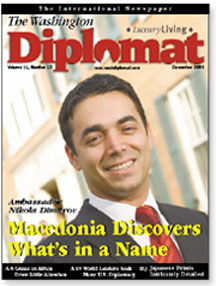
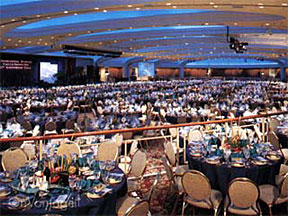
This morning I prayed with President George W. Bush and rock star Bono. It wasn't exactly an intimate moment, however, since there were another 3,500 people in the room, a mammoth ballroom in the Washington Hilton. Because I was the guest of a member of Congress, I had a great seat only about 50 feet away from the President. At our table were a number of leaders, including a handsome young man who spoke excellent English. He turned out to be Nikola Dimitrov, the ambassador to the U.S. from Macedonia. I later learned that he is the youngest of all ambassadors to the U.S.
It's an odd thing to be in a room with so many famous and powerful people. On the dais were variety of senators, including Joseph Lieberman, Kay Bailey Hutchinson, and several others. Seated in my region were dozens of national leaders, including Senate Majority Leader Bill Frist and many other senators and congressmen. In most of life, seeing only one of these people would be worth writing home about (though it's much more common in Washington, obviously). But they fade in significance when they're in the shadow of President and Mrs. Bush, not to mention Bono, and, as it turned out, even a real king (Abdullah II, King of Jordan). |
|
| |
A recent cover story on Nikola Dimitrov, ambassador to the U.S. from Macdonia. Macedonia, as a country, is even younger than its ambassador, having become independent of Yugoslavia on September 8, 1991. |
Of course if you consider the fact that all of us were gathering together for the stated purpose of coming before God in prayer, then this changes the way we think about earthly position and power. Considered on a human scale, this morning I was in close proximity to people who are extraordinarily more wealthy, powerful, and famous than I am. I was a nobody, relatively speaking. (This is mostly fine with me, by the way, because I don't like the pressure and publicity that comes from being a somebody.)
But when you realize that all of us at the breakfast were intentionally in the presence of God, the all-powerful Creator, the Holy One, the King of king and Lord of lords, then differences in human stature fade away. In the eyes of the world, President Bush has so 1,000,000 times more power and privilege than I do. But when we come before God, we're equals. We have equal access to the throne of grace. We get equal hearing with the King of kings.
Now I know this isn't news. I've believed this for a long time, and I expect you have too. But this morning I realized in a new way just what great news this is. And how utterly amazing! And how utterly unlike this world, especially the world of Washington D.C. |
|
| |
The International Ballroom of the Washington Hilton. Not exactly an intimate venue.
|
Every time I'm in Washington, I feel the imprint of gradations of power and prestige. This city is obsessed by such things. I saw all of this from a new angle this time because I was hanging out with a U.S. Congressman. While others waited in a long line to get into the breakfast, ultimately passing through an slow, airport-like security check, I walked behind a curtain and was escorted to my seat, without having anyone even check my ID. Members of Congress, I learned, have lots of perks like this, such as the freedom to park almost anywhere in the District of Columbia without having to worry about parking laws. For a few brief moments, I got to feel what it was like to be privileged.
When it comes to God, however, I am utterly privileged. I have the ultimate guest pass, if you will. The Letter to the Hebrews puts it this way:
Since, then, we have a great high priest who has passed through the heavens, Jesus, the Son of God, let us hold fast to our confession. For we do not have a high priest who is unable to sympathize with our weaknesses, but we have one who in every respect has been tested as we are, yet without sin. Let us therefore approach the throne of grace with boldness, so that we may receive mercy and find grace to help in time of need (Hebrews 4:14-16)
Through Jesus Christ, I can approach God's throne with utter freedom and confidence, even with boldness. (The Greek word translated here as "boldness" literally means "freedom of speech," and refers to our freedom to say anything openly to God.) And so can George W. Bush. And so can Paul Hewson (aka Bono). And so can you.
I confess that I usually take this for granted. But today, when I felt distinctions of privilege and power, when I realized how little of both I really have, I am struck anew by the miracle of my access to God.
President Bush, in his brief remarks at the prayer breakfast, alluded to this same reality.
In this country, we recognize prayer is a gift from God to every human being. It is a gift that allows us to come before our Maker with heartfelt requests and our deepest hopes. Prayer reminds us of our place in God's creation. It reminds us that when we bow our heads or fall to our knees, we are all equal and precious in the eyes of the Almighty.
"Prayer reminds us of our place in God's creation." How true this is! On the one hand, it reminds us that we are all humble subjects of the King of kings, whose proper posture before God is bowed in submission. On the other hand, prayer reminds us that we are also God's beloved children in Christ, who have the unprecedented freedom to approach God with open, fearless, childlike hearts.
Tonight, President Bush remains the most powerful man in the world. And Bono remains one of the most popular, wealthy, and influential. Next to them, I'm relatively powerless, unknown, poor, and feeble. But as we pray our prayers tonight, God doesn't see human privilege. Rather, He sees George, Paul, and Mark. He welcomes us equally into His presence. And He invites us to share our hearts in just the same way. What a wonder!
Praying with People Who Aren't Christians
Part 2 of series: Ruminating on the National Prayer Breakfast
Posted for Sunday, February 4, 2006
The National Prayer Breakfast is sponsored by a Christian group known as the Fellowship Foundation or simply, the Fellowship. Though this group flies under the radar, it has no secret agenda other than to bring people of faith together for fellowship and prayer. In both the U.S. Senate and the House of Representatives, there are weekly prayer gatherings sponsored by the Fellowship, a place where people can come together, not as Republicans or Democrats, but simply as human beings seeking after God. Most participants in the weekly prayer meetings are Christians, though others are welcome. Norm Coleman, a Republican Senator from Minnesota, for example, is a Jewish man who regularly participates in the prayer meetings.
This year he was also a co-chairman of the Prayer Breakfast, sharing with Senator Mark Pryor, a Democrat from Arkansas, whom I assume is a Christian. It was the first time since the breakfasts began, in 1952, that a Jew has been a co-chairman.
Ironically, last year Coleman stirred up concern among his fellow Jews when, speaking at the Prayer Breakfast, he said, "I have a profound respect for the tangibility and accessibility of God that my colleagues find in Jesus." This year Coleman didn't mention Jesus, at least not that I can remember. He did, however, pray several lines in Hebrew, which he then translated into English. Senator Joseph Lieberman, another Jew who led in prayer at the breakfast, did likewise. |
|
| |
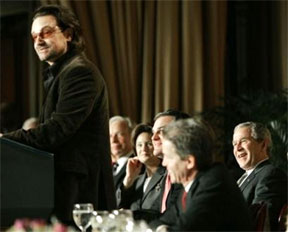
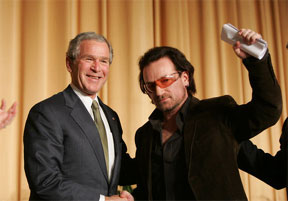
Senator Coleman is in the immediate foreground, next to Senator Pryor. Bono is speaking, much to the apparent delight of the President. (AP Photo/Ron Edmonds) |
In an even larger effort to include non-evangelical, non-Christian prayers, this year's breakfast ended on a surprise note, when Senator Coleman invited forward King Abdullah II of Jordan, a Muslim, who shared a few remarks and offered the benediction.
President Bush, in his brief remarks, also stressed the common bond among people of faith, at least people who share Abraham as a common father of faith. Here are some excerpts from his speech:
I appreciate the fact that people from different walks of life, different faiths have joined us. Yet I believe we share one thing in common: We're united in our dedication to peace and tolerance and humility before the Almighty.
In our country, we recognize our fellow citizens are free to profess any faith they choose, or no faith at all. You are equally American if you're a Hebrew -- a Jew or a Christian or Muslim. You're equally American if you choose not to have faith. It is important America never forgets the great freedom to worship as you so choose.
I want to thank you for the fine tradition you continue here today. I pray that our nation will always have the humility to commend our cares to Providence and trust in the goodness of His plans.
So, what was most striking about this year's National Prayer Breakfast, especially when you view it in light of its history, was the concerted effort to downplay the Christian element and to highlight the interfaith dimension. The consistent them was: Though we are people of different faiths, we all pray to one God, and in this we find our unity.
Some folks were pleased with this effort at greater inclusiveness. Nathan J. Diament, director of public policy for the Union of Orthodox Jewish Congregations of America, said, "All Americans should hope and work to ensure that this very public, very pluralistic and very inspirational program be held up as a model for future events."
Others were not as delighted. Wesley Pruden, editor in chief of The Washington Times, wrote a rather stinging editorial which he entitled, "No Jesus, please. We're Praying." His column began:
Congress and a lot of political Washington met yesterday for their annual National Prayer Breakfast. Even the president was there, but Jesus was odd man out.
There was a Muslim king, a rock musician, and enough congressmen to populate an entire wing at Allenwood, but the sponsors, evangelical Christians all, had agreed to cool it with the Jesus talk lest it make the odd unbeliever uncomfortable. Prayers were offered to Whoever or Whatever might be listening.
In a sense Pruden was right, in that Jesus wasn't mentioned much (if at all) at the Prayer Breakfast. Bono did mention Him, not as One who hears prayers or in whose name Christians pray, but as one who proclaimed the year of Jubilee. I would not go so far as to say that Jesus was the odd man out, however. I happen to believe He was there, both in the Spirit and in His people, who were there by the thousands.
In fact, the vast majority of people at that breakfast prayed in the name of Jesus, even if we didn't hear the name mentioned out loud. Praying in the name of Jesus isn't a matter of saying, "in Jesus's name, Amen" at the end of a prayer, though this is a fine practice that I usually employ in my public prayers. Rather, praying in the name of Jesus means praying at His invitation, under His authority, and for His purposes. Christians, who approach God only through Jesus, always pray in His name, whether we say it or not. So there were many in the Hilton ballroom praying to Jesus, even if His name flew under the radar.
Is it a good thing for people of different faiths to gather for prayer? Is it a good thing for Christians to participate in prayer gatherings that are not explicitly Christian? Is it a good thing for Christians to lead in prayer and not mention the name of Jesus out of a desire to include non-Christian folk? Is it a good thing for Christians to be led in prayer by Jewish Senators and even a Muslim king?
Tricky questions, these. Tomorrow I'll venture some answers. In the meanwhile, may the Lord bless You, in Jesus's name, Amen!
Should Christians Pray with People Who are Not Christians?
Part 3 of series: Ruminating on the National Prayer Breakfast
Posted for Monday, February 6, 2006
As I explained in my last post, perhaps the most striking thing about this year's National Prayer Breakfast was its effort to be inclusive of non-Christian participants. Two Jewish senators led in prayer, Joseph Lieberman and Norm Coleman, and Coleman was a co-chair of the whole affair. The breakfast was concluded by a few words from King Abdullah II of Jordan, a Muslim.
Compared with recent prayer breakfasts, the name of Jesus was strikingly absent. I can't remember any prayers being offered in His name, and though He was mentioned a couple of times, there was no sense that this prayer gathering had anything to do with Jesus in particular. This is curious, given the fact that the National Prayer Breakfast is sponsored by the Fellowship Foundation, and evangelical Christian ministry, and that the vast majority of people at the breakfast were Christians of an evangelical strain. We are people who not only tend to end our prayer with "in Jesus's name," but also who actually pray to Jesus Himself, believing Him to fully God as well as fully human.
But is it okay for us to gather with non-Christian folk to pray? And when we do, is it right for us not to use the words "in Jesus's name" at the end of our prayers? I'm going to deal with this second question a bit later. Today, I want to begin considering whether Christians should even be in a place to pray along with people who aren't Christians. |
|
| |
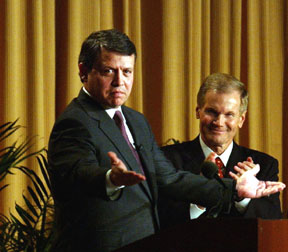
King Abdullah of Jordan at the luncheon following the National Prayer Breakfast. No, he's not raising his hands in prayer, but rather in gratitude for applause. Behind the king is Bill Nelson, a senator from Florida.
|
In one sense, this is a silly question, because Christians should be praying with non-Christian folk all the time. I'm referring here to what happens in church, a Christian gathering in which non-Christians should be regular participants. If a church isn't drawing non-believers and including them in prayer, then something is wrong with that church. Every week at my church there are lots of non-Christian folk present. My heart's desire is that they will enter into genuine communication with God along with me.
Or consider the case of an evangelistic crusade. The point, of course, is to get non-Christian people there so that they might receive Christ as Lord and Savior. In every crusade meeting I've attended, prayers were offered by Christians, prayers that were meant to include non-Christian folk. In fact, the evangelist usually leads non-Christian folk in very specific prayer. Let's face it, only a non-believer can pray "the sinners prayer," and confess faith in Jesus Christ.
But what about a situation in which there is no evangelistic intent. Should Christians gather with non-Christians to pray? Does this somehow imply that people can approach God any religious tradition, and that Jesus is simply one among many ways to come before God? If this were true, then this would be a problem, since orthodox Christians believe that Jesus is, in fact, not simply one way among many options, but THE WAY to God.
I don't believe that all prayer with non-Christian people necessarily demotes Jesus to the status of "one mediator among many." It really depends on what is said (and not said) in the gathering. If people talk as if there are many equally legitimate ways to approach God, then this is a problem from a Christian perspective. (It is also a problem, by the way, from a Muslim or Jewish perspective.) But if people simply come before God in prayer, if they intend to communicate with the one true God, then I don't think interfaith prayer is necessarily inconsistent with orthodox faith.
Of course this pill is easier to swallow when we're talking about Judaism and Islam, both of which recognize and address the God of Abraham. It's much harder to think of interfaith prayer in broader perspective. Hindus pray to several gods. And Buddhists don't really pray at all in the sense of communicating with a divine being. Buddhist prayer is more a matter of meditation or thinking transformative thoughts. So it wouldn't make much sense to pray with Buddhists. And it would be hard to use monotheistic language when praying with Hindus. (I'll deal a bit further with the question of whether Jews, Christians, and Muslims pray to the same God in an upcoming post.)
Should Christians Pray with People Who are Not Christians? (continued)
Part 4 of series: Ruminating on the National Prayer Breakfast
Posted for Tuesday, February 7, 2006
Yesterday I began answering the question: Should Christians pray with people who are not Christians? I suggested that this can be okay, especially when we're joining together with people who recognize the God of Abraham (Jews, Christians, Muslims). It's a lot messier if our prayer partners recognize multiple gods (Hinduism) or no god at all (Buddhism).
Part of what would make interfaith prayer not okay is if we were asked to check our faith in Christ at the door of the prayer gathering. This would be unacceptable to me. Yet I would argue that if Christians don't contradict core Christian theology in what they say in interfaith prayer meetings, then praying with non-Christian folk can be a good thing. In fact, it might build important bridges between Christians and people from other religions.
In some ways, praying with non-Christians is rather like what Paul said in his speech to pagan Greeks on the Areopagus in Athens:
“Athenians, I see how extremely religious you are in every way. For as I went through the city and looked carefully at the objects of your worship, I found among them an altar with the inscription, ‘To an unknown god.’ What therefore you worship as unknown, this I proclaim to you. The God who made the world and everything in it, he who is Lord of heaven and earth, does not live in shrines made by human hands, nor is he served by human hands, as though he needed anything, since he himself gives to all mortals life and breath and all things. From one ancestor he made all nations to inhabit the whole earth, and he allotted the times of their existence and the boundaries of the places where they would live, so that they would search for God and perhaps grope for him and find him—though indeed he is not far from each one of us. For ‘In him we live and move and have our being’; as even some of your own poets have said, ‘For we too are his offspring.’ Since we are God’s offspring, we ought not to think that the deity is like gold, or silver, or stone, an image formed by the art and imagination of mortals." (Acts 17:22-29)
Although Paul does not endorse paganism, but rather critiques it, he also makes an effort to connect with and, to an extent, legitimize the Athenian "groping" for God. Their altar to an unknown god Paul sees as an altar to the one, true God. And he affirms that God is not far from all people, and that we are all, in a sense, God's offspring. Praying with non-Christian folk, it seems to me, can be rather like this. It's a way to affirm the genuineness of their effort and desire to communicate with God, even if they do not think of God in Christian terms.
| These days we Christians need to be more open than ever before to the benefits of praying with non-Christians, especially Muslims. Although we differ in crucial respects when it comes to theology, and these differences should not be ignored or minimized, we nevertheless are reaching for the same God. In coming before God (Allah, in Arabic), we all humble ourselves and recognize God's sovereignty. Moreover, we find solid common ground, the ground upon which we place our knees when we pray. In our world which is increasingly divided between Muslims and non-Muslims, and in which this divide often leads to violence, and in which Islamic extremism poses a threat to our lives and our civilization, I think we need to forge stronger community with moderate Muslims, the kind of Muslims who would be willing to pray with us. Interfaith prayer gatherings are one place where this can happen. |
|
| |
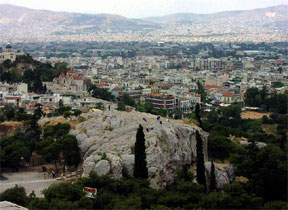
The Areopagus, or Mars Hill, in Athens, from the top of the Acropolis. From this angle Mars Hill looks more like a big rock.
|
In such gatherings, there must be no requirement that we abandon our core faith, whether we are Christian, Jewish, Muslim, or whatever else. I would not attend or participate in a prayer service that asked me to give up or contradict my commitment to Christ. I would not utter some written, corporate prayer that implied that all ways to God are equal. (Nor would a faithful Muslim do this, by the way.) But I would be a part of a prayer meeting in which participants freely chose not to emphasize matters in which they differ, while focusing on that which they hold in common. (As I mentioned above, it would be hard to do this with Hindus and other polytheists, or with Buddhists and other atheists. We'd have to look elsewhere for common ground.)
At the National Prayer Breakfast, much was said about joining together with people of other faiths in order to come together before God in prayer. I don't remember anyone stating or implying that all religions are alike, or that there are numerous, equally valid ways to approach God. It didn't seem as if I was being asked to compromise my own faith or to participate in a prayer that I couldn't endorse. Therefore, I did not feel uncomfortable at the Prayer Breakfast. More importantly, I didn't do or say anything that was inconsistent with my Christian faith.
Nevertheless, I know that some Christians believe that genuine believers must always mention Jesus's name in our prayers, and that not to do so is wrong. In my next post I'll consider whether it's okay for Christians not to use the words "in Jesus's name" when they conclude their prayers in public, or to be led in prayer by others who do not pray in the name of Jesus.
What Does It Mean to Pray "In Jesus's Name"?
Part 5 of series: Ruminating on the National Prayer Breakfast
Posted for Wednesday, February 8, 2006
In my last two posts I've considered whether it's appropriate for Christians to pray with people who are not Christian. My answer, in a nutshell, was: yes, at times, depending on the context and the content for the prayer.
I have Christian friends who believe that every time a Christian prays, it's necessary for that person to mention the name of Jesus specifically, by saying "in Jesus's name" or "through Christ our Lord" or something similar. Thus they would not be pleased with what happened at the National Prayer Breakfast, where Christians prayed without using Jesus's name before saying "Amen."
Questions: Is it important or even necessary for Christians to say the name of Jesus at the end of their prayers? Is this what it means to pray in Jesus's name?
In the Gospel of John, Jesus teaches His disciples to pray "in his name": "And I will do whatever you ask in my name, so that the Son may bring glory to the Father. You may ask me for anything in my name, and I will do it" (John 14:13-14). Yet Jesus doesn't mean that we must say "in Jesus's name" at the end of every prayer, though this is surely a fine thing to do as long as we don't think of "in Jesus's name" as magic words. To pray in Jesus's name is to pray under His authorization. It means to approach God through Jesus and to seek, not our own will, but the will of Jesus our Lord.
Therefore, all Christians should pray in Jesus's name and no other, whether they say "in Jesus's name" or not. When I, and thousands of other Christians at the Prayer Breakfast, agreed with Senator Joseph Lieberman, a Jewish man, in prayer, we were praying in Jesus's name, even though he was not and did not use the familiar Christian ending to his prayer. I was coming before God in the name of Jesus because that's the only way I pray.
If you're still not convinced that it's okay for Christians to pray without saying "in Jesus's name" or the more liturgical, "through Christ our Lord," at the end, you need to look no further than to the prayer that Jesus Himself taught His disciples. The so-called "Lord's Prayer," the paramount model for Christian prayer, does not include "in Jesus's name" or anything like that. If these words were necessary, you'd certainly have expected Jesus to have taught them.
Similarly, we have many Christian prayers in the New Testament, in the letters of Paul, for example. They don't end with the words "in the name of Jesus." Yet they are all offered in Jesus's name. In fact, Colossians 3:17 makes it clear that we're to do everything, not just to pray, "in the name of the Lord Jesus." This isn't about saying certain words. Rather, it's about living under the authority of and as servants of Jesus at all time.
| I almost always close my personal and public prayers with "in Jesus's name." For me, this is an important reminder of the grounds on which I approach God. But there have been times when I have not used the word "Jesus" in prayer in order to reach out to and include non-Christian people. For example, a few years ago I was asked to offer a prayer at the Irvine City Council meeting. I did so, but didn't end my prayer with my usual phrase, "in Jesus's name." I knew there were Jewish people present, and so I wanted them to be able to join with me rather than feeling excluded. |
|
| |
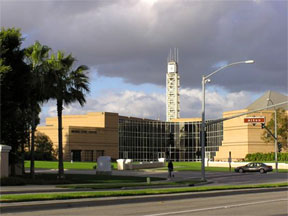
Irvine City Hall. With that tower, it looks rather like a modern church. But don't get the wrong idea. |
A pastor friend of mine was very unhappy with me. He said that we should always say the name of Jesus, and that not to do so was cowardly and dishonoring of Christ. I'm quite sure he was wrong about the cowardly part, because I wouldn't be in the least afraid to confess my faith in Christ at a city council meeting if I thought it were appropriate. Moreover, I was actually trying to honor Christ by reaching out to non-Christian folk. Now I may well have been wrong, but I'm quite sure my motivations were Christ-honoring. It seemed to me that the Jesus who welcomed tax collectors and sinners into fellowship might not have been bothered by my decision not to mention His name in the presence of those who would be offended by it.
On another occasion I was asked to give a prayer at the Irvine Mayor's Prayer Breakfast. Once again, this was an interfaith (and no faith) group, so I chose not to close my prayer by using the name "Jesus." I stood up to pray, and offered a fairly short prayer of intercession for the mayor and others serving in our city. It was nothing fancy. Just a simple prayer from my heart. After the breakfast, I received a surprisingly large number of compliments from people, thanking me for my prayer. Some of these came from folks who were not Christian, or even particularly religious. Yet they sensed something special in the prayer, though I thought of it as rather ordinary.
In retrospect, I think what people were feeling, though they didn't have the words to express it, was the fact that I was praying in the name of Jesus. I was approaching God, not with formality or religiosity, but with childlike simplicity. I spoke to God as if we were intimately related. This impressed people who did not know that intimacy. Why was I able to approach God in this way? Because I prayed in the name of Jesus, under His authority and by His invitation. Because of Jesus, and Jesus alone, I was able to approach God's throne of grace with boldness. This was striking to people who lacked the freedom Jesus offers when we pray in His name. This story illustrates, I believe, both what it really means to pray in Jesus's name, and the potential benefit of not using the word "Jesus" in some situations.
In my next post I want to pursue this issue a bit further, and offer an ironic illustration of what it means to pray in the name of Jesus.
What Does It Mean to Pray "In Jesus's Name"? (continued)
Part 6 of series: Ruminating on the National Prayer Breakfast
Posted for Thursday, February 9, 2006
I grew up believing that praying in the name of Jesus meant, literally, saying "in Jesus's name" at the end of my prayers. It wasn't until I began to study the New Testament with some care that I discovered the error of my ways. I tried to explain a better way to think in my last post.
Today I want to offer an example that might help to illustrate part of what it means to pray "in the name of Jesus."
Sixteen years ago, Designing Women was one of the most popular sitcoms on television. It focused on the lives of four women who worked in an interior design office in Atlanta. Designing Women was filmed at a television studio in Los Angeles, not far from where I lived and worked. My friend Betty worked for Designing Women as part of the stage crew. Specifically, she was responsible for the set on which the show was filmed.
One time Betty invited me to watch a filming of the show. I would be joining a studio audience of a couple hundred people. As I met Betty before the taping began, she gave me a tour of the facilities, including the stage. There I was, standing right where they filmed the show, with a crowd of people watching in envy as Betty showed me all of the insider secrets.
While I was getting my blue ribbon tour, the director called Betty aside for a quick meeting. She told me to wait where I was, and ran off. Soon she disappeared behind the set. At first I enjoyed the view from the set, noticing how fake everything looked from that perspective, whereas it looked so real on television. But as Betty was delayed, I began to get a little nervous. Here I was, on the set of the show, with no identification to prove that I belonged there. I wondered what I would do if security came to question me. How could I prove that it was okay for me to be on the set? What would I say if somebody asked me, "Why are you here?" I realized I had only one explanation, which happened to be the truth. I would say, "I'm here because Betty invited me here. I'm here because of Betty." If I were using biblical vocabulary, I might have said, "I'm here in the name of Betty." |
|
| |
The primary cast of Designing Women. In the background you can see the set where I was standing when Betty went to her meeting.
|
As it turned out, nobody bothered me while I was on the set. The crew ignored me, and the security folk didn't seem to worry about me. After several minutes, Betty returned, and all was well.
Praying in the name of Jesus is rather like standing on the set of Designing Women. We are able to approach God's throne of grace (Hebrews 4:16), we are welcome in God's presence, not because of who we are, but because of who Christ is, and because He has invited us. We have every right to communicate intimately with God, not because we ourselves have any right to do so, but because Christ has given us this privilege by grace. When we pray "in the name of Jesus," we are coming before God, not in virtue of any status we have by ourselves, but because of who we are as believers in Jesus. If God were to ask me when I pray, "Why are you here?" my answer would be, "Because Jesus invited me." More deeply, my answer should be, "Because Jesus, by His death, made a place for me here."
Do Christians and Muslims Pray to the Same God?
Part 7 of series: Ruminating on the National Prayer Breakfast
Posted for Friday, February 10, 2006
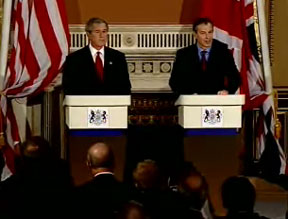
Do Christians and Muslims pray to the same God? Answering this question can get one in a heap of trouble. In November 2003, President Bush and English Prime Minister Tony Blair were holding a joint press conference in London. Near the end, one of the reporters said: "Mr. President, when you talk about peace in the Middle East, you've often said that freedom is granted by the Almighty. Some people who share your beliefs don't believe that Muslims worship the same Almighty. I wonder about your views on that." The reporter added that he'd like Mr. Blair's opinion as well. The Prime Minister, speaking second, waxed eloquent about freedom and values, clearly sidestepping the question of who worships whom. Mr. Bush, however, had plowed ahead with a blunt answer: "I do say that freedom is the Almighty's gift to every person. I also condition it by saying freedom is not America's gift to the world. It's much greater than that, of course. And I believe we worship the same God."
I wouldn't be surprised if sometime in the future I end up doing a longer series on the question of whether Muslims and Christians pray to the same God. In fact, I imagine that in the months and years ahead I'll have much more to say about Islam, Christianity, and the interaction between them. In our world, few topics are more timely and crucial. But, for now, I want to offer a few basic theses concerning Christians, Muslims, and the God (Gods?) to whom we pray.
Thesis #1: The answer to the question of whether or not Christians and Muslims worship the same God depends, to a great extent, on what one means by the word "same." If "same" means, similar in character, then the answer is "no." If "same" means something like "the one Creator," then the answer is "yes."
Thesis #2: Both Christians and Muslims believe that there is only one God, and they intend to pray to that one God.
Thesis #3: Christians and Muslims, though they agree upon certain aspects of God's nature, disagree on much that is absolutely essential. In particular, Christians believe that God's nature is triune (Father, Son, Spirit) and that Jesus is fully God. Muslims explicitly and bluntly deny this. This is only one example of many core disagreements between Muslim and Christian conceptions of God.
Thesis #4: The attempt by some people to trivialize the theological differences between Muslims and Christians, though sometimes motivated by honorable goals (like world peace), is mistaken and will end up making matters worse rather than better. Today's news provides a sad but germane example of what I'm talking about. Christians would be insulted if Muslims published cartoons of Jesus, especially if these put Jesus in a bad light. But it's highly unlikely that thousands of Christians would respond to this insult by rioting, burning mosques, and so forth. To assume that Muslims are rather like Christians in their theology, and vice versa, is both wrong and foolish.
Thesis #5: If one is truly monotheistic, then the question "Do Muslims and Christians pray to the same God?" is almost nonsensical, since there isn't another God to whom anybody could pray. (Allah, by the way, is simply the Arabic word for God. Christians who speak Arabic pray to Allah in the name of 'Isa [Jesus in Arabic].)
Thesis #6: The more important question, and one that is harder to answer, is: Does God hear the prayers of people whose theology is wrong, even very wrong? If, for example, one prays to Zeus, does God hear this prayer in any sort of favorable way? Or does God close His ears, in a sense? And if so, then how theologically correct does one have to be in order to get a hearing from the Almighty?
Thesis #7: The question "Do Muslims and Christians pray to the same God?" seems different in some ways from "Do Muslims and Christians worship the same God?" Consider what it would be to answer "yes" to these two questions. If one said, "Yes, Muslims and Christians worship the same God," this would seem to imply (though not necessarily) that the one God gladly receives worship in both the Muslim and the Christian mode. This implication would be denied by most orthodox Christians and orthodox Muslims, however. Yet if one said, "Yes, Muslims and Christians pray to the same god," this seems to speak less about the theology of the person praying and more about the direction of the prayer.
| Let me close with an illustration of this last thesis. Suppose that I slipped and fell off a steep, high cliff. Somehow I managed to grab a root near the top of the cliff, thus keeping me from plummeting to my death. So I started yelling for help to anyone on the top of the cliff who might hear me. Suppose that a Muslim man heard my cries. While peering over the cliff, he slipped, and soon joined me as we dangled over the abyss, saved from instant death by our little root. Soon we were both crying out for help, in both English and Arabic. All of a sudden we heard a deep, resonant, male voice from the top of cliff, asking how he might help. "Help us, help us" we cried, each in our own tongue, "Pull us up to safety." "I'll help you," came the reply, both in English and in Arabic, "but I need to get a rope." Now, suppose that the deep, resonant, male voice sounded a whole like that of Darth Vader (or Mufasa from The Lion King), so I pictured our savior as James Earl Jones in the flesh. But suppose that my partner heard a voice that, to him, sounded like that of the imam (congregational prayer leader) from his mosque. As we continued to call out to the one who was soon to rescue us from our peril, I kept on picturing James Earl Jones, while my Muslim counterpart pictured his imam. |
|
| |
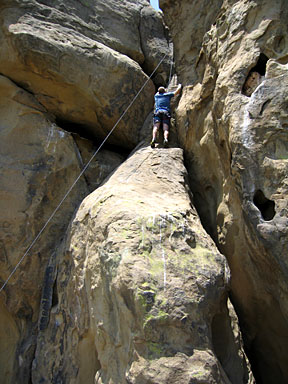
In fact, when I dangle from high cliffs, I make sure I'm carefully roped in, since James Earl Jones can't be counted on for a rescue. |
Question: Were we calling out to the same person? Answer: Well, it all depends. If you mean, did we envision the same person as our savior, the answer is "no." If you mean, did the same person hear our cries, regardless of our expectations of his identity, the answer is "yes."
So then, do Christians and Muslims cry out to the same God for mercy? It all depends on what you mean by the question.
Bono's Sermon
Part 8 of series: Ruminating on the National Prayer Breakfast
Posted for Monday, February 13, 2006
My first experience of Bono wasn't an altogether positive one. My sister was a huge fan of the Irish rock band U2, of which Bono (born Paul David Hewson) was the lead singer. So I got the latest U2 CD and played it on my home stereo. Since I was doing some work in a room separated from the speakers, I turned up the system to a volume louder than usual. As I was listening to one of the early tracks, all of a sudden I heard nothing at all. Checking to see what was wrong, I discovered that Bono had fried my speakers, literally. It was the only time in my life that this happened, and I blamed it on U2. So much for getting to know Bono.
In the year's since then, I've had mixed feelings about Bono. I've admired his music, even though it's not quite my style. I've noted with interest his profession of Christian faith, and groaned when he let the F-word slip on national television when U2 won a Grammy. But I've been impressed, most of all, with his consistent effort to use his wealth and fame to fight poverty. Bono has not seemed to me like one of the trendy Hollywood types who dabble in social causes in between their cosmetic surgeries. His war on poverty has lots of integrity and intelligence, whether you agree with his strategies or not.
Bono's appearance at the National Prayer Breakfast was not known in advance, at least not to most of us in attendance. Since the breakfast was a sell-out, organizers didn't need to trade on Bono's fame to fill the room. I did not know Bono was the featured speaker until I got to my table and read the program. There, along with the President and seven U.S. Senators, was Bono, who was described as "Co-Founder of DATA, Musician."
Bono wasn't hard to pick out of the crowd on the dais. He was, after all, the only man not sporting a tie. Instead, he was wearing his customary dark glasses and what appeared to be a leather jacket.
When it was time for his speech, Bono appeared to be nervous. At first he spoke awkwardly, like he wasn't sure that he belonged at a prayer meeting where he was giving the sermon. But the beginning of his speech was brilliant. He used self-deprecating humor to calm himself down and to prepare the audience to listen to him. |
|
|
|
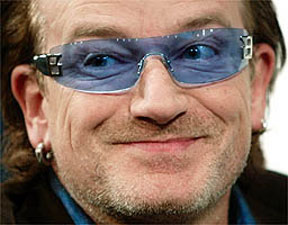
Top: Bono (supposedly).
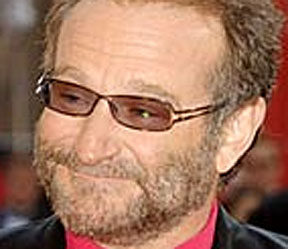
Bottom: Robin Williams (supposedly).
So here's my question, has anyone ever seen these two men in the same place and the same time? Or are we dealing with a Clark Kent/Superman phenomenon? Do we have actual evidence that Bono is not really just Robin Williams playing a clever role? Where is the proof?
|
After his opening greetings, he said,
Please join me in praying that I don’t say something we’ll all regret.
That was for the FCC.
Now that was an astute beginning for several reasons. First, by putting himself down, Bono assumed a posture of humility, rather than moral one-up-man-ship. Second, since the room was filled largely with conservative Christians, many of whom would have remembered negatively Bono's gaff at the Grammys, this opening also helped many folks let down their guard. It was a tacit admission of guilt, as well as a humorous and humble opening. Not surprisingly, it got a good laugh.
A minute later Bono continued,
You know, one of the things I love about this country is its separation of church and state. Although I have to say: in inviting me here, both church and state have been separated from something else completely: their mind.
Mr. President, are you sure about this?
It’s very humbling and I will try to keep my homily brief. But be warned—I’m Irish.
More self-effacing humor. But these were not just throw away lines. Central to Bono's theme in his homily will be a connection between church and state. Bono will appeal to God in an effort to get the state (the federal government) to do something. A good introduction to a speech not only engages the audience, but also introduces themes to come later. Also, by speaking to the President in this way, Bono implicitly acknowledged the President's authority. A great rhetorical move.
By complementing Bono's rhetoric, I'm not criticizing him. Far from it. I admire carefully-crafted rhetoric. It's something we need more of in our country, not less. It's hard to imagine a better introduction to this speech, given the audience, not only of national leaders, but of conservative evangelicals. Self-deprecating humor, wisely communicated, opens the minds and hearts of listeners. It says, implicitly, "I'm not really better than you. I'm just a guy," which disarms people who are thinking, "Why should I listen to this rock star? Who is he that I should pay attention to him? Why should I trust this guy today?"
In fact, after he stopped being funny, Bono tried hard to connect with the folks who were at the breakfast on a more substantial level:
I presume the reason for this gathering is that all of us here—Muslims, Jews, Christians—all are searching our souls for how to better serve our family, our community, our nation, our God.
I know I am. Searching, I mean. And that, I suppose, is what led me here, too.
Now this may or may not be what actually motivated many of the breakfast attendees to show up. I was there primarily to spend time with a friend, to pray, and to gawk at famous people (not necessarily in that order). But by saying, in effect, "We're all in this together," Bono was building a bridge between himself, the liberal-leaning, F-word-saying, Irish rock star, and his conservative-leaning, F-word-hating, American evangelical audience.
The brilliance of Bono's beginning makes me wonder if he has a speech writer. But it wouldn't surprise me if Bono wrote this speech himself, partly because his voice was authentic, partly because Bono is a talented poet, and partly because he once said that, if he weren't a rock star, he'd probably have made his living as a speech writer. Moreover, he explained that "I'm always writing speeches or articles for causes I believe in."
In my next post I'll analyze the core content of Bono's sermon. But I wanted to take time in this post to look at his introductory rhetoric because, I think, it illustrates the intelligence of the man and the well-thought-out character of his cause. Bono didn't swagger in and give a pompous, profane speech that turned off his audience. Rather, he found just the right rhetorical angle for the context in which he was to sermonize. This is one sharp man!
Bono's Sermon: His ONE Point
Part 9 of series: Ruminating on the National Prayer Breakfast
Posted for Tuesday, February 14, 2006
Yesterday I introduced Bono's "sermon" at the National Prayer Breakfast on February 2, 2006. I spoke admiringly of his rhetorically astute introduction, in which he used self-effacing humor to get the audience on his side.
So what was Bono's main point, his punch line, if you will? He came to the prayer breakfast to garner support for the ONE Campaign, which he described as "a growing movement of more than two million Americans [and five million by elections] . . . left and right together . . . united in the belief that where you live should no longer determine whether you live." Here is the essence of Bono's pitch, in his own words:
|
Mr. President, Congress, people of faith, people of America:
I want to suggest to you today that you see the flow of effective foreign assistance as tithing . . . . Which, to be truly meaningful, will mean an additional one percent of the federal budget tithed to the poor. . . .
America gives less than one percent now. Were asking for an extra one percent to change the world. To transform millions of lives—but not just that -- and I say this to the military men now – to transform the way that they see us. |
|
|
Bono is the most visible and effective proponent of the ONE Campaign. According to the Campaign website:
ONE is a new effort by Americans to rally Americans - ONE by ONE - to fight the emergency of global AIDS and extreme poverty. The ONE Campaign is engaging Americans through a diverse coalition of faith-based and anti-poverty organizers to show the steps people can take, ONE by ONE, to fight global AIDS and poverty.
The particular focus of this campaign, as Bono explained it, is for the federal government to devote one percent of its annual budget to alleviating poverty in the third world, especially Africa.
In his sermon, Bono presented several arguments for the ONE Campaign's goal. These included:
1. God cares for the poor in a special way, and so should we.
"Look, whatever thoughts you have about God, who He is or if He exists, most will agree that if there is a God, He has a special place for the poor. In fact, the poor are where God lives. . . .
"I mean, God may well be with us in our mansions on the hill. I hope so. He may well be with us as in all manner of controversial stuff… maybe, maybe not. But the one thing we can all agree, all faiths and ideologies, is that God is with the vulnerable and poor."
2. This is not merely a matter of charity, but of justice.
"And finally, it’s not about charity after all, is it? It’s about justice.
"Let me repeat that: It’s not about charity, it’s about justice.
"And that’s too bad.
"Because you’re good at charity. Americans, like the Irish, are good at it. We like to give, and we give a lot, even those who can’t afford it.
"But justice is a higher standard. Africa makes a fool of our idea of justice; it makes a farce of our idea of equality. It mocks our pieties, it doubts our concern, it questions our commitment.
"6,500 Africans are still dying every day of a preventable, treatable disease, for lack of drugs we can buy at any drug store. This is not about charity, this is about Justice and Equality."
3. Politicians who support the ONE Campaign will help their own political cause.
"We hear that call in the ONE Campaign, a growing movement of more than two million Americans [and five million by elections] . . . ."
4. Devoting one percent of the federal budget to fighting poverty is in America's own interest as a matter of national security.
"America gives less than one percent now. Were asking for an extra one percent to change the world. To transform millions of lives—but not just that and I say this to the military men now – to transform the way that they see us.
"One percent is national security, enlightened economic self-interest, and a better safer world rolled into one. Sounds to me that in this town of deals and compromises, one percent is the best bargain around."
5. Devoting one percent of the federal budget to fighting poverty will make a real difference in the lives of real people.
"One percent is the girl in Africa who gets to go to school, thanks to you. One percent is the AIDS patient who gets her medicine, thanks to you. One percent is the African entrepreneur who can start a small family business thanks to you. One percent is not redecorating presidential palaces or money flowing down a rat hole. This one percent is digging waterholes to provide clean water."
6. If America does what the ONE Campaign advocates, she will be looked upon favorably by history, and even by God.
"To give one percent more is right. It’s smart. And it’s blessed.
"I truly believe that when the history books are written, our age will be remembered for three things: the war on terror, the digital revolution, and what we did—or did not to—to put the fire out in Africa."
"History, like God, is watching what we do."
Prior to Bono's sermon, I had some vague idea of the ONE Campaign. But his presentation forced me to examine it more carefully. In my next post I'll talk about what I found to be surprising about this campaign – very surprising. I'll also outline my personal response to this proposal.
The ONE Campaign: Some Facts, Including
Some Surprising Ones
Part 10 of series: Ruminating on the National Prayer Breakfast
Posted for Wednesday, February 15, 2006
In my last post I explained that the focus on Bono's "sermon" at the National Prayer Breakfast was calling upon Americans to support the ONE Campaign. This campaign seeks to persuade the U.S. Congress and the President to earmark an additional one percent of the federal budget to fight AIDS and poverty in the third world. According to supports of the campaign, this additional $25 billion each year would make a huge difference in the world. The ONE Campaign FAQ claims (PDF only):
By directing an additional ONE percent of the U.S. budget toward providing the most basic needs – and fighting the corruption that wastes precious resources –– we can help transform the futures and hopes of an entire generation in the poorest countries. If the U.S. were to devote an additional ONE percent—one cent for every dollar spent by the federal government—to helping the world’s poorest people help themselves, America would demonstrate a commitment to the Millennium Goals, an internationally agreed upon effort to halve global poverty by 2015.
With an additional ONE percent of our budget we can help prevent 10 million children from becoming AIDS orphans; We can help get 104 million children into grade school; We can help provide water to almost 900 million people around the globe; We can save almost 6.5 million children under 5 from dying of diseases that could be prevented with low-cost measures like vaccination or a well for clean water, and We can build a better, safer world for all.
The chief strategy of the ONE Campaign is to get millions of people to sign "The ONE Declaration," which reads:
"WE BELIEVE that in the best American tradition of helping others help themselves, now is the time to join with other countries in a historic pact for compassion and justice to help the poorest people of the world overcome AIDS and extreme poverty. WE RECOGNIZE that a pact including such measures as fair trade, debt relief, fighting corruption and directing an additional one percent of the U.S. budget toward meeting basic needs - education, health, clean water, food, and care for orphans - would transform the futures and hopes of an entire generation in the poorest countries. WE COMMIT ourselves - one person, one voice, one vote at a time - to make a better, safer world for all."
Given that the ONE Campaign advocates a federal government solution to the problem of disease and poverty, it would be easy for some to write it off as a clever "lefty" scheme, well-intentioned, perhaps, but unrealistic and overly dependent on the government. This characterization of the ONE Campaign would be strengthened by an awareness of some of the signers of the Declaration. You'll find lots of the usual Hollywood types, including: Ellen Degeneres, P-Diddy, Brad Pitt, and Susan Sarandon.
But dismissing the ONE Campaign as one more idealistic, partisan, left-wing effort would be a mistake. For one thing, notice who else has signed the Declaration: Michael W. Smith (Christian rock artist and friend of the President), Rick Warren (the purpose-drivine Southern Baptist, who is not known for his leftist views), and . . . prepare yourself for a surprise . . . Pat Robertson. That's right, the televangelist with a hardcore, right wing agenda, he too supports the ONE Campaign. Now that should at least make us pause long enough to take the ONE Campaign seriously, if we were inclined not to do so.
Moreover, the ONE Campaign was founded by more than just Bono's activist group, DATA (Debt, AIDS, Trade, Africa). Among the co-founders are some of the finest Christian organizations on the planet, including Bread for the World, World Concern, and World Vision. These organizations have vast and deep experience dealing with poverty, disease, and tragedy throughout the world. They are distinctly Christian and distinctly non-partisan. They are not awash in sophomoric idealism because they've been in the trenches of the world for decades.
Given the founders and the supporters of the ONE Campaign, it surely deserves to be taken seriously by all Americans, no matter what our political inclinations. Even those who tend to dislike big government solutions to problems and to prefer tax cuts to increasing the federal budget should stop and consider whether the ONE Campaign makes a moral claim upon us that transcends the usual political squabbles. According to Bono in his sermon, the ONE Campaign clearly reflects God's own commitment and agenda. |
|
| |
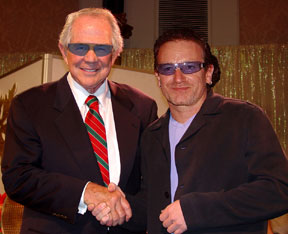
Now there's a sight you don't see everyday. Well, actually, you don't ever get to see it for real. I confess to a wee bit of digital editing here. Well, okay, more than a wee bit.
|
Is Bono right in this claim? I'll take up this question next time.
Is God on the Side of the Poor?
Part 11 of series: Ruminating on the National Prayer Breakfast
Posted for Thursday, February 16, 2006
The logical fulcrum for Bono's advocacy of the ONE Campaign is his belief that God is on the side of the poor. This isn't something he just made up. It's been a popular mantra among socially-active Christians for a long time. Roman Catholics have often spoken of a "preferential option for the poor," claiming to be imitating God's own preferences. Some evangelicals have also argued that God is on the side of the poor, though with certain important qualifications. (See, for example, two articles by Ron Sider called "Is God Really on the Side of the Poor?" and "An Evangelical Theology of Liberation.") A recent statement on civic responsibility issued by the National Association of Evangelicals includes this paragraph (see my commentary on this statement):
God identifies with the poor (Ps. 146:5-9), and says that those who “are kind to the poor lend to the Lord” (Prov. 19:17), while those who oppress the poor “show contempt for their Maker” (Prov. 14:31). Jesus said that those who do not care for the needy and the imprisoned will depart eternally from the living God (Matt. 25:31-46). The vulnerable may include not only the poor, but women, children, the aged, persons with disabilities, immigrants, refugees, minorities, the persecuted, and prisoners. God measures societies by how they treat the people at the bottom.
Thus Bono echoed familiar Christian themes when he said things like:
Look, whatever thoughts you have about God, who He is or if He exists, most will agree that if there is a God, He has a special place for the poor. In fact, the poor are where God lives.
| |
I mean, God may well be with us in our mansions on the hill… I hope so. He may well be with us as in all manner of controversial stuff… maybe, maybe not… But the one thing we can all agree, all faiths and ideologies, is that God is with the vulnerable and poor.
God is in the slums, in the cardboard boxes where the poor play house… God is in the silence of a mother who has infected her child with a virus that will end both their lives… God is in the cries heard under the rubble of war… God is in the debris of wasted opportunity and lives, and God is with us if we are with them. |
|
| |
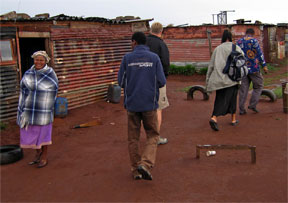
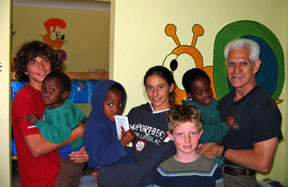
A team from my church recently visited some AIDS victims in Soweto, South Africa. |
It’s not a coincidence that in the Scriptures, poverty is mentioned more than 2,100 times. It’s not an accident. That’s a lot of air time, 2,100 mentions.
Get involved in what God is doing—because it’s already blessed. Well, God, as I said, is with the poor. That, I believe, is what God is doing. And that is what He’s calling us to do.
Is this correct? Does Scripture actually teach that God is so identified with the poor? Is caring for and doing justice for the poor truly a biblical priority, or is it trumped up by those with a certain social agenda?
I'm not convinced that poverty is mentioned in the Bible more than 2,100 times. That seems like an exaggerated number to me. But, otherwise, Bono's points accurately reflect both the frequency and the centrality of biblical passages concerning God and the poor. In my next post I'll look at several of these passages and comment on their relevance. Today I'll end with one particularly juicy text from Isaiah 58:
6 Is not this the fast that I choose:
to loose the bonds of injustice,
to undo the thongs of the yoke,
to let the oppressed go free,
and to break every yoke?
7 Is it not to share your bread with the hungry,
and bring the homeless poor into your house;
when you see the naked, to cover them,
and not to hide yourself from your own kin?
8 Then your light shall break forth like the dawn,
and your healing shall spring up quickly;
your vindicator shall go before you,
the glory of the LORD shall be your rear guard.
9 Then you shall call, and the LORD will answer;
you shall cry for help, and he will say, Here I am.
If you remove the yoke from among you,
the pointing of the finger, the speaking of evil,
10 if you offer your food to the hungry
and satisfy the needs of the afflicted,
then your light shall rise in the darkness
and your gloom be like the noonday.
11 The LORD will guide you continually,
and satisfy your needs in parched places,
and make your bones strong;
and you shall be like a watered garden,
like a spring of water,
whose waters never fail.
12 Your ancient ruins shall be rebuilt;
you shall raise up the foundations of many generations;
you shall be called the repairer of the breach,
the restorer of streets to live in.
God and the Poor: Biblical Testimonies
Part 12 of series: Ruminating on the National Prayer Breakfast
Posted for Friday, February 17, 2006
Yesterday I began considering the claim made by Bono in his Prayer Breakfast "sermon," that God is "with" the poor. Like many Christians from a variety of theological traditions, Bono asserts that God is on the side of the poor, and therefore we should be as well. This is his primary argument in favor of the One Campaign, an effort to get the U.S. government to devote one percent of its budget to alleviate poverty and disease, especially in Africa.
I concluded my last post by quoting several verses from Isaiah 58, in which God calls His people to "loose the bonds of injustice, . . . to share [their] bread with the hungry, and bring the homeless poor into [their] house" (vv. 6-7). The Lord urges them to "offer [their] food to the hungry, and satisfy the needs of the afflicted" (v. 10). If God's people will do this, then they will experience rich blessing, including divine guidance and protection. Although this passage from Isaiah was not originally spoken to us, it surely reveals something of God's timeless priorities, not to mention God's heart.
But there are many, many other biblical passages that make a similar point. If you read through the Bible, you can't help but be impressed by how often the issue of poverty is addressed (even if Bono's 2,100 times is a bit of a stretch). A concern for the poor isn't a feature simply of the Old Testament prophetic literature. In fact, it can be found in all major genres of Scripture, including: law, history, psalms, wisdom, prophets, gospels, and epistles. |
|
| |
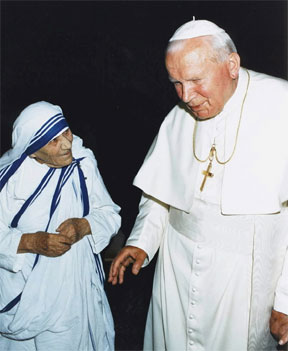
Mother Teresa and John Paul II, two of the last century's strongest advocates for the poor. |
In the rest of this post, I'm going to list a variety of biblical texts without further comment. These represent different portions of Scripture and different kinds of writing. They highlight different aspects of God's concern for the poor. Yet, in spite of their differences, these passages are unified in pointing to the centrality of the poor when it comes to God's heart, God's justice, and God's agenda for humanity. If you read these passages carefully, and if you realize that they represent dozens of others like them, I think you'll agree that the God of the Bible cares deeply for the poor and for the alleviation of their poverty, and that God calls His people to share his commitment.
Exodus 22:25 If you lend money to my people, to the poor among you, you shall not deal with them as a creditor; you shall not exact interest from them.
Exodus 23:6 You shall not pervert the justice due to your poor in their lawsuits.
Leviticus 19:10 You shall not strip your vineyard bare, or gather the fallen grapes of your vineyard; you shall leave them for the poor and the alien: I am the LORD your God.
Deuteronomy 15:1 Every seventh year you shall grant a remission of debts. 2 And this is the manner of the remission: every creditor shall remit the claim that is held against a neighbor, not exacting it of a neighbor who is a member of the community, because the LORD’S remission has been proclaimed. 3 Of a foreigner you may exact it, but you must remit your claim on whatever any member of your community owes you. 4 There will, however, be no one in need among you, because the LORD is sure to bless you in the land that the LORD your God is giving you as a possession to occupy,
Deuteronomy 15:10 Give liberally and be ungrudging when you do so, for on this account the LORD your God will bless you in all your work and in all that you undertake. 11 Since there will never cease to be some in need on the earth, I therefore command you, “Open your hand to the poor and needy neighbor in your land.”
Psalm 41:1 Happy are those who consider the poor;
the LORD delivers them in the day of trouble.
Psalm 72:4 May [the king] defend the cause of the poor of the people,
give deliverance to the needy,
and crush the oppressor.
Psalm 82:3 Give justice to the weak and the orphan;
maintain the right of the lowly and the destitute.
4 Rescue the weak and the needy;
deliver them from the hand of the wicked.”
Psalm 140:12 I know that the LORD maintains the cause of the needy,
and executes justice for the poor.
Proverbs 14:31 Those who oppress the poor insult their Maker,
but those who are kind to the needy honor him.
Proverbs 19:17 Whoever is kind to the poor lends to the LORD,
and will be repaid in full.
Isaiah 11:1 A shoot shall come out from the stump of Jesse,
and a branch shall grow out of his roots. . . .
4 but with righteousness he shall judge the poor,
and decide with equity for the meek of the earth;
he shall strike the earth with the rod of his mouth,
and with the breath of his lips he shall kill the wicked.
Matthew 25:34 Then the king will say to those at his right hand, "Come, you that are blessed by my Father, inherit the kingdom prepared for you from the foundation of the world; 35 for I was hungry and you gave me food, I was thirsty and you gave me something to drink, I was a stranger and you welcomed me, 36 I was naked and you gave me clothing, I was sick and you took care of me, I was in prison and you visited me."
Luke 4:18 “The Spirit of the Lord is upon me,
because he has anointed me
to bring good news to the poor.
He has sent me to proclaim release to the captives
and recovery of sight to the blind,
to let the oppressed go free"
Luke 14:13 But when you give a banquet, invite the poor, the crippled, the lame, and the blind.
James 2:1 My brothers and sisters, do you with your acts of favoritism really believe in our glorious Lord Jesus Christ? 2 For if a person with gold rings and in fine clothes comes into your assembly, and if a poor person in dirty clothes also comes in, 3 and if you take notice of the one wearing the fine clothes and say, “Have a seat here, please,” while to the one who is poor you say, “Stand there,” or, “Sit at my feet,” 4 have you not made distinctions among yourselves, and become judges with evil thoughts? 5 Listen, my beloved brothers and sisters. Has not God chosen the poor in the world to be rich in faith and to be heirs of the kingdom that he has promised to those who love him? 6 But you have dishonored the poor. Is it not the rich who oppress you? Is it not they who drag you into court? 7 Is it not they who blaspheme the excellent name that was invoked over you?
In my next post I'll say a bit more about these passages, and how they help us to respond to the ONE Campaign.
Reflections on the ONE Campaign
Part 13 of series: Ruminating on the National Prayer Breakfast
Posted for Monday, February 20, 2006
In my last five posts in this series I've been considering Bono's "sermon" at the National Prayer Breakfast, the main point of which was to promote the ONE Campaign. The One Campaign is an effort by a wide assortment of individuals and aid organization to get the United States government to devote one percent of its annual budget to eliminating poverty throughout the world, and especially in Africa.
In my last three posts I've been focusing on the idea, articulated by Bono in his speech, echoing many other Christians, that God is on the side of the poor, and therefore we should be also. My last post was a collection of biblical passages from both Old and New Testaments which show, rather conclusively for anyone committed to biblical authority, that God does have a great concern for the poor, and that God's people ought to share this concern and act accordingly. For example, I quoted Proverbs 19:17, which reads, "Whoever is kind to the poor lends to the LORD, and will be repaid in full."
Biblical passages like this certainly support the intentions of the ONE Campaign, which are often summarized by the desire to "make poverty history." Helping the poor and seeking to eliminate the causes of poverty are surely consistent with God's revelation of His character and will. I don't think it's possible for a person to take the authority of Scripture seriously and not be committed to caring for the poor and to working for the alleviation of poverty. This means that I, and other Christians like me, should embrace the ultimate goals of the ONE Campaign. |
|
| |
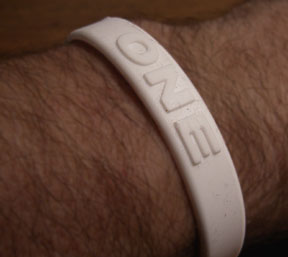
Supporters of the ONE Campaign are encouraged to wear one of these white wristbands.
|
Given the biblical mandate for Christians to care for the poor and to eliminate the causes of poverty, it seems almost unChristian to question the specific proposals of the ONE Campaign. Yet, I do not believe that every biblically-committed Christian must necessarily support the proposed strategies of the ONE Campaign, including its main strategy, which is the dedication of one percent of the federal budget to fighting global poverty. This specific proposal assumes many things upon which persons of good heart and strong conscience might disagree.
It assumes, for example, that it's appropriate for the federal government to use taxes for charitable causes. This may well be true, but it's certainly a debatable point.
Consider the specifics of the ONE Campaign for example. One percent of the national budget is about $25 billion. With the U.S. population approaching 300 million, this means that each person in the country would contribute a little over $80 per person, per year, to the cause. Of course this contribution would not be voluntary, but mandated by law and collected through income taxes. Now I'm more than happy to contribute $80 a year to help end poverty, or $320/year if you count my family members. In fact, we gratefully give a good bit more than this amount each year to some of the organizations that are sponsoring the ONE Campaign. I consider this my moral duty and privilege as a Christian. But there's quite a difference between giving money freely and having it taken through taxation. I have Christian friends who are exceedingly generous in their charitable giving, but who don't believe the federal government should be using tax dollars, taken from people without their consent, for charitable purposes.
To tell you the truth, my personal jury is still out on the question of whether this is something the government should do or not. I've heard arguments on both sides, and I've not yet been fully persuaded either way. (If you're new to my blog, I should explain that I often blog on issues about which I haven't fully made up my mind.) My point here is simply that a person could be solidly committed to ending poverty and sacrificially involved in this cause through charitable giving and personal involvement, and still not support the means of the ONE Campaign, even though fully endorsing its ends.
The One Campaign has produced a moving, one-minute video in support of its cause. (You can view it from the One Campaign website. Click on the "Watch the Video" link.) The video is made up of more than thirty celebrities reading, phrase by phrase, a statement in support of the campaign. The last line is read by Tom Hanks, who says, "We're not asking for your money. We're asking for your voice." This is true, in a way. But it's also not true, in another way. Yes, the One Campaign is not asking people to contribute voluntarily to the cause of alleviating poverty. But it is asking people to put pressure on the federal government to devote an additional one percent of the budget to this cause. If this were to become law, then everybody in the country would be forced to contribute an average of $80 per year through taxation. So, yes, the One Campaign isn't asking directly for our money. But it is asking us to support legislation that would in fact require us to pay a lot of extra money in taxes. And these taxes would come, not only from people who support the One Campaign, but from all citizens whether they liked it or not. This might in fact be the moral thing for our government to do. But I think this point at least deserves both scrutiny and open debate. I don't think it's something that one can merely assume either way.
There are other assumptions made by the One Campaign that need to be clarified and, in my opinion, debated before we move as a nation in this direction. I'll address a couple more of these in my next post.
Further Reflections on the ONE Campaign
Part 14 of series: Ruminating on the National Prayer Breakfast
Posted for Tuesday, February 21, 2006
In my last post I began reflecting on the ONE Campaign. I stated that its ultimate goal – to "make poverty history" – is surely a laudable one, especially for those of us whose values are shaped by the Bible. Yet I also suggested that the means proposed by the ONE Campaign, principally the commitment of one percent of the U.S. federal budget for poverty relief, were open to debate. In particular, the use of tax money for poverty relief in foreign countries seems like something that should be openly debated, and not merely assumed to be a good thing.
But the ONE Campaign makes other assumptions that deserve careful scrutiny. For example, it seems to believe that the U.S. Government would be an effective conduit of funds for the war on poverty. To be sure, if devoting one percent of the federal budget became a matter of law, the government would be able to collect the money needed through the IRS. Taxing people is surely easier and more successful than trying to get them to donate. But I have concerns about whether the federal bureaucracy should be entrusted with the disbursement of $25 billion a year to help eradicate poverty. I'm just not convinced that the government would handle this responsibility well.
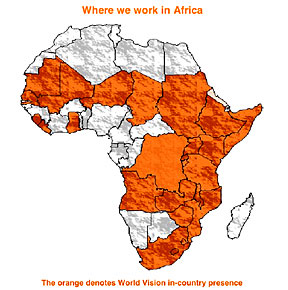
| For one thing, according to the ONE Campaign website, the government would disburse funds to "honest governments, private charities and faith-based institutions." I'll raise a concern about the "honest governments" piece a bit later. For now, I simply want to note that the ONE Campaign envisions tax dollars being directed to "faith-based institutions." No matter what your personal perspective on this idea, you've got to admit that this has been one of the more controversial topics of the last few years. Whenever President Bush mentioned government funding of faith-based institutions, his critics hit the roof. Now, it surely makes sense to me to fight poverty through faith-based institutions, like World Vision, because they have a strong track record in the field of effective care for the poor and building social structures to eliminate poverty (like schools, medical facilities, and water sources). For an overview of World Vision's work in Africa, see the World Vision Africa website. But the idea that the federal government would fund a part of World Vision's effort, when the organization has a explicit Christian commitment, is a messy one at best. Again, this may be the right thing to do, but there ought to be a fair amount of debate about the point. |
|
| |
Countries in Africa in which World Vision is active. Picture from the World Vision Africa website.
|
Moreover, I'm not confident that the federal government is the right institution to oversee such a project. The recent FEMA scandals illustrate my point all too well. If we can't trust the federal government to provide an effective response to our own national crises, why should we trust it to do a good, or even an adequate job responding to the crises in Africa and elsewhere in the third world?
The fact is that the U.S. Government, like most if not all Western governments, has a very difficult time grasping the needs, cultural distinctives, and political realities of Africa. We have managed to do some things well, thank God. Bono, in his sermon to the National Prayer Breakfast, credited the President and the U.S. Government with funding AIDS relief that has put 700,000 people onto anti-retroviral drugs (for HIV patients). According to Bono, we can be "very, very proud" of this achievement.
But the picture of American involvement in Africa is a confused and not altogether pretty one. Just today, ironically enough, a front-page story in the Los Angeles Times chronicled the multiple failures of the U.S. and other Western governments to grasp what's going on in African politics. As a result, we've end up supporting repressive regimes, or offering development aid in one year, only to withdraw it in the next when a government doesn't fulfill our expectations. As things keep getting worse in several African countries, the Times article focuses on Ethiopia, Uganda, and Kenya, the leaders of these countries end up blaming "what they call the overbearing policies of international donors for many of their woes." Uganda's President, Yoweri Museveni, who was once praised by Presidents Clinton and Bush, has offended Western nations with his anti-democratic policies to such an extent that many have cut or withdrawn development aid. Undeterred, Museveni has complained about the "paternalistic arrangement of the so-called donor-beggar relationship."
No matter how much the leaders of some African nations may be at fault, it seems like Western nations, including the U.S., are out of their league in the African aid game. Please understand that I'm saying this as a rank amateur, with no idea how to make things better. But at least you can see why I'm less than excited about a program that expects the U.S. government to be an effective administrator of billions upon billions of dollars in aid to Africa. It seems to me that we should at least ask if there might be a better way.
I imagine the response of ONE Campaign folk supporters be, "No, there really isn't a better way." Perhaps one of the strongest arguments in favor of the campaign would be this: There is no other institution in the world, other than the United States government, that could collect and disburse the multiple billions of dollars needed to eradicate poverty in Africa and elsewhere. Even granting the likelihood of inefficiency and ineffectiveness in the process, the size of the problem is such that no organization other than the U.S. government could raise and administer the funds needed to "make poverty history."
I find this argument persuasive, to a point. Yet it is based upon an assumption that needs to be examined in more detail. I'll save this for my next post.
A Bit More on the ONE Campaign
Part 15 of series: Ruminating on the National Prayer Breakfast
Posted for Wednesday, February 22, 2006
In recent posts I have been reflecting on the ONE Campaign. In today's post I want to add a bit more to what I've already said. Before I do this, however, it may be good to print the ONE Declaration once again, since it summarizes the point of the Campaign:
"WE BELIEVE that in the best American tradition of helping others help themselves, now is the time to join with other countries in a historic pact for compassion and justice to help the poorest people of the world overcome AIDS and extreme poverty. WE RECOGNIZE that a pact including such measures as fair trade, debt relief, fighting corruption and directing additional resources for basic needs - education, health, clean water, food, and care for orphans - would transform the futures and hopes of an entire generation in the poorest countries, at a cost equal to just one percent more of the US budget. WE COMMIT ourselves - one person, one voice, one vote at a time - to make a better, safer world for all."
Though I have been raising some concerns about the "one percent more of the US budget" part of the Campaign, I should say that I appreciate the Declaration's recognition that this alone won't solve the problem of poverty. "Fair trade, debt relief, fighting corruption" are certainly essential to the solution, as rightly emphasized in the Declaration. Of course the details of fairness and relief won't be easy to work out in practice.
The ONE Campaign website frequently mentions the need to fight corruption in countries plagued by poverty. On the Issues page of the Campaign website, a whole paragraph is devoted to the issue of corruption. It reads:
While corruption is harmful to all governments, losing resources to corrupt leaders is particularly devastating in poor countries where every dollar lost results in one less child in school or one less well dug to provide clean water. Approaches like America's Millennium Challenge which direct assistance to honest governments are the most effective, as is channeling assistance through private (and faith-based) relief and development agencies.
Note: The Millennium Challenge is a program launched by President Bush in 2002. For more information, check The Millennium Challenge Account page of the White House website.
The problem of corruption among African governments was specifically recognized in a recent speech by Archbishop Desmond Tutu addressed to the Assembly of the World Council of Churches. Here's a key paragraph from the summary provided on the World Council of Churches website:
|
[Archbishop Tutu] said of economic progress in Africa that the situation required a two-fold approach. Rich nations had to understand that an unjust economic order could not continue. However, he added, "We have been our own worst enemies. Africa has had a succession of corrupt governments - though Mobutu and Savimbi were encouraged by the West. But we too have responsibility. Government exists for the sake of the governed." |
|
| |
Archbishop Desmond Tutu at the recent World Council of Churches meeting in Brazil.
|
Though I know relatively little about African history and politics, it does seem that government corruption is a huge problem in this continent. Moreover, as documented in a recent story in the Los Angeles Times, some of the leading governments in Africa are not only corrupt, but also repressive and anti-democratic. For this reason, many Western nations (the article mentions Britain, Norway, Ireland, the U.S., and the Netherlands) have cut back development funding.
The ONE Campaign, though acknowledging the problem of government corruption, seems to assume that poverty will be overcome largely through the influx of billions upon billions of Western dollars. No doubt there is a measure of truth in this assumption, since dollars can do things like build hospitals, schools, and water treatment plants, or buy medicines for children stricken with HIV. Yet I wonder how much indigenous corruption is a significant cause of poverty, at least in some areas. If this is true, then adding dollars into the equation might make matters worse, rather than better. Or there might be short term gains, but long term losses.
Bono, in his National Prayer Breakfast sermon, addressed this concern in a couple of key paragraphs:
One percent is the girl in Africa who gets to go to school, thanks to you. One percent is the AIDS patient who gets her medicine, thanks to you. One percent is the African entrepreneur who can start a small family business thanks to you. One percent is not redecorating presidential palaces or money flowing down a rat hole. This one percent is digging waterholes to provide clean water.
One percent is a new partnership with Africa, not paternalism towards Africa, where increased assistance flows toward improved governance and initiatives with proven track records and away from boondoggles and white elephants of every description.
This sounds good, but I wonder how, practically speaking, we're supposed to make sure that development funds don't redecorate palaces, fill rat holes, underwrite boondoggles, and purchase white elephants. The Los Angeles Times article chronicles the repeated failures of Western governments to make sure aid dollars are well-used by honorable governments, as well as the increasing unwillingness of many African leaders to respect Western concerns about democracy and human rights. So I'm left to wonder about the practicality of the ONE Campaign's core strategy. It sounds good in a sermon, but will it work in the real world?
Another issue which, it seems to me, must be addressed in a larger forum has to do with global economics. Archbishop Tutu, in his speech to the World Council of Churches, spoke of "rich nations" needing "to understand that an unjust economic order could not continue." I expect that some of his concern is addressed in the ONE Campaign's call for "fair trade" and "debt relief." Yet I suspect there is much more here. So if it's true that poverty in Africa and elsewhere in the world is partly a result of an "unjust economic order" perpetuated by "rich nations," then devoting one percent of the U.S. federal budget to development in poor nations may not address some of the root causes of poverty. Here again, I'm not sufficiently knowledgeable to comment on the extent to which Archbishop Tutu is correct in what he alleges. But I remain troubled that the ONE Campaign may be overlooking both indigenous and global causes of poverty.
So far in my examination of the ONE Campaign, I have argued that its fundamental goal – to make poverty history -- is laudable and consistent with God's concern for the poor as revealed in the Bible. I have also raised several concerns about the specific strategies of the ONE Campaign. In my next post, I'll explain what I find to be most vital about this Campaign, and how I hope it impacts both our country as a whole and our individual lives.
Why the ONE Campaign is So Important
Part 16 of series: Ruminating on the National Prayer Breakfast
Posted for Thursday, February 23, 2006
In my last few posts I've been reflecting on the ONE Campaign. I'd sum up my reflections with two points:
1. The basic purpose of the ONE Campaign, "to make poverty history," is laudable, especially for those of us who follow biblical teaching.
2. The central proposal of the ONE Campaign, namely the use of one percent of the federal budget to fund the war on poverty, seems to me fraught with complications, both ethical and practical, and in need of serious, in-depth public debate.
Given my second point, it might seem as if I am unhappy about the ONE Campaign. But nothing could be further from the truth. Even though I remain to be convinced about the "one percent plank" of the Campaign's platform, I nevertheless believe that the ONE Campaign is playing an extraordinarily important role in our nation and, indeed, in our world.
Principally, the ONE Campaign is raising national awareness of the problem of poverty in our world, especially in Africa. It's terribly easy for Americans, most of whom live far removed from the horrors of poverty, to minimize what is surely the most horrible problem in our world today. Yes, I believe that global terrorism is a major threat. And, yes, I'm deeply concerned about the growing polarization between Muslims and the rest of the world. But if you add up all of the suffering that results from these crises, the total wouldn't begin to match the suffering caused by poverty.
According to the Food and Agriculture Organization of the United Nations, hunger and malnutrition are killing almost six million children each year. Many of these children die from infectious diseases that their bodies would ordinarily be able to fight were they not so weakened by hunger and malnutrition. This statistic alone points out the horrifying reality of poverty in our world. Six million children dying each year!
Of course there are many other negative conditions connected with poverty besides death from malnutrition, including: poor education, terrible health care, hopelessness, etc. These impact hundreds of millions of people throughout the world, most of them living in sub-Saharan Africa and southern Asia. According to Bread for the World, more than two billion people throughout the world are chronically malnourished.
Of course we can and should debate the root causes of poverty, and work on eradicating these. But I would add my small voice to chorus of people who are saying that, no matter what causes poverty, the fact of widespread poverty in our world is unacceptable. It's simply wrong that there are so many poor people on this earth. The wrong is made even more obvious by the fact that many of us live in relatively luxury, often with very little awareness of or concern for the poor. |
|
| |
Whatever has caused this child to be in this terrible condition, all persons of conscience must agree that it is morally unacceptable.
|
The ONE Campaign is helping to reverse this lack of awareness and concern by bringing the realities of poverty into the public square. People like Bono are using their fame and influence to force us to think about that which we'd rather avoid. And they are challenging us to consider what our role should be in the effort to "make poverty history." This impact of the ONE Campaign is extraordinarily important and timely. Thus, though I have reservations about some of the specifics of the Campaign, I'm extremely grateful for its existence and hope that it continues to promote awareness and public debate.
It seems to me that the issue of global poverty needs to be a much more prominent feature of American concern and conversation. In the last presidential election, for example, poverty was almost completely off the radar. This is understandable, given that fact that it's not a hot button issue for most voters. But I believe it should be, and the ONE Campaign could make this happen. My hope would be that in the next presidential election, candidates will have to explain how they envision America's role in the war on global poverty, and that their attractiveness to voters will be directly related to the thoughtfulness and integrity of their answers.
I realize this might sound overly idealistic. Okay, fine. I admit that most of us are self-centered, and that we'd rather not bother about poverty on the other side of the globe, especially if taking it seriously might require us to make certain sacrifices, like paying more for imported goods, or buying fewer designer shoes (not my weakness) or electronic gizmos (my weakness). Nevertheless, I believe that it would be possible for millions upon millions of Americans to become committed to the cause of eliminating global poverty. I say this, in part, because I believe many Americans have, underneath a shell of selfishness, generous hearts. The more they realize the human cost of poverty, the more they will want to help. Moreover, around 150 million American claim to acknowledge biblical authority. This means, in principle, that there are a whole lot of folks in our country who could be persuaded to join the war on poverty with their prayers, their activism, and their giving.
In my next post I will wrap up my discussion of the ONE Campaign my talking about its impact on my own life, and by suggesting a way that campaign supporters might be able to make a huge difference for the poor right now, without having to wait for elections, congressional votes, and so forth and so on.
Introducing the EIGHTY Campaign
Part 17 of series: Ruminating on the National Prayer Breakfast
Posted for Friday, February 24, 2006
With this post I'm wrapping up my reflections on the ONE Campaign, an effort to end global poverty by, among other things, getting the U.S. government to devote an additional one percent of the federal budget to fighting poverty throughout the world. So far I've applauded the basic goal of the Campaign, while raising some doubts about its central proposal to reach that goal. But, as I explained in my last post, I think the ONE Campaign is crucial because it is bringing the huge problem of poverty into the spotlight of American attention. We Americans simply have to take to heart the horrible fact that almost six million children will die this year because they are poor. And, no matter what the causes of this situation or what we believe should be done to fix it, it's time for all Americans to embrace the goal of eradicating poverty. Folks who see government as key in this work should press on with their efforts. Those who see private charities and business as central to the solution should press on with their efforts. But none of us should sit back and let millions of innocent children starve to death.
I've said that I think a national conversation about world poverty is extremely important. I hope this will happen, and that one result will be a growing demand that politicians begin to address this issue and propose their solutions. Our next president, no matter who he or she may be and which party he or she represents, should be expected, as a candidate, to lay out a vision for how America will fight global poverty. This vision should be a major factor in the 2008 elections.
Yet my fear is that all of this conversation about poverty might, in the end, amount to little more than hot air, and hot air won't feed dying children. We can talk, and talk, and talk, and while we're talking, millions of people will die of malnutrition. Millions of Americans can wear the ONE Campaign wristbands with the best of intentions, but this won't necessarily save one child from death this year. Or next year. Or the next. Even if the ONE Campaign were to be successful, it won't help the children who are starving to death today.
So, though I'm glad for the impact of the ONE Campaign, I'm also nervous that its impact will be delayed, or negligible. Worse yet, it might even allow millions of armband wearing Americans to feel virtuous about their participation in the war on poverty without requiring them to make any personal investment in the battle. This is a real danger, I think. We like to feel good about ourselves and our moral stands. We don't like to make personal sacrifices in light of them.
I believe the ONE Campaign offers a chance for millions of Americans to get personally involved in the war on poverty, right now. We don't have to wait for Congress to act. We can start today to make a difference. In fact, we can help save lives today. And we can do so by participating in the EIGHTY Campaign.
Haven't heard of this Campaign? No surprise, since I just made it up. Let me explain what it is.
Using very rough figures, if the ONE Campaign succeeds, and if the federal government votes to dedicate an additional one percent of its budget for poverty relief, then this works out to about $80 per year, per American, in additional taxes. So, every supporter of the ONE Campaign believes that the federal government should raise his or her taxes by an average of $80 per year to fund the war on poverty. This means, or at least it should mean, that every supporter of the ONE Campaign is willing to give $80 per year (at least) for this effort. (In reality, of course, wealthier supporters of the Campaign would give much more, while less wealthy supporters would give less.)
So, here's the core proposal of the EIGHTY Campaign:
Every person who supports the ONE Campaign should freely give eighty additional dollars per year to help overcome poverty. This should start right now, and should continue until the legal strategy of the ONE Campaign prevails.
Of course if the federal government never goes along with the one percent idea, then the ONE Campaign would, nevertheless, have raised huge amounts of money for poverty relief.
In his sermon at the National Prayer Breakfast Bono mentioned having two million signers of the ONE Declaration, with five million by November. If two million people were to give $80 each, that adds up to $160 million dollars in 2006 alone. If five million were to give $80 in 2006, that's roughly $400 million. Now that wouldn't end global poverty, but it sure would make a big difference. And this difference could happen right now, without getting any government involved.
Personal involvement in the EIGHTY Campaign would also strengthen the resolve and the credibility of the ONE Campaign supporters. Let's face it, it's not hard to wear a white wristband, especially when somebody cool like Bono asks you to do it. It takes a bit more commitment to give away $80. After all, that might be the cost of a pair of jeans, or eighty songs downloaded from the I-Tunes Store, or one night out at a nice restaurant. I'm sure many of those who wear ONE Campaign wristbands are students who would claim not to have an extra $80. But I wouldn't be surprised if those same students spend that much each month on lattes from Starbucks.
| Now let me make all of this more personal. I've been concerned about poverty for quite a while. Much of this concern has been stirred up through my church, which has numerous connections to ministries in the third world. In recent years, we've had growing relationships with folks in sub-Saharan Africa, which have translated into hands-on ministry (through mission trips) and a fair amount of charitable giving. We've helped build a school in Swaziland, and are working on other ways to care for African victims of HIV, especially children. My family and I have also been regular supporters of World Vision for many years. So a concern for the poor and a measure of personal involvement (largely through giving) are not new to me. |
|
| |
Four people from my church (the lighter skinned folk) caring for HIV orphans in South Africa.
|
Yet I've been thinking more about world poverty recently, thanks to the ONE Campaign. And I've been moved to do more. I don't know where this "more" will take me, though I expect that my family and I will actually visit our mission partners in Africa before too long. But, in the meanwhile, I've decided to be the first (and perhaps the only) supporter of the EIGHTY Campaign. For a few selfish moments, I reasoned that my family and I already give way more than this to World Vision and other Christian missions that are fighting hunger and AIDS in Africa, so I didn't have to cough up another eighty bucks. But then I felt embarrassed by my self-centered stinginess. Surely I can afford an additional $80 for hunger relief. And I can still have my lattes.
So I visited the World Vision USA website. At the top of their homepage there's a button entitled "Ways to Give." One click took me to page with lots of options for charitable giving. I clicked on the one that read, "Feed hungry children in Africa - $20." On the next page it was easy to change the amount to $80. In a couple more minutes my contribution was completed.
In telling you this, I realize that I may be doing something that Jesus Himself forbids, namely, giving to the poor for the sake of public approval. But my point isn't to brag. Rather, it's to let you know, first of all, that I'm trying hard not to be a hypocrite in all of this. Second, I want you to know how easy it is to make a real difference right now for hungry children in Africa. I just did it, easily. I don't feel especially virtuous, but I do feel as if I've done the right thing.
If you think the EIGHTY Campaign is a good idea, then by all means give to World Vision or to some other relief organization with a strong record of making a real, cost-effective difference in the world. And if you're a blogger, perhaps you can help get out the word about the EIGHTY Campaign.
At the end of the ONE Campaign video, Tom Hanks says, "We're not asking for your money. We're asking for your voice." Well, the EIGHTY Campaign is asking for your money, not for the Campaign, but for the kids. Give eighty bucks to the folks who can feed starving children. Do it now! Why wait?
Home
|