| |
A Resource by Mark D. Roberts |
|
Unmasking the Jesus Seminar
by Rev. Dr. Mark D. Roberts
Copyright © 2005 by Mark D. Roberts
Note: You may download this resource at no cost, for personal use or for use in a Christian ministry, as long as you are not publishing it for sale. All I ask is that you give credit where credit is due. For all other uses, please contact me at mark@markdroberts.com. Thank you.
My Various Writings on Jesus
The Birth of Jesus: Hype or History?
Was Jesus Divine? The Early Christian Understanding
Why Did Jesus Have to Die?
Was Jesus Married? A Careful Look at the Real Evidence
What Was the Message of Jesus?
How Can We Know Anything about the Real Jesus?
What Languages Did Jesus Speak and Why Does It Matter?
Recovering the Scandal of the Cross?
The Passion of the Christ: An In-Depth Review
Book -- Jesus Revealed: Know Him Better to Love Him Better
Robert W. Funk and the Jesus Seminar 
Part 1 of the series: Unmasking the Jesus Seminar
Posted for Monday, September 12, 2005
In yesterday's post I commented on the strange combination on the obituary page of the Los Angeles Times. There was Bob Denver, who made his mark on the world as the character of Gilligan from the hit sitcom, Gilligan's Island. Joining Denver was Robert W. Funk, a biblical scholar. As I began to explain yesterday, Funk's fame depended less on his academic efforts and more on his combination of organizational ability and PR genius. Let me elaborate a bit.
Robert Funk made his greatest mark on the world, not through his academic efforts, but through his leadership of the Westar Institute, which he founded in 1985. This institute, though seemingly an academic think-tank, was in fact an agenda-driven effort to undermine orthodox Christianity. In saying this, I am not dishonoring the memory of Robert Funk, but in fact preserving his memory. As you'll see later in this post, and in tomorrow's as well, Funk was quite clear about his anti-Christian agenda.
Funk's most successful creation was the Jesus Seminar, a group of scholars and others (including film director Paul Verhoeven, who made such religious classics as Basic Instinct and Showgirls) who took it upon themselves to decide what Jesus really said and did. They made presentations and voted by use of different colored beads. This enterprise, though apparently objective, was in fact a stacked deck from the beginning. After all, Robert Funk himself determined who was in the Seminar and who wasn't. If you knew anything about New Testament scholarship, you could see from the configuration of Jesus Seminar fellows that they were going to end up with a very minimal Jesus at best. (In fact seven of the fellows were colleagues of mine in grad school at Harvard.)
It was obvious from the beginning that Funk's agenda for The Jesus Seminar was not consistent with classical Christianity. He said so himself in the very first meeting of the Seminar: |
|
| |
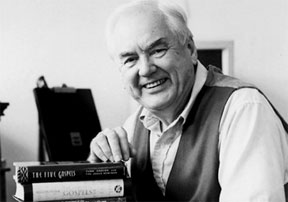
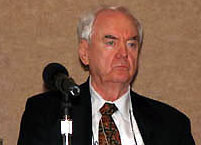
Above: Robert W. Funk (1926 - 2005)
Below: Alan Hale (1918 - 1990)
So I'm looking at the photo of Robert Funk (above), and thinking about Bob Denver/Gilligan, when all of a sudden it occurs to me that Funk looks rather like The Skipper from Gilligan's Island. Strange things happen to people when they spend too long staring at computer screens.
|
 |
Those of us who work with that hypothetical middle [between creation and the end of all things] —Jesus of Nazareth—are hard pressed to concoct any form of coherence that will unite beginning, middle, and end in some grand new fiction that will meet all the requirements of narrative. To put the matter bluntly, we are having as much trouble with the middle—the messiah—as we are with the terminal points. What we need is a new fiction that takes as its starting point the central event in the Judeo-Christian drama and reconciles that middle with a new story that reaches beyond old beginnings and endings. In sum, we need a new narrative of Jesus, a new gospel, if you will, that places Jesus differently in the grand scheme, the epic story. (italics mine)
When somebody asks for a new gospel, implying that the classic Christian gospel is insufficient, you know you've left orthodoxy far beyond. In Funk's new gospel, Jesus doesn't fare so well. At another time Robert Funk said this about Jesus:
We should give Jesus a demotion. It is no longer credible to think of Jesus as divine. Jesus' divinity goes together with the old theistic way of thinking about God.
The plot early Christians invented for a divine redeemer figure is as archaic as the mythology in which it is framed. A Jesus who drops down out of heaven, performs some magical act that frees human beings from the power of sin, rises from the dead, and returns to heaven is simply no longer credible. The notion that he will return at the end of time and sit in cosmic judgment is equally incredible. We must find a new plot for a more credible Jesus.
So, though the Jesus Seminar gathered a number of scholars, and though some of its methods were the stuff of critical scholarship, and though some of the fellows are fine biblical scholars, the Seminar itself was not a truly academic exercise. It was, in fact, a carefully-contrived effort to erode classic Christian faith.
And it was, above all, a brilliant PR scheme. Robert Funk managed to convince the mainstream media that he and his fellows were discovering once and for all what Jesus really said and did. For several years Funk was omnipresent in newspapers and on television programs, assuring us that Jesus never really said most of what is attributed to him in the gospels, and that he didn't rise from the dead, and that orthodox Christianity is completely wrong in almost everything it believes about Jesus. Funk explained all of this soberly, allowing the public to believe that the Jesus Seminar was a theologically-neutral effort of well-meaning scholars to discover the truth about Jesus. By perpetuating this image, quite in contrast to his more honest remarks in meetings of the Jesus Seminar, Funk was less than fully candid. But the secular media, predictably enough, swallowed Funk's bait, hook, line, and sinker. For years we saw stories about how the Jesus Seminar concluded that Jesus didn't say much of what is attributed to him in the gospels, and that He didn't actually rise from the dead. (Gasp! What a surprised conclusion!)
Finally, the Jesus Seminar ran its course, as it ran out of things about Jesus to debunk. Though the Seminar continues to meet, and sponsors programs in a few churches (!), it has largely disappeared from the public eye. It did launch the careers of several scholars who continue to pontificate on the "historical" Jesus, however, prolific folk like Marcus Borg and John Dominic Crossan. (I should note that some of the fellows of The Jesus Seminar were serious scholars whose reasonable voices were drowned in the sea of Funk's agenda. I have a friend, a highly critical scholar, in fact, who was once a member of the Seminar, but was "fired" by Funk when he complained that the Seminar process was an intellectual sham.)
Perhaps you think I'm being too hard on Robert Funk, and am exaggerating his anti-Christian agenda. Tomorrow I'll provide even more evidence that reveals Funk's broader vision, evidence from his own pen, in fact, evidence that Funk himself didn't hide, but rather boldly proclaimed (and posted on the Internet). You'll see just how eager he was to displace orthodox Christianity with something altogether different.
The Radical Vision of Robert Funk
Part 2 of series: Unmasking the Jesus Seminar 
Posted for Tuesday, September 13, 2005
A New Theology Blog Hosted by World Magazine
World Magazine is hosting a new theological blog, called, sensibly enough, Theologica. There are ten bloggers in the Theologica consortium, including me. The ten of us represent a wide range of religious experience and theological perspective, though still within a range you could safely call "evangelical." I will be posting on Theologica on a regular basis, though with a somewhat narrower range of subject matter than on my home blog. I'll include links on my site to let you know what I'm doing over there. But I'd highly recommend that you visit Theologica on a regular basis. |
In yesterday's post I noted recent death of Robert W. Funk, founder of the Westar Institute and its famous (infamous!?) Jesus Seminar. I claimed that Funk put together the Seminar as a part of his plan to derail orthodox Christianity, including and especially classic Christian understanding of Jesus.
If you're unfamiliar with my writing, or if you're unfamiliar with the work of Robert Funk, you may think me overly critical, perhaps even inexcusably hyperbolic. Did Funk really want to overthrow Christian orthodoxy? Wasn't he just a scholar who came up with some ideas about Jesus that are uncomfortable for orthodox Christians like me? Can I defend my claims about Funk's anti-Christian agenda?
Yes, indeed I can. Easily, in fact, by using Robert Funk's own words. In 1998 he wrote a short paper entitled "The Coming Radical Reformation." This paper included 21 theses (without arguments) that encapsulate Funk's vision for the future of Christianity (or the end of Christianity). Two of those theses I included in my last post on Funk (the ones about demoting Jesus). In this post I'll reproduce several more of Funk's theses: |
|
| |
Robert Funk at one of the meetings of the Jesus Seminar.
|
1. The God of the metaphysical age is dead. There is not a personal god out there external to human beings and the material world. We must reckon with a deep crisis in god talk and replace it with talk about whether the universe has meaning and whether human life has purpose.
4. The notion that God interferes with the order of nature from time to time in order to aid or punish is no longer credible, in spite of the fact that most people still believe it. Miracles are an affront to the justice and integrity of God, however understood. Miracles are conceivable only as the inexplicable; otherwise they contradict the regularity of the order of the physical universe.
5. Prayer is meaningless when understood as requests addressed to an external God for favor or forgiveness and meaningless if God does not interfere with the laws of nature. Prayer as praise is a remnant of the age of kingship in the ancient Near East and is beneath the dignity of deity. Prayer should be understood principally as meditation—as listening rather than talking—and as attention to the needs of neighbor.
9. The doctrine of the atonement—the claim that God killed his own son in order to satisfy his thirst for satisfaction—is subrational and subethical. This monstrous doctrine is the stepchild of a primitive sacrificial system in which the gods had to be appeased by offering them some special gift, such as a child or an animal.
10. The resurrection of Jesus did not involve the resuscitation of a corpse. Jesus did not rise from the dead, except perhaps in some metaphorical sense. The meaning of the resurrection is that a few of his followers—probably no more than two or three—finally came to understand what he was all about. When the significance of his words and deeds dawned on them, they knew of no other terms in which to express their amazement than to claim that they had seen him alive.
20. The Bible does not contain fixed, objective standards of behavior that should govern human behavior for all time. This includes the ten commandments as well as the admonitions of Jesus.
As you can well imagine, I don't agree with much of this. In fact, I think there are only two sentences here that I can affirm:
The notion that God interferes with the order of nature from time to time in order to aid or punish is no longer credible, in spite of the fact that most people still believe it.
I think that to speak of God "interfering" with the order of nature is a theologically mistaken way to think of the world. Rather, I believe that God is regularly and profoundly involved in this world, including the order of nature. My problem is with the notion of "interfering."
The resurrection of Jesus did not involve the resuscitation of a corpse.
I agree with this statement, and so do most orthodox Christians. What happened to Jesus was far more than merely a "resuscitation of a corpse." See 1 Corinthians 15, for example. But I do believe, contra Funk, that the body of Jesus really did come out of the tomb, experiencing something far more wonderful and transcendent than resuscitation.
You can see in Funk's theses what lies behind the Westar Institute and the mission of the Jesus Seminar. To his credit, Funk laid his cards on the table in "The Coming Radical Reformation." Many scholars who share his theological agenda keep their personal opinions secret, realizing that knowledge of what they believe would undermine their scholarly credibility. When he was dealing with the secular press, however, Funk did not explain how the Jesus Seminar was part and parcel of his larger theological vision. Rather, the Seminar wore a mask of scholarly objectivity and dispassionate scientific inquiry. It's this mask that I am attempting to take off in this series.
I think it's pretty obvious that Robert W. Funk wasn't exactly a big fan of Christian orthodoxy. But now that he has passed from this life into the next, he knows the truth, whatever it may be. Of course if his worldview is correct, he knows nothing at all, since he didn't seem to believe in an afterlife. But I happen to think that Robert Funk has now seen the Lord "face to face," even as he once saw as if in a mirror, "dimly," indeed, very dimly (1 Corinthians 13:12).
My gratitude for Robert W. Funk is rather limited. His early academic work did help me in mine, especially his translating of the NT grammar book which I have used for dozens of hours, maybe hundreds. His later efforts having to do with Jesus haven't helped me directly, though they have forced me to sharpen my own thinking about Jesus. For this I am grateful. I only wish such a fine mind had been employed for the sake of the genuine gospel, rather than for the sake of replacing it with Funk's new revised version of the gospel.
The Jesus Seminar: What I Expected
Part 3 of series: Unmasking the Jesus Seminar
Posted for Wednesday, September 14, 2005
I first heard about the Jesus Seminar in the late 1980's. I was back at Harvard meeting with one of my New Testament professors to discuss my Ph.D. dissertation. For some reason, he started talking about the Jesus Seminar. When I confessed that I didn't know what he was talking about, he spouted "It's #*!&*!," using a word that won't appear in my blog.
This professor, you must understand, was by no means an evangelical or conservative Christian. Liberal in theology, he was also a highly critical New Testament scholar who approached the question of the historical Jesus with what I would call "acute skepticism." So his difference with the Jesus Seminar was not the sort that one might find among evangelicals who have a high regard for the historicity of the gospels. Rather, my professor thought it was #*!&*! to think that one could determine what Jesus really said by getting a bunch of academics together in a room and voting.
Though I knew relatively little about the Jesus Seminar at this time, I had pretty clear expectations about how it would approach the whole question of what Jesus said and did. I figured that the Seminar would deal with the historical Jesus in the mode that was common in secular New Testament scholarship. |
|
| |
Harvard Divinity School, where I spent most of my time while earning my Ph.D. in New Testament, and which produced at least 10% of the fellows in the Jesus Seminar, though none on the Harvard faculty joined the Seminar.
|
This mode included two crucial parts. Part 1 was extreme skepticism about the historical reliability of the New Testament gospels. For decades it had been common for non-conservative biblical scholars to assume – often without argument or evidence – that much of what appears on the lips of Jesus in the biblical gospels was made up by the early church. There are lots of reasons for this bias, which I don't have time to explain now. But it meant, for example, that when the Gospel of Mark attributes a certain saying to Jesus, many scholars had an a priori inclination to believe that Jesus did not say what he appears to have said. In the case of the historical accuracy of the biblical gospels, it was "Guilty until proven innocent," and not the other way around. Given the constituency of the Jesus Seminar, I expected that extreme skepticism would be rule of the day, and I was right in a way. But, in another way, I was quite wrong, because at many times the Seminar operated with almost naïve faith in the authenticity of certain sayings of Jesus. I'll explain what I mean later.
The second element of New Testament scholarship on Jesus that I expected to find in the Jesus Seminar was faithful reliance on the criterion of dissimilarity. This criterion was developed by New Testament scholars in the middle of the 20th century, as a response to the hyper-skepticism that dominated studies of Jesus at that time. Whereas many scholars argued that we couldn't really know if Jesus actually said anything attributed to him in the gospels, other critical scholars devised a way to show how certain sayings almost surely came from Jesus himself. This way was the criterion of dissimilarity. It ran something like this: If a saying of Jesus doesn't sound like something in Jesus's Jewish culture or religion, and if it doesn't sound like something that was common in the early Christian church, then it may well have come from Jesus himself.
I must confess that I'm not a big fan of the criterion of dissimilarity, though it can help severe skeptics find sayings of Jesus that they can believe to be authentic. The problem is, however, that what's left after you apply the criterion of dissimilarity is authentic, but distorted.
Think about it for a moment. If you consider any influential leader of history – and surely Jesus should fit into that category – you'd expect that person to reflect in many ways the ideas and language of his or her age. Moreover, you'd expect that this person's followers would pick up on a number of his or her ideas, even if they changed, misunderstood, or added to them. So if you take away from Jesus that which he shared with Judaism of His day, and if you take away that which the early Christians picked up from Jesus, you're left with something authentic that may, however, misrepresent the heart and soul of Jesus's real teaching.
| Let me use a personal analogy. Suppose someday people are studying my sermons for some strange reason. And suppose they are doubting whether I really wrote what is attributed to me. So they decide to take away from my preaching whatever I share in common with American evangelicals (my theological culture) and whatever my own church has actually learned and repeated from my preaching. What would be left? Not much. And you'd completely eliminate almost everything I consider to be most important about my preaching. |
|
| |
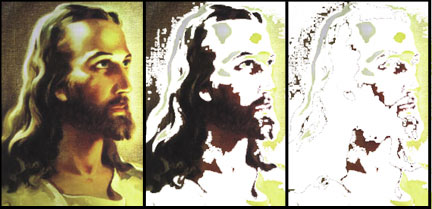
The montage above exemplifies the problem with using the criterion of dissimilarity. I began with Sallman's classic portrait of Jesus. Then I took away the light brown color, which is rather like taking away Judaism from Jesus. Then, from this new picture, I took away the dark brown color, which is like taking away from Jesus that which He holds in common with the early church. What is left behind is certainly part of Sallman's original picture. But the image looks almost nothing like the original.
|
This analogy is rough, of course, if not vainly self-serving. But it does point out the folly of relying too heavily upon the criterion of dissimilarity when trying to determine what Jesus actually said. In the end, you may get authentic stuff, but it's most likely that you'll miss all of the most important stuff.
The Jesus Seminar did employ the criterion of dissimilarity in places, much as I expected. But it did so far less than I anticipated, almost to a shocking degree. In fact, rather than approach the sayings of Jesus with skepticism, and applying the criterion of dissimilarity with rigor, the Seminar adopted a completely different, novel approach to Jesus. This approach, oddly enough, ends up looking a whole lot like the conservative approach to Jesus that the Seminar writings so often decry.
In my next post I'll explain how the Jesus Seminar did in fact approach the sayings of Jesus, with a methodology that I found quite unexpected.
The Jesus Seminar: A Beady Democracy?
Part 4 of series: Unmasking the Jesus Seminar
Posted for Thursday, September 15, 2005
When I first heard of the Jesus Seminar, I envisioned scholars laboring over ancient tomes in library carrels, then presenting their findings to their colleagues in roundtable discussions, then debating the minute details of each proposal, and trying to come to a consensus, though I doubted that a consensus was likely, or even possible when it came to the question of what Jesus actually said. I knew that New Testament scholars held a wide range of views on this matter, and that their conclusions often reflected widely different starting points.
What I did not picture was a roomful of academics secretly dropping colored beads into boxes as a way of voting on what Jesus said or not. But that's exactly what happened in the Jesus Seminar. After relatively brief presentations on passages from the gospels, and minimal debate, the Seminar Fellows voted in secret by using red, pink, gray, and black beads. This was something I had never imagined, and it seemed more like a glass bead game than a serious academic exercise.
For one thing, the very notion of a secret vote impressed me as contrary to the spirit and commitment of academia. If scholars are known for anything positive, it's for publicly displaying their conclusions and their arguments so that they be supported or critiqued by others. A secret ballot contradicts this principle of openness and accountability. (I wonder if the secrecy was meant to mask the fact that the results of each vote were almost always predetermined by the makeup of the Seminar itself. Why else vote in secret?)
In case you're unfamiliar with the meaning of the Seminar's bead game, let me explain. The beads indicated the extent to which a scholar believed a certain saying attributed to Jesus to be uttered by Jesus or not. According to the helpful paraphrase in The Five Gospels (the summary of the Jesus Seminar findings written by Robert Funk and Roy Hoover), the beads had the following significance:
red: That's Jesus!
pink: Sure sounds like
Jesus.
gray: Well, maybe.
black: There's been some
mistake.
Then, when the votes were in, they were given numerical value and averaged, so that each saying of Jesus ended up with a red, pink, gray, or black color. These results were published in The Five Gospels, with verses printed in the appropriate colors. This was, by the way, an intentional updating of the "words of Jesus in red" Bibles of the past. |
|
| |
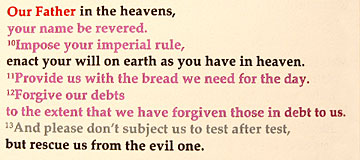
Here is how "The Lord's Prayer" in Matthew 6 appears in The Five Gospels. The translation is the so-called Scholars Version made by members of the Jesus Seminar. You can see words in red (surely Jesus), pink (probably Jesus), gray (maybe Jesus, but probably not), and black (not Jesus). I guess all we can know for sure is that the Lord's Prayer was once even shorter!
|
This voting system wasn't quite as helpful as it seems, however. For one thing, it completely masks significant disagreement among Fellows in the Seminar. If, for example, a certain saying of Jesus received relatively similar numbers of red, pink, gray, and black votes, then the correct conclusion would be that there is no scholarly consensus at all, and it would be important for people outside of the Seminar to know this. But, in fact, the saying would get a gray vote, suggesting that the Seminar as a whole had major doubts about whether it originated with Jesus or not. The reader would be led to believe that there was scholarly agreement when in fact such harmony was nowhere to be found. (The clearest case in The Five Gospels is Thomas 42, where the vote was split 20/30/30/20, and was printed in gray, even though half of the Seminar Fellows regarded the verse as probably or certainly from Jesus Himself. See The Five Gospels, p. 496)
In certain instances, the final color of a saying seems to be more the result of the bias of the Seminar than its actual numerical vote. Concerning the parable of the two sons in Matthew 21:28-31, here's what The Five Gospels says, "Fifty-eight percent of the Fellows voted red or pink for the parable, 53 percent for the saying in v. 31b. A substantial number of gray and black votes pulled the weighted average into the gray category" (p. 232). So, even though a solid majority of the Fellows believed that the parable was probably or certainly from Jesus, the parable is colored in gray. The power of the minority voting with black beads could obscure the judgment of the majority.
I know this sounds like nonsense, but it is defended in the "Introduction" to The Five Gospels. "Black votes in particular could readily pull an average down, as students know who have on "F" along with several "A"s. Yet this shortcoming seemed consonant with the methodological skepticism that was a working principle of the Seminar: when in sufficient doubt, leave it out." One might add, even if the majority puts it in, sometimes you can leave it out.
On the surface, the voting scheme of the Seminar appeared to be fairly objective. Yet, when you peek under the mask of democratic fairness, here's what you find:
Robert Funk himself chose the Fellows of the Seminar, virtually guaranteeing the results he wanted at the outset. But then, even when a majority of the skeptically-minded Fellows believed that a saying of Jesus was certainly or probably from Jesus Himself, a minority could skew the result by voting black. And because the vote was secret, there was no way for anybody to hold the black-bead voters accountable. The average person would be led to believe that the Seminar as a whole held that a saying was probably not from Jesus, even though the truth was that 1) there was a wide diversity of opinion, and 2) the majority of Fellows considered the saying to be probably or certainly from Jesus.
In sum, the Seminar's method of voting and reporting on the authenticity of Jesus's sayings was fraught with obfuscation and bias. It suggested a degree of scholarly consensus that was often nowhere to be found. It precluded the kind of accountability that is common in academia. And it pressed certain sayings into the gray and black realm even when the majority of Fellows had regarded them as red or pink.
The best thing about the beady voting method, however, was that it captured the imagination of the press. Funk and his Fellows had devised a lousy way of evaluating the authenticity of Jesus's sayings, but a brilliant PR device.
The Jesus Seminar: A Circle Dance?
Part 5 of series: Unmasking the Jesus Seminar
Posted for Friday, September 16, 2005
As I explained in yesterday's post, I was surprised by the way the Jesus Seminar decided to determine which sayings of Jesus were authentic. At first glance, the red, pink, gray, and black bead system seemed innocuous enough, though perhaps a little silly. But upon deeper inspection, it was fraught with shortcomings. So this was one of my first unhappy surprises as I investigated the Jesus Seminar.
The next surprise was perhaps even more startling and disheartening. It came as I read the "Introduction" to the Jesus Seminar's first and most influential work, The Five Gospels. Now I fully expected to find the sorts of approaches that were familiar to me because of my academic work at Harvard. So I wasn't surprised when I read things like:
the gospels are now assumed to be narratives in which the memory of Jesus is embellished by mythic elements that express the church's faith in him, and by plausible fictions that enhance the telling of the gospel story for first-century listeners who knew about divine men and miracle workers firsthand. Supposedly historical elements in these narratives must therefore be demonstrated to be so.
Funk and Hoover, writers of the "Introduction," speak as if all scholars make this assumption. In fact many highly regarded scholars at highly respected academic institutions do not make these assumptions about the gospel narratives. But, given the make up of the Jesus Seminar, I wasn't surprised to find this sort of skepticism in their writings.
What shocked me was how the Jesus Seminar proposed to evaluate the authenticity of the sayings of Jesus. The "Introduction" to The Five Gospels lists twelve "Rules of Written Evidence" and twenty four "Rules of Oral Evidence." Here's how the rules are described:
The Jesus Seminar formulated and adopted "rules of evidence" to guide its assessment of gospel traditions. Rules of evidence are standards by which evidence is presented and evaluated in a court of law.
So, the Seminar used their "rules of evidence" to evaluate which sayings Jesus really said and which He did not, to varying degrees of probability. |
|
| |
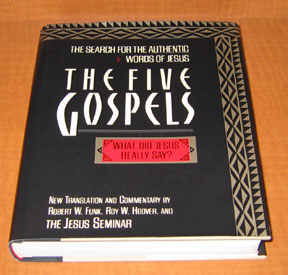
A photo of The Five Gospels. Notice the red box, which boldly asks, "What did Jesus really say?" |
So far, so good. This is how scholarship proceeds, with rules or practices that help scholars to evaluate evidence carefully and objectively. But when I first read the rules adopted by the Jesus Seminar, I was astounded. Why? To put the matter bluntly: Many of their rules completely beg the question. They don't established principles for evaluating evidence. Instead, they make assumptions that utterly presuppose the very thing the Seminar is supposedly trying to discover, how and what Jesus actually said.
Let me provide a couple of examples. Today I'll draw from the "Rules of Written Evidence" section. Tomorrow I'll focus on the "Rules of Oral Evidence." The "Rules of Written Evidence" have to do with what the gospel writers did (or supposedly did) with the oral traditions and written sources at their disposal. The "Rules of Oral Evidence" concern the way the sayings of Jesus were passed down by word of mouth before they were written down.
Here are two (of twelve) of the "Rules of Written" evidence that helped the Jesus Seminar to judge the authenticity of the sayings of Jesus:
• Words borrowed from the fund of common lore or the Greek scriptures are often put on the lips of Jesus.
• The evangelists frequently attribute their own statements to Jesus.
Both of these "rules" fall in the general category entitle "False attribution" (pp. 22-23). They explain how the gospel writers attribute certain sayings to Jesus that he did not actually say. The ideas embodied in these "rules" are familiar to anyone who has read much of secular New Testament scholarship. They're not original or, to me, unexpected.
But what astounded me was that these "rules" were established before the examination of the gospels actually took place. These were meant to be rules that guided inquiry. But in fact they look much more like results of inquiry, not the rules of evidence. How, I wonder, did the Fellows know that "the evangelists frequently attribute their own statements to Jesus" before they evaluated the evidence of the gospels? It doesn't take a rocket scientist, or a New Testament scholar, to realize that this is impossible, unless one completely begs the question and makes unproven assumptions about what Jesus said.
Ask yourself: Is it possible to know that "words borrowed from the fund of common lore or the Greek scriptures are often put on the lips of Jesus" before you evaluate the actual evidence of the gospels themselves? Of course not. Can't be done. It is possible, after evaluating the evidence, to conclude that the gospel writers put sayings on the lips of Jesus. But you simply can't know this prior to investigating the text, unless you assume your conclusion at the beginning. And that's exactly what the Jesus Seminar did.
As I mentioned in a previous post, this is an example of where the Jesus Seminar uses the scholarly tool known as the criterion of dissimilarity, though with a reckless abandon that boggles the mind.
Let me supply an example from The Five Gospels. In Matthew 15:14b Jesus says, "If a blind person guides a blind person, both will fall into some ditch" (Scholars Version). This same sentence appears in a similar form in Luke 6:39, which suggests that the saying originates from the theoretical sayings document known as "Q" (and thus, according to the Jesus Seminar, is quite early chronologically). A similar saying also appears in the Gospel of Thomas 34: "If a blind person leads a blind person, both of them will fall into a hole" (Scholars Version). The Jesus Seminar holds, quite tendentiously, I might add, that the Gospel of Thomas is the oldest and most reliable of the gospels (see p. 18). So, according to their own reasoning, we have in Matthew 15:14b a saying that appears in both of the oldest gospel texts (Q and Thomas), and in more or less the same form. This would lead one believe that Jesus actually said it, or at least probably. So you'd expect a red or pink conclusion.
If you did, you'd be wrong. The saying is printed in gray in The Five Gospels (p. 202). Here's why:
The saying has the ring of a proverb, like the one found in Prov 26:27: "Whoever digs a pit will fall into it; a stone will roll back on the one who starts it rolling." As common wisdom, it would be appropriate on the lips of almost any sage. As a proverb, it could have entered the tradition at almost any point. A few Fellows thought Jesus could have uttered this proverb, but the preponderance of votes were gray and black. (pp. 202-203)
So, basically, the saying was rejected merely on the basis that is was similar to what any sage might say. There was no analysis of whether Jesus could have said this, whether it made sense in light of his other sayings, or whether the antiquity of the evidence in Q and Thomas mattered. The Seminar applied one of its rules, and the saying was rejected. End of story.
And this is to be seen as objective, careful scholarship? It looks to me more like a circle dance, in which one simply assumes that Jesus was a certain way, and then casts out all evidence that doesn't fit the assumption, and then concludes that Jesus was a certain way. There is no testing of a thesis with evidence because the contrary evidence is simply discarded. Only that which fits the thesis is accepted. Talk about circularity.
All of this is especially ironic because the Jesus Seminar assumes that Jesus was a sage, rather like other sages of his day (p. 32). Yet when a saying of Jesus sounds like something that a first century sage might have said, the Seminar rejects it on the basis that it could have been said by any sage. So, though Jesus was a sage, according to the Seminar, when he says something that sounds like a sage, that saying is to be rejected. This is a bizarre form of circularity, more of a Catch-22, actually. Wouldn't it make much more sense for the Fellows to argue, on the basis of their own assumptions, that a sage-like saying that appears in both of the oldest "gospels" was at least probably from Jesus, and deserved at least a pink vote. Yes, it would make sense, unless one approaches the gospels with such excessive skepticism that it blinds one from seeing the evidence with any historical objectivity.
What can I say about the presumption of the Jesus Seminar in claiming to help people discover what Jesus really said? Let me conclude with a bit of common wisdom. You can decide whether I really wrote this, or whether some hacker added to this post: "If a blind person guides a blind person, both will fall into some ditch."
Swing Your Partner Round and Round
Part 6 of series: Unmasking the Jesus Seminar
Posted for Monday, September 19, 2005
In my last post in this series I suggested, somewhat irreverently, that the Jesus Seminar was like a circle dance in the way it dealt with evidence. Even before the Seminar examined the purported sayings of Jesus, it had already assumed much of what it would eventually conclude. That's called arguing in a circle. But if it's done as artfully as the Jesus Seminar did it, it deserves to be called circle dancing.
Last time I explained how in the "Introduction" to The Five Gospels, the most important text produced by the Jesus Seminar, the writers (Robert Funk and Roy Hoover) laid out thirty six "Rules of Evidence" by which to evaluate the sayings of Jesus. The first twelve of these are "Rules of Written Evidence," which I critiqued in my last post. Today I want to examine some of the twenty four "Rules of Oral Evidence."
Not all of these are bad rules. For example, one rule states:
• Sayings or parables that are attested in two or more independent sources are older than the sources in which they are embedded.
|
|
| |
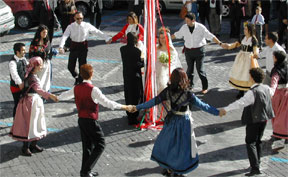
No, this is not a meeting of the Jesus Seminar. It just looks like it.
|
This makes plenty of sense, and is a good rule by which to weigh the sayings of Jesus.
But other "Rules of Oral Evidence" seem to fall like manna from heaven. For example:
• Jesus rarely makes pronouncements or speaks about himself in the first person.
• Jesus makes no claim to be the Anointed, the messiah.
Now you must remember that these are not set forth as the conclusions of an objective process of evaluation. These are the starting points, the assumptions made by the Seminar by which it will evaluate the sayings of Jesus.
Once again, the circularity of this process is so obvious as to be almost laughable. Before the Seminar examined the statements attributed to Jesus, it could assume that "Jesus makes no claim to be the Anointed, the messiah." Huh? I am well aware that many critical scholars believe this to be true as a result of their study. But on what basis, other than sheer prejudice, can one assume this at the beginning of one's study? Divine revelation?
I suppose a Seminar Fellow could argue that this rule of evidence is merely an implication of the previous one: "Jesus rarely makes pronouncements or speaks about himself in the first person." But this too seems to have fallen out of thin air. How do the Fellows know this prior to examining the actual sayings of Jesus?
The "Introduction" to The Five Gospels actually tries to answer this question with two arguments. The first argument assumes that Jesus was a "sage of the ancient Near East" (p. 32). Here's the argument itself: "Like the cowboy hero of the American West exemplified by Gary Cooper, the sage of the ancient Near East was laconic, slow to speech, a person of few words . . . . As a rule, the sage is self-effacing, modest, unostentatious." (p. 32). So, we can know what Jesus didn't say by assuming that he's like cowboy heroes from old Westerns?
The second argument at least refers to Jesus, and not to movie characters from American society two millennia after Jesus. Here's the argument:
Jesus taught that the last will be first and the first will be last. He admonished his followers to be servants of everyone. He urged humility as the cardinal virtue by both word and example. Given these terms, it is difficult to imagine Jesus making claims for himself – I am the Son of God, I am the expected One, the Anointed – unless, of course, he thought that nothing he said applied to himself. (p. 33)
Once again I point out that the rules of oral evidence come before the analysis of the sayings of Jesus. Yet this paragraph makes all sorts of assumptions about what Jesus said and didn't say, and this is meant to defend the rule that will be used to determine what Jesus said and didn't say.
Morever, though Funk and Hoover find it "difficult to imagine Jesus making claims for himself . . . ," this hasn't been a problem for theologians and Bible scholars throughout the ages, right down to our day. Even those who, in the end, deny that Jesus claimed to be messiah, don't have a problem imagining that He might have. When it comes to making up rules of evidence, Funk and Hoover have a rich, almost unlimited imaginations, but I guess their creativity stops when they think about Jesus Himself.
The superficiality and literalness of their argument are almost silly. Since Jesus interpreted messianic claims as a call to self-sacrifice and servanthood (see, for example, Mark 10:32-45), His making a messianic claim was hardly contrary to His call to humility. Furthermore, Funk and Hoover say, "it is difficult to imagine Jesus making claims for himself – I am the Son of God, I am the expected One, the Anointed – unless, of course, he thought that nothing he said applied to himself." Of course there's another possibility: "It is difficult to imagine Jesus making claims for himself . . . unless, of course, they were true and needed to be stated." I recognize that the Jesus Seminar rejects this possibility out of hand. But this is just one more example of a blantantly obvious do-si-do. The only way they can rule out of court the possibility that Jesus made messianic claims is by assuming that he actually said certain things before they begin, and then by putting a superficial spin on Jesus's meaning. Very odd indeed!
In my next post I will examine a couple more "Rules of Oral Evidence." Stay tuned . . . .
The Jesus Seminar and Oral Tradition
Part 7 of series: Unmasking the Jesus Seminar
Posted for Tuesday, September 20, 2005
In my last post I began examining the so-called "Rules of Oral Evidence" that the Jesus Seminar used to evaluate the authenticity of sayings attributed to Jesus. In this post I want to dig a little deeper into the Seminar's understanding of oral tradition, and how this influences their estimation of Jesus.
Oral Tradition and the Sayings of Jesus
Before I get back to the Seminar and its rules, however, I should say something about oral tradition and the sayings of Jesus. Most scholars, even the most conservative, believe that the New Testament gospels (and Thomas too, if you want to include it) were written no earlier than twenty years after the death of Jesus. Most would date the writing of Matthew, Luke, John, and Thomas to more than forty years after Jesus passed from the scene. So the historian wonders how the gospel writers had access, if indeed they did have access, to the sayings of Jesus. What happened between the time Jesus said something and the time it, or something like it, was written down for posterity?
We don't have to dream up an answer to this question because the Gospel of Luke provides one, one that is supported more or less by almost all responsible biblical scholars (including most members of the Jesus Seminar, I'd imagine). This is what Luke, writing anywhere from 70 to 90 A.D., says about his sources:
Since many have undertaken to set down an orderly account of the events that have been fulfilled among us, just as they were handed on to us by those who from the beginning were eyewitnesses and servants of the word, I too decided, after investigating everything carefully from the very first, to write an orderly account for you, most excellent Theophilus, so that you may know the truth concerning the things about which you have been instructed. (Luke 1:1-4)
Luke refers to two different kinds of source material. On the one hand, there are written sources at his disposal ("many have undertaken to set down an orderly account"). On the other hand, there are oral traditions ("just as they were handed on to us by those who from the beginning were eyewitnesses and servants of the word"). So before anything was written down about Jesus, his sayings and descriptions of his actions were passed down orally. In time, these were recorded in various writings, some of which we have and some of which (like the hypothetical "Q" and other sources) we do not have.
So, if the sayings of Jesus were at first passed down orally, the historian wonders about how reliable this process was, and whether what's reported in the gospels actually began with Jesus Himself.
Oral Tradition according to the Jesus Seminar
The Jesus Seminar rightly addresses the question of oral tradition and its reliability. And it rightly formulates rules for evaluating the evidence of the gospels in light of the fact that it had been passed on orally. Unfortunately, however, several of the Seminar's key rules are tendentious, if not obviously bogus. It seems pretty clear, from the "Introduction" to The Five Gospels, that the Fellows of the Seminar desperately want the independent sayings of Jesus, such as found in the Gospel of Thomas, to be the oldest and most reliable.
For example, in the discussion of "Orality and Memory" in the "Introduction," we find the following paragraph: |
|
| |
Sometimes oral traditions can be quite interesting.
|
We know that the oral memory best retains sayings and anecdotes that are short, provocative, memorable – and oft-repeated. Indeed, the oral memory retains little else. This information squares with the fact that the most frequently recorded words of Jesus in the surviving gospels take the form of aphorisms and parables. It is highly probable that the earliest layer of the gospel tradition was made up almost entirely of single aphorisms and parables that circulated by word of mouth, without narrative context – precisely as that tradition is recorded in Q and Thomas. (p. 28)
This argument, if you can call it that, leads to the following rules of evidence:
• The oral memory best retains sayings and anecdotes that are short, provocative, memorable – and oft-repeated.
• The earliest layer of the gospel tradition is made up of single aphorisms and parables that circulated by word of mouth prior to the written gospels. (p. 28).
In application, these rules mean that if certain sayings of Jesus are embedded in a narrative, those sayings are not authentic. When The Five Gospels deals with Mark 5, for example, a chapter that includes sayings of Jesus in the context of stories (the Gerasene demoniac, the healing of the woman with a flow of blood, the raising of Jairus's daughter), all of these sayings are summarily dismissed. Here's why:
The stories Mark has collected in chapter five of his gospel contain words ascribed to Jesus that are suitable only for the occasion. They are not particularly memorable, are not aphorisms or parables, and would not have circulated independently during the oral period. They cannot, therefore, be traced back to Jesus. (p. 62)
So the rules are applied, and the sayings of Jesus in Mark 5 are rejected because they are memorable only when found within stories about Jesus.
I'd like to begin to chronicle the flaws in the Jesus Seminar's understanding of oral tradition, but there's so much to say, I'm going to hold off until tomorrow. I'll pick up the conversation right where I left off today.
Storytelling and Early Christianity
Part 8 of series: Unmasking the Jesus Seminar
Posted for Wednesday, September 21, 2005
Yesterday I began looking at how the Jesus Seminar approached the issue of oral tradition as it relates to the sayings of Jesus. If you missed this post, you may want to scroll up for a quick review. In this post I want to offer some criticisms of the Seminar's thinking about oral tradition.
Flaws in the Jesus Seminar's Understanding of Oral Tradition
I've already pointed out several times in this series the circularity of the Jesus Seminar's arguments, so I won't beat a dead horse, though it's certainly tempting in this instance. Yet the Seminar's rejection of sayings embedded in narrative does get some evidential support in the "Introduction." Let's look more closely at that evidence put forward in the "Introduction" to The Five Gospels.
"We know that the oral memory best retains sayings and anecdotes that are short, provocative, memorable – and oft-repeated."
This is surely right, to a point. Consider contemporary examples, such as: "Go ahead, make my day!" or "I'll be back" or "Here's looking at you, kid!" Yet the Seminar wants to press this truth farther than common sense would allow. Hence . . . .
"Indeed, the oral memory retains little else."
Little else than what? Than short, provocative sayings? Is that so? Is the Seminar actually claiming that stories aren't remembered and passed on orally? This seems to be their point.
"This information squares with the fact that the most frequently recorded words of Jesus in the surviving gospels take the form of aphorisms and parables."
Except for all of the sayings that are not aphorisms and parables, such as in Mark 5, which the Seminar rejects as inauthentic (see my last post). Besides, it's one thing to argue that aphorisms and parables are often remembered, and another to conclude that only aphorisms and parables are remembered. The Seminar energetically jumps to the latter conclusion.
"It is highly probable that the earliest layer of the gospel tradition was made up almost entirely of single aphorisms and parables that circulated by word of mouth, without narrative context – precisely as that tradition is recorded in Q and Thomas."
What evidence makes this highly probable? The "Introduction" refers to ancient historians who invent words for characters, though this is hardly representative of oral culture (p. 29). Otherwise, the only bits of evidence cited are "recent experiments" into human short-term and long-term memory, studies that suggest people remember the "gist" of story but not its words (p. 28). Does it dawn on the Seminar that studies of contemporary people in non-oral cultures may not be entirely relevant here? Does it occure to the Seminar to examine studies of real oral cultures? Apparently not.
What is utterly and shockingly lacking in the Seminar's conversation is any reference to or apparent awareness of studies of how oral tradition really works in oral cultures. My cynical side says this is lacking because the evidence thoroughly undermines everything the Jesus Seminar is trying to assume and, in the end, conclude about Jesus and the traditions surrounding Him.
Stop for a moment and think about what you know of oral cultures, cultures that gather around the fire and pass on common lore. What gets passed on in these settings? Short parables and witty sayings? Perhaps. But what mostly gets passed on? Stories! Stories repeated again and again. Narratives are surely and obviously the primary stuff of oral tradition. The notion, therefore, that the earliest Jesus traditions were single aphorisms and parables "without narrative context" is highly unlikely. Are we really to think that stories about Jesus weren't passed on by his followers? Does it make sense to believe that aphorisms must have circulated independently of narratives at first, and that the stories were only added later? I don't think so.
In fact, a few paragraphs above I mentioned three familiar aphorisms what are passed down in our culture: "Go ahead, make my day!" "I'll be back" and "Here's looking at you, kid!" If you think about it, none of these makes much sense apart from the narrative (movie) in which it was first found. Now the sayings have a life of their own, but originally they only made sense in a narrative context, and this is what gave the sayings their oral viability.
So far I've appealed to common sense, or to what you might have learned from the Discovery Channel. But there is a wide and respected body of academic literature that makes the point about the priority of narrative and shows how stories are passed on. (If you're interested, I'll list some of this literature below.) What genuine scholars of oral culture have found is that narratives are indeed passed on with careful attention to detail, even to the words used, and that sayings are often embedded within these stories. They've also found that there is a certain amount of flexibility allowed in the telling of the stories and in the passing down of sayings, but formal constructs and corporate accountability limit the freedom of the storyteller. |
|
| |
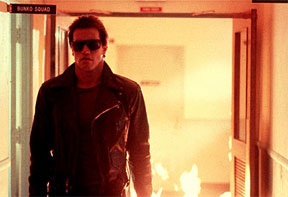
"I'll be back!" As it turned out, he did come back, and in forms we'd never have imagined when The Terminator first came out. This past summer when my family took a tour of the California State Capitol in Sacramento, the official tour guide actually referred to the Governor as "the Governator." Go figure!
|
When all of this is applied to the New Testament gospels, it readily disproves the claim of the Jesus Seminar that the earliest tradition was composed of individual sayings without narrative context, though it's certainly possible that part of the earliest tradition was so composed. Moroever, studies of oral culture weigh heavily against the extreme skepticism of the Seminar, by showing that the oral culture of Jesus might well have carefully preserved both His words and His deeds, though not with rigid literalism. Whether this is true of the gospel material can't be proved without careful examination of the gospels themselves, of course. At least it can't by scholars who seek to base their conclusions on historical data rather than a priori assumptions. But the actual social scientific data concerning "Orality and memory" suggest that one should approach the gospels in a way very different from the Jesus Seminar. In particular, we have no good reason at all for rejecting before we begin the sayings of Jesus that come within stories. One could even argue that these sayings more accurately preserve what Jesus really said than sayings that floated around independently.
The Jesus Seminar tells a story about how the sayings of Jesus in the gospels came to be. In this story, the tradition about Jesus begins with short aphorisms and parables that circulated without narratives. In time, these morph into something larger through the imagination of the early Christian community. The independent sayings become connected or get placed within stories. Those who pass on the tradition add generously to it, exercising what The Five Gospels calls "the storyteller's license" (p. 29) The stories about Jesus are made up to turn Him into something He was not, and sayings are made up to fit stories, and so forth and so on. Evidence for this story of Christian origins supposedly comes from scholarly knowledge of oral tradition.
But actual scholarly knowledge of oral tradition doesn't support this story, nor I would argue, does evidence from the gospels. In fact, I'd suggest that the Jesus Seminar itself exercised "the storyteller's license" to a considerable degree when making up its account of the origins of Christianity. Where it had no evidence, it invented it. And when the real scholarly evidence counted against the Seminar's story, the Seminar simply ignored that evidence altogether. In the end we are presented by the Seminar with little more than a creative fiction about Christian origins, one that neatly fits the agenda of Robert Funk, but has little to do with what Jesus and His early followers actually did or said.
Resources on Oral Tradition, Oral Culture, and Jesus
Note: None of the books listed below is available online. But the two articles are readily available, the Bailey article in HTML and the Wright article as a PDF. If you want to delve more deeply into the issues of this post and series, I highly recommend these articles.
Online Articles:
Kenneth E. Bailey, "Informal Controlled Oral Tradition and the Synoptic Gospels." This excellent article is online, and well worth the read, though it is not written for a popular so much as for an academic audience.
N.T. Wright, "Five Gospels But No Gospel: Jesus and the Seminar" (180K PDF). Note: If you're looking for an insightful and pointed critique of the Jesus Serminar, I'd recommend this article highly.
Books:
Kenneth E. Bailey, Poet and Peasant and Through Peasant Eyes (combined edition)
Albert B. Lord, The Singer of Tales
Henry Wansbrough, ed., Jesus and the Oral Gospel Tradition (only $120 from Amazon.com. Buy several and give them to your friends for Christmas!)
N.T. Wright, Jesus and the Victory of God, 133-137.
N.T. Wright, The New Testament and the People of God, 418-443.
Was Oral Tradition Like Playing Telephone?
Part 9 of series: Unmasking the Jesus Seminar
Posted for Thursday, September 22, 2005
In my last post I criticized the Jesus Seminar's understanding of how oral tradition functions and their application of this mistaken understanding to the sayings of Jesus. Referring to several serious studies of oral culture, I suggested that we should approach the gospel materials with an openness to the very real possibility that they preserve, in essence if not in exact words, the sayings (and actions) of Jesus.
But I can imagine an objection to what I'm saying that goes something like this:
Don't we know from experience how unreliable the human memory can be when it comes to the spoken word? Haven't you ever played the party game called "Telephone"? Does this prove that we really can't trust oral tradition to preserve the sayings of Jesus?
I want to address this objection because it seems so commonsensical, and because it helps to illustrate reasons why the oral tradition about Jesus can in fact be trusted. (Thanks to blog reader Scott for suggesting this line of reasoning.)
If you're not familiar with Telephone, which is sometimes called "Whisper Down the Alley," let me explain. You get a bunch of people to sit in a circle, the more the merrier. Then somebody starts by secretly writing down a sentence, something like: "Pastor Mark is going to the fair tomorrow because he's meeting a friend there." After writing down the sentence, the writer whispers it to the person next to him or her. Then the receiver turns to the next person and whispers the message. And so it goes, all the way around the circle. When the message comes to the last person, that one says it out loud. Then the composer of the message reads the original sentence. Inevitably, the final sentence is quite different from the original. "Pastor Mark is going to the fair tomorrow because he's meeting a friend there" has become "Pastor Mark is going to float up into the air tomorrow because he's so full of hot air."
If you've never played Telephone before, you might think I'm exaggerating. But, in fact, I'm not. Try it for yourself and you'll see just how much the message changes as it's passed around the circle. If you start with a longer message – three sentences – the changes will be even more pronounced.
So, then, does a parlor game prove that the oral tradition about Jesus cannot be trusted? No, in fact, it actually helps to illustrate why we can put trust in the process by which the sayings of Jesus were passed on orally. I say this for several reasons. |
|
First, Telephone only works in a culture that is not like the oral culture of the first century A.D. People in an oral culture become quite proficient at remembering and passing on oral material.
Admittedly, we're not very good at listening, remembering, and passing on things accurately. That's what makes Telephone fun. But if this game were to be played in an oral culture, I imagine that it wouldn't really work, because the players would do a much better job with accurate transmission of information.
I can't prove this. (Well, I could prove it, actually, if I had enough time and money to do studies in the oral cultures that still exist today. But I don't have the time or the money.) But I can provide a couple of analogous illustrations. First, consider the case of remembering phone numbers. When I was younger, in an age before phones with computer-chips, I had memorized many phone numbers. I wouldn't be surprised if I once knew 25 numbers by heart. Now I'll bet I can't come up with more than five. What explains the difference, apart from the aging of my brain? Necessity and practice. When I needed to memorize numbers, I did. And as I did this, I became good at it.
A second example comes from the days when my wife was training to be a psychotherapist. After her sessions with clients, she was expected to write out a "verbatim" of the sessions, an accurate transcript of what was discussed. In time, she became quite proficient at this. Why? Again, it was a matter of necessity and practice. So, it seems logical that when people have a need to remember sayings or stories, and when they practice remembering and repeating them, they get good at it. We should expect the earliest followers of Jesus to be so good at playing Telephone that the game would be quite boring.
Second, Telephone works because the message is passed around secretly, without accountability or the possibility of correction. Early Christian tradition, on the contrary, was almost always passed on in corporate settings where accountability was provided and corrections could be made.
I'm sure there were times when followers of Jesus told others what Jesus said in private conversations. But the process of tradition was something that found its home in the early Christian communities. Studies of oral cultures have shown that these cultures allow for a measure of freedom in the passing on of traditional material, but only within certain limits. The community self corrects as necessary, guaranteeing that the stories and sayings are passed on with a high level of accuracy.
Back to the Telephone example, suppose the rules of the game were different, and the communications weren't secret. If one person made a mistake in passing on the message, others would be there to correct the mistake. What a dull game it would be if the group could make sure that what was passed on was accurate.
Third, Telephone works because the message is relatively unimportant, if not absurd. The players have no strong reason to guarantee the accuracy of the transmission process. The early Christians, on the contrary, had strong reasons to preserve what Jesus actually did and said.
Most of the earliest followers of Jesus believed that He was the messiah of Israel. Soon, in fact, He was believed to be the Lord Himself. His teachings were regarded as divinely-inspired and, indeed, the ultimate source of divine guidance for living, not to mention salvation. Thus there would have been strong reason to transmit the sayings of Jesus with considerable accuracy. (Ironically, if Jesus had really been only the reticent sage "discovered" by the Jesus Seminar, it's likely that nobody would have bothered to remember his peculiar sayings.)
Again, consider the case of Telephone. Suppose, instead of saying something trivial or silly, the first speaker delivers a bit of news worth remembering, something like: "Tomorrow, at 8:30 a.m. exactly, at the corner of State and Main, a man will be giving out $100 bills." I'll bet that the transmission of this information would be much more reliable than when the statement is just for fun.
So, the Telephone game turns out, upon inspection, to highlight reasons for believing that the early followers of Jesus passed on His words with a high level of accuracy. Here are some relevant conclusions to this conversation.
• Unlike Telephone players, the first Christians lived in an oral culture that had trained them to be proficient at passing on stories and sayings.
• Unlike Telephone secrecy, the passing on of the traditions about Jesus occurred primarily in public settings that ensured the basic integrity of the transmission.
• Unlike Telephone sentences, the sayings of Jesus were believed by those who passed them on to be the most important words ever spoken, essential for salvation and for abundant living. Thus the early Christians had strong reason to remember and to repeat the sayings (and stories) of Jesus accurately.
I'm not suggesting that the early Christians literally memorized every saying of Jesus and passed it down verbatim. The variety we find in the gospels belies this notion. Besides, Jesus most certainly spoke Aramaic, and almost everything we have in the gospels is in Greek. So we can't claim to have the literal words of Jesus in most cases. But we can claim to have access to sayings and words that closely approximate what Jesus actually said. The facts of oral culture support, rather than undermine, basic confidence in the historical accuracy of the gospels.
What Do Scholars Really Think About Jesus?
Part 10 of series: Unmasking the Jesus Seminar
Posted for Friday, September 23, 2005
The popular impact of the Jesus Seminar was based largely upon the image, one might be tempted to say "the myth," of the Seminar as a group of unbiased scholars who carefully sifted the evidence to discover what Jesus really said (and didn't say). I've shown in this series how much reality failed to measure up to this image. But the facts didn't keep the promoters of the Jesus Seminar, largely Robert Funk, from trumpeting the idea that they were doing what scholars really do. The new translation in The Five Gospels was called, audaciously enough, The Scholars Version. And throughout the "Introduction" to The Five Gospels we read about how scholars do this and scholars think this and so forth and so on.
This might lead one to wonder what scholars really do think about Jesus? If the Jesus Seminar did not exemplify the best in scholarship on Jesus, where can this be found? And if the grouping of Fellows was not representative of New Testament scholars in general, what, if anything, can be said about what scholars actually think about Jesus?
Perhaps the one thing that is indisputable about scholarship on Jesus is that there is a wide diversity of opinion about Jesus. You can find respected scholars who believe that Jesus said very little of what shows up on his lips in the gospels. And you can find respected scholars who believe that much of what is attributed to Jesus he really did say (albeit in Aramaic, rather than Greek). And you can find everything in between. Much of the difference has to do, not with scholarly methods, but with the starting points. Approach the gospels with extreme skepticism, and you'll discover that Jesus didn't say much of what's in there. Approach the gospels with a healthy caution, and you'll conclude that they're actually reliable sources for historical knowledge about Jesus.
In recent years there have been a large number of scholarly efforts to make sense of Jesus, efforts that have used the critical skills of contemporary New Testament scholarship, efforts that have been respected by a wide range of scholars. In many cases these efforts have come to the conclusion that a much of what is attributed to Jesus in the gospels can, on historical grounds, be understood as coming from Jesus Himself. (I say "on historical grounds," because I am, for the moment, bracketing the question of divine inspiration of Scripture. Right now I'm treating the gospels as human documents, even though they I believe they are far more than this.)
This whole enterprise, by the way, has a long and storied history. The so-called "quest for the historical Jesus" began well over a century ago, and has had several iterations. Many scholars would say that we're now in the middle of the third quest for the historical Jesus. (If you're curious about the history of theis "quest," I highly recommend The Jesus Quest: The Third Search for the Jew of Nazareth by Ben Witherington III. Witherington is a respected critical scholar who, nevertheless, writes for an informed lay audience in this book.) |
|
| |
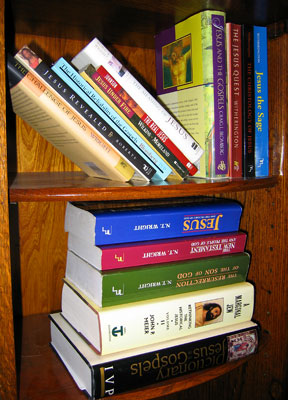
These are just a few of the recent books on Jesus that are both academically credible and more conservative in results. |
If you go to your local Borders or Barnes & Noble and look for books on Jesus, you'll face a dizzying array of options, some written by serious scholars, some by pseudo-scholars, some by pastors, and some by authors who, in my opinion, must have been inhaling illegal substances. If you want to publish a book on Jesus these days, it seems, the wackier the better. Yet even on the shelves of secular stores you'll find some books on Jesus written by trustworthy scholars who come from a wide variety of backgrounds and perspectives. In the rest of this post, I want to mention some of these authors and books, adding somes notes of explanation or recommendation.
Luke Timothy Johnson. Johnson is a top-notch academic scholar who is currently the R.W. Woodruff Professor of New Testament and Christian Origins at Emory University. (Before that he taught at Yale, which I will not hold against him.) Religiously, Johnson is a Roman Catholic, and his scholarly approach to Jesus would not satisfy many evangelicals. But he is a devastating and well-informed critic of the Jesus Seminar who builds a strong case for the trustworthiness of the biblical gospels in his book, The Real Jesus: The Misguided Quest for the Historical Jesus and the Truth of the Traditional Gospels.
Jesus Under Fire. This short, readable book was written by several conservative evangelical scholars who sought to respond to the Jesus Seminar in a way that would be available to non-specialists. It represents solid conservative scholarship, though Jesus Under Fire is not meant to persuade an academic audience. It provides a good introduction to the issues from an evangelical perspective.
Craig Blomberg. Blomberg is a well-regarded evangelical scholar. He is a professor of New Testament at Denver Seminary, and has written extensively on Jesus. Two of his many books are outstanding introductions to Jesus and the gospels, written from a well-informed conservative perspective: Jesus and the Gospels and The Historical Reliability of the Gospels.
John P. Meier. Meier is a Catholic priest and professor of New Testament at the Catholic University of America. He is an extraordinarily thorough and careful critical scholar, whose voluminous writings on Jesus are not easy to digest. Though some of his conclusions would not satisfy conservative scholars, Meier shows how rigorous application of critical tools leads a careful scholar to much more traditional results than one finds from the Jesus Seminar. All three of Meier's books on Jesus have the basic title, A Marginal Jew.
Ben Witherington III. Witherington is Professor of New Testament at Asbury Theological Seminary. In addition to The Jesus Quest, which I mentioned previously, Witherington has authored two academic books on Jesus: The Christology of Jesus and Jesus the Sage. This last book sounds like it hails from the Jesus Seminar, but in fact it is a serious academic tome that places Jesus squarely within the Wisdom tradition of Judaism (not the world of the Hellenistic Cynic philosophers, or even the world of the American cinematic cowboy). Witherington has a blog, by the way, which is well worth a regular visit.
N.T. Wright. No scholar has done more to put the Jesus Seminar in its place than Wright, a prolific scholar who has taught at Oxford, Cambridge, and (gasp!) Harvard. He's shown the folly of the Seminar, not by writing books critical of the Seminar, but by publishing masterful positive tomes on Jesus. His academic writing on Jesus takes up more than 2,000 extremely dense pages in three groundbreaking books, The New Testament and the People of God, Jesus and the Victory of God, and The Resurrection of the Son of God. The are books for academic specialists, primarily, though I'd highly recommend them to any college graduate who is truly serious about the quest for the historical Jesus. The good new for the non-specialist is that Wright also publishes for lay readers. The Challenge of Jesus: Rediscovering Who Jesus Was and Is presents Wright's main ideas in a very readable, 200-page format. Wright is now the Bishop of Durham in England (Anglican).
The Meaning of Jesus. N.T. Wright teamed up with Marcus Borg to co-write a book on Jesus. This is remarkable, because Wright represents the best of careful, critical, conservative scholarship on Jesus, while Borg is perhaps the best known of the Fellows from the Jesus Seminar. In this book, these two scholars lock horns in a respectful but blunt dialogue over Jesus. If you're unfamiliar with the issues of this debate, this book may be the best way to ease into unfamiliar waters, with two of the ablest experts to guide you.
It won't surprise you that I find Wright's position on Jesus to be far more convincing than Borg's, though Borg has many valid insights. It isn't just that I happen to agree with Wright. He wins the argument for three powerful reasons. First, his grasp of the literature and culture of Judaism in the time of Jesus is immense. He runs circles around most other scholars in this crucial arena. Second, Wright places Jesus within this milieu, and shows how much sense Jesus makes when He's thought of as a first-century Jew. Third, Wright doesn't only address thousands of specific issues with masterful wisdom. He also provides a panoramic overview of Jesus and early Christianity, one that is stunning in its elegance and reasonableness. I'm not saying that I agree with everything Wright has written (or even that I understand it, frankly). But I believe he has shown beyond reasonable argument that Jesus must be seen in his original cultural setting, and that when He is seen this way, much of what He is supposed by the gospels to have said makes great sense as coming from Jesus Himself.
Not all conservatives are as favorable to N. T. Wright as I am. Some are unsettled by his unapologetic use of critical scholarly methodologies. Others are upset by his conclusions, fearing that he has somehow left Christian orthodoxy behind. Indeed, Wright's picture of Jesus does not fit many of the images of Jesus in evangelical piety. But, whether one agrees with Wright or not, I think it's impossible to minimize his impact on historical Jesus studies, both now and in the future.
Wright does not have a blog, to my knowledge. But there is a wonderful website that has collected many of his writings, speeches, and sermons, and made them available online.
Dictionary of Jesus and the Gospels. This dictionary, published by InterVarsity Press, collects some of the best scholarship on Jesus, addressing a wide range of topics, not only the historical Jesus issues. The authors are mainly conservative Christians. But they are also top-notch scholars. This dictionary is a fantastic resource, and I highly recommend that you purchase it for your library. It isn't cheap, but it's well worth the price. (Actually, this book is part of a collection that's available on CD. This will cost you a hefty chunk of change, but it's one of the best Bible study tools I know of.)
Conclusion
In this post I do not mean to imply that most New Testament scholars uphold conservative positions when it comes to Jesus. To do so would be just as disingenous as the Jesus Seminar's opposite insinuation. I began by mentioning a wide diversity of opinion, and I'll closely by making the same point. What I do find both incorrect and almost insulting is the assumption made in The Five Gospels that all real scholars think along the lines of the Jesus Seminar. In fact, some of the brightest and most influential New Testament scholars have argued that the New Testament gospels are reliable sources of historical information about Jesus. Surely their voices deserve to be heard and respected, even by those who ultimately disagree with them.
You may be wondering what reasons we have for regarding the biblical gospels as trustworthy accounts of Jesus's actual ministry? In my final posts of this series, I'll pick up that question.
Are the New Testament Gospels Reliable?
Part 1 of series: Are the New Testament Gospels Reliable?
Part 11 of series: Unmasking the Jesus Seminar
Posted on Monday, September 25, 2005
This post serves as a bridge between two different blog series. It's the last post in a series called Unmasking the Jesus Seminar, and the first post in a new series called Are the New Testament Gospels Reliable?
In my Unmasking series, I showed that the Jesus Seminar, a gathering primarily of New Testament scholars, appeared to be an objective attempt to determine what Jesus really said (and did). But, in fact, it was part of the overall vision of its founder, Robert Funk, to undermine orthodox Christianity, and especially its understanding of and faith in Jesus. The collection of Seminary Fellows, combined with the methodology they followed in their work, predetermined the Seminar's results. Beginning with extreme skepticism concerning the reliability of the gospels as historical sources about Jesus, the Seminar concluded – surprise! – that the gospels tell us relatively little about the historical Jesus. I don't mean to imply that every Fellow in the Jesus Seminar was a poor scholar (some were quite fine), or that everything the Seminar produced was worthless. But, on the whole, the main thrust of the Seminar's work was both academically suspect and injurious to Christian orthodoxy.
For the most part, the Jesus Seminar is old news these days. It no longer makes headlines because, frankly, it ran out of sayings and actions of Jesus to debunk. Once it showed that Jesus didn't say much of what was attributed to him in the gospels, and that He didn't do much of what was attributed to him in the gospels, there wasn't much left for the Seminar itself to say or do.
Nevertheless, it seemed good to me to engage the Jesus Seminar on a critical basis. I wrote the Unmasking series, partly because some of the Fellows from the Jesus Seminar, like John Shelby Spong or Marcus Borg, continue to pass on the sins of the fathers to the children through their writings. Moreover, many people who never read one actual word published by the Jesus Seminar still live under its ominous shadow. I know Christians who have had a nagging feeling that sometime in the recent past a bunch of objective scholars got together and discovered that Jesus didn't say much of what the gospels record. And I know non-Christian folk who read the newspaper accounts of the Jesus Seminar and, to this day, have had no reason to doubt what was so enthusiastically reported about the historical unreliability of the gospels. I've tried to suggest many reasons to doubt the results of the Jesus Seminar, so that people might not be haunted or inspired by its ghost.
Yet the Jesus Seminar's passing didn't put an end to imaginative speculation about Jesus and the gospels. The most recent version of such comes from Dan Brown's bestselling book, and soon to be hit movie, The Da Vinci Code. To his credit, Brown doesn't claim to have written non-fiction. His book, after all, is a novel. Yet within the construct of the novel there is a lot of what is presented as if it were in fact historically accurate information about Jesus and early Christianity. And then there's the tantalizing statement on the first page of the book: "All descriptions of artwork, architecture, documents, and secret rituals in this novel are accurate." Since The Da Vinci Code has much to say about many early Christian documents, it seems as if Dan Brown is claiming that anything he says about these documents is actually true.
In fact, many readers, both Christian and non-Christian, have taken the fictional history of early Christianity as its presented in The Da Vinci Code as fact. When characters say things like, "All scholars know that . . .," many readers have taken this as a statement of fact, rather than an fictional claim of a novel. The result is that many people now believe that the biblical gospels, Matthew, Mark, Luke and John, are unreliable sources of information about Jesus, and that the non-canonical gospels, like the Gospel of Mary or the Gospel of Philip, provide the unabridged truth about Jesus. |
|
| |
This movie, staring Tom Hanks, is due to be released on May 19, 2005
|
In my series called Was Jesus Married? A Careful Look at the Real Evidence, I've examined the latter part of this belief. I've shown that the non-canonical gospels, in addition to being unreliable sources of information about Jesus, actually provide almost nothing to support the fiction of Jesus's marriage as it's presented in The Da Vinci Code. But this book has left a lingering impression, rather like the distant echoes of the Jesus Seminar, that the New Testament gospels are unreliable.
Therefore, as I finish up my Unmasking the Jesus Seminar series, I'd like to segue into a new but related series, one I'm calling Are the New Testament Gospels Reliable? In the several posts of this new series, I want to explain why Matthew, Mark, Luke, and John are, in fact, reliable.
I'm thinking of reliability in two different senses. On the one hand, I intend to show that the biblical gospels are reliable sources of historical information about Jesus. In spite of their various limitations, these documents can help us to know quite a bit about what Jesus said and did. On the other hand, I also want to show that the New Testament gospels are reliable as a basis for faith in Jesus. Christians who take these documents seriously as guides to knowing Jesus are, in my view, acting reasonably, and I want to explain why. (Yes, of course I have a bias in this matter. But I think I can defend my bias with reasonable arguments and ample evidence.)
My new series, therefore, will pick up where the Unmasking series leaves off. I hope that I have shown why the Jesus Seminar should be dismissed by folks who want to know the facts about Jesus. I hope that I will show a better way to determine who Jesus was, what He said, and what He did. Therefore, this new series is the positive flip-side of the Unmasking series.
Before finish this post, I want to mention five further points.
First, this new series will be an elaboration of another series I did called How Can We Know Anything About the Real Jesus? I won't repeat everything in that series, especially the material about non-biblical sources of information about Jesus. But I will take the closing points of that series and develop them much further in this new series.
Second, as I stated at the beginning of How Can We Know Anything About the Real Jesus?, I am well aware that the topic I'm planning to discuss is vast, complex, and filled with controversies. If you're not familiar with my background, I should mention that I completed a Ph.D. in New Testament at Harvard, where I studied with some of the top critical scholars in the world, and where I had many bright colleagues, at least seven of whom ended up as Fellows in the Jesus Seminar. So I'm quite familiar with many of the critical issues associated with the gospels and the question of the historical Jesus. Moreover, when I wrote my book Jesus Revealed, I read a lot of the newer academic literature on Jesus, including things published by Jesus Seminar Fellows. So, though I'm not a full-time scholar, I'm reasonably up to date on the scholarly conversation about Jesus.
Third, this new series is meant primarily for my blog readers – an educated group composed mostly of non-specialists. In other words, I'm not writing for New Testament scholars. This means I will not footnote my comments as I would if I were producing an academic paper. And I will feel the freedom to make generalizations without backing up everything I say with reams of evidence.
Fourth, if you're the sort of person who likes those reams, you should check out the preceding post in the Unmasking series ("What Do Scholars Really Think About Jesus?") In this post I made reference to lots of scholarly literature on Jesus and the gospels. Perhaps the most directly relevant book for this new series is The Historical Reliability of the Gospels by Craig Blomberg. Blomberg is a top-notch evangelical scholar who defends the trustworthiness of the biblical gospels in 250 demanding yet readable pages.
Fifth, in this new series I hope to show why it's reasonable to regard the New Testament gospels as reliable, both for historical inquiry and for personal faith. I cannot prove that the gospels are accurate, however, because this sort of proof cannot be had in historical investigations. Nor can I solve all of the problems that attach themselves to the question of the trustworthiness of the gospels. Many of these, quite honestly, I'm still working on in my forays into academia. But I do believe that a reasonable person, looking at the facts with an open mind, will conclude that the New Testament pictures of Jesus, while not photographic, are sufficiently realistic to merit both scholarly and spiritual confidence.
For the continuation of this conversation, see the series Are the New Testament Gospels Reliable?
Home |